

The Distribution Question
In April, Musk endorsed 'universal high income' at the Saudi-US Investment Forum. In July, Altman went on Theo Von's podcast and pitched 'universal extreme wealth' via 1 billion AI-generated tokens per person globally. In October 2025, the Guaranteed Income Pilot Program Act appropriated $495 million for a three-year federal pilot. 72 U.S. cities and states have run guaranteed income pilots across 26 states. The rhetoric of AI-driven mass displacement is everywhere. The empirical picture is materially more modest: Goldman Sachs estimates 2.5–6.7% displacement risk; the Fed projects 4.4% unemployment by end 2026 with no AI-driven spike; Harvard Business Review found 77% of AI-attributed layoffs were anticipatory. Meanwhile the Hormuz interim deal has operationally unraveled. The framework's new three-part series — The Distribution Question — reads what is actually being proposed, by whom, on what empirical basis, and what the gap between rhetoric and reality reveals about the institutions the proposals serve.
Full analysis: newaustrianeconomics.com/forum/38-rhetoric-reality-2026-distribution-debate
Welcome to Issue #013 of The Dispatch. Each Monday, this letter takes one situation from the week's news and reads it through the lens of Carl Menger and Antal Fekete — paired with a foundational concept, the dashboard, the framework's prediction record, and a piece from the archive. If someone forwarded this to you, subscribe here.
The Lens
Elon Musk's "universal high income" formulation dates to the middle of 2025 — not merely a floor above poverty but a high income delivered through humanoid-robot productivity gains. He did address a Saudi-US Investment Forum in Riyadh, but in May 2025, not April 2026; he returned to the theme in April 2026, describing the payments as federal government checks funded by an increase in the money supply, which is the more analytically consequential version because it names a funding mechanism. In July, Sam Altman appeared on Theo Von's podcast and pitched "universal extreme wealth" via 1 billion AI-generated tokens per person globally, based on a projected 20 quintillion token annual output — an evolution from his May 2024 "universal basic compute" proposal through his "universal basic wealth" reframe in a Theo Von conversation reported in late August 2025. In October 2025, Rep. Bonnie Watson Coleman introduced H.R. 5830, the Guaranteed Income Pilot Program Act of 2025 — appropriating $495 million per fiscal year through 2030 for a three-year, 20,000-participant federal pilot delivering monthly payments equal to fair-market rent for a two-bedroom home in each participant's zip code. Mayors for a Guaranteed Income, launched with the Economic Security Project in June 2020, has drawn around a hundred mayors, and by the most commonly cited count more than 150 U.S. cities now run a program of some kind — the largest being Cook County, Illinois, which paid 3,250 residents over two years from 2022 out of $42 million in federal pandemic funds. Ontario is not expanding basic income: its pilot was canceled by the Ford government in July 2018, one year into three, and the province has been defending a class action over the cancellation since. Japan is reported to be exploring UBI components in response to demographic pressure, though not at the level of official policy.
The rhetoric of AI-driven mass displacement is everywhere. The empirical picture is materially more modest: Goldman Sachs Research estimates 2.5–6.7% displacement risk with a two-year resolution period. The Federal Reserve projects 4.4% unemployment by end 2026 with no AI-driven spike. A Harvard Business Review analysis found that 77% of AI-attributed layoffs were anticipatory — the technology had not yet replaced the workers when the layoffs occurred. Oxford Economics found that 60% of companies citing AI in their layoff announcements were using it as justification for cuts driven by other factors.
Meanwhile, the Hormuz interim deal has operationally unraveled. Iran attacked the Qatari LNG tanker Al Rekayat and the Saudi supertanker Wedyan on July 7. At least nine ships have been attacked since July 6. Traffic has fallen to a three-week low. On July 15, the U.S. fired a new wave of strikes on Iran and hit a tanker trying to skirt the blockade. The DFC $40 billion facility documented in Forum #36 remains at zero policies. The MOU has effectively expired less than a month after it was signed.
Two institutional stories operating in parallel this week. The distribution debate proposes universal wealth mechanisms grounded in AI abundance that has not yet arrived. The Hormuz theater shows what happens to institutional interventions that arrive after the substrate has been compromised. The framework's new three-part series reads what the distribution proposals actually are.
Lead Essay: Seven Variants, One Structural Pattern
The 2026 distribution debate is not a single proposal but a family of seven variants that share a common structural feature: response to AI-driven economic displacement through some form of direct or indirect wealth distribution to individuals. The variants differ in mechanism, funding source, and institutional gatekeeper. They share the underlying assumption that AI-driven abundance will require redistribution to prevent mass unemployment — an assumption the empirical labor market data does not yet support.
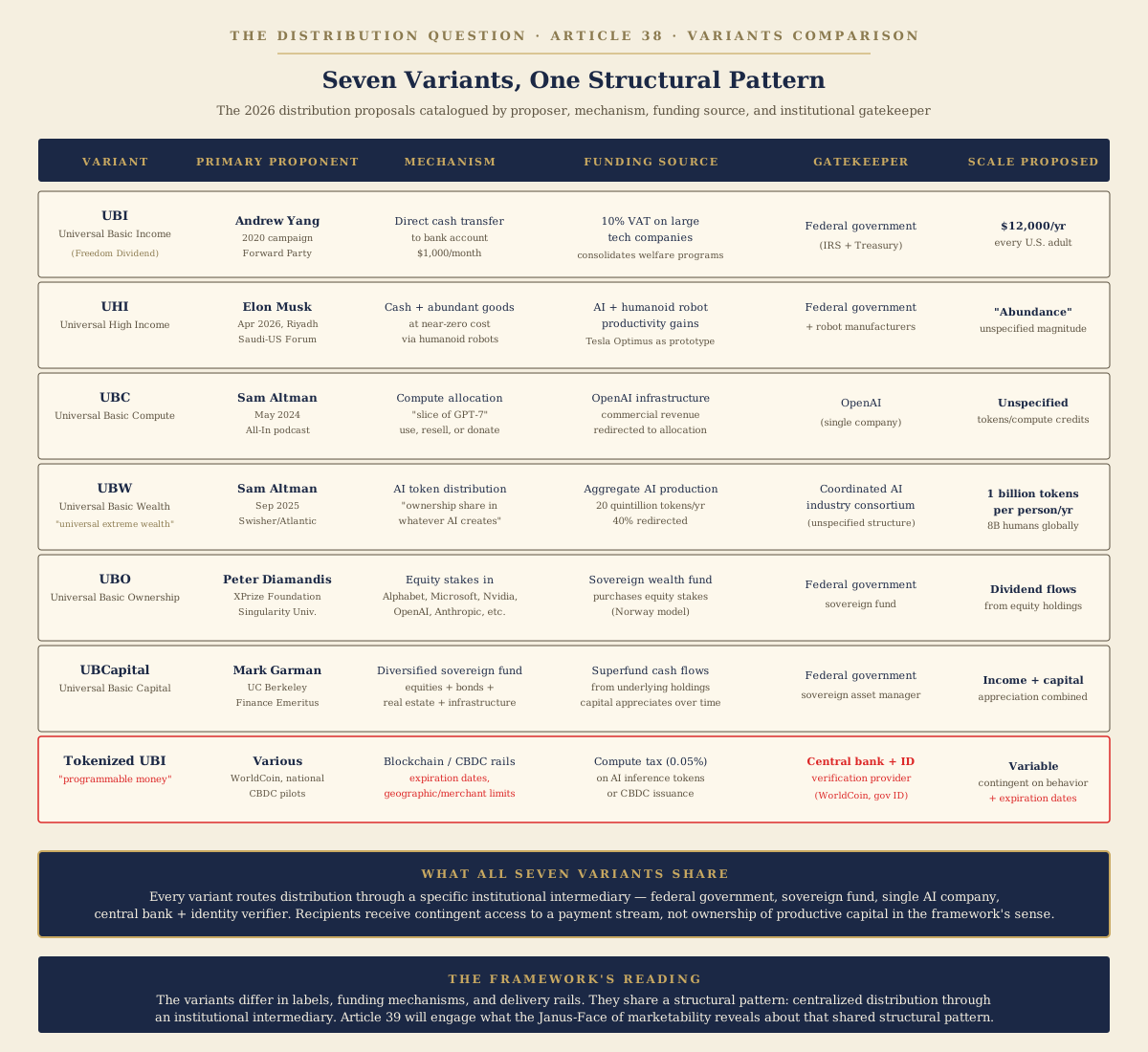
Every variant routes distribution through a specific institutional intermediary. Recipients receive contingent access to a payment stream rather than ownership of productive capital in the framework's precise sense. This is the structural observation that unifies all seven variants and that Forum #39's theoretical apparatus develops. Whether the intermediary is the U.S. federal government (UBI, UHI, UBO, UBCapital), a single AI company (UBC), an AI industry consortium (UBW), or a central bank paired with an identity verification provider (Tokenized UBI), the recipient's claim depends on the intermediary continuing to honor it. The intermediary can adjust the payment, restrict its use (Tokenized UBI's expiration dates and merchant limits are already in the WorldCoin design), condition its receipt on identity verification, or withdraw it entirely at institutional discretion.
The empirical picture of the AI-displacement problem is where the rhetoric-reality gap becomes most visible. The headline estimates driving UBI advocacy — McKinsey Global Institute's "up to 45% at risk," the World Economic Forum's "85 million jobs displaced" (a 2020 figure — its 2025 Future of Jobs report projects 92 million displaced against 170 million created by 2030, a net gain of 78 million, which cuts against the displacement framing rather than for it), the ILO's 12% displacement assessment — are in a fundamentally different range from the institutional and macroeconomic projections. Goldman Sachs Research's base case is 2.5%. Goldman's maximum widespread-AI case is 7%. The Federal Reserve's projected end-2026 unemployment increase is 0.5 percentage points. These are not incompatible readings of the same data; they are different definitions of "displacement risk" — the McKinsey and WEF figures include jobs that could theoretically be automated over decades; the Goldman and Fed figures estimate what will actually happen at operational scale in the near term.
The 77% anticipatory layoffs finding from Harvard Business Review and the 60% "AI as excuse" finding from Oxford Economics together indicate that the headline displacement narrative overstates what has actually occurred. Companies are announcing AI as a driver of workforce reductions in ways that would not survive careful outside analysis of the specific tasks being eliminated. The mass-unemployment narrative is institutionally convenient for actors advancing UBI and CBDC proposals — it provides political urgency the empirical data does not yet support.
The framework's theoretical apparatus for reading the seven variants comes from Antal Fekete's Janus-Face of marketability. Menger's Absatzfähigkeit (marketability) has two distinct faces that must both function for a monetary system to serve its purpose. Marketability in the large — the capacity to settle large payments, preserve value across long time horizons, function as a store of wealth — was historically optimized by gold. Marketability in the small — the capacity to settle daily transactions, pay wages, function as a circulating medium — was historically optimized by silver. A working monetary system required both. What the seven distribution variants distribute is not money in the framework's precise sense — it is currency whose marketability has been degraded on both faces. UBI cash held over time depreciates (marketability in the large fails). Tokenized UBI restricted by expiration and merchant limits (marketability in the small fails). Altman's tokens routed through a consortium gatekeeper (both faces fail simultaneously). The specific mechanisms differ; the underlying failure is common.
The framework's central observation across the series is that Altman's evolution from UBI → UBC → UBW is an unintentional rediscovery of the framework's insight that ownership beats distribution — but Altman still gets it wrong because his proposed ownership vehicles route through single institutional intermediaries. Ownership of tokens issued by an AI consortium is not the same as ownership of productive capacity independent of the consortium's continued operation. The question the debate is not asking, and that Forum #40 engages: "What monetary and institutional substrate would enable individuals to own productive capacity broadly enough that the distribution question does not require centralized administration in the first place?"
That is the substrate-level restoration grounded in the Golden Triangle (Forum #33) and the personal savings principles of Forum #37, extended to the institutional scale that the distribution question requires. The framework does not oppose helping displaced workers. It opposes the specific proposals under active discussion in 2026 because their institutional mechanisms concentrate power rather than distribute it, and because the empirical basis for the urgency does not yet support the transformation being proposed.
→ Read the full series: Forum #38 — Rhetoric and Reality · Forum #39 — The Janus-Face of Marketability · Forum #40 — The Delivery Mechanism and What Comes Instead
Concept in Focus: The Janus-Face of Marketability
Antal Fekete's Janus-Face of marketability is one of his most original contributions — the observation that Menger's Absatzfähigkeit has two distinct faces that must both function for a monetary system to serve its purpose. Named after the two-faced Roman god who looked forward and backward simultaneously, Fekete's concept identifies two structural functions that any working monetary asset must perform:
Marketability in the large (salability): the capacity to sell any quantity of the asset without materially moving the price against the seller. This face is what makes an asset suitable for storing large amounts of wealth across long time horizons — retirement savings, sovereign reserves, long-term capital preservation. Historically optimized by gold: 400-ounce London Good Delivery bars trading in institutional markets at prices that do not move materially with size.
Marketability in the small (hoardability): the capacity to be held in convenient units for daily transactions, wage payments, and small purchases — with a premium on immediate delivery. Historically optimized by silver: small-denomination coins circulating in daily commerce at prices closely tied to the underlying metal weight. Fekete's classic illustration was the paper boy and his silver dime — silver's marketability in the small kept the daily-commerce layer functioning.
A working monetary system required both faces. Gold alone could not efficiently handle small daily transactions; silver alone could not efficiently store large amounts of wealth. The bimetallic architecture that governed most of the pre-1914 period — with gold and silver operating in complementary layers, connected through a specific mint ratio and a specific set of institutional practices — was the operational form the Janus-Face took in practice.
Applied to the distribution question, the Janus-Face reveals the shared structural failure of the seven variants. UBI cash and UHI cash fail on marketability in the large because the depreciation of the underlying currency erodes wealth across time. Tokenized UBI with expiration dates and merchant restrictions fails on marketability in the small because the restrictions constrain its use as circulating medium. Altman's AI tokens fail on both faces simultaneously because the consortium gatekeeper controls both the store-of-value dimension (through token issuance policy) and the medium-of-exchange dimension (through the compute-market rails through which the tokens are redeemable).
What is being distributed in every variant is not money in the framework's precise sense. It is currency whose marketability has been degraded — sometimes deliberately (Tokenized UBI's expiration is a design feature), sometimes structurally (fiat currency's depreciation across time is a design feature of the post-1971 substitute-layer environment). Ownership of productive capacity independent of institutional intermediaries — the framework's positive alternative — provides the marketability that distribution schemes cannot.
The Atlas page on the Origin of Money covers Menger's saleability spectrum from which Fekete's Janus-Face is derived. The gold/silver bimetallic architecture that made the Janus-Face operational in the pre-1914 era is covered in the Golden Triangle.
The Scorecard
Several framework predictions are approaching or entering resolution windows.
Forum #26 Hormuz lag — the July CPI print (mid-August) is now the critical resolution test. The June print's 3.5% headline (below the framework's 4.5–5.5% Q3 band) was explained by the framework as an MOU-enabled brief energy-price compression. That MOU has now operationally unraveled — 9 ships attacked since July 6, U.S. strikes on Iran July 15, Treasury reimposed sanctions, CENTCOM struck Iranian military sites. The July print will show whether the June compression was a one-window artifact (framework's forecast) or the beginning of a genuine calibration issue.
Forum #36 DFC facility — further validated by the MOU operational collapse. The framework's prediction was that the facility "will not write meaningful policy volume through mid-August 2026." Less than three weeks after MOU signing, the MOU has effectively expired and the DFC facility remains at zero policies. Structural conditions preventing utilization have not materially changed.
Forum #34 China physical clearing architecture — the ICBC deadline is 4 days out (Friday July 24). After settlement, ICBC and other major Chinese state banks will fully cease individual precious metals trading services linked to the Shanghai Gold Exchange. Retail leveraged paper-gold trading in China effectively ends. The framework's recorded prediction — "the retail paper-gold layer is being pulled out by design" — is about to be operationally confirmed at the retail deadline.
Forum #32 Warsh institutional pivot — the July 29–30 FOMC (Warsh's second) is 9 days out. The framework's recorded prediction was that the 130-word statement discipline and the Chair's dot-plot abstention would hold through at least September and October. Warsh's second meeting is the first substantive durability test.
New predictions from Forum #38–#40 recorded to the ledger: (1) at least one of the seven distribution variants achieves formal legislative advancement or executive pilot expansion in 2026–2027; (2) CBDC delivery infrastructure achieves operational deployment in at least one G20 economy for a UBI-style pilot by end 2027; (3) Altman's UBW proposal (or successor variant) becomes the model for at least one AI industry consortium pilot within 12 months; (4) the empirical AI-displacement data continues to track substantially below the mass-unemployment rhetoric through Q4 2026.
The Actionable
The framework's operational observations calibrated to the distribution question and the Hormuz re-escalation:
- Read the distribution debate through the Janus-Face rather than through partisan positioning. The framework is not opposed to helping displaced workers. It is opposed to specific mechanisms whose institutional structure concentrates power rather than distributes it. Each of the seven variants can be evaluated against the two faces of marketability: does the recipient hold something that stores value across time (marketability in the large)? Does the recipient hold something usable in daily transactions without institutional gatekeeper permission (marketability in the small)? Every current variant fails at least one face; most fail both.
- Ownership beats distribution as a structural principle. Whether the ownership is of physical monetary metals, of productive land or businesses, of specific equity positions in high-quality operating companies, or of the substrate-level infrastructure the Golden Triangle envisions — the household saver's diagnostic question is whether they hold assets whose marketability does not depend on continued permission from an institutional intermediary.
- The Hormuz re-escalation extends the input-cost trajectory. Households making planning decisions should assume the July CPI print (mid-August) shows re-acceleration in the energy channel as the shipping disruption resumes. The framework's Q1-Q2 2027 peak-impact forecast has not changed; the June print's temporary compression is now expected to reverse.
- Watch the July 29–30 FOMC and the July 24 ICBC deadline. Two near-term institutional events on the framework's ledger. The FOMC will test Warsh's institutional pivot durability. The ICBC deadline will operationally confirm the Chinese state-directed retreat from retail paper gold.
- The Distribution Question series is available to read in full. Forum #38 (descriptive terrain), Forum #39 (theoretical Janus-Face core), and Forum #40 (delivery mechanism analysis and positive alternative). The framework's most systematic engagement to date with a specific active policy debate.
Educational content only — not investment advice.
From the Archive
"The subjective theory of value has two variants, based on the two variants of marketability, salability and hoardability. There is one aspect of marketability, salability, describing the ease with which a good in question can be exchanged for other goods, sold at short notice in bulk without paying a substantial price concession. There is another aspect of marketability, hoardability, describing the ease with which a good in question can be exchanged for other goods at short notice, in small quantities."
— Antal Fekete, Monetary Economics 102 — Lecture 3: The Janus-Face of Marketability (2003)
Fekete's 2003 lecture at Gold Standard University was one of his most systematic developments of the Janus-Face concept. The distinction between salability (marketability in the large) and hoardability (marketability in the small) — one of Fekete's original contributions to monetary theory — provides the analytical apparatus that Forum #39 applies to the 2026 distribution debate. What Fekete identified as the two structural functions gold and silver historically served is what the seven distribution variants uniformly fail to provide. The debate has moved a great deal in twenty-three years. The underlying framework has not.
→ Read the full lecture in the Fekete Archive
Also This Week
- The theoretical core: Forum #39 — The Janus-Face of Marketability: What Menger and Fekete Reveal About Universal Distribution. The framework's most systematic engagement with the Fekete Janus-Face concept applied to a contemporary policy question. Also includes the framework's refutation of the standard gold-bug objection that UBI produces hyperinflation — Fekete's demonstration that the velocity assumptions underlying that critique are unreliable, and that the actual problems with universal distribution are about power concentration and substrate dependency rather than about inflation.
- The constructive alternative: Forum #40 — The Delivery Mechanism and What Comes Instead: UBI, CBDC, and the Framework's Positive Alternative. Extended analysis of CBDC as the emerging delivery rail for distribution proposals; China's digital yuan as the operational prototype; the third-order beneficiary framework scaled from personal savings to universal citizen level; and the framework's positive alternative grounded in Golden Triangle substrate restoration and Solo 401(k)-scale individual sovereignty extended institutionally.
- Hormuz re-escalation reaches severity: Iran attacked at least 9 ships since July 6. On July 15 the U.S. fired a new wave of strikes on Iran and hit a tanker trying to skirt the blockade. Traffic at three-week low. The DFC $40B facility remains at zero policies. The MOU has effectively expired less than a month after signing.
- China ICBC deadline Friday July 24 — retail paper-gold trading via the Shanghai Gold Exchange ends after settlement. Forum #34's recorded prediction operationally confirmed.
- Atlas: The Origin of Money — Menger's saleability spectrum, the foundation underneath Fekete's Janus-Face and the framework's treatment of the seven distribution variants.