
The Boomer Trade: A One-Time Monetary Windfall and Why It Cannot Be Replicated
A worker born in 1950 who purchased a first home in 1980 paid roughly $66,000 for a property whose 2026 successor sells for $408,800. Stated as a nominal return, that is a 6.2x appreciation over forty-five years. Stated as a CAGR, it is approximately 4.1% annually — modest by equity-market standards. Stated against the median household income of the same period — which rose from approximately $22,400 in 1981 to $80,734 in 2026, a 3.6x nominal expansion — it is the largest sustained outperformance of any major asset class against the underlying earning capacity of the workforce that would eventually have to bid for it.
This pattern was not the result of housing's intrinsic productive value. The bricks did not become more productive. The land did not generate more income. What happened was a 50-year monetary regime change whose specific mechanics produced an enormous and largely one-directional wealth transfer from younger workers to older asset holders, with housing as the principal vehicle. The transfer was real. It was also exceptional. The conditions that produced it have now reversed in every dimension that matters, and the cohort entering the housing market in 2026 is being asked to pay out the windfall at terms that the underlying economic reality cannot sustain.
This essay is not a generational complaint. It is a structural analysis. The boomer cohort did not engineer the monetary regime that produced their housing windfall. They were, in the most literal sense, in the right place at the right time during the most expansionary phase of the post-1971 fiat experiment. The windfall accrued to them not because of any choice they made beyond participation. The corresponding burden on the post-2021 cohort is not a moral wrong inflicted by the boomers. It is the back side of the same monetary mechanism, working its way through the system.
The framework relevant to seeing this clearly is the same framework that runs through the rest of this series: Menger's saleability spectrum and Fekete's analysis of how paper substitutes behave in the long arc of monetary regime change. Applied carefully, it produces an analysis sharper than the conventional generational-warfare narrative and considerably more useful as a guide to what the next several decades will actually look like.
The 1971 inflection
The relevant starting date for the boomer housing trade is not 1946 (when the cohort began being born) or 1964 (when its youngest members were born). It is August 15, 1971 — the day President Nixon closed the gold window, ending the dollar's last formal redeemability into a commodity money and inaugurating the pure-fiat regime that has run continuously for 55 years.
Before 1971, the U.S. monetary system operated under a constraint, however imperfect. Foreign holders of dollars could exchange them for gold at a fixed price ($35 per ounce, established in 1934). The constraint was not a strict gold standard — domestic redeemability had ended in 1933 — but it imposed a discipline on monetary expansion that mattered. When dollar issuance outpaced gold reserves, foreign holders could and did redeem, draining U.S. gold stocks. The 1971 closure was a response to exactly this dynamic: U.S. gold reserves had fallen from roughly 20,000 tons in 1950 to approximately 8,500 tons by 1971, and the run-rate of redemption made the formal arrangement unsustainable.
The closure removed the last external check on monetary expansion. From 1971 forward, the dollar's purchasing power was determined entirely by the policy choices of the Federal Reserve and the Treasury, with no external commodity reference. The consequences for prices were immediate and sustained. Between 1971 and 2026, the U.S. Consumer Price Index rose by approximately 670%. The same dollar that bought a basket of goods in 1971 buys roughly 13 cents of that basket today. By any conventional measure, the post-1971 dollar has been one of the most rapidly debased major reserve currencies of the 20th and 21st centuries.
This is not a controversial observation. The Federal Reserve does not dispute it. The official inflation-targeting framework of the post-1996 Greenspan era explicitly accepted 2% annual inflation as a policy goal — an explicit commitment to continuous monetary debasement that compounds to a halving of purchasing power roughly every 35 years. The 1971 inflection moved the system from a regime of monetary discipline (however imperfect) to a regime of policy-targeted continuous debasement. The boomer cohort entered its prime asset-accumulation years inside this new regime.
The mechanism of the transfer
The mechanism by which post-1971 monetary expansion transfers wealth from younger workers to older asset holders is what economists call the Cantillon effect, after the 18th-century banker Richard Cantillon, who first articulated it in his Essay on the Nature of Trade in General (1755). New money does not enter the economy uniformly. It enters at specific points — typically through the banking system, through bond markets, through the institutions closest to the central bank's primary dealer relationships — and propagates outward over time.
The first holders of newly-issued money spend it before prices have adjusted. The last holders spend it after prices have adjusted. The first holders therefore capture a real benefit; the last holders bear a real cost. The mechanism is not a tax in any formal sense, but the redistributive effect is identical to a tax — and it operates continuously, in proportion to the distance each economic actor sits from the point of money issuance.
In the post-1971 American economy, this mechanism worked through a specific chain. New money entered through the Federal Reserve's open-market operations, primarily by purchasing Treasury securities from primary dealer banks. The banks expanded credit, much of it secured against real estate, propagating the new money through the mortgage market. Asset prices — including home prices — rose first, because asset markets are the closest receivers of the credit expansion. Wages and consumer prices rose more slowly, because wage and consumer-price markets are further from the point of issuance.
The result, sustained across five decades, was a continuous outperformance of asset prices against wage growth. A worker who held assets at the start of the period captured the full Cantillon benefit. A worker who would acquire assets later in the period had to bid for them with wages whose growth had lagged the asset-price growth produced by the same monetary mechanism that had inflated those assets. The earlier the entry, the larger the captured benefit. The later the entry, the larger the bid required.
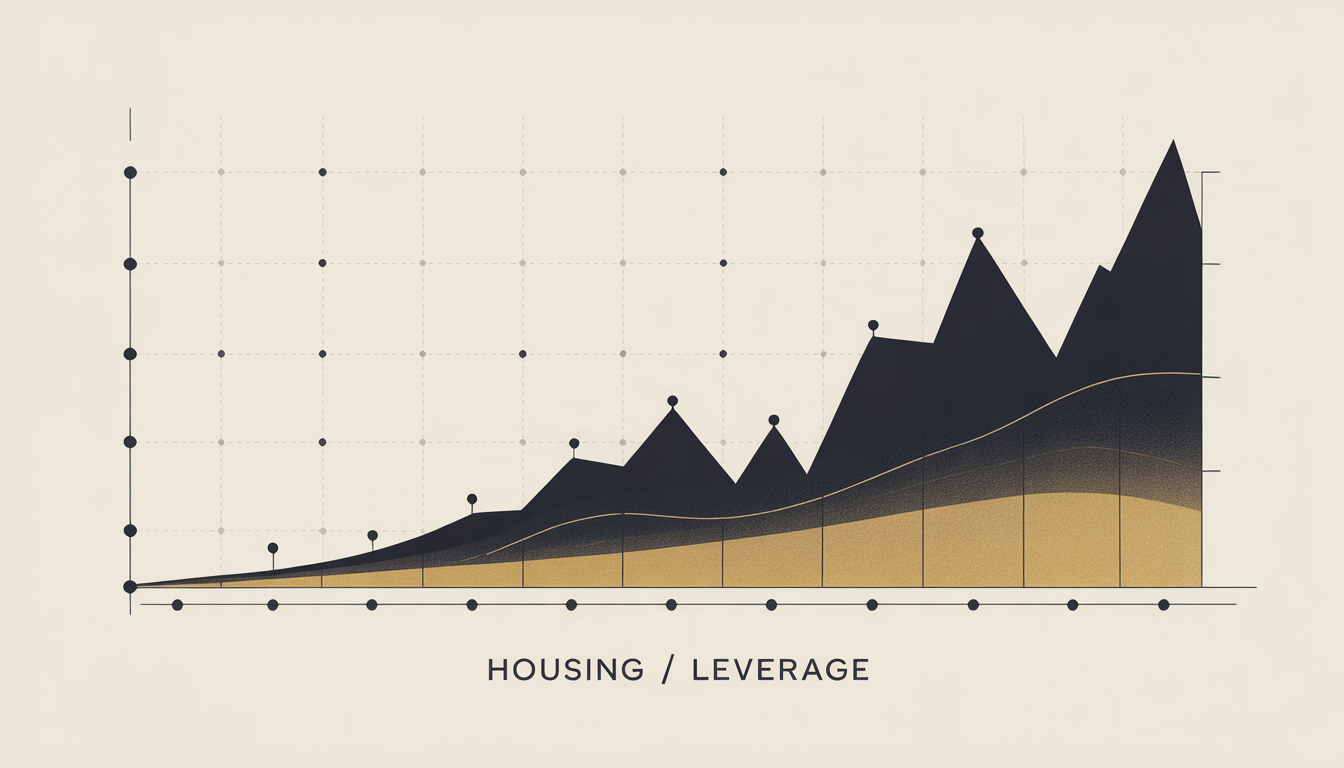
For housing specifically, this mechanism was amplified by the leverage embedded in the 30-year mortgage. A boomer who purchased a $66,000 home in 1980 with 20% down put $13,200 of equity at risk against a $52,800 mortgage. As the home appreciated to $400,000+ across the next 45 years, the equity claim grew accordingly, while the mortgage debt was repaid in dollars whose purchasing power had been continuously debased. The leverage multiplied the Cantillon gain. The same leverage applied in reverse to the cohort that would eventually have to acquire the property at the inflated price would not produce a symmetric loss — because the eventual buyer is not paying with debased dollars from the past, but with current-period earnings against current-period prices. The asymmetry is the source of the wealth transfer.
The interest-rate dimension
Cantillon-effect inflation is one mechanism. The interest-rate cycle that ran from 1981 to 2021 is the second, and arguably the more powerful one for housing specifically.
In October 1981, the 30-year fixed-rate mortgage in the United States peaked at approximately 18.45%. This was the high water mark of the Volcker era, when the Federal Reserve had committed to crushing inflation regardless of the short-term economic cost. From that peak, mortgage rates fell — with periodic counter-trend rallies — for the next forty years, reaching a trough of 2.65% in January 2021. The cumulative decline was 15.8 percentage points across four decades.
The implications for housing were structural. Every basis-point decline in long-term rates produced a proportional increase in the home value that any given monthly payment could support. A worker in 1981 borrowing $66,000 at 18% paid roughly $993 per month in principal and interest. A worker in 2021 with the same $993 monthly payment capacity could borrow approximately $246,000 at 2.65% — a 3.7x increase in mortgage principal capacity, achieved entirely through the rate decline, with no underlying improvement in the worker's earning capacity. Compounded across the entire workforce and across forty years, this rate decline alone is the proximate cause of much of the home-price appreciation that boomer homeowners now interpret as the merit of housing as an investment.
The rate decline is over. The 30-year rate cannot fall another 15 percentage points from current levels without going to negative territory, and even Japan — which has run the most aggressive zero-rate policy among major economies — found that the political-economy consequences of negative long-term rates eventually became unsustainable. The current 6.23% rate is closer to the historical mean than to either extreme. A homebuyer in 2026 cannot expect a multi-decade rate decline to multiply their borrowing capacity. The mechanism has spent itself.
This is the analytical heart of the boomer-trade observation. The post-1971 housing windfall was driven by two mechanisms: (1) Cantillon-effect monetary expansion, which inflated asset prices against wages, and (2) a forty-year rate decline, which expanded borrowing capacity against fixed payment ability. Neither mechanism can be re-run from current starting conditions. The Cantillon effect requires continuous expansionary monetary policy, which the inflation environment of 2022–2026 has constrained. The rate-decline mechanism requires that rates have somewhere to fall, which they no longer do at scale. The boomer trade was a specific configuration of the post-1971 regime; the configuration is exhausted.
The transfer mechanism in the present
In 2026, the boomer cohort is the largest selling cohort in the housing market for the first time in modern American history. The leading edge of the cohort is now 80 years old. The trailing edge is 62. Demographic data on housing transitions consistently show that adults over 65 transition out of single-family homes at accelerating rates — through downsizing, transition to assisted living, or estate disposition — and the boomer cohort's age distribution is now solidly in the transition zone.
The buying cohort is, mechanically, the post-1985 generations: late Gen X, millennials, and the leading edge of Gen Z. The price they are being asked to pay is the boomer entry price compounded by 45 years of Cantillon-effect inflation and rate-decline-driven leverage expansion. The interest rate at which they are being asked to finance that price is roughly equivalent to the rate environment of the early 2000s — historically moderate, but vastly higher than the rate environment in which the boomer cohort acquired most of its current wealth position.
The math of the trade, evaluated at the median, does not work. A median U.S. household earning $80,734 in 2026 buying a median U.S. home at $408,800 with 20% down at 6.23% pays approximately $2,005 monthly in principal and interest, plus roughly $600–800 in property tax and insurance, for a total housing cost of approximately $2,600–2,800. This is 39–42% of gross household income, well above the 30% federal cost-burden threshold. For a household at the median income level, the median home is unaffordable on conventional underwriting metrics.
The market clears anyway, through a combination of mechanisms that reveal the structure of the transfer. Down-payment assistance from family — overwhelmingly from boomer parents to younger buyers — has become the dominant first-time buyer financing mechanism in expensive metros. Dual-income household requirements have shifted from optional to mandatory in most markets, requiring both adults to be earning to qualify for the median home. Federal subsidy programs — FHA, VA, USDA, state and local DPA programs — backstop the purchases that conventional underwriting cannot support. Reduced household formation — the share of adults aged 25–34 living with parents has approximately doubled since 2000 — represents the population that has been priced out entirely.
Each of these is a partial rerouting of the transfer through different channels. Down-payment assistance from boomer parents transfers the wealth inside the family rather than across the broader generational interface, but transfers it nonetheless. Dual-income requirements double the household labor input required to acquire the same shelter quality the boomer cohort acquired with one income. Federal subsidy programs route the transfer through the federal balance sheet, ultimately payable by the taxpayer base — which is, demographically, the same younger cohort. Reduced household formation is the failure of the transfer to clear at the margin, and the population it produces is one of the most economically and politically significant features of the 2026 American social landscape.
The Mengerian saleability framing
The framework can describe what is happening in saleability terms cleanly. The boomer's home, considered as an asset, retains its physical characteristics from 45 years ago. Its Mengerian saleability — divisibility, durability, transportability, homogeneity, freedom from political weaponization — has not improved. What has improved is the infrastructure of substitute claims that allows households to bid for it.
The 30-year mortgage architecture, the agency MBS secondary market, the down-payment assistance ecosystem, the dual-income household norm, the federal subsidy programs — these together constitute a saleability enhancement layer that the boomer's home benefits from when it is sold. The home is not more saleable. The institutional support for the buyer's bid has become more elaborate. From the boomer seller's perspective, this distinction does not matter — the cash at closing is the same regardless of whether it came from a private down payment, a parental gift, an FHA loan, or a state DPA program. From the framework's perspective, it matters profoundly.
The saleability enhancement layer is itself a substitute structure, in the same Fekete sense as the agency MBS market discussed in the previous essay. It exists because the underlying economic relationship (median income to median home price) cannot itself sustain the transactions the market requires. The substitutes paper over the gap. They have papered over progressively larger gaps for forty years. The framework predicts that the substitutes can continue to paper over gaps until they cannot — at which point the saleability of the boomer's home reverts to what its underlying market would actually clear at, which is a meaningful discount to the prices currently being achieved.
This is the structural source of the housing market's apparent fragility in 2026. The seller-cohort's expected price reflects the substitute layer's full extension. The buyer-cohort's actual ability reflects the underlying economic reality. The gap is filled by federal credit enhancement, family wealth transfers, and reduced household formation. None of these is a stable equilibrium. All are stress points where the system can decompress under sufficient pressure.
Why this is not generational warfare
The temptation in describing the above is to frame it in moralistic terms — to suggest that the boomer cohort exploited younger generations, or that the younger generations are somehow owed compensation, or that policy intervention should explicitly redistribute the windfall. The framework rejects all three of these framings.
The boomer cohort did not engineer the monetary regime that produced their housing windfall. The closing of the gold window in 1971 was a Nixon administration decision driven by short-term political-economy considerations. The Volcker rate cycle of 1979–1981 was a Federal Reserve response to inflation that the boomer cohort had no role in creating. The post-1981 rate decline was the cumulative result of decades of monetary policy decisions made by central bankers responding to their own incentives. The boomer cohort participated in the housing market that these policy decisions produced. They did not produce the policy decisions.
The younger cohorts are not owed compensation by the boomer cohort, because no transfer was taken from them in any deliberate sense. The transfer is the cumulative consequence of a monetary regime change, mediated by tens of millions of individual market transactions, none of which involved any party deliberately disadvantaging another. Reframing this as a moral debt produces no useful policy guidance and obscures the underlying analytical observation.
The correct framing is structural. A specific monetary regime, operated for 55 years, produces specific cohort-level outcomes that look like wealth transfers but are properly understood as the differential exposure of different cohorts to the same monetary expansion at different points in their working lives. The boomers caught the windfall because they were buying assets at the leading edge of the post-1971 expansion. The younger cohorts face the unwinding because the same expansion has now run to its logical limits and the substitute structures can no longer extend further at the same rate.
The policy implication is not redistribution. The policy implication is honesty about what the regime has produced and what its continuation requires. The post-1971 system has reached a point at which its continuation requires either renewed monetary expansion (which inflation makes politically impossible) or further extension of substitute structures (which is the trajectory currently in progress). Neither of these is sustainable indefinitely. The regime will end. The framework cannot predict the timing or the specific trigger. The framework can predict that when it ends, the housing market's price structure will adjust to reflect the underlying economic relationships rather than the substitute-supported ones, and that adjustment will be the largest housing-price event in American history.
What this means for the household
The household making housing decisions in 2026 needs to understand that it is operating inside the late phase of a specific monetary regime, and that the parameters of that regime are not stable on the time horizons that housing decisions involve.
For the buyer, the conventional pro-housing argument — that home prices have appreciated reliably for decades and will continue to do so — is supported entirely by the regime that is now exhausting itself. The price appreciation that sold homes for the past several decades reflected mechanisms that are not available going forward. Future appreciation will, in expectation, more closely track wage growth and underlying productive economic conditions than it has at any point since 1971. Real (inflation-adjusted) appreciation may approach zero or go negative for an extended period, as it did in Japan from 1991 forward.
For the seller in the boomer cohort, the corresponding observation is that the saleability enhancement layer that has supported your home's price is not guaranteed to remain in place. If the layer compresses — through tightened federal underwriting, reduced agency MBS support, exhaustion of family wealth transfer capacity, or a duration crisis in the substitute structure described in the previous essay — the price your home commands will compress with it. Sellers in elastic-supply markets are particularly exposed; sellers in supply-constrained metros have somewhat more cushion, but only somewhat.
For both, the practical implication is that housing in 2026 is no longer a wealth-storage instrument with positive expected real return. The conditions that produced the 1971–2021 outperformance are not recurring. The instrument's intrinsic Mengerian saleability characteristics, audited in the previous essay in this trilogy, reassert themselves as the substitute layer compresses. What remains is the consumption utility of the home (real, but consumption-grade), the inflation-hedging optionality of the fixed-rate mortgage (real, but conditional on continued inflation), and the forced-savings behavioral mechanism (real, but available through other instruments). These are smaller benefits than the cultural narrative suggests.
The honest analytical statement is this: the boomer trade was a one-time event in the specific monetary regime that ran from 1971 to 2021. The conditions for its replication do not exist. Households making housing decisions in 2026 should evaluate the decision on its current-period merits — consumption utility, inflation hedge, behavioral savings — rather than on the implicit assumption that the regime that produced the historical returns will continue. The next forty years will not look like the previous forty.
What Fekete saw
Fekete's framework anticipated this configuration. His analysis of the post-1971 monetary regime — articulated across decades of essays beginning with his 1996 paper Whither Gold? — treated the closure of the gold window as a finite experiment whose specific trajectory would unfold across roughly half a century. He argued that the experiment would proceed through several distinguishable phases: an initial period of high inflation as the new regime established itself (1971–1981), an extended period of falling rates and asset-price expansion as the system worked through the implications of unconstrained credit creation (1981–2021), and a terminal phase of rising spreads, capital erosion, and substitute-structure failure as the regime exhausted its expansionary capacity (which Fekete believed had begun in the 2000s and would intensify across the 2020s and 2030s).
The boomer trade fits inside Fekete's middle phase exactly. It was not a feature that any individual planner designed. It was the natural consequence of the regime's mechanics, captured by the cohort that happened to be acquiring assets during the expansion phase. The post-2021 cohort is operating inside Fekete's terminal phase, in which the substitute structures begin to compress and the underlying economic relationships re-emerge in the data.
The framework does not prescribe what households should do about this. It describes what is happening. The household that understands the description has a meaningful informational advantage over the household that does not, in the same way that the gold-bull who understood Fekete's framework in 2007 had a meaningful informational advantage over the gold-bull who did not. The advantage is not predictive precision about timing. It is structural clarity about which mechanisms are operating and what their failure modes look like.
The next essay in this trilogy turns from the structural and empirical observations to the constructive question: if the post-1971 housing finance architecture is exhausted, what would replace it under a sound monetary regime? The question is not academic. As the substitute structures compress, the political-economy pressure to design replacements will intensify. The framework has specific things to say about what works and what does not. The final essay sets them out.
This is the second essay of the Housing Trilogy. The next and final essay proposes what an honest replacement for the 30-year mortgage architecture would look like under a sound monetary regime — a constructive exercise in applying the Menger-Fekete framework to the design of household financial instruments suitable for the post-fiat era.