
The Saleability Audit of Bitcoin: What Menger Would Say in 2026
The cryptocurrency debate has been frozen into two postures that have not changed materially since 2017. The maximalist position holds that Bitcoin is the most saleable monetary good ever created — superior to gold, immune to political weaponization, the inevitable apex of monetary evolution under Menger's own framework. The skeptical position holds that Bitcoin doesn't actually work for the people it claims to liberate — the African villager, the rural Chinese citizen, the unbanked Nigerian farmer — and that its real-world adoption is concentrated in Western speculation, criminal commerce, and state-level sanctions evasion.
Both positions are partially right. Both miss what Menger's framework actually says when applied carefully to Bitcoin specifically, and both miss what is actually happening on the ground in the emerging markets where the monetary stakes are highest. The 2026 ground truth is neither what the maximalists describe nor what the skeptics describe. It is something more nuanced, more uneven, and considerably more interesting than either camp acknowledges.
This essay is the first of a trilogy applying the New Austrian framework to cryptocurrency in 2026. The premise is simple: the framework cannot be deployed selectively. Either Menger's saleability spectrum and Fekete's substitute-layer analysis apply universally to monetary phenomena, or they apply nowhere. They apply universally. So we run the audit on Bitcoin with the same rigor we ran it on the U.S. single-family home in essay seven, and we let the audit produce whatever it produces. The results will not flatter either side of the conventional debate.
The Mengerian criteria, applied to Bitcoin
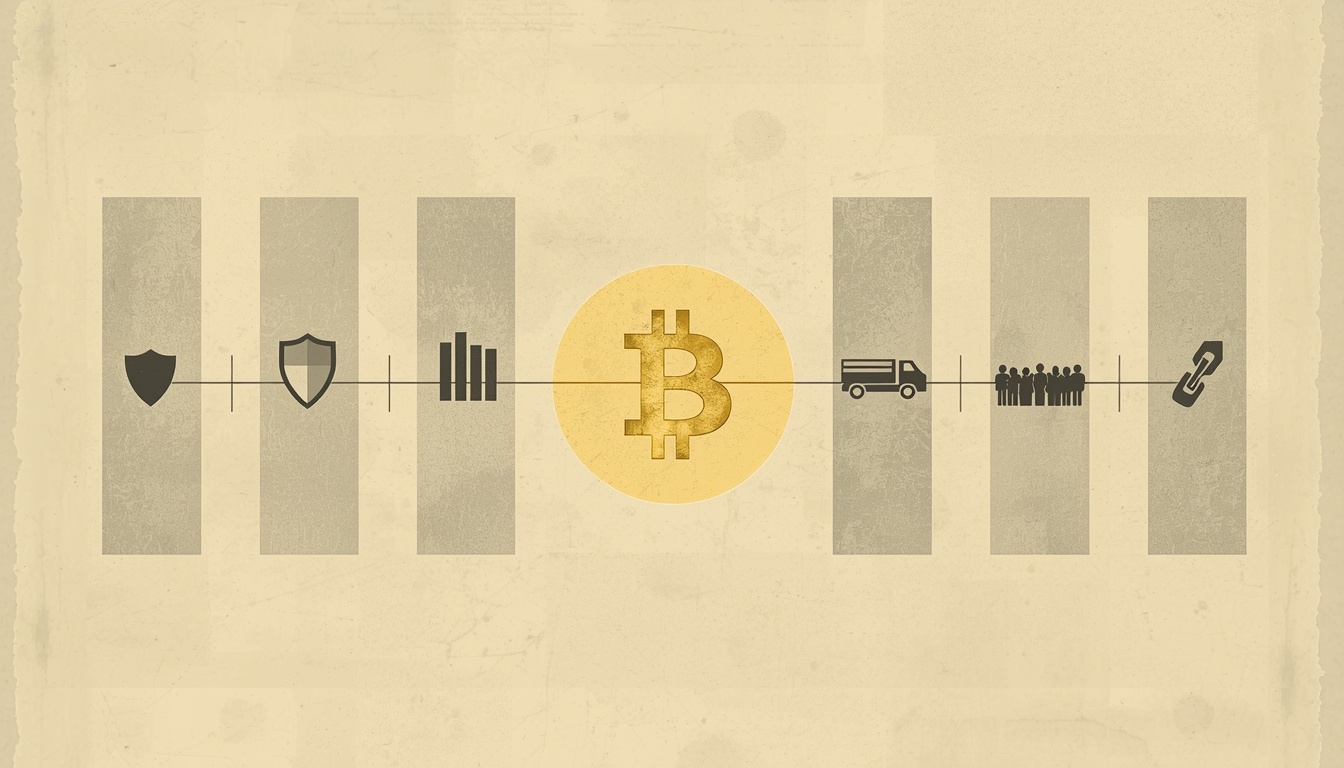
The previous essays in this series established the six characteristics by which Menger ranked goods on his saleability spectrum: divisibility, durability, transportability, homogeneity, widespread demand, and freedom from political weaponization. The framework treats all six as objective properties measurable through observable market behavior, not as subjective preferences. Apply them to Bitcoin one at a time.
Divisibility. Bitcoin is divisible to eight decimal places (one satoshi = 0.00000001 BTC), which at current prices is roughly 0.00075 cents — divisibility several orders of magnitude finer than any physical currency in human history. This is not a small advantage. Menger considered divisibility a core saleability property because it determines whether the good can clear transactions across a wide range of value sizes. Bitcoin's divisibility is, on this criterion alone, structurally superior to gold, silver, and any fiat currency including the U.S. dollar. Score: maximum, near-perfect.
Durability. Bitcoin is durable in a specific and unusual sense: the underlying ledger persists through cryptographic and network consensus rather than through physical preservation. Properly stored private keys do not corrode, do not fade, do not require maintenance in the conventional sense. The durability is, however, conditional on three substrates remaining intact: the cryptographic algorithms (ECDSA, SHA-256), the global network of nodes maintaining the ledger, and the holder's continued ability to access their private keys. The first of these is now under active threat from quantum computing, which is the central topic of the next essay in this trilogy. The second has held remarkably well for sixteen years. The third is the source of the ~5.6 million BTC currently classified as "lost" — coins whose holders have died, lost their keys, or otherwise become unable to access them. Score: high, but conditional on substrate integrity in a way that makes the score increasingly fragile in 2026.
Transportability. Here Bitcoin's saleability properties become genuinely revolutionary. A Bitcoin holder can transport any quantity of value across any border, with no physical mass, in seconds, with no central permission required. Menger considered transportability one of the most consequential saleability properties — it is precisely the property that allowed gold to displace less transportable monetary goods historically. Bitcoin's transportability strictly dominates gold's. It also dominates the dollar's, because the dollar's transportability depends on permissioned correspondent banking infrastructure that the holder does not control and that can be denied at any point in the chain. Score: maximum. This is Bitcoin's strongest Mengerian property.
Homogeneity. A Bitcoin is a Bitcoin. Every UTXO of equivalent denomination is mechanically identical to every other. This is, in principle, a near-perfect homogeneity score. In practice, the homogeneity is qualified by the chain-analysis problem. Coins that have passed through OFAC-sanctioned addresses, through known mixing services, or through wallets with adverse provenance histories trade at a discount on regulated exchanges and may be refused entirely by major counterparties. This is the same phenomenon that produced "tainted gold" historically — a Mengerian-grade good whose homogeneity has been partially destroyed by counterparty risk attached to specific units. Score: structurally high; practically degraded by chain analysis in ways the framework cannot ignore.
Widespread demand. As of 2026, an estimated 800 million people globally hold or have held some form of cryptocurrency. Bitcoin specifically has an estimated 200–300 million addresses with non-zero balances, though the address-to-user ratio is unclear. Daily trading volume runs in the tens of billions of dollars. Compared to a Mengerian-grade monetary good like the U.S. dollar (used by approximately 4 billion people regularly) or gold (held in some form by approximately 2 billion people), Bitcoin's demand is meaningful but second-tier. Compared to any other cryptocurrency, Bitcoin's demand is dominant. Score: medium-high, in absolute terms; very high relative to other cryptocurrencies.
Freedom from political weaponization. This is where the audit becomes most uncomfortable for the maximalist position. Bitcoin's theoretical freedom from political weaponization was the original value proposition: no central party could freeze, confiscate, or invalidate holdings. The 2026 reality is meaningfully different. Chainalysis and similar firms have clustered over one billion wallet addresses into entity groups, identified more than 107,000 unique entities, and provide tools to U.S. agencies including the FBI, DEA, IRS, SEC, and dozens of international counterparts. They helped OFAC seize $344 million in Tether linked to Iran's Hormuz toll in April 2026. Major exchanges block sanctioned addresses. National governments have prosecuted individuals for transactions traced through the public ledger. The pseudonymity that gives Bitcoin its political-weaponization resistance has been degraded to a point that any sophisticated state actor can typically deanonymize any non-trivial chain of transactions. And — most consequentially — BIP-361, the proposal to freeze 5.6 million quantum-vulnerable BTC, demonstrates that the protocol itself can become the source of weaponization under sufficient stress. The promise of unconditional cryptographic ownership is being challenged from inside the developer community for the first time in sixteen years. Score: theoretically high; empirically degraded; trending sharply downward in 2026.
The audit's verdict
A neutral analyst applying the criteria above would arrive at the following composite assessment of Bitcoin's Mengerian saleability in 2026:
- Two criteria (divisibility, transportability) at near-maximum scores.
- Two criteria (durability, homogeneity) at high scores qualified by emerging structural threats.
- One criterion (widespread demand) at medium-high.
- One criterion (freedom from political weaponization) at theoretically high but empirically and increasingly compromised.
This is, by any honest reading, a strong but no longer dominant saleability profile. Bitcoin scores higher than the U.S. single-family home (which essay seven placed at the bottom of the spectrum) by a wide margin. It scores comparably to gold on most criteria, with structural advantages on transportability and divisibility offset by structural disadvantages on durability (gold's substrate is physical and not cryptographically threatened) and on the political-weaponization criterion in 2026 specifically. It scores below the U.S. dollar on widespread demand and on the practical infrastructure for clearing transactions at scale, while scoring above the dollar on transportability and freedom from weaponization (still — though with the gap narrowing).
This is a defensible profile. It is also not the profile the maximalists describe. The maximalist claim that Bitcoin is the most saleable monetary good ever created depends on weighting the freedom-from-weaponization criterion at near-infinity and treating the chain-analysis and BIP-361 developments as edge cases that don't affect the structural argument. The framework rejects this weighting. Menger himself did not weight the criteria — he treated all of them as components of an empirical assessment of how a good actually performs in market exchange. By that empirical standard, Bitcoin in 2026 is one strong monetary good among several, with specific advantages and specific weaknesses, not an apex predator displacing all alternatives.
It is also not the profile the skeptics describe. The skeptical claim that Bitcoin "doesn't work" for emerging-markets users is empirically false at the data level. The framework forces engagement with what is actually happening on the ground.
What is actually happening on the ground
The skeptical position frequently invokes the African villager or the rural Chinese citizen as someone for whom Bitcoin has solved nothing. The framework requires we look at the actual data rather than at the rhetorical figure.
Sub-Saharan Africa moved over $200 billion in on-chain value between mid-2024 and mid-2025, a 52% year-over-year increase placing the region among the world's fastest-growing crypto markets. Stablecoins represented 43% of that activity. This is the most important single empirical observation for an honest assessment, and it is one that maximalists and skeptics both routinely miss.
The ground-truth of cryptocurrency adoption in emerging markets is not Bitcoin. It is stablecoins — primarily USDT and USDC, dollar-pegged tokens that combine the transportability and divisibility advantages of crypto with the saleability properties of the U.S. dollar. The maximalist case for Bitcoin as the dominant monetary good of the unbanked is empirically wrong; Bitcoin's role in those economies is real but specialized. Bitcoin is used for crisis-period flight to self-custody (Iranian protest period, Nigerian naira devaluation moments), for long-term store-of-value accumulation by the digitally literate, and for cross-border value transfer in specific corridors. Stablecoins handle the daily transactional volume because the daily transactional reality requires price stability, which Bitcoin's volatility has never delivered.
Within stablecoins, the framework's saleability audit produces an interesting result. USDT's parent company Tether reported $141 billion in U.S. Treasury holdings and $8.23 billion in excess reserves as of Q1 2026, with $1.04 billion in quarterly net profit. Tether's growing pool of dollar-denominated reserves makes USDT a paper substitute that approximates the Mengerian saleability of the dollar itself, with the transportability and divisibility advantages of the crypto layer added on top. From a pure Mengerian standpoint, this is a structurally superior instrument to the dollar in cash form for cross-border use cases — and the empirical data confirm that emerging-market users have noticed and acted accordingly. (The third essay of this trilogy will engage with the harder structural questions about what stablecoins actually are at the monetary-policy level.)
Nigeria specifically: approximately 25.9 million crypto users, $59 billion in transaction volume between July 2023 and June 2024, 85% of those transactions below $1 million (i.e., retail-scale). Stablecoins account for 43% of retail transactions under $1 million — the rest is mostly Bitcoin and ether. The Central Bank of Nigeria's eNaira CBDC, launched in 2021 with substantial state promotion: 98.5% of eNaira wallets were unused one year after launch. Nigerians actively rejected the CBDC and adopted dollar-pegged private stablecoins instead — a Mengerian-bottom-up event of remarkable clarity.
Kenya: built on M-Pesa's foundation, the country has integrated stablecoin rails into existing mobile money infrastructure. Mercy Corps Ventures pilots reduced remittance fees from 29% to 2% using stablecoins. BitPesa serves 6.5 million users for remittances. The Kenyan retail experience is closer to the maximalist's ideal than the Nigerian — but the dominant instrument is still stablecoins, not Bitcoin.
Ethiopia: 180% year-over-year growth in retail-sized stablecoin transfers in 2025 after the local currency devalued 30%. The fastest-growing retail crypto market in Africa, and again, the activity is concentrated in stablecoins, not Bitcoin.
Iran: the most interesting data point because it is the cleanest test of crypto's freedom-from-weaponization property under maximum political stress. Civilians in Iran are demonstrably moving to Bitcoin for self-custody during periods of internet blackout and political crisis — Chainalysis observed a documented surge in withdrawals from Iranian exchanges to personal Bitcoin wallets during the November 2025 protest period and the February 2026 wartime conditions. But the Iranian state itself, settling Hormuz tolls during the war, used yuan and Tether — not Bitcoin. The civilian-vs-state pattern is itself a Mengerian observation: the saleability properties that matter to a sanctioned state (settlement at scale with willing counterparties) are different from the saleability properties that matter to a civilian under a collapsing currency (immediate self-custody with no permission required). Bitcoin satisfies the second; stablecoins and yuan satisfy the first. The same instrument cannot easily satisfy both, and the empirical reality reflects this.
The maximalist claim that Bitcoin specifically — not crypto generally — is replacing fiat in emerging markets is not supported by the data. The skeptical claim that crypto isn't doing real work for these populations is also not supported by the data. The framework's reading is that crypto is doing real monetary work in emerging markets, that the work is being done predominantly by stablecoins rather than Bitcoin, that Bitcoin plays a specific and important crisis-flight role, and that the monetary architecture emerging in these economies is neither the Bitcoin-replaces-fiat scenario the maximalists predicted nor the failure scenario the skeptics described. It is something newer.
The volatility problem
A separate but related Mengerian observation is that Bitcoin's volatility has structurally prevented it from occupying the highest tier of the saleability spectrum for daily transactional use. Menger considered price stability an implicit consequence of high saleability — the most saleable goods, by definition, command stable exchange ratios against most other goods because their saleability is what is being valued.
Bitcoin's annualized volatility has run between 50% and 100% across its history, with intraday moves of 5–15% common during stress periods. This is not the volatility profile of a monetary good. It is the volatility profile of a speculative asset. Maximalists argue that the volatility will decline as adoption matures and that the long-term store-of-value case is unaffected by short-term volatility. The framework partially agrees — Bitcoin's volatility has trended downward as the asset has matured, and a 30-year holder has indeed captured an exceptional return relative to dollar-denominated baselines. But for the user trying to receive a remittance, pay rent, or settle a commercial transaction within the next 60 days, Bitcoin's price uncertainty is itself a saleability impairment. The market has voted on this question with its choice of instrument: stablecoins for daily transactions, Bitcoin for long-term holds. The vote is a Mengerian outcome.
The framework's prediction is that Bitcoin's volatility will continue to decline gradually as adoption deepens, but that it will not approach stablecoin-level price stability within the next decade absent fundamental changes to the underlying market structure. This means Bitcoin will continue to occupy a specific niche in the monetary spectrum — the high-divisibility, high-transportability, low-political-weaponization, high-volatility tier — rather than displacing dollar-pegged instruments for general transactional use. The maximalist scenario in which Bitcoin becomes the primary medium of exchange for the global economy is, on this analysis, unlikely. The framework does not endorse this prediction with certainty; it observes that the empirical trajectory and the structural factors both point in the same direction.
The energy-cost-as-tax observation
One more Mengerian observation worth surfacing because it is rarely articulated in framework terms. Bitcoin's proof-of-work consensus mechanism imposes a continuous energy cost on the network — currently estimated at 150–180 TWh annually, comparable to the total electricity consumption of a mid-sized industrialized country. This cost is paid by miners and ultimately recouped through block rewards (newly issued BTC) and transaction fees.
In Mengerian terms, this is a tax on the saleability of every Bitcoin in circulation. The energy cost is borne by all holders proportionally, in the form of inflation (newly issued coins diluting existing holdings) until 2140, and increasingly through transaction fees as the block reward halves over time. The annual cost as a percentage of total Bitcoin market capitalization is currently in the range of 1–2%, declining over time as the block reward diminishes.
This is not a fatal flaw. Gold has analogous extraction costs (mining, refining, vaulting). But the framework requires acknowledgment that Bitcoin's saleability is not free of carrying costs in the way that, say, a self-custodied gold coin in a private safe is. The carrying cost is structural to the consensus mechanism. Proof-of-stake alternatives (Ethereum since 2022) have substantially eliminated this cost, at the price of different trust assumptions that the framework would audit differently.
What the audit means
A clean summary of the framework's audit of Bitcoin in 2026:
-
Bitcoin satisfies several of Menger's saleability criteria at near-maximum levels — divisibility and transportability in particular are structurally superior to any prior monetary good in human history.
-
It satisfies others at high levels with significant qualifications — durability is conditional on substrates that are increasingly stressed; homogeneity is degraded by the chain-analysis layer that did not exist in early Bitcoin years.
-
It scores poorly on freedom from political weaponization in ways that contradict the maximalist case — Bitcoin's pseudonymity has been substantially compromised by surveillance infrastructure that operates at industrial scale across virtually every regulated jurisdiction.
-
It does not satisfy the saleability requirements for daily transactional use, due to volatility — and the empirical pattern of crypto adoption in emerging markets confirms this, with stablecoins handling daily transactions while Bitcoin occupies a specialized store-of-value and crisis-flight role.
-
The audit's bottom line is that Bitcoin is a strong but not dominant monetary good — one significant instrument among several in the 2026 monetary architecture, with specific advantages and specific weaknesses, not the apex predator the maximalists describe.
The framework also produces an observation that neither side of the conventional debate has internalized: the most successful crypto-monetary instrument in 2026 is not Bitcoin. It is the dollar-pegged stablecoin. Stablecoins inherit the dollar's existing saleability dominance while adding the crypto layer's transportability and divisibility advantages. They are the actual mass adoption story in emerging markets. They are what Iran is using to settle Hormuz tolls. They are what 43% of Sub-Saharan African crypto volume runs through. Tether's $141 billion in U.S. Treasury holdings makes USDT a de facto extension of dollar monetary architecture into the crypto rails — a structural reality with implications neither the maximalist nor the skeptical narrative captures cleanly.
This is the unfinished question this trilogy will engage. The next essay turns to what may be the largest single Mengerian event in cryptocurrency history: the BIP-361 / Mythos / Q Day convergence, in which the freedom-from-weaponization property of Bitcoin specifically is being challenged from inside the system itself, by mechanisms that the framework's CMP analysis (Article 6) anticipated with remarkable precision.
The maximalists will argue that the audit is too harsh and that the long-term trajectory still ends with Bitcoin's monetary dominance. The skeptics will argue that the audit is too generous and that Bitcoin's structural problems will produce its eventual marginalization. The framework's claim is neither. The claim is that Bitcoin in 2026 is a real and important monetary phenomenon whose saleability properties are now empirically measurable, whose actual role in the global monetary architecture is more specific than either narrative captures, and whose future depends on a small number of structural inflection points that are arriving — for the first time in sixteen years — within the immediate future rather than as theoretical concerns.
The first of those inflection points is the subject of the next essay.
This is the first essay of the Cryptocurrency Trilogy. It establishes the framework for what follows: a structural assessment of Bitcoin specifically (Essay 14, on the BIP-361 / Mythos / Q Day inflection) and a constructive analysis of the broader monetary architecture (Essay 15, on stablecoins, CBDCs, and programmable money). The framework is descriptive, not advocational — it does not advise the reader to buy or sell anything. It describes what is actually happening so that the reader can make their own decisions on solid analytical ground.