Researched and drafted with AI assistance · reviewed and edited by Jason D. Keys
Listen
The Charter That Expired: What a Corporation Used to Be
Read in Jason D. Keys' synthesized voice
Narrated in the author’s synthesized voice, generated with AI from a recording of his own. The words are his; the delivery is machine-rendered.
Download (6.0 MB)A grant, not a form
In the first decades of the American republic, a corporation was not something one formed. It was something one was granted.
Obtaining corporate status required a special act of a state legislature — a bill, introduced and voted on, conferring the privilege on named persons for a named undertaking. The grant was understood as an exception to the ordinary law of partnership, justified by a public purpose the legislature identified: a bridge, a canal, a bank, a college.
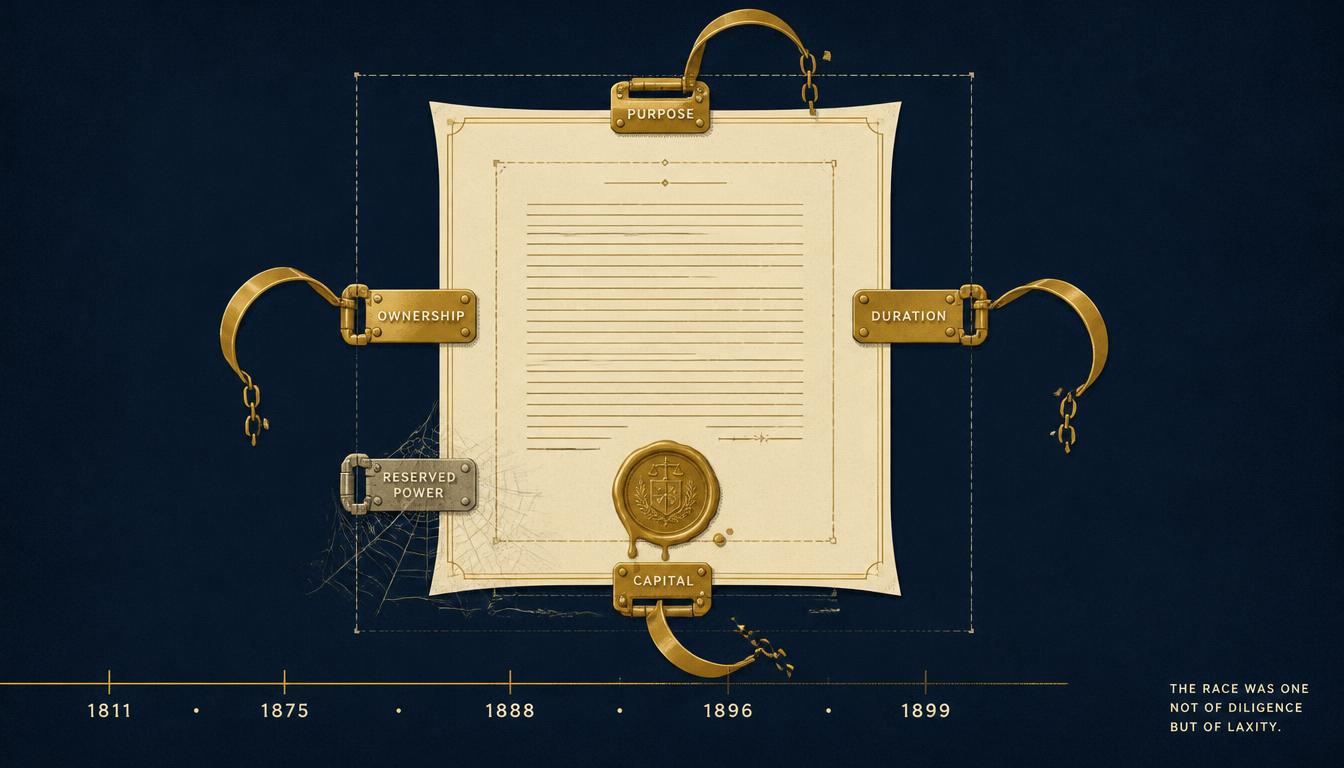
And it came with limits written into the instrument itself. New York's 1811 general incorporation act for manufacturing — among the earliest statutes to permit incorporation without a special legislative act — is instructive about what the era regarded as normal. It enumerated precisely the industries in which such firms could operate. It limited the board of directors to nine persons, who were required to be stockholders. It capped capital stock at one hundred thousand dollars. And it limited the duration of the firm's existence to twenty years. 1
Those were not unusual provisions. Across the general incorporation statutes of the period, roughly forty-one percent imposed a maximum capitalization, and a substantial share limited duration. 1
The corporation, in other words, was a temporary instrument with a stated job. When the job was done or the term ran out, it dissolved.
Brandeis, writing the history from the bench
The clearest account of how this changed was written by a Supreme Court Justice, in dissent, in 1933.
In Louis K. Liggett Co. v. Lee, Justice Louis Brandeis set out the history of American incorporation law at length. His summary of the original regime is worth quoting because it establishes the baseline:
"At first, corporations could be formed under the general laws only for a limited number of purposes — usually those which required a relatively large fixed capital, like transportation, banking, and insurance, and mechanical, mining, and manufacturing enterprises." 2
And on the two limits that mattered most:
"Permission to incorporate for 'any lawful purpose' was not common until 1875; and until that time the duration of corporate franchises was generally limited to a period of 20, 30, or 50 years." 2
Brandeis then states the structural consequence in a single sentence, and it is the hinge of this entire essay:
"The holding company was impossible." 2
A corporation confined to a stated purpose, barred from owning shares in other corporations, capped in its capitalization, and scheduled to expire cannot become a pyramid of controlled entities. Not because anyone prohibited pyramids, but because the components the pyramid requires did not legally exist.
How the limits came off
The removal was not the work of Congress, a court, or any coordinated reform. It was the work of state legislatures competing for chartering revenue, and the sequence is well documented.
New Jersey moved first and most aggressively. Throughout the 1880s and 1890s it relaxed long-standing restrictions on size and combination: permitting corporations to merge with one another in 1888, to deal in each other's securities and thus operate as holding companies in 1889, and to operate outside New Jersey without express legislative permission in 1892. 3 By 1896 it had consolidated this into a comprehensive statute that eliminated time limits on corporate charters and permitted corporations to engage in any business they chose. 4
Other states followed because they had to. Brandeis records the mechanism precisely, and his example is specific: in 1892 the Governor of New York approved a special charter for the General Electric Company modeled on the New Jersey act, on the explicit ground that the enterprise would otherwise obtain a New Jersey charter. Later that same year New York revised its corporation law again to permit the holding of stock in other corporations. 2
Delaware copied the statute. Article IX of Delaware's 1897 constitution abolished incorporation by special act and mandated a general incorporation procedure. 5 On March 10, 1899, Delaware adopted a general corporation law modeled closely on New Jersey's. 6 The sequence was understood at the time as a direct inheritance: New Jersey's liberalization and its later repeal are, in one standard account, "the historical setting ... for the enactment of Delaware's General Corporation Law in 1899, and for [Delaware's] ascendancy." 3
The result, in Brandeis's own figures. Of the seven largest trusts existing in 1904, with an aggregate capitalization exceeding two and a half billion dollars, all were organized under New Jersey law, and three were formed in 1899. During the first seven months of that year alone, 1,336 corporations were organized under New Jersey law with aggregate authorized capital over two billion dollars. 2
Brandeis's judgment on the states that did this was blunt. "The traffic in charters quickly became widespread," he wrote, and the competition for it ran in one direction only: "The states joined in advertising their wares. The race was one not of diligence but of laxity." The large industrial states gave way, in his account, "in order not to lose wholly the prospect of the revenue and the control incident to domestic incorporation." 2
The four limits, and what replaced them
It is worth being precise about what was dismantled, because the losses were distinct and only one of them is commonly noticed.
Purpose. A charter named the business. A corporation chartered to build a canal could build a canal. After 1875 and increasingly thereafter, "any lawful purpose" became standard, and the corporation became a general-purpose legal vehicle rather than an instrument for a specified undertaking.
Duration. Twenty, thirty, or fifty years, after which the enterprise dissolved absent renewal. Perpetual existence replaced it. This is the least discussed and arguably the most consequential, because an entity that does not expire accumulates indefinitely — relationships, holdings, political position — and faces no scheduled moment at which the public reconsiders whether it should continue.
Capitalization. Statutory ceilings on how large a corporation could become. Removed, which was a precondition for the scale that followed.
Ownership of other corporations. The prohibition Brandeis identified as making the holding company impossible. Removed by New Jersey in 1889, which is the specific legal act that made the trust structure unnecessary because the thing the trust worked around was now permitted outright.
One further limit deserves separate mention because it still formally exists. In the wake of Dartmouth College v. Woodward — which the next essay in this series examines — most states wrote into their general incorporation statutes a reserved power to amend or repeal charters. 7 That reservation was the states' hedge against having bound themselves permanently. It has not been removed. It has simply fallen out of use.
Why regulation did not restore the limits
The standard account holds that the Progressive Era represented a counterreaction in which reformers restrained corporate power through federal regulation. The historian Gabriel Kolko's The Triumph of Conservatism (1963) argues that this account inverts the causation. 8
Kolko's thesis, developed from the records of the firms themselves, is that major federal regulation in the period was substantially sought by the regulated industries — because competition was proving more destabilizing to incumbents than regulation would be, and because federal rules could accomplish through law what the trusts had failed to accomplish through combination. Stabilized prices, standardized conditions, and barriers to new entrants were the result, and in Kolko's reading they were frequently the objective.
The framework does not adopt Kolko's larger political conclusions, and his thesis is contested by historians who regard it as overstated. But the mechanism he identifies bears directly on this essay's argument: a regulatory apparatus is a form of incumbency protection available only to entities large enough to engage with it, and the entities large enough to do so were the ones the vanished charter limits had permitted to form.
Menger, and why the distinction is not semantic
The framework's interest here is not antiquarian. It turns on Menger's account of capital, which Article 31 of this catalog developed from the classical definitions.
Menger's theory distinguishes goods by their order. Goods of the first order satisfy wants directly — bread, clothing, shelter. Goods of higher order are those removed from direct consumption, deriving their value from their capacity to produce goods of lower order: flour, the mill, the machinery that builds the mill, the knowledge of how to build it. 9 Capital, in this account, is not a sum of money. It is a structure of higher-order goods arranged in time, and its formation requires that resources be withheld from present consumption and committed to processes that pay out later.
Arranging higher-order goods across time and across many persons requires a legal technology. Partnerships dissolve when a partner dies or withdraws. Individual ownership cannot assemble the capital a railroad requires. The corporation is that technology — a device for holding a structure of higher-order goods together across time and across changes in the identity of its owners.
That is a genuine and valuable function, and the framework says so plainly. Capital formation is not optional. An economy that cannot assemble higher-order goods is an economy that cannot produce much.
The argument of this series is about what happened when the technology lost its limits. A device for assembling capital under a stated purpose, for a stated term, within a stated size, is one kind of institution. The same device with no purpose, no term, no size limit, and the capacity to own other instances of itself is a different institution with the same name.
Capitalism, in the sense Menger's apparatus describes, is the formation of higher-order goods through voluntary exchange and saving. Corporatism is what the legal vehicle for that formation became when its charter stopped expiring. The two are routinely confused, and most of the moral complaint directed at the first is a description of the second.
What the framework takes from this
Three things, stated as findings rather than as rhetoric.
The limits were not abolished by argument. No one made and won the case that corporations should be perpetual, unlimited in purpose, and permitted to own one another. The limits were competed away by states seeking chartering revenue, each acting rationally in isolation. This catalog has repeatedly found that the most consequential institutional changes arrive without anyone deciding them, and this is among the clearest instances.
The reserved power still exists. States retained the authority to amend and repeal charters and have largely stopped exercising it. That is a disused instrument rather than a repealed one, which is a materially different situation from the one usually described.
The complaint is misdirected. A critique of perpetual, general-purpose, mutually-owning corporate entities is not a critique of capital formation, of private ownership, or of voluntary exchange. Treating them as the same argument has allowed the actual institution to escape examination for a century, because its defenders can answer a critique of capitalism that nobody who looks closely is making.
The next essay in this series examines how the entity that emerged from this process acquired constitutional rights — a process that began, as it happens, with a bank.
Sources
Framework cross-references. Article 31 (the classical definitions of labor, land, and capital, and the Mengerian ordering of goods); Article 53 (the argument that consequential institutional change frequently occurs through open, uncoordinated mechanisms rather than concealed ones).
Footnotes
-
Hilt, Eric. "Corporation Law and the Shift toward Open Access in the Antebellum United States." National Bureau of Economic Research. https://www.nber.org/system/files/chapters/c13508/revisions/c13508.rev0.pdf — Source for the terms of New York's 1811 general incorporation act for manufacturing: enumerated industries, a board limited to nine directors required to be stockholders, capital stock capped at $100,000, and duration limited to twenty years. Also the source for the finding that maximum capitalization was imposed in 41 percent of the general incorporation laws surveyed, and that many limited duration. ↩ ↩2
-
Louis K. Liggett Co. v. Lee, 288 U.S. 517 (1933), Brandeis, J., dissenting in part. Source for all quoted passages: "At first, corporations could be formed under the general laws only for a limited number of purposes"; "Permission to incorporate for 'any lawful purpose' was not common until 1875; and until that time the duration of corporate franchises was generally limited to a period of 20, 30, or 50 years"; "The holding company was impossible"; the account of New York's 1892 special charter for General Electric and the subsequent revision of New York corporation law; the figure that all seven of the largest trusts existing in 1904 were organized under New Jersey law with three formed in 1899; the figure of 1,336 corporations organized in New Jersey in the first seven months of 1899 with over two billion dollars of authorized capital (the opinion prints it as "1336"); and the passage on charter competition: "The traffic in charters quickly became widespread," "The states joined in advertising their wares. The race was one not of diligence but of laxity," and the great industrial states yielding "in order not to lose wholly the prospect of the revenue and the control incident to domestic incorporation." All quoted passages verified against the opinion text at https://www.law.cornell.edu/supremecourt/text/288/517 — full text also at https://supreme.justia.com/cases/federal/us/288/517/ ↩ ↩2 ↩3 ↩4 ↩5 ↩6
-
Sanga, Sarath. "The Origins of the Market for Corporate Law." Columbia Law and Economics Studies, 1 July 2020. https://law-economic-studies.law.columbia.edu/sites/default/files/content/Sanga_Origins%20of%20Market%20for%20Corporate%20Law.pdf — For the statutory sequence, in the paper's own terms: New Jersey "relaxed long-standing restrictions on size and business combinations, enabling corporations to merge with each other (1888), to deal in each other's securities and thus act as holding companies (1889), and to operate outside New Jersey without express permission from New Jersey's legislature (1892)." On the consolidation: "An 1896 overhaul consolidated these and other enabling provisions," citing Grandy (1989) at 681. Sanga also records that New Jersey enacted three holding-company statutes beginning in 1888, and that New York passed a comparable measure in 1892. The underlying economic history is Grandy, Christopher. "New Jersey Corporate Chartermongering, 1875–1929." The Journal of Economic History, Vol. 49, No. 3 (September 1989), pp. 677–692, https://doi.org/10.1017/S0022050700008810 — "New Jersey played a dominant role in the merger wave at the turn of the century. The state facilitated the rise of large firms by liberalizing its corporation law in exchange for incorporation fees and franchise taxes." See also Yablon, Charles M. "The Historical Race Competition for Corporate Charters and the Rise and Decline of New Jersey: 1880–1910." Journal of Corporation Law, Vol. 32, No. 2 (2007), pp. 323–380. The quoted characterization of New Jersey's liberalization as "the historical setting ... for the enactment of Delaware's General Corporation Law in 1899, and for [Delaware's] ascendancy" is Seligman (1976) at 270, quoted in Sanga. ↩ ↩2
-
"Delaware's SB21 Continues 150 Years of Corporate Power and Regulatory Capture." ProMarket, Stigler Center at the University of Chicago Booth School of Business, 23 June 2025. https://www.promarket.org/2025/06/23/delawares-sb21-continues-150-years-of-corporate-power-and-regulatory-capture/ — Source for the characterization of the 1896 New Jersey overhaul as eliminating time limits on corporate charters and permitting corporations to engage in any business, and for the role of James B. Dill in drafting the statutes. ↩
-
"History Lessons: Explaining the Origins of Corporate Charter Competition." Jotwell, Corporate Law section. https://corp.jotwell.com/history-lessons-explaining-the-origins-of-corporate-charter-competition/ — Source for Article IX of Delaware's 1897 constitution abolishing incorporation by special act, for the prior practice in which incorporation occurred through special legislative acts with an average wait of two years, and for the concern that the special-act procedure invited lobbying. ↩
-
Delaware General Corporation Law, Title 8, Chapter 1 of the Delaware Code, adopted 10 March 1899. See also Arsht, S. Samuel. "A History of Delaware Corporation Law." Delaware Journal of Corporate Law, Vol. 1, No. 1 (1976), and Larson, Joel. "A Brief History of Delaware's General Incorporation Law of 1899." Delaware Journal of Corporate Law, Vol. 1, No. 2, pp. 249–287. ↩
-
Pollman, Elizabeth. "Corporate Personhood and Limited Sovereignty." Vanderbilt Law Review, Vol. 74 (2021). https://cdn.vanderbilt.edu/vu-wordpress-0/wp-content/uploads/sites/278/2021/11/19121712/Corporate-Personhood-and-Limited-Sovereignty.pdf — "In the wake of Dartmouth, most states passed general incorporation statutes that reserved the" power to amend or repeal charters, described as the "principal mechanism by which states hedged on commitments to" corporations. ↩
-
Kolko, Gabriel. The Triumph of Conservatism: A Reinterpretation of American History, 1900–1916. The Free Press of Glencoe, 1963. The argument that federal regulation in the Progressive Era was substantially sought by the regulated industries as a means of achieving stability and barriers to entry that private combination had failed to secure. The framework notes that Kolko's thesis is contested among historians and adopts the mechanism rather than the full political conclusion. ↩
-
Menger, Carl. Principles of Economics (1871), Chapter I, on goods of first and higher order, and Chapter III, on the theory of value as applied to goods of higher order. https://mises.org/library/book/principles-economics — The ordering of goods by their distance from direct want satisfaction, and the dependence of higher-order goods' value on their capacity to produce goods of lower order. ↩
Related essays
The Hormuz Yuan Toll: A Spontaneous Mengerian Event
Iran charging yuan tolls at Hormuz during wartime, India paying for Russian crude outside the dollar, the 1974 US-Saudi economic commission expiring unreplaced — these are not geopolitical conspiracies. They are textbook Mengerian monetary evolution, happening in real time.
Monetary Power to the People
Money is a medium in McLuhan's sense — an extension of the human body that amplifies the capacity for exchange. Understanding this is the critical path to navigating the financial disruptions of the present age.
The Saleability Audit of Bitcoin: What Menger Would Say in 2026
Bitcoin maximalists insist Bitcoin is the most saleable monetary good ever created. Skeptics insist it doesn't work for the African villager or the rural Chinese citizen the maximalists invoke. Both positions miss what Menger's framework actually says when applied carefully. The audit produces uncomfortable results in both directions — Bitcoin scores remarkably well on some criteria and remarkably poorly on others — and the actual ground-truth of crypto adoption in emerging markets in 2026 is something neither camp accurately describes.