Principles of Economics
Carl Menger · 1871
The founding text of the Austrian School. In 328 pages, Menger overturned the cost-of-production theory of value, established the subjective theory of marginal utility, and showed how money emerges spontaneously from market processes — all without a single equation.
Author
Carl Menger
First published
1871, Vienna
School
Austrian Economics
This edition
Mises Institute, 2007
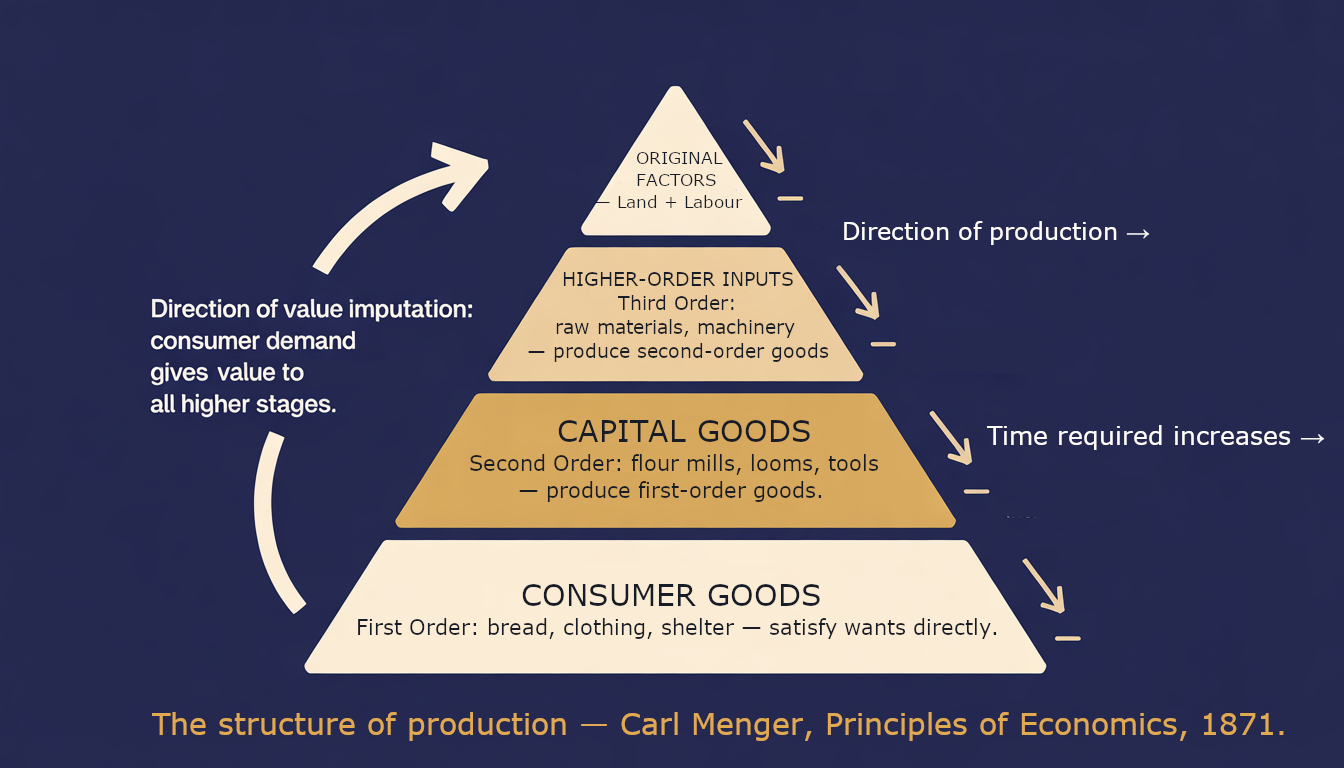
Menger's order of goods: value flows backward from consumer wants through every stage of production — the insight that grounded Austrian capital theory.
Core Concept — The Orders of Goods
Menger's foundational insight: goods exist in a causal order. Consumer goods satisfy needs directly (first order). Capital goods serve to produce consumer goods (higher orders). Value flows backward from consumer needs through the entire chain of production.
Human Need
Hunger, warmth, shelter…
satisfies
First-Order Goods
Bread · Coat · Medicine
Directly consumed to satisfy needs
produced by
Second-Order Goods
Flour · Cloth · Raw Materials
Inputs to produce first-order goods
produced by
Third-Order & Higher
Grain · Farmland · Capital · Labour
Remote causes; value derived from consumer goods
Key implication: The value of a flour mill depends on the value of flour, which depends on the value of bread, which depends on how urgently people want to eat. Capital goods are not independently valuable — their value is imputed backward from final consumption.
Core Concept — Marginal Utility
The value of any unit of a good equals the importance of the least important need it satisfies. As you acquire more units, each additional unit covers progressively less urgent needs.
| Unit | Need it serves (example: water) | Marginal value |
|---|---|---|
| 1st | Drinking — survival | 100 |
| 2nd | Cooking — daily meals | 80 |
| 3rd | Bathing — hygiene | 60 |
| 4th | Watering garden | 40 |
| 5th | Washing carriage← value = this | 20 |
The marginal principle: When you have 5 units of water, the value of each unit equals the 5th unit's value (washing the carriage) — because that is what you would lose if one unit disappeared. This is why abundant water is cheap and scarce diamonds are dear, despite water being more useful overall.
Core Concept — The Spontaneous Emergence of Money
No king, government, or social contract created money. Menger shows how individuals, seeking to trade more effectively, spontaneously converged on the most marketable goods as a medium of exchange.
Barter Economy
Each person must find someone who wants exactly what they have. The "double coincidence of wants" problem severely limits trade.
Highly Marketable Goods Emerge
Some goods (cattle, grain, precious metals) are easier to sell than others. Observant traders start accepting these goods even if they don't need them — because they can trade them later.
Network Effects Amplify the Trend
As more traders accept the highly marketable good, its marketability increases further. Rejecting it becomes costly. The process accelerates through self-reinforcing adoption.
Money
The most marketable commodity becomes universally accepted. No decree required — money is a spontaneous institution that emerges from individual self-interest.
Menger's conclusion: "Money is not an invention of the state. It is not the product of a legislative act, even though the state may endorse and regulate it. It is a social institution that arises from the economic interest of individuals."
Key Ideas
Subjective Value
Value is not inherent in objects but is a relation between goods and human needs. Two people can trade the same object at different valuations — both are correct.
Marginal Utility
A good's value equals the importance of the least urgent need it satisfies. Add one more unit and value falls — it now serves a less pressing need.
Orders of Goods
Capital goods derive their value from the consumer goods they produce. A flour mill's value depends on bread's value, which depends on human hunger.
Spontaneous Money
Money was not invented by authority or social contract. The most marketable goods naturally became money as individuals sought to reduce transaction costs.
Chapter Guide
The General Theory of the Good
pp. 51–76Four prerequisites of goods-character. The hierarchy of orders — bread is first-order, flour second, grain third. Goods derive their value from causal connection to human needs.
Economy and Economic Goods
pp. 77–113Scarcity creates economic goods; abundance creates non-economic goods. Economizing is the rational allocation of scarce means to ends. The origin of economy in scarcity.
The Theory of Value
pp. 114–174Subjective marginal utility. Value is the importance of the least significant satisfaction a good secures. Labour theory of value is refuted — cost follows value, not vice versa.
The Theory of Exchange
pp. 175–190Exchange occurs only when both parties gain. Limits of economically beneficial trade are set by subjective valuations. Mutual benefit, not exploitation, defines the market.
The Theory of Price
pp. 191–225Prices emerge from individual valuations under isolated exchange, monopoly, and bilateral competition. Prices are not set — they are discovered through the exchange process.
Use Value and Exchange Value
pp. 226–235Two forms of the same phenomenon. Use value: goods satisfy needs directly. Exchange value: goods obtain other goods through trade. Both are expressions of subjective importance.
The Theory of the Commodity
pp. 236–256Marketability (Absatzfähigkeit) — how easily a good can be sold at its full value. Goods vary enormously in saleability. This difference explains why some become money.
The Theory of Money
pp. 257–285The most marketable commodities become money through individual self-interest. No authority or social contract needed — money is a spontaneous market institution.
Why It Matters
Before Menger, economists explained value through the amount of labour embedded in a product. Ricardo and Marx built vast systems on this foundation. Menger demolished it in his first chapter: value originates in the subjective importance of human needs, not in objective production costs.
Simultaneously — and independently — William Stanley Jevons in England and Léon Walras in Switzerland reached similar conclusions about marginal utility. The "Marginal Revolution" of 1871 transformed economics. But where Jevons and Walras expressed their theories mathematically, Menger remained resolutely verbal and causal — a choice that shaped the entire Austrian tradition.
The implications remain radical today: prices are not set by costs, wages are not set by labour, and money was not created by government. All are spontaneous market outcomes. Menger's framework gave subsequent Austrians — Böhm-Bawerk, Mises, Hayek — the foundation for capital theory, business cycle theory, and the critique of central planning.