

Being Early Is Being Wrong
The framework's substrate-fragility diagnosis has been directionally true since 1971. A saver who acted on it by holding physical gold from 1980 to 2000 would have watched their hedge's real value fall by roughly three-quarters. Being right and being punished are not incompatible under substitute-layer conditions. This week the framework launched a new series — Stress-Testing the Framework — to subject its own conclusions to the same rigor it has applied to UBI, CBDC, and capital destruction. The three installments arrive with the Warsh FOMC's first unified three-way dissent since 2016, the yield curve repricing Fed credibility rather than policy, and the launch of a new podcast whose first episode scores a framework call as partially wrong. The catalog is applying its own standards to itself.
Full analysis: newaustrianeconomics.com/forum/42-being-early-is-being-wrong-calibration-problem
Welcome to Issue #015 of The Dispatch. Each Monday, this letter takes one situation from the week's news and reads it through the lens of Carl Menger and Antal Fekete — paired with a foundational concept, the dashboard, the framework's prediction record, and a piece from the archive. This issue is being delivered a few days late; the volume of catalog activity this week required careful engagement rather than a rushed dispatch. The next issue will resume the Monday cadence. If someone forwarded this to you, subscribe here.
The Lens
The framework's substrate-fragility diagnosis has been directionally true since August 15, 1971. That is not a controversial claim within the catalog. Every prior essay in the Watching the Cracks series, every Golden Triangle installment, every Fekete-derived reading of the post-1971 monetary architecture rests on it.
A saver who acted on that diagnosis by holding physical gold from 1980 to 2000 would have watched the real value of their hedge fall by roughly three-quarters — a cumulative purchasing-power decline that no reasonable household portfolio can absorb as a 20-year unrealized loss. Being right about the underlying condition and being financially punished for acting on the correct diagnosis are not incompatible under substitute-layer conditions. They are the specific empirical pattern the framework's own records show across the 55-year window since Bretton Woods collapsed.
This week the framework did something distinctive. It launched a new series — Stress-Testing the Framework — to subject its own conclusions to the same evidentiary standard it has applied to UBI, CBDC, and capital destruction across the catalog's prior forty-one Forum essays. The first installment (Forum #42) develops the calibration problem with real numbers: five historical windows from 1971 to 2026, a worked sensitivity analysis of the actual cost of a hard-asset hedge across a range of allocation sizes during the worst window (1980–2000), an honest test of whether disciplined rebalancing or technical analysis can reduce the calibration cost (the answer, argued carefully, is more negative than the framework has previously acknowledged), and a first attempt at treating hedge sizing as an actuarial problem rather than as an assertion of a percentage range.
The Stress-Testing series is not a retraction of the framework's structural diagnosis. It is a specific and honest engagement with the gap between diagnosis and prescription that the diagnosis alone cannot close.
Alongside the series, three additional major events landed this week. The July 28–29 Warsh FOMC produced a 9–3 vote with the first unified three-way dissent since September 2016 — Hammack, Kashkari, and Logan all favoring +25bp — and the market repriced Fed credibility rather than policy (the 2-year yield fell 4bp, the 10-year rose 5bp, and the 30-year hit a 19-year high on the same afternoon; the Dow closed 1,100 points lower). The catalog launched The Framework's Reading, a new podcast whose Episode #001 — The Credibility Repricing — scores three prior framework calls including one it got partially wrong. And the Fekete archive corpus completed a massive systematic restoration from source PDFs — 189 articles restored, 37 more restored, and the last 21 hand-finished. Roughly 247 articles in total.
The catalog is applying its own standards to itself, publicly, on the record. That is the story.
Lead Essay: The Calibration Problem
The framework's central Fekete-derived observation is that a saver operating under post-1971 conditions faces a monetary substrate that depreciates by design. The framework's central prescription has been a meaningful hard-asset allocation — Forum #37's 5–25% range in the Saver's Choice Architecture — as diversification against substrate-condition failure. The calibration problem is that gold's real value does not track the substrate diagnosis. It tracks something else.
Real interest rates. The framework's honest empirical finding, developed in detail in Forum #42, is that gold's real value across the 1971–2026 window has moved in wide multi-decade cycles substantially driven by a single well-documented variable — the real (inflation-adjusted) yield on U.S. Treasury securities. Gold's real value rose sharply from 1971 to 1980 as real rates went deeply negative. It fell sharply from 1980 to 2000 as Paul Volcker restored positive real rates. It rose sharply from 2000 to 2011 as real rates fell again. It stagnated from 2011 to 2018. It rose sharply from 2018 through the peak in January 2026. Each of these cycles is a coherent function of real rates, and none of them corresponds cleanly to changes in the framework's underlying diagnosis of substrate soundness, which was directionally the same across all five windows.
The 1980–2000 window is the honest test. A saver who took the framework's substrate-fragility diagnosis seriously in 1980 and allocated 25% to physical gold would have carried an unrealized loss on that 25% allocation of roughly 75% real value across two decades. In dollar terms, a $100,000 allocation to gold at the 1980 peak would have been worth approximately $25,000 in 2000-dollar purchasing power at the trough. Rebalancing back to 25% along the way would have compounded the loss rather than reduced it, because the entire 20-year window was one continuous drawdown from the standpoint of the specific instrument the framework identifies as the hedge. A disciplined rebalancer would have added to a losing position for two decades.
The framework's honest engagement with this history requires two moves. First, name the variable that actually drives the specific instrument's real value — the real interest rate — and acknowledge that the framework's own diagnostic apparatus does not predict this variable. The framework can identify when substrate soundness is decaying (it always is, under substitute-layer conditions); the framework cannot predict when the central bank will suppress or restore real rates, which is what the specific hedge actually responds to. Second, treat hedge sizing as an actuarial problem rather than as an assertion of a percentage. An insurance company writing a policy against a low-probability, high-severity risk does not size the policy at 25% of the insured's net worth. It sizes it at whatever the insured can afford to lose across the payment horizon of the policy without material impact on their other objectives. The framework's revised principle: an allocation to physical gold should be sized such that its worst historically-observed 20-year real drawdown (roughly 75%) is a tolerable loss to the overall portfolio, not a portfolio-destroying event. For most households that reduces the allocation range materially below the 25% upper bound in Forum #37's original architecture.
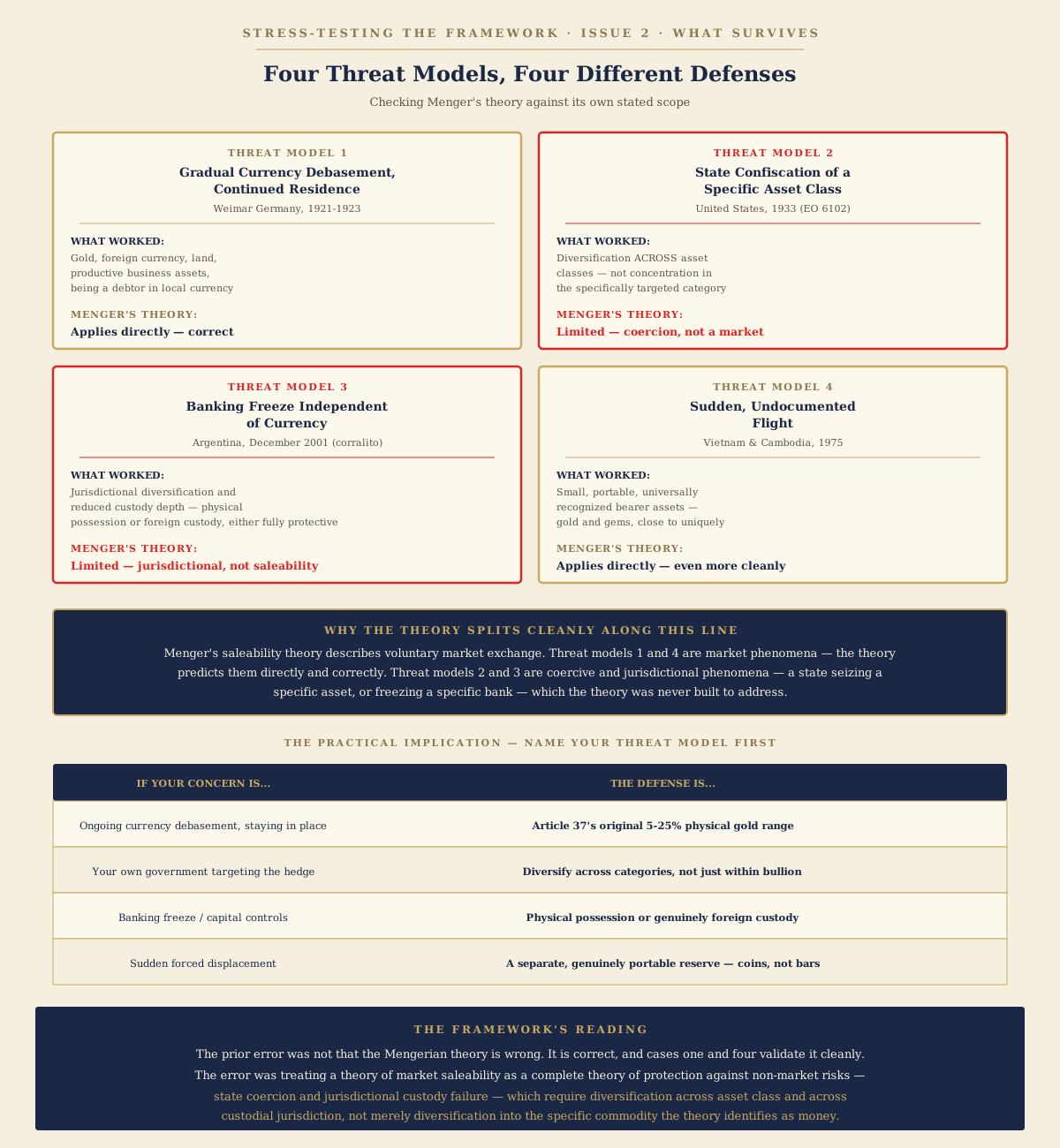
The second Stress-Testing installment (Forum #43) tests the diagnostic-to-prescriptive move directly. Four documented historical cases: Weimar hyperinflation (1921–1923), U.S. gold confiscation via EO 6102 (1933), the Argentine corralito (2001), and the sudden undocumented flight of refugees from Vietnam and Cambodia (1975). Gold cleanly preserves wealth in only one of the four scenarios — sudden undocumented flight, where portability is the dominant variable. The other three require different defenses: diversification across asset class (against state confiscation), diversification across custodial jurisdiction (against banking freeze independent of currency), and gold alongside land, foreign currency, and productive business assets (against gradual debasement with continued residence).
The third installment (Forum #44) closes the arc by generalizing Forum #37's ninth principle. The universal failure mode across every wealth-destruction scenario the framework has documented is being a forced seller — of anything, at any price, at any moment. Three conditions produce it: leverage, illiquidity, and an unavoidable liquidity need. The academic evidence is rigorous on both sides. Campbell, Giglio, and Pathak (2011, American Economic Review) documented that foreclosure sales occur at an average 27% discount to fair market value across two decades of Massachusetts housing transactions. Jacobson, LaLonde, and Sullivan (1993, American Economic Review) documented that displaced manufacturing workers experience long-term earnings losses averaging 25% per year, persisting for years after displacement. Two academic literatures that do not cite each other, measuring what appears to be the same mechanism in different domains, converging within two percentage points. The framework's synthesis: portfolio risk and career risk are not analogous. They are the same mechanism operating in two different assets.
The three Stress-Testing installments together do something the framework has not previously done at this scale: they apply the framework's evidentiary standards to the framework's own conclusions and revise where the honest reading of the evidence requires revision.
→ Read the series: Forum #42 — Being Early Is Being Wrong · Forum #43 — What Survives · Forum #44 — The Forced Seller
Concept in Focus: The Calibration Problem
The framework has long distinguished between the diagnosis of substrate condition and the prescription of what an individual saver should hold. The distinction has been implicit across the catalog but not developed with the rigor Forum #42 now applies. The Calibration Problem is the specific analytical apparatus for engaging that distinction honestly.
The diagnosis identifies structural conditions that persist across time — the post-1971 substitute-layer environment, the Golden Triangle's absence, the substitute-layer accumulation the Watching the Cracks series has documented across the catalog. These conditions are always present under fiat monetary architecture and do not oscillate with the interest-rate cycle. The framework's diagnostic apparatus reads them correctly at every point in the 55-year window.
The prescription — the specific instrument recommended as the hedge against the diagnosed condition — is a different analytical claim. It requires identifying a specific asset whose behavior correlates cleanly with the diagnosed variable. Gold's historical role as the monetary anchor under the pre-1914 architecture, and its retention as a monetary asset held on central bank balance sheets in 2026, are structural facts. But gold's short-term real-value trajectory is driven by real interest rates, which are a policy variable the framework's diagnostic apparatus does not predict. The instrument responds to a variable that the diagnostic apparatus does not read.
The calibration cost of this mismatch is measurable. A 25% allocation to gold at the 1980 peak would have destroyed roughly $19,000 of real purchasing power on each $100,000 allocated across the 1980–2000 window. A saver who held that allocation through the drawdown would have received essentially no compensation for two decades of correct diagnosis. The framework's revised principle is that hedge sizing must be bounded by tolerable worst-case cost, sized like an insurance policy against a low-probability high-severity event rather than as an assertion of a percentage range that a household simply "should" hold.
The Atlas page on The Theory of Interest covers the real-rate framework the calibration problem operates within.
The Dashboard
Snapshot from the live toolkit dashboard as of August 4, 2026. The composite has moved from "moderate elevation" to "acute stress" in a single week.
- Mengerian Stress Index (composite) — 3.22 / acute stress (↑ sharply from 1.69 at Issue #014). The regime has moved up two full labels in one week. Primary drivers: CCB more than doubling and the gold basis widening substantially. RHD remains at its persistent +3.96σ. OTROFF is one of four operational components (ENV still missing). → /toolkit/mengerian-stress-index
- FX Cross-Currency Basis — 175 bps mean absolute deviation (↑ from 82 bps at Issue #014 — more than doubled in a week). The largest single-week move in this metric since the framework began tracking it. Dollar-liquidity stress has returned sharply, coinciding with the post-FOMC yield-curve repricing and the deepening Hormuz disruption. Z-score is back well above the framework's +5 cap. → /toolkit/cross-currency-basis
- Gold Basis (decontaminated) — +1.49% contango — live spot $4,079, COMEX /GCQ26 August front-month $4,088.10, basis +$59.95 (↑ from +0.54% at Issue #014; nearly tripled). The widening contango reflects the futures curve pricing in a substantially higher forward gold price than spot — consistent with the yield-curve repricing where the 30-year Treasury just hit a 19-year high. Weiner-style cobasis: −0.37%. → /toolkit/gold-basis
- Silver/Gold Ratio — 69.19 — gold $4,134.20, silver $59.75 (silver up modestly from $58.70 at Issue #014). Ratio essentially unchanged at the long-run norm of ~70. Both metals are trading in a narrow band relative to prior months. → /toolkit/silver-gold-ratio
- OTROFF (10Y On/Off-the-Run Treasury Spread) — refreshed with the July 23 auction as the new on-the-run note (CUSIP 91282CRE3). The new on-the-run's low coupon (2.375%) against the seasoned off-the-run's 4.375% coupon produces an unusual coupon differential that requires careful interpretation before comparing to prior weeks. The framework's engineering team is engaging the calculation; readers should consult the toolkit page for the current authoritative reading rather than relying on this snapshot. → /toolkit/otroff-spread
The framework's reading of the week's movements: the composite jumped from moderate elevation to acute stress in seven days, driven by the CCB spike and the gold-basis widening. The Warsh FOMC dissent and the 30-year yield's move to a 19-year high on July 30 are the specific institutional events behind the shift. The market is repricing Fed credibility. Dollar-clearance markets and precious-metals substrate markets are the two channels registering that repricing first.
The Scorecard
Multiple prior framework predictions have entered resolution windows this week.
Forum #32 Warsh institutional pivot — CONFIRMED and strengthening. The July 28–29 FOMC produced a 9–3 vote — the fifth consecutive pause, the longest since the 2008 cycle — with the first unified three-way dissent since September 2016. Hammack (Cleveland), Kashkari (Minneapolis), and Logan (Dallas) all favored a +25bp move. Warsh characterized the three-way dissent as "a designed feature" rather than a communication problem. Statement length remains disciplined. The framework's June recorded prediction that the pivot would hold through at least September and October is on track; the July meeting is the first substantive durability test and the pivot passed it.
The June 17 "institutional pivot" reading — PARTIAL, and honestly scored. The framework's Forum #36 analysis treated Warsh's first FOMC (June 17) and the Trump–Pezeshkian MOU (same day) as evidence of a shared institutional pivot. The Fed half was correct and is now strengthening. The executive-branch half was wrong and was repudiated within 21 days: Trump called the deal a waste of time at the NATO summit in Ankara on July 8; Treasury rescinded the crude waiver the same day. The framework's error had a specific name: treating two events sharing a date as evidence of a shared underlying cause. The Framework's Reading Episode #001 scores this call publicly, on the record.
Forum #34 China physical clearing architecture — CONFIRMED. The ICBC retail paper-gold deadline passed on schedule July 24. The framework's May 2026 recorded prediction is operationally confirmed at the retail level.
Forum #16 banking diagnostics — baseline continues to exceed. Farmers State Bank of Oakley, Kansas (July 17) remains the framework's most recent bank-failure resolution. Total 2026 U.S. bank failures: 4. Q2 FDIC Quarterly Banking Profile releases mid-August; the framework's next major reading.
Forum #26 Hormuz lag — the July CPI print (August 12) is the next major resolution test. The June print was below the framework's Q3 4.5–5.5% predicted band at 3.5%, explained by the MOU-enabled brief energy compression. The MOU has now been operationally revoked. The July print will determine whether June was a one-window compression or requires framework calibration revision.
New from Forum #42–44: the framework now records additional predictions calibrated to the honest engagement with its own diagnosis-to-prescription gap. Hedge sizing bounded by tolerable 20-year worst-case cost; four-threat-model framing for wealth preservation; forced-seller conditions (leverage + illiquidity + unavoidable liquidity need) as the universal failure mode across portfolios and careers. Full details on the /scorecard.
The Actionable
The framework's operational observations calibrated to this week's Stress-Testing engagement and the FOMC dissent:
- Name your threat model first. Forum #43's quadrant analysis makes the prior question explicit: what specific collapse scenario are you defending against? Gradual debasement, state confiscation, banking freeze independent of currency, or sudden undocumented flight — each requires a different defense, and only one has gold as the clean answer. Household planning should specify the threat model before selecting instruments.
- Size hedges by tolerable worst-case cost, not by percentage range. The Forum #37 architecture's 5–25% range remains defensible as a bound, but the specific allocation within that range should be sized such that a 75% real drawdown across a 20-year window is a tolerable loss to the overall portfolio — not a portfolio-destroying event. For most households, that reduces the allocation materially below the upper bound.
- The forced-seller framework applies to careers as much as portfolios. Reducing leverage, maintaining liquidity, and preserving skill breadth are the same defense against career-side wealth destruction that they are against portfolio-side wealth destruction. Forum #44 develops the parallel with academic evidence on both sides.
- Watch the July CPI print August 12 and the Q2 FDIC QBP mid-August. Two near-term resolution events on the framework's ledger. The July CPI will test whether June's below-band print was MOU-driven or requires broader recalibration. The Q2 QBP tests the banking-diagnostics prediction record now that the 2026 failure count has exceeded the 2024–2025 baseline.
- The Framework's Reading Episode #001 is available. ~12:50 runtime, the framework's on-the-record scoring of the June 17 pivot and the July 28–29 FOMC. Subscribe via the RSS feed at /reading.
Educational content only — not investment advice.
From the Archive
"The marginal productivity of debt has been diminishing at a rapid clip. The extra debt is not creating the extra output it used to create... The additional new debt is destructive of capital, not constructive. The economy is not investing this new debt. It is consuming it."
— Antal Fekete, The Marginal Productivity of Debt (2006)
Fekete's 2006 essay developed the concept of the marginal productivity of debt — the observation that each successive dollar of new debt added to the economy produces less additional output than the last, until the marginal dollar produces zero or negative output. At that point, additional borrowing is purely destructive — yet the monetary system compels it by continuously suppressing interest rates. This is the mechanism Forum #41 traces from a different angle through Fekete's Law of Liabilities: the same falling-rate regime that appears (in mainstream accounts) to be the "cheapest cost of capital in the history of finance" is silently destroying capital through the accounting asymmetry that hides the destruction. Both essays engage the same substrate condition. Both are honest about the fact that the framework's diagnosis of capital destruction has been continuously correct since 1971 — and about the specific mechanisms by which the destruction accumulates. The Stress-Testing series then applies the same standard to the framework's prescription rather than to its diagnosis, and finds calibration revision required. Fekete's original diagnostic work does not require revision. The framework's application of that work to household portfolios did.
→ Read the full essay in the Fekete Archive
Also This Week
- The Framework's Reading — podcast launched. Episode #001 — The Credibility Repricing is now live. ~12:50 runtime, recorded July 30 after the FOMC decision. The framework's first audio publication. Every prior Forum essay and every prior Dispatch issue now has audio available through the streaming player. RSS feeds are live. New episodes on a biweekly cadence with scored calls each installment.
- Forum #41 — The Bookkeeper's Dilemma: How Falling Interest Rates Destroy Capital, and Why the Accounting Cannot See It — Series One Extension #4. Fekete's Law of Liabilities as the specular twin of the Law of Assets. Traces the 1914 origin of the accounting asymmetry and its one surviving correct implementation in modern pension accounting. Distinguishes carefully from Austrian Business Cycle Theory. The 30-year yield's move to a 19-year high on July 30 is a specific empirical instance of the falling-rate-to-rising-rate transition Forum #41 traces.
- Fekete archive corpus reconstruction complete. ~247 articles restored from source PDFs across the week — 189 restored, 37 additionally restored, and the last 21 hand-finished against the original PDFs. The Fekete archive at /archive/fekete is now the most complete and correct implementation of the primary source material available anywhere online.
- Diagrams page reordered latest-first at /diagrams. Six new diagrams from the Stress-Testing series will be added shortly to the Forum section, including the four-threat-models figure this issue embeds.
- Atlas: The Theory of Interest — the real-rate apparatus underneath the Calibration Problem and Forum #41's Law of Liabilities.