
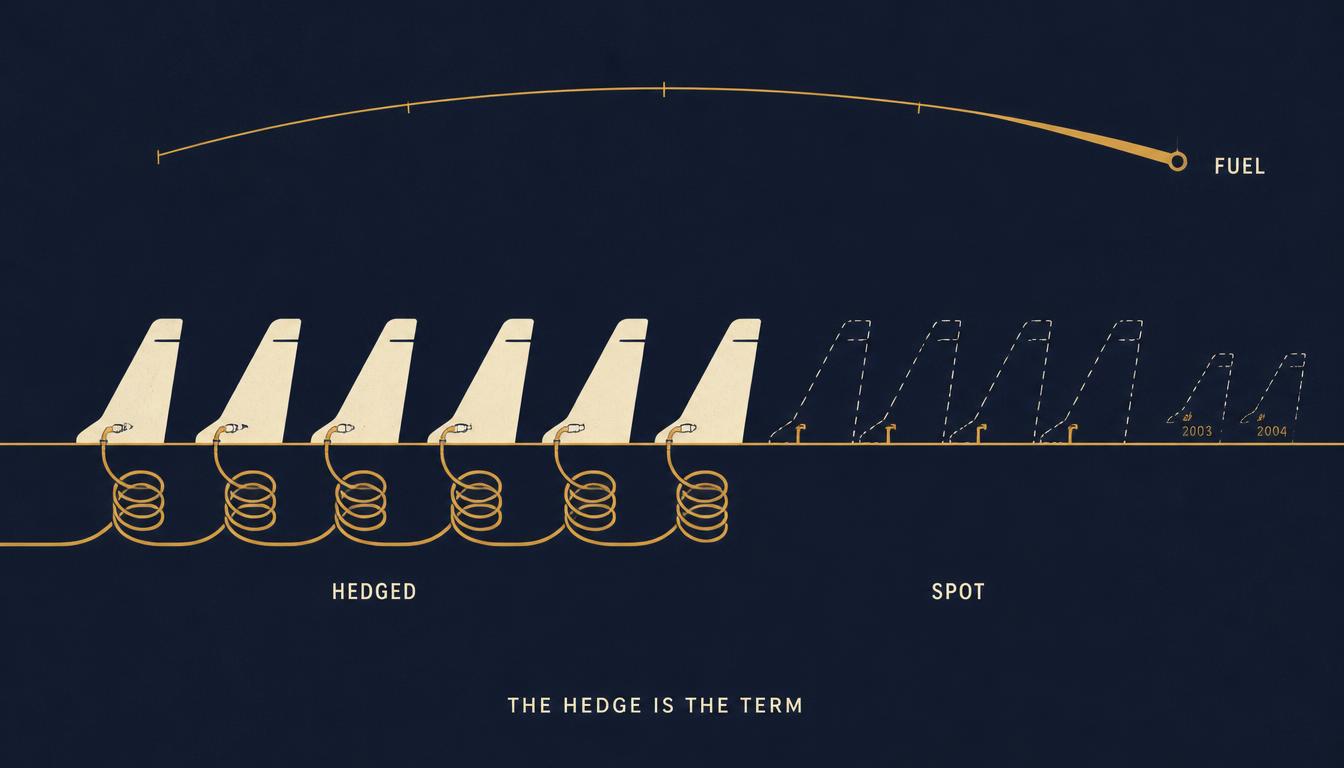
The Shortest Contract
Six months after Spirit Airlines liquidated, the reading Article 35 offered while the failure cluster was still accumulating — that the Hormuz lag had arrived at the airline profit and loss statement and that fuel was the mechanism — is now the consensus explanation, stated without hedging across the trade press. Article 63 scores it as correct and declines to inflate it: fuel is among the largest cost lines in an airline's structure, the crude move was public, and the transmission lag is short. The development that matters more is structural. At least eight further carriers have failed since, including Flybondi, the second-largest airline in Argentina, whose domestic traffic fell from 254,533 passengers in August 2025 to 1,865 in August 2026. But the cluster did not merely remove firms. It removed a competitive category: five low-cost carriers now remain in the United States, Southwest and JetBlue have both migrated to hybrid models, and the precedent — Delta's Song and United's Ted, both shut down within several years of an earlier fuel spike — is exact. The sorting mechanism is the one Article 62 identified in two national housing markets under one rate structure. Exposure to a cost shock is determined by the duration of the obligation that absorbs it. For a household that is the mortgage term. For an airline it is the fuel hedge. The carriers that died were the ones whose largest volatile input repriced continuously, which is a structural property of the ultra-low-cost model rather than a failure of management.
Full analysis: newaustrianeconomics.com/forum/63-the-category-that-was-removed
Welcome to Issue #021 of The Dispatch. Each Monday, this letter takes one situation from the week's news and reads it through the lens of Carl Menger and Antal Fekete — paired with a foundational concept, the dashboard, the framework's prediction record, and a piece from the archive. If someone forwarded this to you, subscribe here.
The Lens
A fuel shock did not damage an industry evenly. It deleted the part of the industry whose contracts were shortest.
On July 5, 2026, two months after Spirit Airlines ceased operations and while the global failure cluster was still accumulating, this catalog argued that the Hormuz lag documented in Article 26 had arrived at the airline profit and loss statement, and that fuel was the operative mechanism.
Six months on, that is the consensus explanation. The director general of the International Air Transport Association said publicly that he expected some airlines to go out of business and others to be acquired, and that Spirit would not be the last. Jet fuel prices have more than doubled since the beginning of the war with Iran. The twenty-two scheduled United States passenger airlines lost a combined $966 million after taxes in the first quarter, and the global industry nearly halved its 2026 profit forecast.
Article 63 scores the call as correct and then does something the framework considers more important than scoring: it declines to inflate it.
The claim was not difficult. Fuel is typically the largest or second-largest line item in an airline's cost structure, the oil move was public, and the lag between a crude price spike and its arrival in a carrier's financials is short and well understood.
What the original essay added, and what the trade coverage still does not, is the connection to the substrate argument. That connection is where this week's analysis actually lives.
Lead Essay: The Category That Was Removed
Start with what has failed since. Article 35 documented Spirit plus nine failures across eight further jurisdictions through late June. The list has grown, and one addition is near-total.
Flybondi, founded in 2016 and grown into the second-largest airline in Argentina after the state-owned flag carrier, suspended all flight operations on August 6, 2026 amid frozen bank accounts and grounded aircraft. On October 2 it filed for creditor protection against liabilities of roughly $120 million. The contraction is visible in a single comparison: in August 2025 it carried 254,533 domestic passengers, a 17 percent market share; in August 2026 it carried 1,865, a share of 0.1 percent. Ten aircraft went back to lessors and the three remaining in the country were inoperative.
Alongside it: Jetflite (Finland) shut down at the start of July. Zenith Airlines (United Kingdom) had its operating certificate suspended, leaving all 41 staff unemployed. OMNI Aviação (Portugal) entered insolvency. Fischer Air (Germany) is insolvent and has become a criminal matter, with the Hamburg public prosecutor charging the airline's chief over flights sold and repeatedly postponed. BeOnd (Maldives), Jet It (United States) and Air Antilles (France) are gone. Running alongside the insolvencies is a parallel wave of operating certificate revocations across six further operators.
The composition confirms the original reading of the cluster's shape: concentrated in charter, regional, low-cost and private aviation, and spanning jurisdictions, currencies and regulatory regimes simultaneously.
But the additive story is not the finding. The structural one is.
The cluster did not just remove firms. It removed a competitive category.
Five low-cost carriers now remain in the United States: Frontier, Allegiant Air, Breeze Airways, Sun Country Airlines and Avelo Air. Southwest and JetBlue — once the leading American low-cost carriers — have both migrated to hybrid models positioned between a low-cost carrier and a traditional airline.
And the competitive consequence is being stated openly. A former airline captain quoted in the reporting notes that legacy carriers learned a set of defensive strategies against the low-cost segment: price-matching, and the introduction of basic economy fares.
The precedent is exact and within living memory of the people running these companies. Delta launched Song in 2003 and United created Ted in 2004, both as responses to low-cost competition. Both failed to gain traction and were shut down within several years after fuel prices spiked.
Then the essay names the sorting mechanism, and borrows it from an entirely different market.
Article 62, published the same week, examined two housing markets under the same rising rate structure and found stress sorting by completely different variables. In Canada, where mortgage terms are commonly five years, the liability reprices at renewal and stress follows balance size — which is why court-ordered listings moved up-market into West Vancouver and Vancouver's West Side, inverting the 2008 pattern. In the United States, where the thirty-year fixed insulates the borrower entirely, stress sorted by equity instead: FHA-insured mortgages carry a delinquency rate of 11.79 percent against 2.72 percent for conventional loans within the Mortgage Bankers Association's survey.
Airlines face the identical structure, on the input side rather than the financing side.
The hedge is the term.
A carrier with substantial forward fuel hedging holds, in effect, a fixed-price obligation for a defined term, and a crude spike does not reach it until the hedges roll. A carrier without hedging reprices continuously, at spot, on every tank.
And the ultra-low-cost model is structurally the least able to hold one. It competes on fare, which compresses margin and leaves little cash to post as collateral against hedging positions. It runs a thinner balance sheet, which raises the cost of the counterparty credit a hedge program requires. It has less pricing power to pass costs through, because the passenger it attracts is the one who chose on price. Every one of those properties is the model working as designed — and together they mean it carries the shortest possible duration against its largest volatile input.
The industry reporting arrives at the same place from the revenue side: budget carriers absorbed the sharpest hit precisely because they lack the higher-margin streams larger airlines use to offset rising costs — premium cabins, high-yield business travelers, credit card loyalty programs. A legacy carrier facing a fuel spike has somewhere else to earn. An ultra-low-cost carrier has the fare, and the fare is what it competes on.
→ Read the full analysis: The Category That Was Removed: Scoring the Airline Cluster Six Months On — The Forum
Concept in Focus: Duration as Discretion
The framework's interest in contract length is not a matter of risk management. Duration is stored discretion. A long contract is an interval during which the holder decides; a continuously repricing one is an interval of zero, in which the market decides and the holder complies.
Read that way, four of this catalog's recent essays are describing one variable.
Article 62 found that a Canadian borrower on a five-year term and an American borrower on a thirty-year fixed face the same rate structure and experience entirely different events, because one has discretion for five years and the other for thirty. Article 63 finds that the carriers which died held zero duration against the input that moved.
And Article 61 finds the same variable in a place nobody is looking for it. That essay — which closes The Distribution Question series — sets three proposals side by side and asks the question none of the coverage asks, which is what the recipient actually ends up holding.
| What is received | What the recipient controls | |
|---|---|---|
| Universal basic income | Currency | Use, subject to programmability |
| Coasean labor-access right | A tradeable permit | Sale timing, under forced-seller conditions |
| Universal basic capital, fund structure | A beneficiary interest | Nothing; no instrument is held |
| Universal basic capital, individual shares | Equity | Nothing for up to seventeen years |
Following Anthropic's commitment of five percent of its equity to a public benefit fund, and Musk's response that he would instead give shares directly to the public, commentary reached for the label universal basic capital. The structure contemplated runs through the Trump Accounts that Article 60 examined, under temporary Treasury regulations issued September 30, 2026 creating a category called the qualified stock contribution. Under those terms the family cannot refuse the gift, and the shares cannot be sold before the earlier of five years or the end of the year in which the beneficiary turns seventeen.
An attorney and former national fraud counsel at the Internal Revenue Service located what is unusual: in charitable giving the receiving trustee normally retains final authority, whereas here it is "the donor that's dictating the terms of the gift."
Three proposals, advanced by people who disagree with each other, converge on giving the recipient something he does not direct.
The framework asserts no coordination, and each proposal reaches the outcome for its own defensible reason. The composite is the point. An airline with no hedge and a child with a seventeen-year lockup are the same object viewed from opposite ends — one holds too little duration to survive a shock, the other holds so much that the holding is no longer his. Discretion is what both lack, and discretion is the variable this catalog has repeatedly identified as the thing distinguishing a price from a number and an owner from a beneficiary.
The Atlas page on the Structure of Production covers the apparatus underneath: production is an arrangement in time, and the length of the contracts holding it together determines what a shock does to it.
The Dashboard
Readings from the live toolkit as of October 28, 2026.
- Gold Basis — +3.04% annualized at constant 90-day maturity, spot $4,061.41. Contango, mid-range. Priced for carry. → /toolkit/gold-basis
- Silver Basis — +2.57% annualized, spot $54.47. Contango, and narrower than last week's +3.48%. → /toolkit/silver-basis
- Silver / Gold Ratio — 74.74, against 71.25 a week ago. Silver has given back the recovery and then some. The ratio has now run 67.8 to 74.0 to 71.3 to 74.7 across four weeks. → /toolkit/silver-gold-ratio
- Cross-Currency Basis — 17.5 bps mean absolute across four pairs. EUR/USD +5.0, GBP/USD +22.8, USD/CHF −21.7, USD/JPY −20.5. Marginally tighter than last week's 19.0. → /toolkit/cross-currency-basis
- ETF NAV Deviation — 21.1 bps panel aggregate across six bond funds. The one component that has moved. The panel averaged 5 to 6 bps in early September. → /toolkit/etf-nav-deviation
- OTROFF (10Y On/Off-the-Run Treasury Spread) — +0.90 bps, maturity-adjusted. An unremarkable premium for the most-current issue. → /toolkit/otroff-spread
- COMEX Deliveries — 513 contracts stopped on October 27 across four contracts. → /toolkit/comex-paper-physical
The framework's reading: the metals are quiet and the bond funds are not. Both precious-metal curves remain in ordinary contango, and silver's fall against gold continues to read as price rather than scarcity — a scarcity event would show in the basis before it showed in the ratio, and it has not. Silver's carry has narrowed two weeks running, which is the thing to watch rather than the thing to report.
The ETF NAV deviation panel is the component worth attention. A bond fund trading away from its basket is a direct measure of how costly it is to move the underlying, and the panel aggregate has roughly tripled since early September while every other instrument on the board sat still. That is a liquidity reading, not a price reading, and it is the kind that precedes rather than follows.
The Scorecard
Article 63 puts four new dated tests on the ledger, and states what would falsify the argument rather than only what would confirm it.
- Whether capital funds a new United States ultra-low-cost entrant in the next two to three years. Breeze and Avelo were both founded in the last decade; the question is whether that remains possible after Spirit. A well-capitalized entrant that gains traction would mean the category was vacated rather than removed, and the structural reading would be wrong.
- Whether the surviving five hedge their way through sustained high fuel. Frontier, Allegiant, Breeze, Sun Country and Avelo face the same constraint Spirit did. Their survival through an extended period of elevated crude would indicate hedging capacity binds less than the essay claims.
- Whether fares rise on former Spirit routes relative to routes where an ultra-low-cost carrier remains. The concentration claim has a price implication, and the framework notes it has not measured it.
- Whether the certificate revocation wave continues. A regulator withdrawing an operating certificate on financial grounds is making a forward solvency judgment rather than recording a completed failure.
The framework also records what would not falsify the argument: further airline failures. Additional insolvencies are consistent with it and do not distinguish it from alternatives.
Forum #55's nearest dated test is eight weeks out. December 24, 2026 is a hard obligation on all twenty-seven EU member states to provide at least one certified European Digital Identity Wallet, under Article 5a(1) of Regulation (EU) 2024/1183.
Forum #16 banking diagnostics — the count holds at 6. No new U.S. bank failure. Six for 2026 against two in each of 2024 and 2025.
Next major resolutions on the ledger: the EUDI Wallet deadline on December 24; the digital euro pilot development phase, running through 2027; and the Q3 FDIC Quarterly Banking Profile.
The Actionable
The framework's operational observations calibrated to Forum #63:
- Ask what repricing interval you are carrying, not what price you are paying. Two operators facing an identical cost shock experience different events depending on how long their contracts hold. The question is not whether an input is expensive but how soon it can become expensive without consent.
- A failure cluster's lasting effect is the concentration, not the failures. The firms that died were the ones whose cost structure repriced; the firms that survived were disproportionately the better-capitalized incumbents the low-cost segment existed to discipline. Count what remains, not what went.
- A shock removes categories, and categories do not reconstitute on their own. The ultra-low-cost carrier was the instrument through which air travel became accessible to people for whom the legacy fare was prohibitive. Its removal is not a price change but a reduction in the set of transactions available — a saleability question on the consumer side, and the kind that rarely appears in a price index at all.
- Scoring a correct call honestly includes saying when it was easy. The fuel attribution was a correct application of an established mechanism, not a non-obvious forecast. Article 50 set the practice of scoring calls on the terms they were made; a record that inflates its wins is not a record.
Educational content only — not investment advice.
From the Archive
"It should be crystal clear that the regime of falling interest rates erodes and ultimately destroys intangible capital. Conversely, the regime of rising interest rates erodes and ultimately destroys tangible capital such as plant and equipment of producing firms, as they are rendered submarginal."
— Antal Fekete, Destruction of Capital, Economic Resonance, Hyperdeflation (2013)
Fekete is describing interest rates rather than fuel, and the distinction matters less than it appears. His mechanism is that a change in the cost structure does not reduce output proportionally — it renders specific firms submarginal and removes them, and which firms those are is determined by what they are holding when the structure moves.
That is the airline cluster exactly. A sector did not shrink by a percentage. A category within it was rendered submarginal and deleted, and the survivors inherited its customers. It is also Article 62 exactly, in the market Fekete names: a rising rate structure working through plant and equipment, which for a household is the house.
The passage is worth reading beside this week's lead because Fekete insists the destruction is real even when no accounting entry records it. A fleet returned to its lessors is visible. A category that can no longer be financed is not, and the second is the larger loss.
→ Read the full essay in the Fekete Archive
Also This Week
- Forum #62 — The Term Is the Variable supplies the argument this week's lead borrows, in the market where it is easiest to see. Court-ordered listings across Greater Vancouver and the Fraser Valley reached 946 between January and September 2026, a ten-year high against 773 for all of 2025 — and the detail that breaks the 2008 template is that the listings moved up-market. The essay also argues that the lock-in effect freezing American inventory is Fekete's Law of Liabilities being priced by millions of households that no accounting standard requires to record it.
- Forum #60 — The Account Your Child Did Not Open works through the statute underneath the universal basic capital discussion. Section 70204 of the One Big Beautiful Bill Act created Internal Revenue Code section 530A; every United States citizen born between January 1, 2025 and December 31, 2028 is eligible for a one-time federal contribution of one thousand dollars, which must be invested in a fund tracking the S&P 500 or a comparable broad index — no sector funds, no individual securities, no self-directed alternative. The essay's position is that there is no unconstrained vehicle, the choice is among constraints, and the right method is to name the threat model before selecting the instrument.
- The Divide continues under Learn, with six contested questions traced through primary texts. What Is Money? remains the natural entry point.
- Atlas: Structure of Production — production as an arrangement in time, and why the length of the contracts holding it together determines what a shock does to it.