
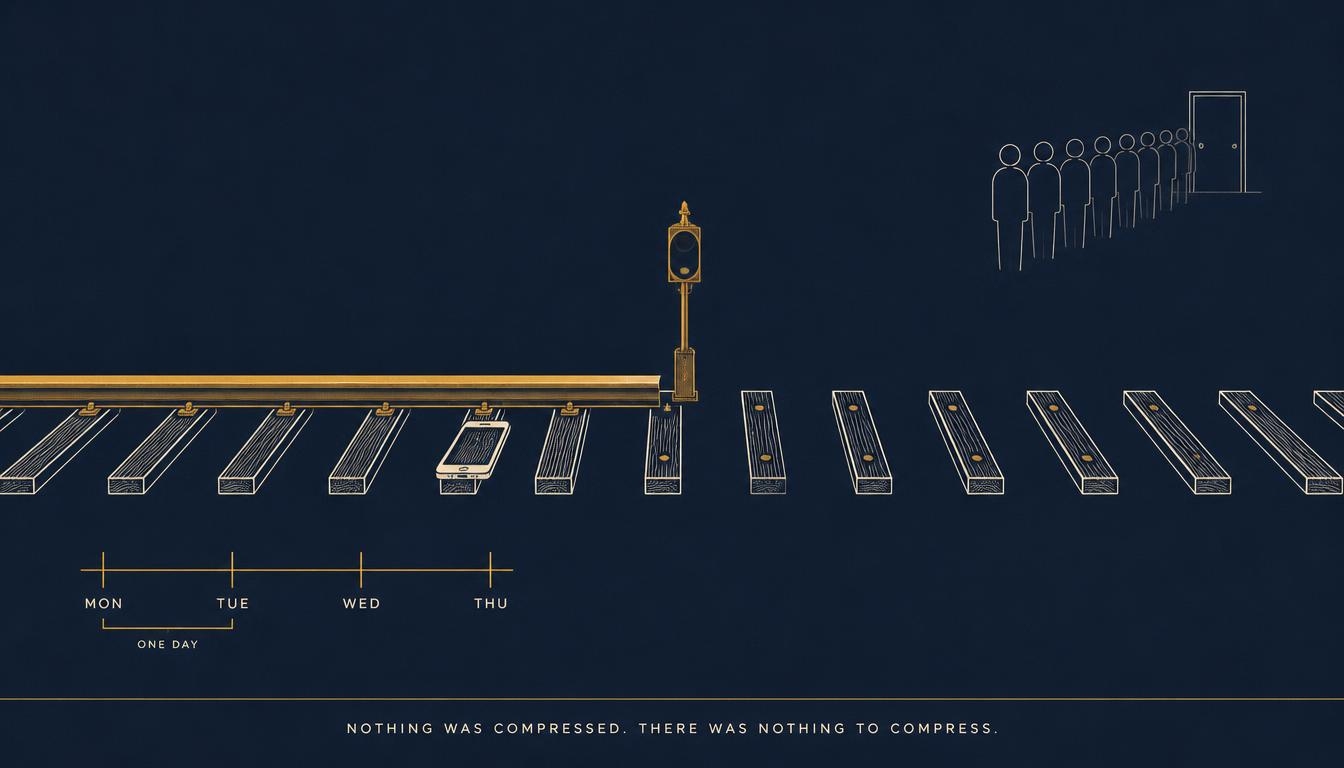
The App Simply Stopped
On Monday, November 2, 2026, Paraguayan regulators finished correcting the books of ueno bank and found its solvency ratio had fallen to 5.56 percent against a required 12. On Tuesday the central bank seized it. The app stopped working, cards stopped working, transfers stopped working, and branches closed — the same day. ueno reported 2,941,996 clients as of June 2026, in a country of roughly seven million people, and approximately 280,000 of them banked nowhere else. Article 65 is not primarily about why ueno failed, which is a documented story of insider lending that regulators had flagged as early as June. It is about why three million people lost access to their money in a single day, which is a different question and the only one that generalizes. It is also a correction to this catalog's own prior work. Article 54 argued that a unified ledger would change not the authority to adjust a depositor's claim but the latency, and treated the days of operational friction in a conventional resolution as the baseline a new architecture would remove. Paraguay shows that assumption was wrong. The friction is not structural but contingent, a property of a particular kind of bank, and an institution built digital-only never has it. Nothing was compressed at ueno, because there was nothing to compress.
Full analysis: newaustrianeconomics.com/forum/65-no-second-rail
Welcome to Issue #023 of The Dispatch. Each Monday, this letter takes one situation from the week's news and reads it through the lens of Carl Menger and Antal Fekete — paired with a foundational concept, the dashboard, the framework's prediction record, and a piece from the archive. If someone forwarded this to you, subscribe here.
The Lens
Three million people woke up on Tuesday with bank accounts and went to bed without them.
The timeline is the argument, so it goes first, stated flat.
Monday, November 2. Regulators investigating ueno bank's loans to companies linked to its owners found poorly documented lending, and expenses the bank had wrongly counted as assets. After the books were corrected, ueno's capital stood below half the legal minimum — a solvency ratio of 5.56 percent against a required 12, with accounting adjustments exceeding 1.6 trillion guaraníes.
Tuesday, November 3. The central bank seized the lender. ueno's app, cards and transfers stopped working. Branches closed.
Wednesday, November 4. Depositors rushed to open accounts elsewhere and crashed other banks' applications in the attempt. Central bank president Carlos Carvallo resigned at the president's request.
Thursday, November 5. President Santiago Peña announced his resignation, having lost the support of his own party. The lower house voted unanimously to impeach him minutes afterward.
Four days end to end. The operative interval — between the determination that the bank was insolvent and the moment three million people could no longer spend their own money — was one.
ueno reported 2,941,996 clients as of June 2026, in a country of roughly seven million people; the Associated Press reports it claimed more than sixty percent of Paraguay's adults as customers. Two figures from that base matter for everything that follows. Approximately 280,000 people banked only with ueno — no second institution, no second card, no second rail. And roughly $800 to $850 million of its deposits were public money, about a quarter of the total.
Lead Essay: No Second Rail
The proximate story is a corruption story, and it is not the interesting one.
Inspectors found a pattern of risky insider lending as early as June, five months before the seizure. ueno lent large sums to companies tied to its owners, beyond legal limits and without sufficient collateral; on a single day in September 2025, nearly $39 million went to three such companies. Prosecutors have charged twenty-seven bank officials and associates, and eight senior executives were detained.
The institutional picture around the lending is worse than the lending. Carlos Carvallo, the central bank president supervising ueno, had previously been president of Financiera Ueno — the bank's own predecessor entity. Peña himself held a stake in ueno's holding company until last year. As recently as October, with solvency doubts already public, Peña defended both the bank and the central bank's oversight of it as a smear campaign.
None of that is minimized. But it explains why ueno failed. It does not explain why three million people lost access to everything they had in a single day. A bank can fail through fraud in any country under any regime, and many have. What is new in Paraguay is not the failure. It is the execution.
And here the essay does something this catalog does rarely: it corrects itself.
In September, Article 54 examined European bail-in authority alongside the Bank for International Settlements proposal for a unified ledger. Its argument was deliberately narrow — not that such an architecture would create a power to adjust a depositor's claim, since that power already exists and has been exercised, but that:
What a unified ledger would change is not the authority. It is the latency.
That essay specified what the latency protects. Executing a resolution means convening an authority, performing a valuation, applying the creditor hierarchy, and propagating instructions across separate systems with their own reconciliation cycles. It takes days, conventionally compressed into a weekend. The friction defends no one deliberately, yet functions as a constraint in three ways: it bounds scope, it creates an interval in which the decision is reviewable, and it makes the action visible before it completes.
Paraguay is not a test of that argument, and Article 65 refuses to present it as one. ueno was not bailed in. No deposit was statutorily converted into loss-absorbing capital. There was no tokenization, no central bank digital currency, no unified ledger, no European framework. It was a seizure and liquidation under a national deposit guarantee regime — a different instrument, in a different legal system. Calling it a confirmation would mean widening the original claim until the evidence fits, which is the move Article 50 refused when it kept a failed inflation call scored as a loss rather than rescuing it with later data.
What Paraguay does is correct the essay's baseline assumption, and the correction matters more than a confirmation would have.
Article 54 treated operational friction as the status quo — the condition every bank operates under, which a new architecture would remove. That was wrong. The friction is not structural. It is a property of a particular kind of institution, and one built digital-only never has it.
When the access layer and the claim ledger are the same object, maintained by the same operator, there is no distance between adjusting the claim and terminating the access. Nothing was compressed at ueno. There was nothing to compress.
The essay states that this cuts both ways, and both are worth having.
It strengthens the underlying claim. Article 54 argued the protection was accidental and undefended. Paraguay is a case where its absence had consequences and nobody noticed it was missing — because nobody had identified it as a protection to begin with. No Paraguayan disclosure, prospectus or supervisory framework treated continuity of access as something a depositor was owed separately from the money itself.
It weakens the framing. Article 54 located the risk in a future architecture under construction in Europe, on a timeline running to 2029. The relevant variable turns out not to be tokenization at all. It is whether an institution has an access layer separable from its claim ledger — and ordinary commercial digital banks, available now, in dozens of countries, do not. The essay was looking at the right mechanism through too narrow a lens.
Of the three functions, reviewability is where the record is unambiguous. The interval between the corrected books and the dead app was roughly twenty-four hours. No court was petitioned. No legislative process intervened. The seizure may well have been correct — a bank at 5.56 percent solvency against a required 12 is insolvent by any measure, and a regulator who delays is choosing a different harm. The point is not that it was wrong. It is that the window in which it could have been reviewed did not meaningfully exist, and nobody decided to eliminate it.
Visibility inverted instructively. The action was instantly visible — the app simply stopped — but visibility arrived after completion rather than during. What followed was the response the friction was supposed to enable: depositors moved, on Wednesday, crashing other banks' applications. They moved after their own money was already frozen. That is a queue forming at a door that has already closed.
→ Read the full analysis: No Second Rail: ueno, Paraguay, and a Resolution That Took One Day — The Forum
Concept in Focus: Saleability as a Binary
Menger's account of money rests on Absatzfähigkeit — saleability, the degree to which a good can be disposed of without loss. This catalog has used it throughout as a continuous measure applicable to any asset, and has argued that the decay of marketability is the signature of an instrument's degradation. A house becomes harder to sell by degrees. A thin-traded bond widens by degrees. Degradation is gradual, and because it is gradual it is observable.
A deposit at a digital-only bank does not decay.
It has a saleability of one until it has a saleability of zero, and the transition is instantaneous, discontinuous, and controlled entirely by a third party.
No commodity has that property and no bearer instrument has it. A banknote in a pocket does not become unspendable because an institution was seized. Gold in a safe does not stop being gold because a regulator corrected a balance sheet. Both can be lost, stolen, confiscated or devalued — but none of those is a state change executed remotely, simultaneously, against every holder at once.
Article 47 developed the Custody Depth score, counting the institutional counterparties between a holder and unencumbered control. Physical possession scores zero. Paraguay supplies the limiting case from the other end: for roughly 280,000 people the count was one, and one was sufficient. Not one institution among several — one institution, full stop, with no parallel arrangement of any kind.
And the guarantee behind it divides in a way worth understanding. Paraguay's deposit fund covers up to seventy-five minimum monthly salaries per depositor — currently 228.3 million guaraníes. Read two measures of that together:
- By depositor, coverage is nearly total. The ceiling fully covers approximately 97 percent of ueno's depositors.
- By value, it is not. Across the system, guaranteed deposits total roughly 25.97 trillion guaraníes against about 151.42 trillion in private-system deposits — approximately 17 percent of deposits by value.
Both are true simultaneously, and a deposit guarantee is routinely defended using the first while the second determines whether the fund survives contact with a large failure. Ninety-seven percent of depositors made whole is a sentence a regulator can say. It is compatible with the great majority of the money being unprotected, because deposits are not distributed evenly across depositors.
That figure belongs to a short series this catalog has been building without intending to. Article 48 found a United States life insurance industry carrying $11.0 trillion against $10.6 trillion in liabilities — a four percent cushion. Article 64 noted Binance's SAFU fund at roughly $1 billion against a $6.3 billion loss. Paraguay's guarantee fund stands at roughly $1 billion against a $2.8 billion failure. Three sectors, two months, one observation: a cushion is only meaningful relative to the loss distribution it is sized against, and in none of the three cases is that relationship published.
The Atlas page on the Origin of Money covers the apparatus underneath — saleability as the property that selects a money in the first place, and what it means for an instrument to have it only conditionally.
The Dashboard
Readings from the live toolkit as of November 9, 2026.
- Gold Basis — +3.27% annualized at constant 90-day maturity, spot $4,063.55. Contango, mid-range, and spot has recovered its early-November dip. → /toolkit/gold-basis
- Silver Basis — +2.74% annualized, spot $51.91. Contango, and the carry has normalized from last week's +5.02%. → /toolkit/silver-basis
- Silver / Gold Ratio — 78.46, against 79.04 a week ago. The first weekly reading in five that has not gone against silver. → /toolkit/silver-gold-ratio
- Cross-Currency Basis — 9.6 bps mean absolute across four pairs. EUR/USD +7.1, GBP/USD +15.6, USD/CHF −7.3, USD/JPY +8.4. The tightest reading in several weeks, and all four pairs now inside 16 bps. → /toolkit/cross-currency-basis
- ETF NAV Deviation — 15.0 bps panel aggregate across six bond funds. Steady. → /toolkit/etf-nav-deviation
- OTROFF (10Y On/Off-the-Run Treasury Spread) — +0.68 bps, maturity-adjusted. Near the low end of its observed range. → /toolkit/otroff-spread
- COMEX Deliveries — 161 contracts stopped on November 6 across two contracts. → /toolkit/comex-paper-physical
The framework's reading: the silver round trip completed, and the basis called it correctly at both ends. Spot fell from $54.47 to $49.47 and has recovered to $51.91. At the bottom the annualized carry had nearly doubled to +5.02 percent — more carry available at a lower price, which is a paper-driven decline, not a shortage. It has since fallen back to +2.74 as the price recovered.
Had physical silver genuinely tightened, the curve would have compressed toward backwardation as the price fell. It did the reverse, twice. The instrument is not predicting the price and does not claim to. It is answering a narrower question — whether a move is about availability — and across five weeks and a nine percent drawdown it has answered no every time.
Everything else on the board is quiet. The cross-currency basis at 9.6 bps is the tightest in several weeks, and OTROFF near the bottom of its range says the most-current Treasury issue commands almost no liquidity premium. On this dashboard, the week's stress was entirely in Paraguay — and none of these instruments measures Paraguay.
The Scorecard
Article 65 puts four dated tests on the ledger, and states an unusually candid falsifier.
- Whether the 280,000 are made whole, and when. Depositors initially receive up to 10 million guaraníes — roughly four percent of the guaranteed ceiling — with the central bank saying it will pay "a la brevedad, sin precisar una fecha." The interval to full guaranteed recovery is the measurable test of what a guarantee is worth in practice rather than in statute.
- What happens above the limit. Deposits above 228.3 million guaraníes are explicitly not guaranteed. The recovery rate on that tranche tells depositors elsewhere what an uninsured balance is actually worth.
- Whether public funds receive different treatment. The state pension and health institute and the hydroelectric dam operators held $800–850 million at ueno. Whether public depositors are made whole on terms unavailable to private ones is a direct test of where the creditor hierarchy sits when the sovereign is itself a creditor.
- Whether any regulator draws the operational conclusion. No regulatory framework known to this catalog treats continuity of access as a requirement distinct from deposit protection.
And the falsifier the essay volunteers against itself: that Paraguay is simply idiosyncratic — a small country with documented governance problems and a central banker who previously ran the failed institution is not a system under stress but a system that was never functioning. The answer offered is that the fraud explains the failure and not the execution. But the essay concedes it has no comparable case in a well-governed jurisdiction to offer against that objection, and says so.
Forum #55's nearest dated test is six weeks out. December 24, 2026 is a hard obligation on all twenty-seven EU member states to provide at least one certified European Digital Identity Wallet.
Forum #16 banking diagnostics — the count holds at 6. No new U.S. bank failure. Six for 2026 against two in each of 2024 and 2025. The ueno seizure is outside this series, which tracks FDIC-insured institutions.
Next major resolutions on the ledger: the EUDI Wallet deadline on December 24; the digital euro pilot development phase; and the Q3 FDIC Quarterly Banking Profile.
The Actionable
The framework's operational observations calibrated to Forum #65:
- The failure mode of a digital claim does not depend on what failed. Theft, insolvency, resolution, sanction, outage, error — the holder's position is identical in every case, because in every case what he controls is not the asset but a permission to transact, granted and revocable by someone else. Two events three days apart, at a cryptocurrency exchange and a Paraguayan bank, produced the same experience for the holder through entirely unrelated mechanisms.
- A second rail is a distinct thing from a larger balance. The 280,000 who banked only with ueno were not necessarily the poorest customers; they were the ones with no parallel arrangement. Redundancy of access and adequacy of savings are different properties, and only one of them is routinely thought about.
- Read a guarantee by value, not only by depositor. Ninety-seven percent of depositors covered and seventeen percent of deposits covered describe the same fund. The first number is the one that gets quoted; the second is the one that determines whether the fund survives a large failure.
- Convenience and vulnerability are frequently the same property. The feature that made ueno resolvable in a day — a single integrated operator running both the ledger and the access layer — is the feature that made it good to use on every other day. That is not an argument against digital banking. It is an argument for knowing which property you are buying.
Educational content only — not investment advice.
From the Archive
"People must feel secure in their possession of gold. This is a prerequisite of what came to be known as the “golden age” that refers to an epoch when people are willing and happy to spend the gold coin because they are confident that they can always get it back on the same terms."
— Antal Fekete, Interview with Guillermo Barba (2014)
The passage is usually read as being about gold. It is more precisely about a condition under which people transact freely, and gold is the instrument Fekete thinks satisfies it.
His claim is that circulation depends on confidence in retrievability — people spend willingly when they are sure they can get the thing back on the same terms. Remove that and the behavior changes before the balance does: the asset goes into hiding, and what looked like a monetary system becomes a queue.
Paraguay ran the experiment in reverse and compressed it into four days. ueno's customers were willing and happy to spend, and the application was genuinely excellent — the bank reached sixty percent of Paraguay's adults in under five years, which is a real achievement in financial inclusion and is not what the essay disputes. Confidence was total right up until Tuesday, when the terms on which the money could be got back changed from any time to 10 million guaraníes now and the rest on a date not yet specified.
What Fekete identifies as the precondition for a functioning monetary order is exactly what nobody had checked. The depositors believed they held money. They held a permission with a single point of failure, and no disclosure framework required telling them.
→ Read the full essay in the Fekete Archive
Also This Week
- Forum #64 — The Math Was Never Attacked, the lead of Issue #022, is the mirror image of this week's argument and the two should be read together. At Binance the technology worked perfectly and roughly $6.3 billion left anyway. At ueno the technology worked perfectly until a regulator switched it off. One was theft and one was lawful resolution; one involved a criminal actor and the other a supervisory authority acting within its mandate. The user experience was identical — the number on the phone stopped being spendable, with no warning, through no act of the holder, and with no recourse at the moment it happened.
- Forum #54 — Contingent Actions and the Unified Ledger is worth rereading now that this week's lead has revised it. The essay's answer — that a programmable settlement layer changes the latency rather than the authority — survives. The premise beneath it, that every bank sits behind days of operational friction, does not.
- Forum #43 — What Survives found that under conditions of sudden displacement, portability dominates every other consideration, and that bearer instruments proved close to uniquely protective. The threat model there was flight across a border. The threat model here is a supervisory determination on a Tuesday morning, and the defense that works against it is the same: an instrument that requires nobody's permission to function.
- Atlas: Origin of Money — saleability as the property that selects a money, and what changes when an instrument has it only at someone else's discretion.