
Researched and drafted with AI assistance · reviewed and edited by Jason D. Keys
The question is not what money does
Almost every textbook answers this question by listing functions. Money is a medium of exchange, a unit of account, and a store of value. That is accurate and nearly useless, because it describes what money accomplishes without saying what makes a particular thing capable of accomplishing it.
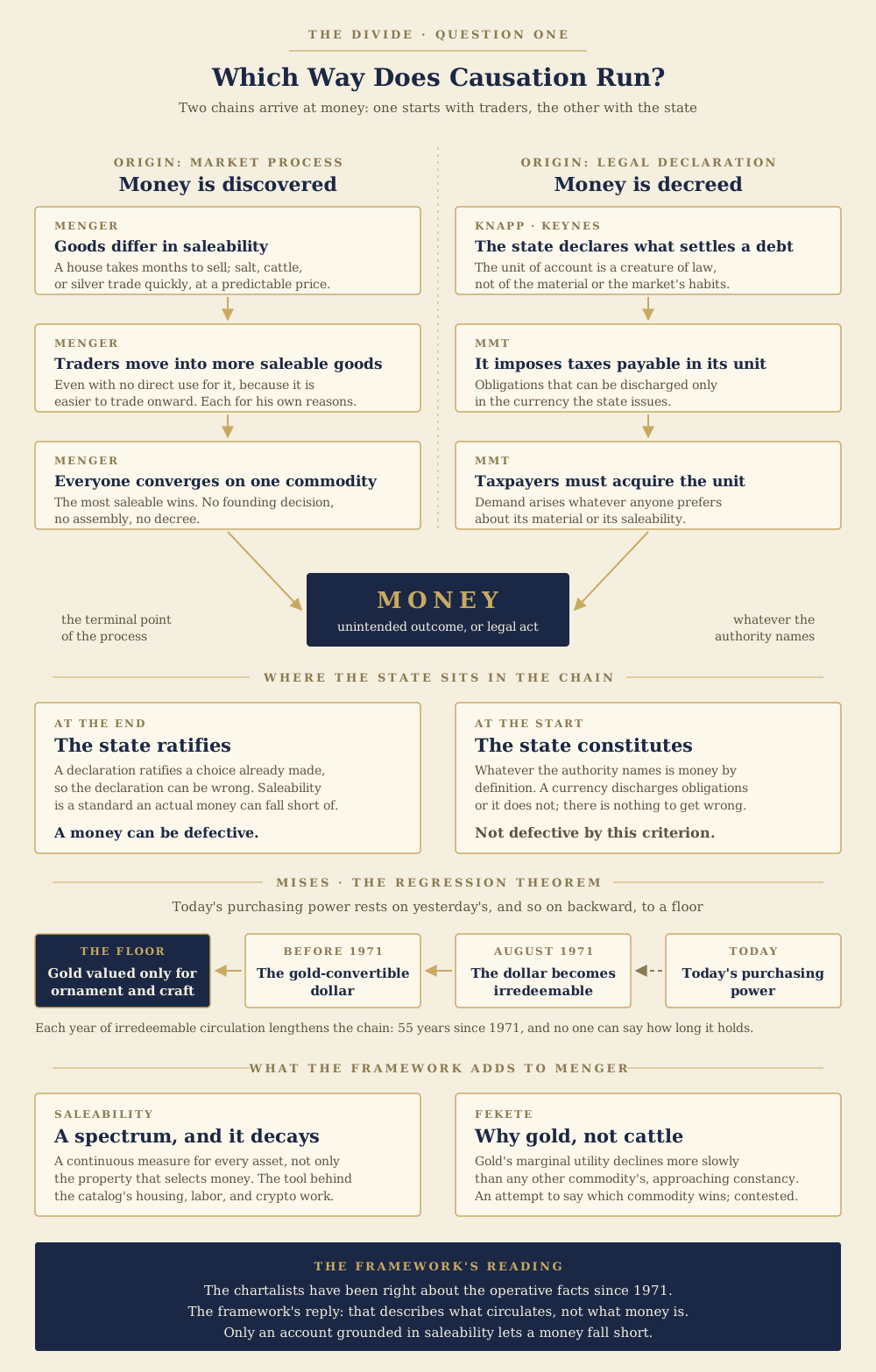
The genuine disagreement is about origin, and it has a consequence that is anything but academic. If money emerges from the choices of market participants, then an authority that declares something to be money is at most ratifying a decision already made, and can get the declaration wrong. If money is constituted by the declaration, then there is nothing to get wrong — whatever the authority names is money by definition.
Those positions license entirely different conclusions about whether a monetary arrangement can be defective. This page takes the four principal answers in sequence.
Answer one: money emerged, and nobody designed it
Menger.
Carl Menger's 1892 essay opens by identifying what he regards as a genuine puzzle: why does an individual accept, in exchange for his goods, a metal disc he cannot eat, wear, or use? 1
His answer turns on a property he calls Absatzfähigkeit — saleability, or marketability. Commodities differ enormously in how readily they can be disposed of without loss. A house is valuable but takes months to sell. A specialized machine may have one plausible buyer in a region. Salt, cattle, or silver can be exchanged quickly, in varying quantities, at a predictable price.
From this difference, Menger derives everything. An individual holding a poorly saleable good who wants something else can improve his position by first trading into a more saleable good, even if he has no direct use for it, because the more saleable good is easier to trade onward. Each person doing this independently, for his own reasons, drives the community toward whatever commodity happens to be most saleable. Money is the terminal point of that process.
The crucial feature is what is absent from the account. There is no founding decision, no assembly, no decree. Menger's argument is that money is the unintended outcome of individually intended actions — the paradigm case of what later writers call spontaneous order.
The strongest version: money is not an invention. It is a discovery that no one made, arrived at by people who were not looking for it.
Answer two: money is a creature of law
Knapp, and Keynes after him.
Georg Friedrich Knapp's The State Theory of Money (1905) begins from the opposite end. Money, he argues, is defined not by what it is made of but by what the legal order accepts in discharge of obligations. 2 A unit of account is a creature of law; the state declares what shall satisfy a debt, and that declaration — not the material, and not the market's prior habits — is what makes the thing money.
Knapp's position is often caricatured. He did not claim the state can make a worthless thing valuable by fiat. His claim is narrower and harder to refute: that the unit of account is a legal institution, that the state's power to name what settles obligations is the operative fact, and that monetary history is better explained by legal history than by commodity properties.
Keynes endorsed this directly. In the Treatise on Money (1930) he wrote that money of account is "the primary concept of a Theory of Money," that it comes into existence "along with Debts, which are contracts for deferred payment, and Price-Lists, which are offers of contracts for sale or purchase," and that the state claims the right "to determine and declare what thing corresponds to the name" and to vary that declaration. Knapp's chartalism, he said, is "fully realised" from the moment the state assumes that right. 3
The strongest version: look at what actually happens. Every monetary unit in the world today is a legal creation. Taxes are assessed in it, debts are enforceable in it, and nobody consulted the market about the unit.
Answer three: emerged, and traceable backward
Mises and the regression theorem.
Mises accepted Menger's account and then confronted a problem it appears to generate. If a thing is valued because people expect to exchange it onward, and they value it for the same reason, the explanation looks circular. Money has purchasing power because people expect it to have purchasing power.
His answer, in The Theory of Money and Credit (1912), is the regression theorem. 4 Today's demand for money rests on yesterday's purchasing power, which rested on the day before's, and so on backward — not infinitely, but to a specific terminus: the day the commodity was valued only for non-monetary uses. Gold was desired for ornament and craft before it was money. The chain of expectations has a floor, and the floor is commodity value.
The theorem does real work for the Austrian position, because it supplies an answer to the circularity objection without abandoning the subjective theory of value. But it also commits Mises to a historical claim — that every money traces back to a commodity — which chartalists dispute and which the record of the past fifty years has made awkward.
The strongest version: an explanation of money's value that terminates in a non-monetary use is the only kind that does not beg the question.
Answer four: taxes drive money
Modern Monetary Theory.
MMT revives Knapp's chartalism with a specific mechanism attached. The state issues a currency and simultaneously imposes tax obligations denominated in it. Since those obligations can be discharged only in that currency, a population with tax liabilities must acquire it — which generates demand for the currency independently of anyone's preference about its material or its saleability.
The slogan is that taxes drive money. 5 The state does not need to persuade anyone to accept its currency; it needs only to require payment in it.
MMT then draws monetary-operations conclusions from this that are contested well beyond the Austrian camp — about the constraints on sovereign spending, and about whether a currency-issuing government is financially constrained in the way a household is. Those conclusions are a separate question from the account of origin, and this page treats them separately, as they should be.
The strongest version: whatever the historical origin of money, the demand for any particular modern currency is not a mystery. It is a legal obligation with enforcement behind it.
Where the four actually conflict
| Question | Menger | Knapp / Keynes | Mises | MMT |
|---|---|---|---|---|
| Origin | Market process | Legal declaration | Market process | Legal declaration |
| What the state does | Ratifies | Constitutes | Ratifies | Constitutes |
| Source of value | Saleability | Acceptance in payment | Traced to commodity use | Tax obligation |
| Can a money be defective? | Yes | Not by this criterion | Yes | Not by this criterion |
| Does commodity backing matter? | Historically | No | Yes, necessarily | No |
Three disagreements are substantive rather than verbal.
First: does the state create money or ratify it? This is the sharp one, and both sides have their best evidence in different centuries. Menger's account fits the record of commodity monies arising where no state could decree anything. 6 Knapp's fits the modern period, where every unit of account is a legal construction.
Second: can a monetary arrangement be defective? If money is whatever discharges obligations, the question of whether a currency is good money has no purchase — it discharges obligations or it does not. Only an account grounded in a property like saleability generates a standard against which an actual money can fall short. This is the disagreement that matters most for everything else on this site, because the framework's entire body of work presupposes that the question is meaningful.
Third: must money trace back to a commodity? Mises's regression theorem says yes. Fifty-five years of irredeemable currency circulating at positive value is the obvious objection, and Austrians answer it by noting that the dollar's regression runs through its own gold-convertible past. That answer is coherent and it weakens over time, since the chain lengthens every year and no one can say how long it holds.
What the framework adds
This site's framework takes Menger as its foundation and extends him in two directions.
Saleability is a spectrum, and it decays. Menger treated saleability as the property that selects money. The framework treats it as a continuous measure applicable to every asset, and asks what happens when the saleability of an instrument degrades while its nominal price is maintained. The decay function of marketability is developed in the catalog's early essays and is the analytical tool behind its housing, labor, and crypto work.
Fekete's extension: constancy of marginal utility. Fekete identified what he regarded as the distinctive property of gold — that its marginal utility declines more slowly than that of any other commodity, approaching constancy — and built his theory of interest on it. 7 Where Menger explains why some commodity becomes money, this purports to explain why that commodity does and why its monetary role is unusually stable. Fekete regarded Mises as having missed this connection entirely. 8
The structural parallel is worth noting, because it is how Fekete understood his own project: Menger described direct exchange giving way to indirect exchange, and Fekete described direct conversion of income into wealth — hoarding and dishoarding — giving way to indirect conversion through the bond market. 9 The second essay in this series develops that move.
Where the framework is exposed
The chartalists have been right about the operative facts for fifty-five years. Since August 1971, every major currency has been irredeemable, legally constituted, and demanded principally because tax and debt obligations are denominated in it. The framework's reply is that this describes what circulates, not what money is, and that the distinction is exactly the point. But a reader is entitled to notice that an account of money which does not describe any currency now in use is doing something other than describing the world.
The regression theorem is aging. The framework relies on it less than orthodox Austrians do, but it inherits the problem. Each year of successful irredeemable circulation makes "the chain runs back to 1971, and before that to gold" a longer and less satisfying answer.
Menger's account does not predict which commodity wins. It explains the process and is consistent with silver, cattle, cowries, or gold. Fekete's constant-marginal-utility argument is an attempt to close that gap, and whether it succeeds is contested even among those sympathetic to him. 10 It is a claim about an empirical property of gold, and it is not obvious how one would measure it.
What to read next
Within The Divide: the next question — What is interest? — takes up Fekete's extension of Menger directly, and is the strongest ground the framework occupies.
In the Atlas: the concept pages on the origin of money, marginal utility, and money versus currency develop saleability and constant marginal utility; the marketability decay function has its own visualizer in the Toolkit.
In the Forum: What Survives tests the Mengerian account against four documented monetary collapses and finds it predicts two of them correctly and is silent on the other two. You Don't Need a Conspiracy When You Have Mandates argues that the informational content of a price depends on discretionary participants, which is the same property from a different direction.
Sources
A note on method. Each school is presented from its own primary texts rather than from secondary summaries, and each is given its strongest form before any reply is offered. Where this framework disagrees, it says so and states what would count against it.
Footnotes
-
Menger, Carl. "On the Origin of Money," translated by C. A. Foley. Economic Journal 2, no. 6 (June 1892): 239–255. https://www.jstor.org/stable/2956146 (full text: https://fee.org/resources/on-the-origin-of-money/) — for the puzzle of accepting "little metal disks" and the argument from differing saleableness to a common medium of exchange. ↩
-
Knapp, Georg Friedrich. The State Theory of Money (1905; abridged English translation by H. M. Lucas and J. Bonar, 1924). https://archive.org/details/in.ernet.dli.2015.224223 — for money as "a creature of law" and the claim that a theory of money "must therefore deal with legal history." ↩
-
Keynes, John Maynard. A Treatise on Money, Vol. I, The Pure Theory of Money (1930), Chapter 1, "The Classification of Money." https://archive.org/details/in.ernet.dli.2015.30220 — for the four quoted passages on money of account and Knapp's chartalism. ↩
-
Mises, Ludwig von. The Theory of Money and Credit (1912; English translation 1934, new edition 1953), Part Two, Chapter 8, "The Determinants of the Objective Exchange-Value, or Purchasing Power, of Money." https://mises.org/online-book/theory-money-and-credit/part-two-value-money/chapter-8-determinants-objective-exchange-value-or-purchasing-power-money — for the regression from today's purchasing power back to a value based only on non-monetary use. ↩
-
Wray, L. Randall. "MMP Blog #8: Taxes Drive Money." New Economic Perspectives, July 24, 2011. https://neweconomicperspectives.org/2011/07/mmp-blog-8-taxes-drive-money.html — for the MMT claim that a tax liability payable in the government's currency is sufficient to ensure its acceptance. ↩
-
Radford, R. A. "The Economic Organisation of a P.O.W. Camp." Economica 12, no. 48 (November 1945): 189–201. https://doi.org/10.2307/2550133 — for cigarettes emerging as currency among prisoners with no issuing authority. ↩
-
Fekete, Antal E. Monetary Economics 102: Gold and Interest, Lecture 1, "The Nature and Sources of Interest." Gold Standard University, January 1, 2003. https://professorfekete.com/articles/AEFMonEcon102Lecture1.pdf — for gold's marginal utility declining more slowly than any other commodity's, "so slowly that it is practically constant," as the basis of his theory of interest. ↩
-
Fekete, Antal E. "When Atlas Shrugged… Part Two: Gibson's Paradox and the Gold Price." October 11, 2006. https://www.gold-eagle.com/article/when-atlas-shrugged-0 — for "Mises missed this fundamental connection between gold and interest." ↩
-
Fekete, Antal E. Monetary Economics 102, Lecture 2, "The Exchange of Income and Wealth." January 15, 2003. https://professorfekete.com/articles/AEFMonEcon102Lecture2.pdf — for the passage from direct to indirect conversion of income and wealth as analogous to Menger's passage from direct to indirect exchange; see also the interview "Antal Fekete's Neo-Misesian Revisionism and Why He Believes It Is Necessary," The Daily Bell, March 30, 2014, https://thedailybell.com/all-articles/exclusive-interviews/anthony-wile-antal-feketes-neo-misesian-revisionism-and-why-he-believes-it-is-necessary/ — for indirect conversion through gold bonds. ↩
-
Fekete, Antal E. Monetary Economics 102, Lecture 5, "The Pentagonal Model of Capital Markets." February 1, 2004. https://professorfekete.com/articles/AEFMonEcon102Lecture5.pdf — for a Gold Standard University participant's objection that gold's marginal utility only approximates constancy, and Fekete's concession that constancy is "a first approximation." ↩