
Researched and drafted with AI assistance · reviewed and edited by Jason D. Keys
Why start here
Economists disagree about many things. On most of them the disagreement is about magnitude, or timing, or which effect dominates — arguments that could in principle be settled by better data.
Interest is not like that. The major schools disagree about what kind of thing interest is, and those positions cannot all be true at once. One tradition says it is a price. Another says it is explicitly not a price but a ratio. A third says it is a price of something entirely different from what the first tradition thinks. No amount of data resolves that, because they are not measuring the same object.
This page takes the four principal answers in the order they entered the literature, presents each from its own texts, and then states where the framework this site develops stands — including where it is weakest.
Answer one: the price that equilibrates saving and investment
The classical and neoclassical tradition.
The oldest formal answer treats interest as an ordinary price in an ordinary market. Savings are the supply of loanable funds. Investment demand is the demand for them. Interest is the price that clears the market between them: when more people wish to save than to borrow, the rate falls until borrowers appear; when investment demand outruns saving, the rate rises until saving is induced.
This account has an intuitive appeal and a long pedigree, running from Adam Smith and Ricardo through to the formal loanable funds models of the twentieth century. Its central implication is that interest performs a coordinating function — it is the signal that brings the quantity society wishes to save into line with the quantity it wishes to invest.
Wicksell's refinement. Knut Wicksell, in Interest and Prices (1898), introduced a distinction that every later school had to reckon with. He separated the natural rate — the rate that would prevail if capital were lent in kind, without money intervening — from the money rate actually charged by banks. 1 When the money rate sits below the natural rate, credit expands and prices rise; when above, the reverse.
That distinction matters enormously for what follows, because it opens the possibility that the observed rate of interest and the "real" rate governing capital allocation can come apart. Almost every subsequent disagreement is a disagreement about what happens in that gap.
The strongest version of this answer: interest is a price like any other, performing the ordinary function of prices, which is to allocate a scarce resource — in this case, command over present purchasing power.
Answer two: not a price at all, but a ratio
Böhm-Bawerk and Mises.
Eugen von Böhm-Bawerk argued that interest arises from something prior to any market: the fact that human beings systematically value present goods above future goods of the same kind and quantity. He gave three grounds for this. First, differing circumstances of want and provision — a person expecting to be better supplied later rationally values present goods more. Second, a systematic underestimation of future wants. Third, the technical superiority of present goods, which can be employed in roundabout production processes that yield more output. 2
Mises radicalized this into the doctrine of originary interest, and the crucial move is a negative one. In Human Action he states the position directly:
"Originary interest is not a price determined on the market by the interplay of the demand for and the supply of capital or capital goods. Its height does not depend on the extent of this demand and supply. It is rather the rate of originary interest that determines both the demand for and the supply of capital and capital goods." 3
And its nature:
"Originary interest is the ratio of the value assigned to want-satisfaction in the immediate future and the value assigned to want-satisfaction in remote periods of the future." 3
Read that carefully, because it is the reason this school cannot simply be merged with the first. For Mises, interest is not a price. It is a ratio between two valuations — a feature of the structure of human action that would exist in a world without banks, without money, and without a loan market at all. The market rate on a bond is a downstream phenomenon that reflects originary interest plus an entrepreneurial component plus a price premium, but originary interest itself is logically prior to all of it.
The strongest version: interest is not created by lending. Lending reveals it. A rate of interest would exist in the valuations of a man alone on an island deciding whether to eat the fish today or build a net.
Answer three: the reward for parting with liquidity
Keynes.
In 1936 Keynes rejected both preceding answers, and he did it with an argument that is one sentence long and difficult to dismiss:
"It should be obvious that the rate of interest cannot be a return to saving or waiting as such. For if a man hoards his savings in cash, he earns no interest, though he saves just as much as before." 4
That observation is fatal to the simplest version of answer one. A person who saves by stuffing banknotes in a drawer has saved exactly as much as a person who buys a bond, and receives nothing. So whatever interest is a reward for, it is not saving.
Keynes's alternative: interest is the price of surrendering liquidity, not the price of surrendering consumption.
"The rate of interest is not the 'price' which brings into equilibrium the demand for resources to invest with the readiness to abstain from present consumption. It is the 'price' which equilibrates the desire to hold wealth in the form of cash with the available quantity of cash." 4
And its interpretation:
"The rate of interest at any time, being the reward for parting with liquidity, is a measure of the unwillingness of those who possess money to part with their liquid control over it." 4
The consequence is that interest becomes a monetary phenomenon. It is determined by the quantity of money and by the public's desire to hold it, not by the productivity of capital or the structure of time preference. And it carries a disturbing corollary: if liquidity preference becomes sufficiently strong, the rate at which people will part with cash can exceed any rate at which investment is profitable. Saving and investment need not be coordinated by the interest rate at all. They can both fall together.
The strongest version: the hoarding objection is real and it has never been fully answered. Any theory of interest must explain why the saver who holds cash earns nothing, and a theory grounded purely in abstinence or in time preference struggles to.
Answer four: the price of exchanging income for wealth
Fekete.
Antal Fekete, working in the Menger tradition, poses the question as a meeting between two people:
"What happens when a man with wealth to spare but who is in need of an income meets another with income to spare but who is in need of wealth?" 5
Picture them concretely. A retiree has accumulated savings across a working life — a stock of value. What he lacks is income, because he no longer works, and he faces the problem that consuming his principal is irreversible and his lifespan unknown. An entrepreneur has the opposite problem: her business generates a flow of earnings but she lacks the stock of capital to expand it.
When they transact, each obtains what they lack and surrenders what they hold in surplus. The rate of interest is the price at which this particular exchange clears.
Then Fekete adds the step that makes the theory distinctive. Both parties have an alternative to trading with each other. The wealth-holder can convert wealth into income directly, by consuming it. The income-holder can convert income into wealth directly, by saving it. These require no counterparty:
"By direct conversion of income into wealth is meant hoarding, and by direct conversion of wealth into income is meant dishoarding of a fungible commodity. Since direct conversions are cumbersome and inefficient, the passage to indirect conversion or exchange represents an improvement. Interest can be thought of as the measure of this improvement. In particular, zero interest means direct conversion." 5
Note what that last clause does. Zero interest, in this account, is not cheap money. It is the condition under which the exchange yields no advantage over doing it yourself — so the exchange stops, and hoarding replaces lending. The mechanism by which savings become capital is not lubricated at zero. It is abolished.
Fekete also makes a methodological point that bears on everything above:
"There is no market quoting the rate of interest directly. In order to find out what the going rate of interest is one must go to the bond market, get a quotation for the bond price, and calculate the rate of interest from there." 6
The yield curve is therefore not a report on the price of credit. It is the only instrument through which that price is expressed at all.
The strongest version: the trade is between two different forms of economic object — a stock and a flow — not between two dates. Stocks and flows have different properties. Wealth is illiquid and subject to declining marginal utility; income has neither disadvantage. That difference is what makes the exchange mutually advantageous, and it is invisible in a framework that sees only present goods and future goods.
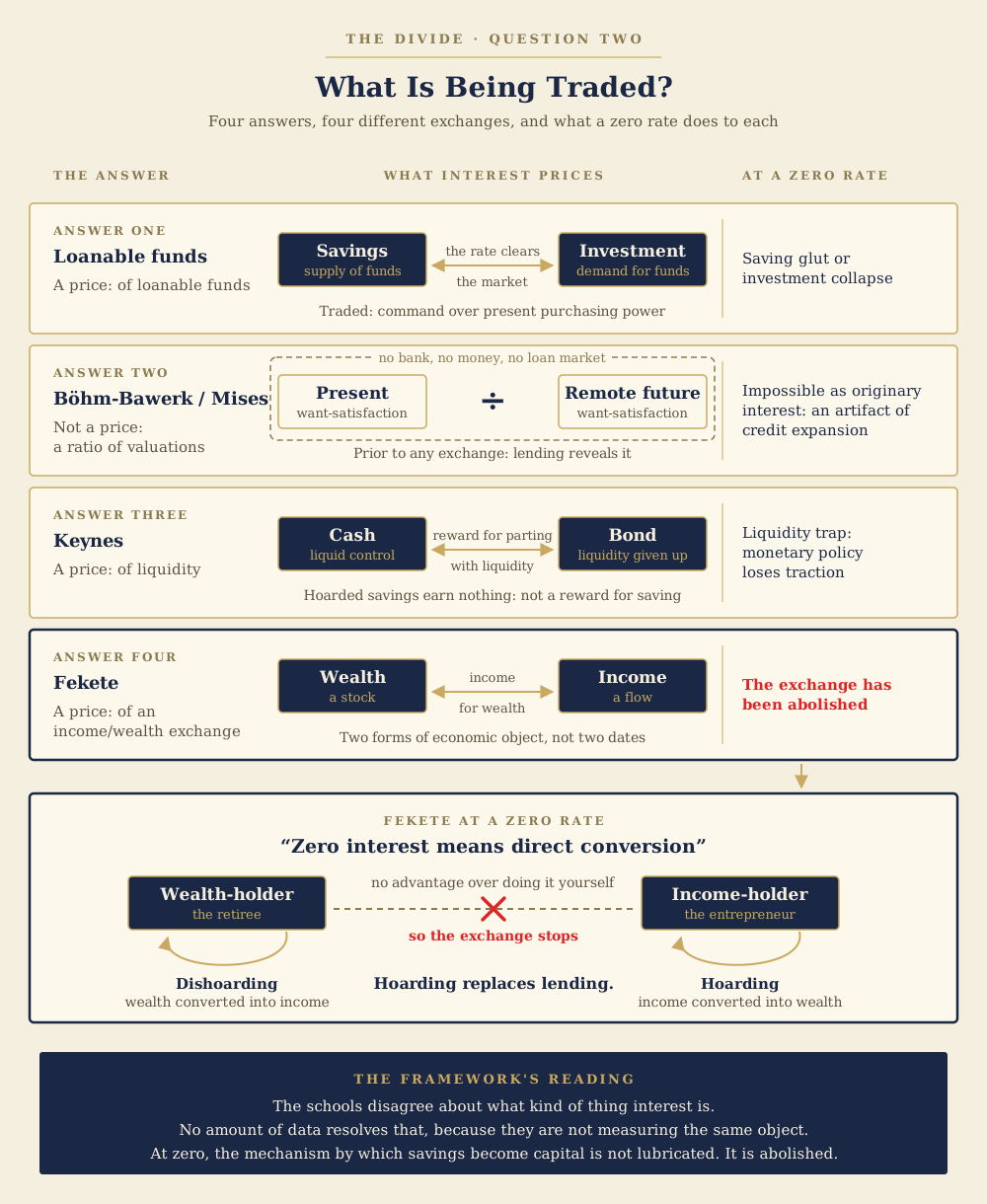
Where the four answers actually conflict
It is worth being precise about which disagreements are substantive and which are terminological.
| Question | Loanable funds | Böhm-Bawerk / Mises | Keynes | Fekete |
|---|---|---|---|---|
| Is interest a price? | Yes — of loanable funds | No — a ratio of valuations | Yes — of liquidity | Yes — of an income/wealth exchange |
| What is traded? | Present purchasing power | Nothing; interest is prior to trade | Liquidity | A stock for a flow |
| Is it monetary? | Real, with a monetary overlay | Real; money is a veil | Monetary | Real, but discoverable only in the bond market |
| What does zero mean? | Saving glut or investment collapse | Approaching the vanishing of time preference | Liquidity trap | The exchange has been abolished |
| Where is it observed? | The loan market | Nowhere directly | The money market | Inferred from bond prices |
Three genuine incompatibilities fall out of that table.
First: is interest prior to markets, or produced by them? Mises says the ratio exists in human valuation before any exchange occurs. Keynes and Fekete both say interest is the price of an actual trade between actual parties. These cannot both be right about what the object is.
Second: is it real or monetary? Keynes's answer is unambiguously monetary — interest is determined in the market for money. Mises's is unambiguously real — money is a veil over an underlying ratio. Fekete's position is interesting here and often misread: the exchange he describes is real, but he insists the rate can only be observed through a monetary instrument.
Third: what does a zero rate signify? This is where the schools make divergent and testable predictions. Keynes predicts a liquidity trap in which monetary policy loses traction. Fekete predicts something more specific — that the exchange mechanism itself ceases, producing hoarding at every level of the system. Mises predicts that a zero rate is impossible as an expression of originary interest and must therefore be an artifact of credit expansion.
What the framework adds
This site's framework takes Fekete's answer as its foundation. Three things follow that the other accounts do not supply.
A discriminating test. If interest is the price of exchanging income for wealth, then any transaction bearing an interest rate can be examined against a question: is such an exchange actually occurring? A merchant borrowing to finance a shipment receives wealth and pledges future income — both sides present. A household borrowing to finance consumption pledges future income and receives goods that are consumed, leaving nothing on its side of the ledger when the transaction completes. The two have identical legal form and are categorically different under the test. This catalog develops that distinction at length and finds that it articulates precisely what the historical prohibitions on usury were reaching for and could never state.
A named agent. Where time preference supplies an aggregate psychological disposition that cannot be observed in any individual, Fekete supplies a specific actor: the marginal bondholder, who arbitrages between the bond market and the gold market and whose trading regulates the rate. 7 That is a mechanism rather than a disposition, and mechanisms can be looked for.
A prediction about zero. "Zero interest means direct conversion" is a claim with observable consequences: at a zero rate, wealth-holders offered nothing for parting with wealth retain it. The decade following 2008 produced corporate cash balances accumulating rather than being deployed, 8 bank reserves sitting at the central bank rather than financing lending, 9 and central banks accumulating gold. 10 Each is direct conversion in Fekete's sense — the cumbersome alternative that the exchange exists to improve upon.
Where the framework is exposed
A page in this series is incomplete without the replies, and three of them are serious.
Mises's reply: the distinction collapses. A Misesian can argue that Fekete's "exchange of a stock for a flow" is simply time preference described in different vocabulary. Converting wealth into an income stream is exchanging present goods for future goods. If so, the framework has renamed originary interest rather than replacing it. The framework's answer is that stocks and flows differ in properties — illiquidity and declining marginal utility attach to one and not the other — and that a theory tracking only dates cannot see this. Whether that difference is doing real analytical work or is a restatement is a live question, and this page does not claim it is settled.
Keynes's reply: the exchange may not clear. Fekete's two parties are better off trading, and the rate is where they meet. Keynes's entire point is that there may be no rate at which they meet — that liquidity preference can be strong enough that the wealth-holder prefers cash at any rate the entrepreneur can profitably pay. Fekete's account of zero interest is arguably closer to Keynes here than either would accept, since both predict hoarding; they differ on whether the cause is the price being too low or the preference being too strong.
The framework's own hardest problem: the mechanism requires a gold standard. Fekete was explicit that the marginal bondholder's discipline depends on being able to flee into gold. Under irredeemable currency, he observed, accepting paper for a gold bond means taking zero in exchange for a positive income — a jump "from the frying pan into the fire." 7 So the agent his theory names cannot perform the function his theory assigns him in the monetary system we actually have.
This catalog has argued that Fekete specified one option too few — that the marginal bondholder can still decline to appear at the auction, which requires no superior asset and leaves an observable signature in auction results. That extension is the framework's own work and not Fekete's, and a reader should weigh it as such.
And one empirical complication the framework reports against itself. Work in this catalog examining gold's realized price path across five decades found it governed principally by real interest rates — the inflation-adjusted return on a yield-bearing alternative — rather than by monetary soundness. That is closer to an opportunity-cost story in the loanable funds tradition than to either time preference or income-for-wealth exchange. The framework's position is that this concerns the price of gold rather than the nature of interest, and the two questions are separable. A critic is entitled to find that convenient.
What to read next
Within The Divide: the next question — What does credit expansion do? — takes the same four schools into territory where their disagreement produces incompatible policy conclusions.
In the Atlas: the concept pages on the theory of interest and the gold basis develop the mechanisms named above.
In the Forum: The Bookkeeper's Dilemma applies the accounting asymmetry of a falling rate structure to capital destruction. The Exchange That Isn't runs the income-for-wealth test against sovereign debt and the usury prohibitions. Three Hands on the Dial develops the marginal bondholder's withdrawal from Treasury auctions, which is where Fekete's mechanism is extended beyond what he wrote.
Sources
A note on method. Each school is presented from its own primary texts rather than from secondary summaries, and each is given its strongest form before any reply is offered. Where this framework disagrees, it says so and states what would count against it. The purpose of The Divide is to let a reader see the contested ground clearly enough to hold a position for reasons, including a position against the one argued here.
Footnotes
-
Wicksell, Knut. Interest and Prices (1898; English translation 1936). Mises Institute PDF: https://mises-media.s3.amazonaws.com/Interest%20and%20Prices_2.pdf — for the distinction between the natural rate and the money rate of interest. ↩
-
Böhm-Bawerk, Eugen von. The Positive Theory of Capital (1889), translated by William Smart. Mises Institute PDF: https://cdn.mises.org/The%20Positive%20Theory%20of%20Capital.pdf — for the three grounds on which present goods are valued above future goods. ↩
-
Mises, Ludwig von. Human Action (1949), Chapter XIX, "The Rate of Interest," section 2, "Originary Interest." https://mises.org/online-book/human-action/chapter-xix-rate-interest/2-originary-interest — for both quoted passages. ↩ ↩2
-
Keynes, John Maynard. The General Theory of Employment, Interest and Money (1936), Chapter 13, "The General Theory of the Rate of Interest." https://www.marxists.org/reference/subject/economics/keynes/general-theory/ch13.htm — for the three quoted passages. ↩ ↩2 ↩3
-
Fekete, Antal E. Monetary Economics 102: Gold and Interest, Lecture 2, "The Exchange of Income and Wealth." Gold Standard University, January 15, 2003. https://professorfekete.com/articles/AEFMonEcon102Lecture2.pdf — for the income-and-wealth question and the direct-conversion passage. ↩ ↩2
-
Fekete, Antal E. Monetary Economics 102, Lecture 6, "The Hexagonal Model of Capital Markets." March 1, 2004. https://professorfekete.com/articles/AEFMonEcon102Lecture6.pdf — for the passage on calculating the rate of interest from bond quotations. ↩
-
Fekete, Antal E. "When Atlas Shrugged… Part Two: Gibson's Paradox and the Gold Price." October 11, 2006. https://www.gold-eagle.com/article/when-atlas-shrugged-0 — for the marginal bondholder's arbitrage between the gold market and the bond market, and the "frying pan into the fire" passage. ↩ ↩2
-
Moody's Investors Service, reported by ABL Advisor, July 24, 2017. https://www.abladvisor.com/articles/12297/report-u-s-companies-hoarded-more-cash-in-2016-spent-less — for U.S. nonfinancial corporate cash of $1.84 trillion at the end of 2016. ↩
-
Federal Reserve Bank of St. Louis. Excess Reserves of Depository Institutions (EXCSRESNS), FRED. https://fred.stlouisfed.org/series/EXCSRESNS — for the post-2008 growth in reserves held at the Federal Reserve. ↩
-
Central Banking. "Central banks break 20-year streak with net gold purchase in 2010," reporting World Gold Council data. https://www.centralbanking.com/central-banking/news/1940034/central-banks-break-streak-net-gold-purchase-2010 — for central banks becoming net buyers of gold in 2010. ↩