
Researched and drafted with AI assistance · reviewed and edited by Jason D. Keys
Why this question splits the room
The previous two installments examined questions where the schools disagree about what an object is. This one is different: they largely agree about the mechanics of credit creation and disagree violently about its consequences.
That makes it the most policy-consequential question in the series. If credit expansion systematically misdirects capital, the correct response to a bust is to let it proceed. If credit expansion raises output when resources are idle, the correct response is more of it. If the damage comes from subsequent contraction rather than prior expansion, the correct response is to prevent the contraction — which is, in substance, what every central bank has done since 2008.
It is also the question on which the framework this site develops is least neutral, because it takes a position that puts it at odds with most of the Austrian tradition rather than with the mainstream. That dispute gets its own section.
Answer one: expansion misdirects capital
Mises and Hayek.
The Austrian theory of the business cycle begins from Wicksell's distinction, introduced in the previous installment of this series: the natural rate of interest, which would prevail if capital were lent in kind, against the money rate actually charged by banks.
When banks expand credit beyond prior saving, the money rate falls below the natural rate. Entrepreneurs respond rationally to the signal they are given — a lower rate makes longer, more roundabout production processes appear profitable, so investment shifts toward projects further from final consumption. Hayek's Prices and Production (1931) develops this as a change in the structure of production rather than its level. 1
The problem is that the signal was false. No additional saving occurred; consumers have not deferred consumption to free the resources those longer processes require. The expansion creates a competition for the same resources between the newly launched long projects and existing consumption demand. Mises's term for the resulting misdirection is malinvestment. 2
The bust follows necessarily. The projects cannot all be completed because the real resources were never there. And the Austrian conclusion that follows is the uncomfortable one: the bust is not the disease. It is the recognition of an error committed during the boom, and attempts to prevent it preserve the misallocation rather than curing it.
The strongest version: the interest rate is a signal about the availability of real resources. Falsify the signal and you get real errors, which must eventually be discovered. No amount of subsequent stimulus creates the savings that were never made.
Answer two: with idle resources, the constraint is spending
Keynes.
Keynes's objection is not that the Austrian mechanism is incoherent. It is that it describes an economy at full employment, and the economy he was writing about in 1936 was not.
If labor and capital are idle, the competition for resources at the heart of the Austrian story does not arise. Additional credit financing additional investment does not bid resources away from consumption; it employs resources that were employed in nothing. And through the multiplier, the initial expenditure raises income, which raises consumption, which raises income again. 3
Keynes's deeper claim concerns causation. He regarded the classical position — that saving determines investment — as reversed. Investment determines saving, through income. An economy can therefore settle at an equilibrium with persistent unemployment, which no adjustment of relative prices corrects, because the problem is a shortfall in aggregate demand rather than a distortion in capital structure.
The strongest version: the Austrian account requires resources to be scarce at the margin. When a quarter of the workforce is unemployed, the premise does not hold, and a theory that recommends liquidation under those conditions is answering a question nobody asked.
Answer three: the error was the contraction
Friedman and Schwartz.
A Monetary History of the United States, 1867–1960 (1963) advances a claim that cut against both preceding accounts, and it did so with evidence rather than theory. 4
Friedman and Schwartz documented that the United States money stock fell by roughly a third between 1929 and 1933. 4 Their argument is that the Depression's severity is explained by this contraction — by a Federal Reserve that permitted banking panics to destroy deposits and failed to act as lender of last resort — rather than by the preceding expansion of the 1920s.
The conclusion is that the Great Depression was not a failure of capitalism and not an inevitable correction of prior malinvestment. It was a policy failure, specifically a failure of monetary policy, and it was avoidable.
This is the position that won. It is why central banks responded to 2008 and to 2020 as they did, and the intellectual lineage is direct. 5
The strongest version: whatever one believes about the 1920s, a one-third contraction in the money stock is not a correction. It is a second catastrophe layered on the first, and it was chosen.
Answer four: credit is not one thing
Fekete, and the dispute within the Austrian school.
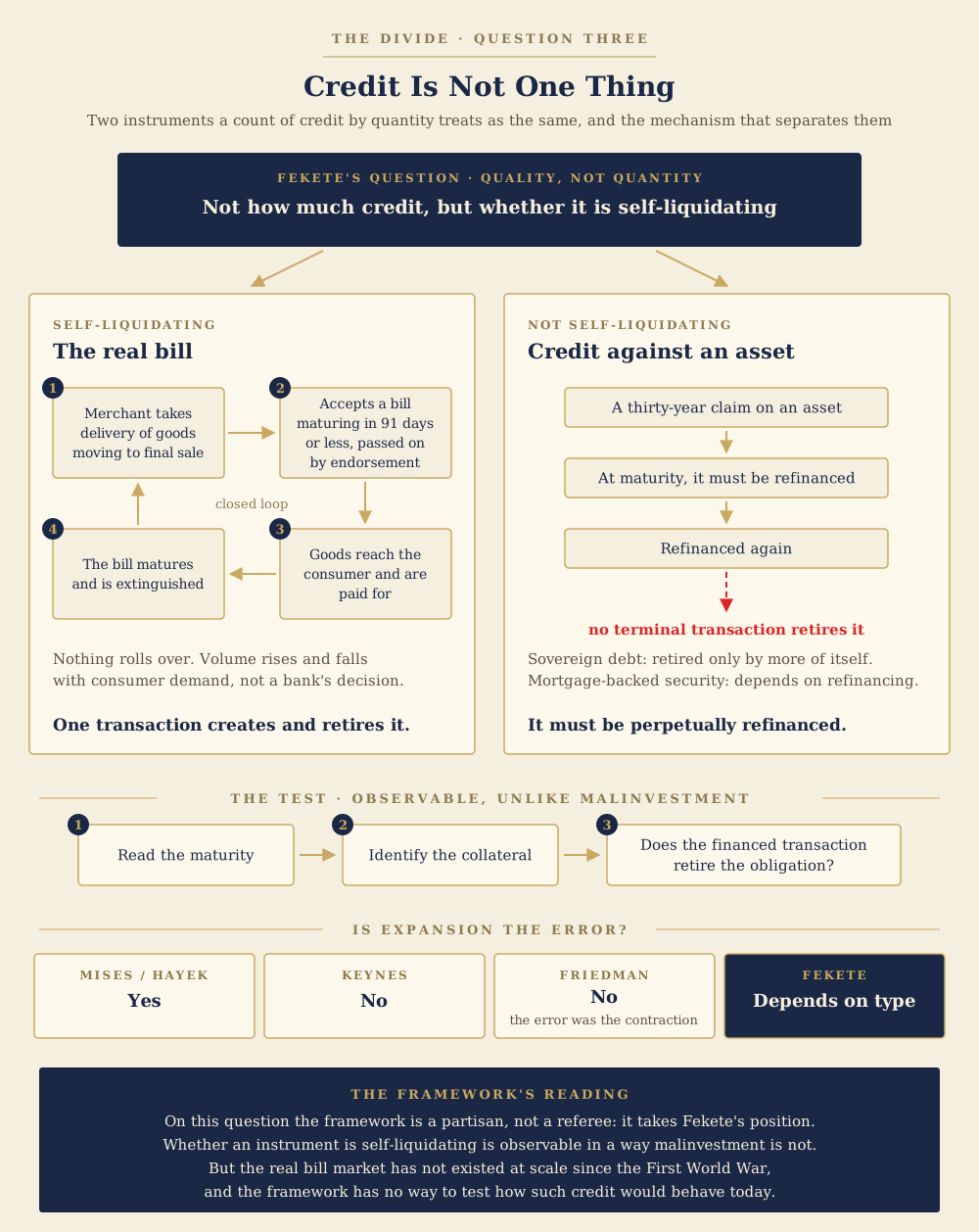
Fekete's position is that the preceding three arguments share a defective premise — that credit can be treated as homogeneous and measured by quantity. His counter-claim is that the relevant variable is quality, specifically whether credit is self-liquidating. 6
The paradigm case is the real bill. A merchant takes delivery of goods already moving toward final sale and accepts a bill of exchange maturing in ninety-one days or less. The bill circulates by endorsement. When the goods reach the consumer and are paid for, the bill matures and is extinguished. Nothing rolls over, because the transaction that created the credit is the transaction that retires it.
Fekete's claim is that this is not credit expansion in the sense the business cycle theory describes, and he puts it sharply: it is "a major misconception to think that real bills involve lending and borrowing." 7 No one saves, no one borrows, and the volume of such credit rises and falls automatically with consumer demand rather than with any bank's decision.
The intramural fight. Mises rejected the Real Bills Doctrine. Rothbard rejected it more forcefully. Fekete's response is that in doing so they departed from the founder of their own school:
"Menger did not castigate commercial banks by calling them by the derogatory name 'fractional reserve banks' for covering part of their note and deposit liability by real bills maturing in gold coin in 91 days or less; Mises did. Menger fully accepted Adam Smith's Real Bills Doctrine; Mises rejected it." 7
He goes further, holding that the Great Depression was caused in substantial part by the disappearance of the real bill market after the First World War — precisely inverting the orthodox Austrian account, in which the Depression corrects a prior inflationary boom. 7
The strongest version: a theory that counts credit by quantity cannot distinguish a ninety-one-day claim on goods already sold to a consumer from a thirty-year claim on an asset that must be refinanced. Those two instruments behave differently in a crisis, and treating them as the same quantity discards the information that matters.
Where the four conflict
| Mises / Hayek | Keynes | Friedman | Fekete | |
|---|---|---|---|---|
| Is expansion the error? | Yes | No | No | Depends on type |
| Is the bust necessary? | Yes | No | No | Depends |
| Correct response to bust | Allow liquidation | Fiscal expansion | Prevent monetary contraction | Restore self-liquidating credit |
| What matters about credit | Quantity vs. saving | Effect on demand | Quantity (money stock) | Quality (self-liquidating or not) |
| Cause of the Depression | Prior malinvestment | Demand collapse | Monetary contraction | Loss of the bill market |
Two of these disagreements are decidable in principle and one is not.
Decidable: what happened in the 1930s. Friedman and Schwartz produced the monetary data, and the one-third contraction is not seriously contested as a fact. What remains contested is whether it was cause or consequence — whether the Fed failed to act or whether the collapse of credit quality made the contraction unavoidable.
Decidable in principle: whether self-liquidating credit behaves differently. This is an empirical question about instrument behavior, and the data to answer it existed before 1914. It has not been answered to anyone's satisfaction, partly because the instrument largely ceased to exist.
Not decidable: whether the boom's malinvestment is real. Malinvestment is defined counterfactually — it is investment that would not have occurred at the natural rate — and the natural rate is unobservable. This is the Austrian theory's deepest methodological problem and it is not resolved by any amount of data.
What the framework adds, and where it is a partisan
The framework takes Fekete's position, which means that on this question it is not a neutral surveyor. Readers should weigh it accordingly.
What it adds: a distinction that survives the measurement problem. Whether a given instrument is self-liquidating is observable in a way that malinvestment is not. One can read the maturity, identify the collateral, and determine whether the financed transaction retires the obligation. The catalog applies exactly this test to sovereign debt — which is not self-liquidating, must be perpetually refinanced, and is retired only by the issuance of more of itself.
What it adds: an explanation of the 2008 pattern that quantity theories struggle with. The instruments that failed were not distinguished by quantity. They were distinguished by whether the underlying claim could extinguish itself. A mortgage-backed security has no terminal transaction that retires it; it depends on refinancing and on asset price levels. That is a quality distinction, and it is the one the crisis actually turned on.
Where it is exposed, and these are serious.
The orthodox Austrian objection is direct. Robert Blumen, writing on Fekete's proposal in 2005, placed it in a lineage: "As with all inflationist theories, the alleged benefit is that an increase in the quantity of paper claims enables the production of more wealth." 8 The charge is that self-liquidating credit is a distinction without a difference, since the bills circulate as purchasing media and add to the broad money supply regardless of how they are retired.
The historical objection is worse. The Real Bills Doctrine was not merely theorized — it was the operating philosophy of the Federal Reserve in the 1920s and 1930s, and it has been blamed for the Fed's failure during the contraction. Humphrey and Timberlake's Gold, the Real Bills Doctrine, and the Fed (2019) argues that the doctrine's needs-of-trade logic justified allowing the money stock to shrink as output fell, converting a downturn into a collapse. 9 The reply that follows from Fekete's position is that what the Fed practiced was not the doctrine — that the Fed accepted bills not backed by goods in urgent consumer demand 10 — but a reader should notice that this reply has the structure of a no-true-doctrine defense.
And the framework's own acknowledgment: the real bill market has not existed at scale since the First World War. Every claim about how such credit would behave in a modern economy is an extrapolation from pre-war evidence, and the framework has no way to test it.
What to read next
Within The Divide: the next question — What does a falling rate structure do to capital? — is where the framework's distinctive claim is sharpest and where it diverges from all three of the other schools at once.
In the Atlas: the concept pages on real bills and self-liquidating credit and the business cycle.
In the Forum: The Golden Triangle develops the Golden Triangle, of which real bills is the second pillar. The Exchange That Isn't applies the self-liquidation test to sovereign debt and finds it fails. Both Sides of the Cushion traces credit from a paycheck to a data center.
Sources
A note on partisanship. On most questions in this series the framework can present the schools and then state its own position as one among several. On this question it is a participant in a live dispute within the Austrian tradition, and the orthodox objections summarized above are not strawmen — they are the arguments of serious people who have read the same texts. A reader who finds Blumen and Timberlake more persuasive than Fekete has not misread the evidence.
Footnotes
-
Hayek, Friedrich A. Prices and Production (1931), in Prices and Production and Other Works, Mises Institute. https://cdn.mises.org/prices_and_production_and_other_works.pdf — for credit expansion as a change in the structure of production rather than its level. ↩
-
Mises, Ludwig von. Human Action (1949), Chapter XX, "Interest, Credit Expansion, and the Trade Cycle," section 9. https://mises.org/online-book/human-action/chapter-xx-interest-credit-expansion-and-trade-cycle/9-market-economy-affected-recurrence-trade-cycle — for malinvestment as the boom's misdirection of scarce factors of production. ↩
-
Keynes, John Maynard. The General Theory of Employment, Interest and Money (1936), Chapter 10, "The Marginal Propensity to Consume and the Multiplier." https://www.marxists.org/reference/subject/economics/keynes/general-theory/ch10.htm — for the multiplier. ↩
-
Friedman, Milton and Anna Jacobson Schwartz. "The Great Contraction, 1929–33," Chapter 7 of A Monetary History of the United States, 1867–1960 (1963), reprinted by NBER (1965). https://www.nber.org/system/files/chapters/c9273/c9273.pdf — for the money stock falling by over a third from August 1929 to March 1933. ↩ ↩2
-
Bernanke, Ben S. "On Milton Friedman's Ninetieth Birthday." Federal Reserve Board, November 8, 2002. https://www.federalreserve.gov/boarddocs/speeches/2002/20021108/ — for the Federal Reserve's acceptance of the Friedman–Schwartz account. ↩
-
Fekete, Antal E. "Fractional Reserve Banking Revisited," addendum to Monetary Economics 101: The Real Bills Doctrine of Adam Smith. February 16, 2004. https://www.gold-eagle.com/article/fractional-reserve-banking-revisited — for real bills as self-liquidating, "paid at maturity with the gold coin of the final consumer." ↩
-
Fekete, Antal E. "Dr. Antal Fekete: Blowing Up Modern Austrian Economics… in a Good Way," The Daily Bell, posted January 11, 2015. https://thedailybell.com/all-articles/gold-silver/anthony-wile-dr-antal-fekete-blowing-up-modern-austrian-economics-in-a-good-way/ — for the lending-and-borrowing passage, the Menger–Mises passage, and the blocking of the bill market after 1918 as the cause of the Depression. ↩ ↩2 ↩3
-
Blumen, Robert. "Real Bills, Phony Wealth: An Error in Fekethmetic." LewRockwell.com, October 12, 2005. https://www.lewrockwell.com/2005/10/robert-blumen/an-error-in-fekethmetic/ — for the quoted passage. ↩
-
Humphrey, Thomas M. and Richard H. Timberlake. Gold, the Real Bills Doctrine, and the Fed: Sources of Monetary Disorder, 1922–1938. Cato Institute, 2019. https://www.cato.org/books/gold-real-bills-doctrine-fed-sources-monetary-disorder-1922-1938 — for the real bills doctrine as the Fed's operating philosophy and the source of the money stock's collapse. ↩
-
Fekete, Antal E. "Dr. Antal Fekete Discusses the Controversial Real Bills Doctrine and Free-Banking," The Daily Bell, May 3, 2009. https://thedailybell.com/all-articles/exclusive-interviews/anthony-wile-dr-antal-fekete-discusses-the-controversial-real-bills-doctrine-and-free-banking/ — for real bills as finance for goods in most urgent consumer demand, excluding accommodation bills, treasury bills, and other "fake bills." ↩