
Researched and drafted with AI assistance · reviewed and edited by Jason D. Keys
A question most economists would not recognize as open
The three preceding installments examined questions where the disagreement is visible — where a reader can find the schools arguing with each other in print.
This one is different. The orthodox answer is so widely shared that it functions as an assumption rather than a position, and the dissent this page develops is held by a small enough group that most working economists have never encountered it.
That asymmetry is a reason for caution, not for excitement. A claim rejected by nearly everyone is usually rejected for good reasons. What follows presents the orthodox position at full strength first, and states clearly what would have to be true for the dissent to be correct.
The orthodox answer: falling rates create capital
Three independent lines of reasoning converge on the same conclusion.
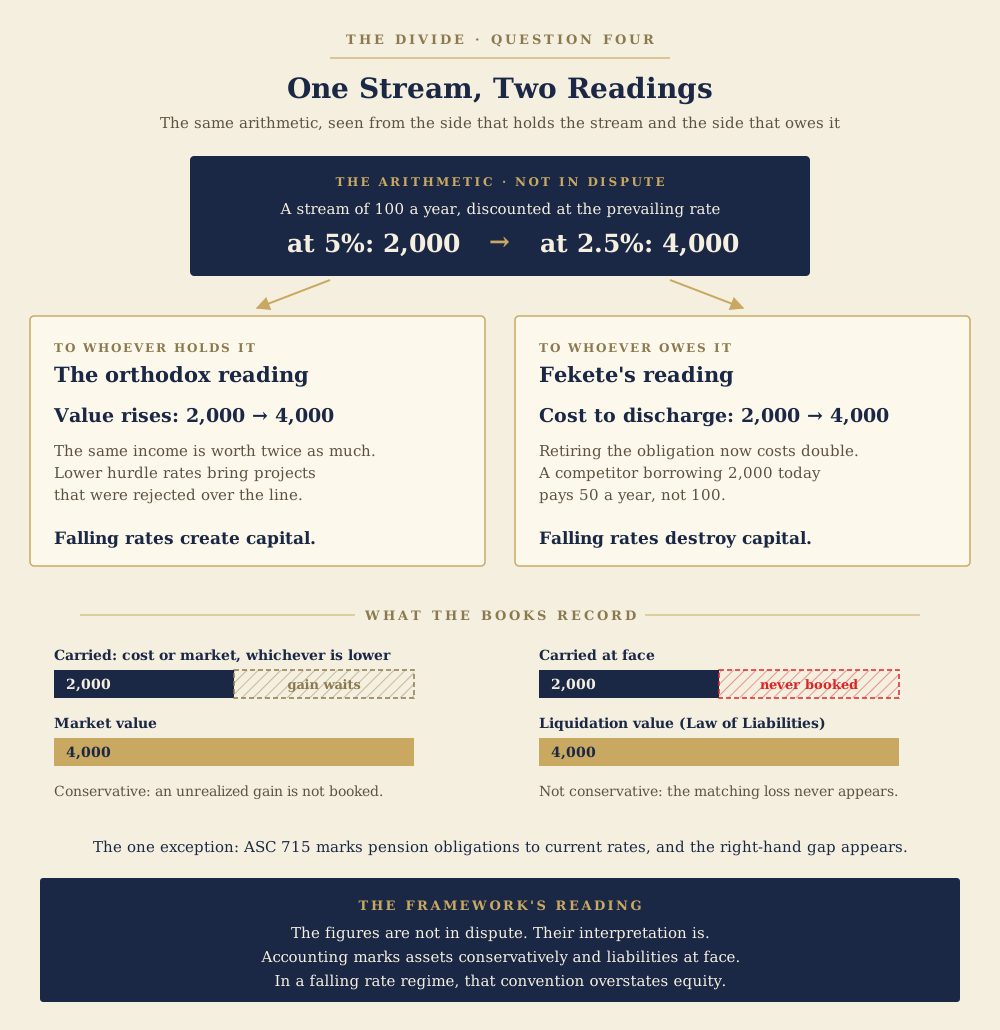
The valuation argument. The present value of any future cash flow is that flow discounted at a rate. Lower the rate and the present value rises, mechanically and by arithmetic. A perpetuity paying one hundred currency units annually is worth two thousand at five percent and four thousand at two and a half. This is not a theory; it is the definition of present value, and it underlies every discounted cash flow model in use.
The hurdle rate argument. A firm undertakes a project when its expected return exceeds its cost of capital. Falling rates lower the hurdle, so projects previously rejected become viable. The stock of capital in the economy should therefore rise.
Keynes's mechanism. The General Theory supplies the formal version. The marginal efficiency of capital is the discount rate that equates the present value of an asset's expected returns to its supply price. Investment proceeds until the marginal efficiency of capital equals the rate of interest. 1 Lower the rate and investment extends further down the schedule.
The policy conclusion follows directly, and it has been the operating assumption of every major central bank for four decades: when investment is insufficient, lower rates.
The strongest version: this is not a school's opinion. It is arithmetic plus a behavioral premise that is almost tautological — firms invest when returns exceed costs, so reduce costs and you get more investment.
The Austrian qualification
The Austrian tradition does not deny the mechanism. It denies that the resulting investment is sound when the rate decline is artificial.
As the third installment of this series developed, a money rate driven below the natural rate signals an availability of real resources that does not exist. Investment extends into longer production processes that cannot be completed, because the savings to sustain them were never made. The capital stock appears to grow and is subsequently revealed not to have.
But notice the scope of this dissent. It concerns which investments occur and whether they can be completed. It does not claim that falling rates destroy capital that already exists and was soundly deployed. An Austrian analyzing a firm that borrowed sensibly at a market rate, invested in a genuinely productive asset, and operates it profitably would say that firm is unaffected by subsequent rate movements except through ordinary channels.
The strongest version: falling rates misallocate. They do not expropriate.
Fekete's dissent: falling rates destroy capital directly
Fekete's claim is categorically different, and The Bookkeeper's Dilemma develops it at length. His position is that a falling interest-rate structure destroys capital regardless of whether the original investment was sound, through a mechanism that conventional accounting does not record.
The argument. Begin with the treatment of assets. Under the historic Law of Assets, an asset is carried at acquisition cost or market value, whichever is lower — the conservative convention, which recognizes losses promptly and gains only on realization.
Fekete argues there is a symmetric principle governing the other side of the balance sheet, which he calls the Law of Liabilities: a liability should be carried at face value at maturity or at its liquidation value — what it would actually cost to discharge today — whichever is higher. 2
Now consider what a falling rate does to a fixed-rate obligation. A firm borrows ten million at six percent. Rates fall to three. The firm's contractual position has not changed, and conventional accounting records nothing. But the cost of extinguishing that obligation has risen substantially, because retiring a six percent liability in a three percent world means purchasing a bond stream that now commands a premium. A competitor financing the identical asset today does so at half the interest cost.
The first firm has suffered a real economic loss relative to the second, and no accounting standard requires it to be recorded. Fekete's conclusion is that this loss compounded silently across the decades-long decline in the rate structure, and that what was recorded as profit during those decades was in part the non-recognition of this destruction. 3
The strongest version: the asymmetry is real. Accounting marks assets conservatively and liabilities at face. In a falling rate regime, that convention systematically overstates equity, and the error accumulates.
The one place the standards concede it
The argument above would be easier to dismiss if no accounting body had ever adopted it. One has, in one domain.
Under ASC 715, defined benefit pension obligations are measured by discounting projected benefit payments at current market rates, remeasured at each measurement date with no smoothing of the obligation itself. 4 That is Fekete's Law of Liabilities, codified — a liability marked to what it would cost to discharge at prevailing rates.
And the consequence is visible in the data. The aggregate funded status of large United States corporate pension plans failed to recover across the post-2008 period despite strong asset returns, and the actuarial literature attributes the shortfall principally to falling discount rates rather than to investment losses. 5 The obligations grew because rates fell.
Pension actuaries describe this as "underfunding" and treat it as a measurement artifact of the discount rate. Fekete's framework describes the same number as capital destruction made visible. The figures are not in dispute. Their interpretation is. The Bookkeeper's Dilemma develops this at length and treats it as the framework's strongest available evidence.
Where the positions conflict
| Orthodox | Austrian | Fekete | |
|---|---|---|---|
| Falling rates raise asset values | Yes | Yes | Yes |
| Falling rates stimulate investment | Yes | Yes, wrongly | Yes, but misleadingly |
| Falling rates destroy existing capital | No | No | Yes |
| Does soundness of the original investment matter? | n/a | Yes — malinvestment is the mechanism | No — operates regardless |
| Is the loss recorded? | No loss to record | Recorded at the bust | Never recorded |
The decisive disagreement is in the fourth row, and it is what makes Fekete's position distinct rather than a variant of the Austrian one. Malinvestment requires an error at the moment of investment. Fekete's mechanism requires none — it operates on a firm that did everything correctly.
That independence is the claim's strength and its vulnerability. It explains why the 1981–2020 period produced a buyback boom rather than an investment boom despite forty years of falling rates, which the orthodox view struggles with. It also means the loss is unobservable in any conventional statement, which makes it nearly unfalsifiable.
What the framework adds
The pension connection, which Fekete did not make. Fekete articulated the Law of Liabilities as a principle that accounting had never codified. The catalog's contribution is identifying that ASC 715 implements it — that the destruction has been measured continuously for two decades under a different name, by actuaries who do not connect it to any monetary theory. If the framework is right about anything, this is the strongest candidate.
The reversal implication. If falling rates destroy capital unrecorded, a rising rate structure should repair it by running the mechanism backward. The catalog has made that a falsifiable claim with a published threshold and tracks it in the Forum.
The measurement path. The framework has proposed computing the gap between the fair value and carrying value of corporate fixed-rate debt, which public companies disclose in their footnotes 6 — a figure that is in principle extractable from filings and would make the argument quantitative rather than theoretical.
Where the framework is exposed
Almost nobody agrees. This is not a minority position within a live debate. It is a position held by a handful of people and not engaged by the mainstream at all. That is weak evidence against it, but it is evidence, and a reader should want to know why a correct and consequential argument has persuaded so few.
Most of the evidence is interpretive. The pension data is real, but reading it as capital destruction rather than as a discount-rate artifact is an interpretation, and the actuaries who produce the numbers do not share it. The framework's strongest evidence is a different reading of numbers that already have a conventional explanation.
The "unrecorded loss" structure resists falsification. A loss that appears in no statement, by hypothesis, cannot be checked against statements. The proposed fair-value-versus-carrying-value measurement is the framework's answer and it has not yet been executed. Until it is, the argument rests on a mechanism rather than a measurement.
The orthodox reply is not foolish. A defender can say that the firm which borrowed at six percent locked in a known cost and received the funds it wanted, and that the appearance of a loss comes from comparing its position to a counterfactual it never had access to. Fekete's answer is that the comparison is not counterfactual — the competitor financing at three percent is a real competitor in a real market. Whether that answer is sufficient is genuinely arguable.
What to read next
Within The Divide: the next question — Can you measure any of this? — bears directly on the problem just identified, since a theory whose central quantity appears in no statement has a measurement problem by construction.
In the Atlas: the concept pages on the theory of interest and the business cycle.
In the Forum: The Bookkeeper's Dilemma develops this argument in full, including the ASC 715 identification and the historical case. Operation Twist Without the Fed examines the Treasury's attempt to contain the long end. Three Hands on the Dial treats the rate structure as a contested variable with three institutions acting on it.
Sources
A note on confidence. This page presents a position that the overwhelming majority of economists reject or have never considered. The framework believes it is correct and has said why, and has also stated plainly that its strongest evidence is a reinterpretation of figures with an accepted conventional explanation, and that the central quantity it describes appears in no financial statement. A reader should treat the argument as serious and unproven rather than as established.
Footnotes
-
Keynes, John Maynard. The General Theory of Employment, Interest and Money (1936), Chapter 11, "The Marginal Efficiency of Capital." https://www.marxists.org/reference/subject/economics/keynes/general-theory/ch11.htm — for the definition of the marginal efficiency of capital and investment pushed to the point where it equals the rate of interest. ↩
-
Fekete, Antal E. "The Revisionist Theory and History of Depressions," June 29, 2009. https://professorfekete.com/articles/AEFRevisionistTheoryHistoryOfDepressions.pdf — for the Law of Assets, the Law of Liabilities, and Fekete's statement that the latter has never been codified. ↩
-
Fekete, Antal E. Monetary Economics 102: Gold and Interest, Lecture 5, "The Pentagonal Model of Capital Markets," February 1, 2004, section "Falling Interest: Good or Bad?" https://professorfekete.com/articles/AEFMonEcon102Lecture5.pdf — for falling rates leaving business financed at rates far too high, the unrecorded loss, and the payout of phantom profits. ↩
-
PricewaterhouseCoopers. Pensions and employee benefits guide, section 2.4, "Financial assumptions when measuring the plan obligation." https://viewpoint.pwc.com/dt/us/en/pwc/accounting_guides/pensions-and-employee-benefitspeb/peb_guide/Chapter-2-PEB/2_4_Financial_assumptions_when_measuring_the_plan_obligation.html — for ASC 715-30-35-43, discount rates reflecting the rates at which benefits could be effectively settled, reset to current market information at each measurement date. ↩
-
Ehrhardt, John W., Zorast Wadia and Alan Perry. Milliman 2012 Pension Funding Study, March 2012. https://edge.sitecorecloud.io/millimaninc5660-milliman6442-prod27d5-0001/media/Milliman/importedfiles/uploadedFiles/insight/eb-published/2012pensionfundingstudypdf.pdf — for the Milliman 100 funded ratio of 105.2 percent at year-end 2007 and 79.2 percent at year-end 2011, and liability increases of 8.1, 7.8 and 9.3 percent in 2009–2011 attributed to falling discount rates. ↩
-
Deloitte. Roadmap: Fair Value Measurements and Disclosures, section 11.3, "Examples of Financial Instruments Subject to the Disclosure Requirements of ASC 825-10-50-10." https://dart.deloitte.com/USDART/home/codification/broad-transactions/asc820-10/roadmap-fair-value-measurements-disclosures/chapter-11-disclosure/11-3-examples-financial-instruments-subject — for long-term debt among the instruments whose fair value public business entities must disclose. ↩