
Researched and drafted with AI assistance · reviewed and edited by Jason D. Keys
The question underneath the others
The four preceding installments presented disagreements about what interest is, what money is, what credit expansion does, and what a falling rate structure does to capital. Every one of them assumed, tacitly, that the relevant quantities can be observed.
This installment asks whether that assumption holds, and it is the question with the widest consequences. If the price level is measurable, inflation targeting is coherent. If capital can be aggregated, the natural rate of interest is a quantity rather than a metaphor. If economic output is a number, stabilization policy has a target.
And if these things are not measurable in the way the policy apparatus requires, then a great deal of what is done with them is theater, regardless of which school is otherwise correct.
This page is also the one where the framework developed on this site is most obliged to turn the question on itself, because a framework that doubts official statistics while scoring dated predictions against those same statistics owes the reader an account of how both can be true.
The problem, stated concretely
Suppose you want to know whether prices rose last year.
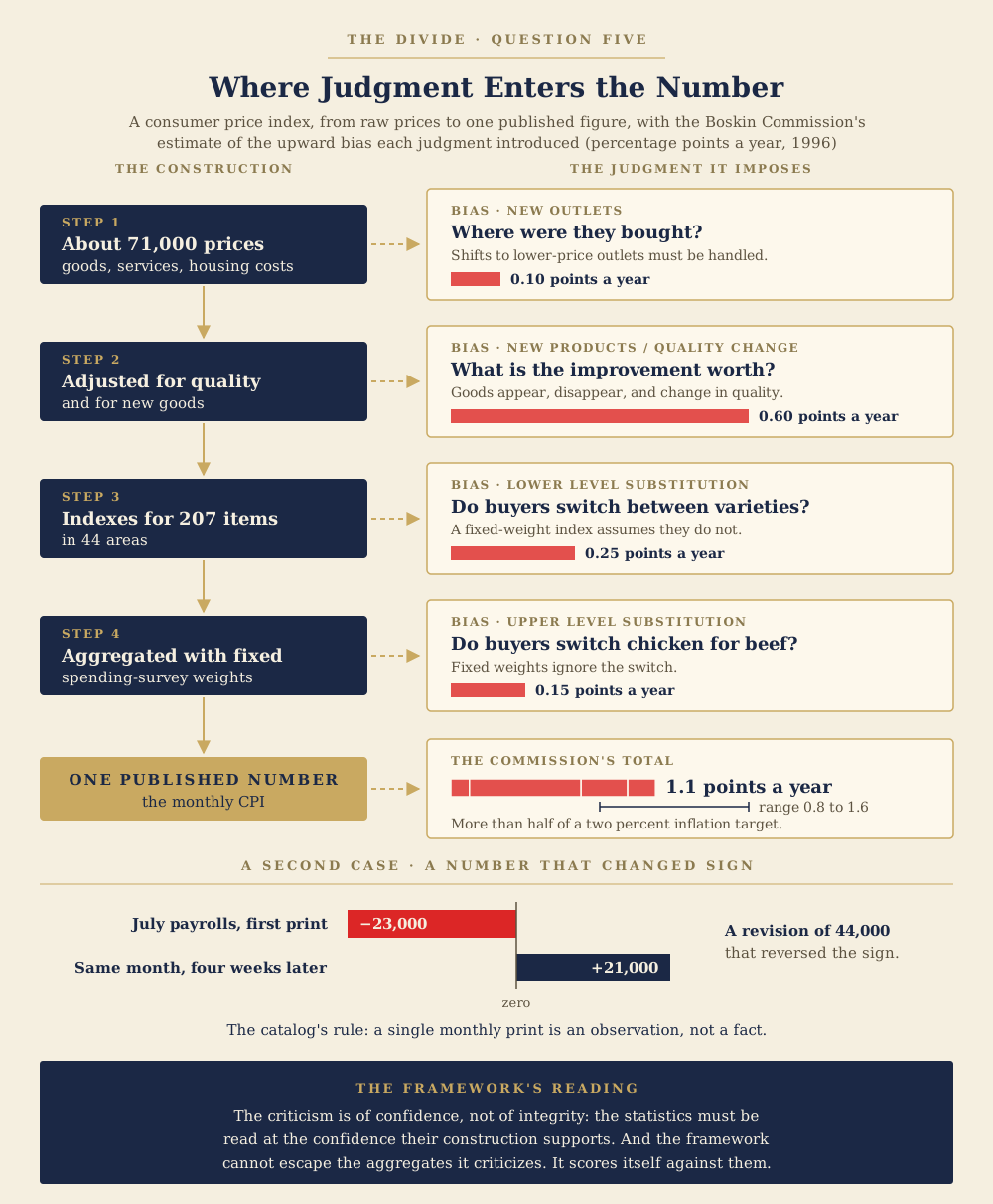
You must first decide which prices, since they did not move together. Then you must weight them, which requires knowing how much of each good people buy — information that changes partly because prices changed. Then you must handle goods that did not exist last year, goods that disappeared, and goods whose quality changed. A smartphone that costs the same as last year's but does more has fallen in price in some sense and not in another, and the adjustment for that — hedonic quality adjustment — requires a judgment about how much the improvement is worth.
None of these steps has a uniquely correct answer. This is the index number problem, and it is not a deficiency of any particular statistical agency. It is a property of the task.
The scale of the resulting discretion is documented. The Boskin Commission, appointed by the United States Senate Finance Committee, reported in December 1996 that the Consumer Price Index overstated inflation by approximately 1.1 percentage points annually, attributing the bias to substitution effects, outlet substitution, quality change, and new product introduction. 1 The report led to methodological changes still in use. 2
Hold that figure next to the policy apparatus built on it. A central bank targeting two percent inflation is calibrating to a quantity that a federal commission concluded was mismeasured by more than half the target. 3
Answer one: calculation requires prices, and aggregates destroy them
Mises.
Mises's argument in Economic Calculation in the Socialist Commonwealth (1920) is usually read as a critique of central planning, but its foundation is a claim about measurement. 4
Rational allocation requires comparing heterogeneous things — a ton of steel against a hectare of timber against a thousand hours of labor. There is no physical unit in which these are commensurable. The only thing that makes them comparable is a price, and prices arise only from exchange between owners making bids and offers.
The implication for aggregates is direct. A statistic that sums heterogeneous goods has already presupposed the prices that make the sum possible. It cannot be used to evaluate those prices, because it is constructed from them, and the weighting is a judgment imposed by the statistician rather than a fact discovered in the data.
The strongest version: an aggregate is not a measurement of the economy. It is a construction whose inputs include decisions no measurement validates.
Answer two: the knowledge is not assemblable
Hayek.
Hayek's "The Use of Knowledge in Society" (1945) makes a claim that is harder than Mises's and more consequential. 5
The knowledge relevant to economic coordination, he argues, is not scientific knowledge of general rules. It is "the knowledge of the particular circumstances of time and place" — the shipper who knows a vessel is half empty, the dealer who knows a local arbitrage, the manager who knows of a machine not fully employed. This knowledge is dispersed across millions of people, is frequently inarticulate, and in many cases exists only as a disposition to act rather than as a statement anyone could transmit.
It therefore cannot be collected. Not because collection is expensive, but because the knowledge does not exist in a form that permits it.
What the price system does, in Hayek's account, is allow this knowledge to be used without being assembled. A price change tells a participant to economize on something without telling him why, and the system coordinates behavior through a signal that carries almost no information about its own causes. He calls it "a mechanism for communicating information" and regards it as a marvel precisely because it accomplishes coordination without comprehension.
The strongest version: the measurement problem is not a data problem. It is a problem about what kind of thing the relevant information is.
Answer three: judge theories by predictions, not assumptions
Friedman.
Friedman's "The Methodology of Positive Economics" (1953) takes the opposite view and became the dominant methodology of postwar economics. 6
His argument is that the realism of a theory's assumptions is irrelevant to its validity. Theories are instruments for generating predictions; a theory with transparently false assumptions that predicts well is a good theory, and one with realistic assumptions that predicts poorly is not. His illustration is that expert billiard players behave as if they solved complex equations, and the theory that models them as doing so is useful regardless of whether they do.
Applied to measurement, the position is that the imperfection of aggregates does not disqualify them. The question is whether models built on them predict. If a monetary aggregate forecasts nominal income, its construction difficulties are a second-order concern.
This methodology is why postwar economics became an empirical discipline, and it underwrites essentially all contemporary macroeconomic practice.
The strongest version: every measurement in every science is imperfect. The standard is usefulness, not correspondence, and a critique that demands perfect measurement would end physics as well as economics.
The framework's own problem
A framework that criticizes official measurement while making dated, falsifiable predictions scored against official statistics has a consistency problem, and this page states it rather than evading it.
The catalog's essay The Sign Flip examined a concrete case. A monthly employment figure was published showing a decline of twenty-three thousand jobs; four weeks later the same agency revised it to a gain of twenty-one thousand. 7 A revision of forty-four thousand that reversed the sign of the number. The article's argument was that the failure was in the reading rather than in the statistics — a survey point estimate with a confidence interval spanning zero had been treated as a count — and it derived a rule: a single monthly print is an observation, not a fact.
But notice what that rule concedes. It does not say the statistics are worthless. It says they must be read at the confidence their construction supports.
That is the framework's position and it is a narrower one than monetary-reform commentary usually takes. Specifically:
The framework uses official statistics and will continue to. Its scorecard is kept against Bureau of Labor Statistics releases, Treasury yields, and Federal Reserve data. It has no alternative source and does not claim to.
Its criticism is of confidence rather than of integrity. The catalog does not argue that agencies falsify data. It argues that preliminary estimates are treated as final, that construction choices embedding judgments are presented as discoveries, and that the apparatus consuming these figures discards the uncertainty the agencies themselves publish.
It prefers quantities with fewer construction decisions. A Treasury yield is a price observed in a market. A payroll estimate is a survey extrapolation. A consumer price index is a weighted construction with hedonic adjustments. These are not equally robust objects, and the framework weights them accordingly — which is why its published falsification thresholds are stated in yields rather than in index levels.
Where the answers conflict
| Mises | Hayek | Friedman | Framework | |
|---|---|---|---|---|
| Can aggregates be constructed? | Only by imposing judgments | Not meaningfully | Yes, well enough | Yes, with stated uncertainty |
| Why not? | No common unit without prices | Knowledge is dispersed and tacit | n/a | Construction choices accumulate |
| Standard for a theory | Logical derivation from action | Explanatory adequacy | Predictive accuracy | Dated falsifiable claims |
| Use official statistics? | Skeptically | Skeptically | Centrally | Yes, read at low confidence |
The genuine conflict is between Friedman and the other three, and it is methodological rather than empirical. Friedman's instrumentalism makes measurement adequacy a practical question settled by whether predictions work. Mises and Hayek make it a logical and epistemic question that cannot be settled that way.
The framework's position is awkwardly between them, and it should say so: it accepts Friedman's standard — dated predictions, scored — while accepting Hayek's warning about what the aggregates can carry. Whether those are consistent is a fair question. The framework's answer is that a prediction stated in observed market prices rather than constructed indices satisfies both, and that this is why its thresholds are written the way they are.
Where the framework is exposed
It cannot escape the aggregates it criticizes. When this catalog cites an inflation rate, it cites the index it has criticized. There is no parallel measurement system, and claiming one would be worse than the problem.
The preference for market prices has limits. A Treasury yield is observed rather than constructed — but as Operation Twist Without the Fed and Three Hands on the Dial document, that yield is currently being acted upon by a central bank, by the issuer of the securities, and by an executive stating a target. A price produced under those conditions is not the clean observation the framework prefers it to be, and the framework has argued precisely this at length. It cannot then treat the same price as its most reliable instrument without acknowledging the tension.
Hayek's argument cuts against the framework too. If dispersed knowledge cannot be assembled, that applies to a framework attempting to characterize the economy's capital structure as much as it applies to a central planner. The catalog's claims about unrecorded capital destruction are claims about an aggregate, and the Hayekian objection does not spare them.
What to read next
Within The Divide: the final question — What should a central bank do? — depends on this one, since every policy rule requires a measurable target.
In the Atlas: the concept page on the price signal develops Hayek's dispersed-knowledge argument. In the Library: Mises's chapter on the sphere of economic calculation sets out the case for calculation in money prices.
In the Forum: Aggregates That Lie argues that official aggregates conceal through their construction. The Sign Flip argues the sharper version — that the problem is also when they are believed — and sets out four rules the catalog holds itself to. Scoring the Board applies those rules to its own prior claims and scores one of them as a loss and another as withdrawn with the data it rested on.
Sources
A note on self-application. This page is the one in the series where the framework's own practice is most directly at stake. It criticizes the confidence placed in official statistics and simultaneously keeps a public scorecard against them. The resolution offered — that the criticism concerns confidence rather than integrity, and that predictions stated in observed market prices are more robust than those stated in constructed indices — is the best the framework has. A reader who finds it insufficient is holding the framework to its own standard, which is the correct thing to do.
Footnotes
-
Advisory Commission to Study the Consumer Price Index (the Boskin Commission). Toward a More Accurate Measure of the Cost of Living, Final Report to the Senate Finance Committee, December 4, 1996. https://www.ssa.gov/history/reports/boskinrpt.html — for the 1.1 percentage point annual bias estimate and its four sources. ↩
-
U.S. Bureau of Labor Statistics. "How Have We Improved the Consumer Price Index? Let Me Count the Ways," Commissioner's Corner, April 7, 2020. https://www.bls.gov/blog/2020/how-have-we-improved-the-consumer-price-index-let-me-count-the-ways.htm — for the post-Boskin methodology changes, including the 1999 switch to geometric means, that remain in the CPI. ↩
-
Federal Open Market Committee. "Statement on Longer-Run Goals and Monetary Policy Strategy," January 25, 2012. https://www.federalreserve.gov/newsevents/pressreleases/monetary20120125c.htm — for the 2 percent target, defined on the price index for personal consumption expenditures, which draws largely on the same price data as the CPI. ↩
-
Mises, Ludwig von. Economic Calculation in the Socialist Commonwealth (1920), translated by S. Adler. Mises Institute PDF: https://cdn.mises.org/economic_calculation_in_the_socialist_commonwealth.pdf — for the argument that rational allocation requires money prices; developed further in Human Action (1949), Part Three, "Economic Calculation," https://mises.org/online-book/human-action/part-three-economic-calculation ↩
-
Hayek, Friedrich A. "The Use of Knowledge in Society." American Economic Review 35, no. 4 (September 1945): 519–530. https://www.econlib.org/library/Essays/hykKnw.html — for "the knowledge of the particular circumstances of time and place," the shipper and arbitrageur examples, and the price system as "a mechanism for communicating information." ↩
-
Friedman, Milton. "The Methodology of Positive Economics," in Essays in Positive Economics, University of Chicago Press, 1953, pp. 3–43. https://press.uchicago.edu/ucp/books/book/chicago/E/bo25773835.html — for judging theories by their predictions rather than the realism of their assumptions, and the expert billiard player. ↩
-
U.S. Bureau of Labor Statistics. The Employment Situation — August 2026, September 4, 2026. https://www.bls.gov/news.release/archives/empsit_09042026.htm — for the revision of July payrolls from −23,000 to +21,000. ↩