
Researched and drafted with AI assistance · reviewed and edited by Jason D. Keys
Where the series arrives
The five preceding questions concerned what things are: money, interest, credit expansion, the effect of a falling rate structure, and whether any of it can be measured. This one concerns what should be done, and it is where the earlier disagreements become operational.
The connections are direct. If credit expansion misdirects capital, a central bank should not expand credit. If the economy can settle at persistent unemployment, it should. If the relevant quantities cannot be measured, a bank cannot target them regardless of what it should want. Someone who has read the preceding pages can predict most of what follows.
What a reader cannot predict is where the disagreements stop being about facts. Several do, and this page says which.
Answer one: stabilize, with discretion
The Keynesian position.
If an economy can settle at an equilibrium with persistent unemployment — the central claim of the General Theory — then a central bank that does nothing is choosing that equilibrium. 1 The institution exists because the alternative is a market that clears at a level nobody wants and that no price adjustment corrects.
Discretion is essential to this position rather than incidental. Shocks differ; a rule calibrated to the last crisis will be wrong about the next. The case for judgment is that the conditions requiring intervention are precisely those that a rule written in advance did not anticipate.
The modern expression is the dual mandate, under which the Federal Reserve is directed to pursue both maximum employment and stable prices, with the tradeoff resolved by the committee's judgment rather than by formula.
The strongest version: the 1930s happened. An institution capable of acting and declining to act is not neutral.
Answer two: follow a rule, because you cannot know enough
Friedman.
Friedman accepted that monetary policy is powerful and concluded from that premise the opposite of the Keynesian position. 2
His argument rests on long and variable lags. A policy action affects output and prices after a delay that is both substantial and unpredictable in length. An authority responding to current conditions is therefore acting on information that will be stale when its action takes effect — and may well be stimulating into a recovery already underway, or tightening into a downturn that has already begun.
The conclusion is that discretionary policy is not merely imperfect but destabilizing. The authority becomes a source of fluctuation rather than a damper on it.
Friedman's proposal was the k-percent rule: expand the money supply at a constant annual rate, publicly announced, regardless of conditions. The rule's virtue is not that it is optimal in any period. It is that it removes the authority's capacity to make things worse and gives the private sector a fixed parameter to plan against.
The strongest version: the case for a rule does not require believing the authority is foolish. It requires only that the lags are longer than the forecast horizon, which is an empirical claim with substantial support.
Answer three: a rule that responds
Taylor.
John Taylor's 1993 paper proposed a formulation that splits the difference and has been enormously influential as description and as benchmark. 3
The rule sets the policy rate as a function of observed inflation relative to target and output relative to potential, with specified coefficients. It is a rule — mechanical, transparent, checkable — but unlike Friedman's it responds to conditions.
Taylor's finding was partly descriptive: the Federal Reserve's actual behavior during periods widely judged successful approximated the rule reasonably well, while departures coincided with periods judged less successful. 4 The policy conclusion is that the gains from discretion are small and the risks are not.
The strongest version: this is the position that works in practice, and it is approximately what most central banks do, whether or not they describe themselves this way.
Answer four: the institution should not exist
Rothbard and the modern Austrian mainstream.
Rothbard's position follows from the Austrian business cycle theory with no additional premises. 5 If credit expansion misdirects capital, and if a central bank's function is to enable credit expansion, then the institution is the mechanism of the cycle rather than its remedy.
The positive program is a hundred percent reserve gold standard: banks hold full reserves against demand deposits, lending is limited to genuine savings, and the money supply changes only with gold production. Fractional reserve banking is treated not merely as unstable but as a species of fraud, since the bank has issued claims exceeding what it holds.
The institutional conclusion is abolition rather than reform. No rule governing a central bank can be correct, because the institution's existence is the error.
The strongest version: every monetary arrangement of the past century has ended in a crisis requiring the authority's own intervention to resolve. A proposal that removes the authority does not need to be perfect, only better than that record.
Answer five: a standard, a bill market, and no monopoly
Fekete.
Fekete's position is regularly misclassified as the Austrian one and is not. He breaks with Rothbard on exactly the point the third installment of this series developed. 6
He rejects the hundred percent reserve standard as untenable, on the grounds that it "leaves the problem of elasticity of the stock of purchasing media completely out of consideration." 6 The economy requires a quantity of circulating purchasing media that varies with the volume of goods moving toward final sale, and a rigid stock cannot supply it. Rothbard's prescription, in his view, would be deflationary and unworkable.
His alternative has three components, developed across the catalog's Golden Triangle material. 7 A gold coin standard, in which coin circulates and is the ultimate means of payment. A functioning real bill market supplying the elastic component — self-liquidating credit that expands and contracts automatically with consumer demand rather than by anyone's decision. And an interest rate discovered in a market for gold bonds rather than administered by any authority.
There is no central bank in this arrangement. But there is also no fixed money stock, because the bill market supplies elasticity without requiring a monopoly issuer to decide how much.
The strongest version: the choice between a rigid stock and a discretionary authority is a false one. A third arrangement existed, functioned for roughly a century, and ended in 1914 for reasons that had nothing to do with its failing.
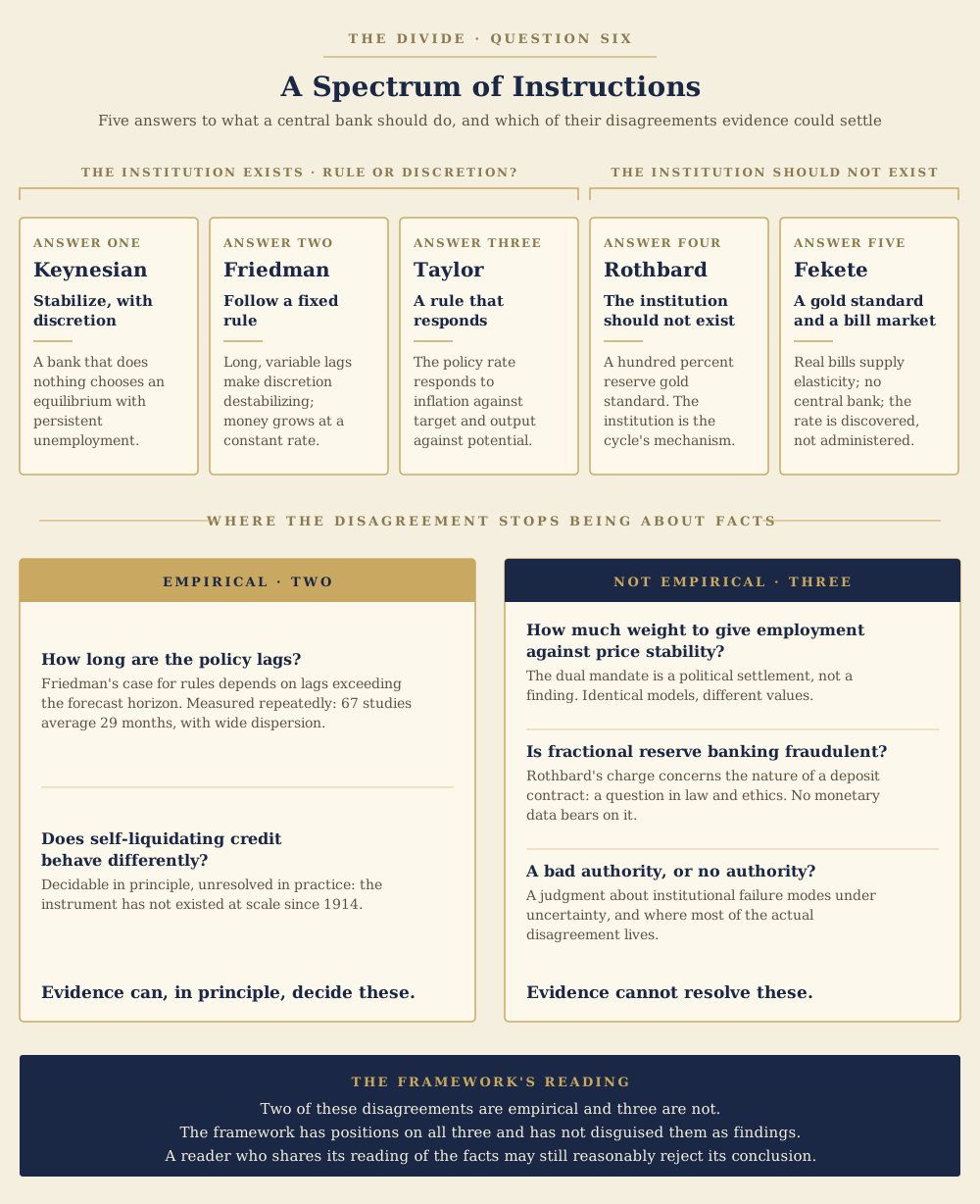
Where the disagreement stops being about facts
| Keynesian | Friedman | Taylor | Rothbard | Fekete | |
|---|---|---|---|---|---|
| Should the institution exist? | Yes | Yes | Yes | No | No |
| Rule or discretion? | Discretion | Fixed rule | Responsive rule | n/a | n/a |
| Source of elasticity | Central bank | Fixed growth rate | Central bank | None | Real bills |
| Who sets the interest rate? | The committee | Indirectly, via quantity | The rule | The market | The market |
| Is the 1930s record decisive? | Yes, for action | Yes, for rules | Yes, for rules | Yes, against the institution | Yes, for the bill market |
Two of these disagreements are empirical and three are not.
Empirical: how long are the lags? Friedman's case for rules depends on lags exceeding the forecast horizon. This is measurable, has been measured repeatedly, and the estimates vary enough that the question remains live. 8
Empirical: does self-liquidating credit behave differently? The third installment established that this is in principle decidable and in practice unresolved, since the instrument has not existed at scale since 1914.
Not empirical: how much weight to give employment against price stability. The dual mandate is a political settlement, not a finding. Reasonable people with identical models differ because they value the outcomes differently.
Not empirical: whether fractional reserve banking is fraudulent. Rothbard's charge is a claim about the nature of a deposit contract. It is a question in law and ethics, and no monetary data bears on it.
Not empirical: how much to weight the risk of a bad authority against the risk of no authority. This is a judgment about institutional failure modes under uncertainty, and it is where most of the actual disagreement lives.
What the framework adds
A reason the choice is not binary. The dominant framing pits a discretionary authority against a rigid metallic standard, and the framework's contribution is that this omits the arrangement that actually operated. Elasticity does not require an authority. It can come from an instrument whose volume is determined by consumer demand rather than by a committee.
An observation about the current moment. The catalog has documented that the Federal Reserve under its present chairman has moved sharply away from forward guidance — statements compressed to roughly 130 words, a chairman declining to submit a rate projection to his own committee's dot plot, and a public disavowal of that committee's inflation forecast. 9 10 11 Simultaneously, the Treasury has expanded purchases of long-dated securities, and the executive has publicly stated a rate target differing from both. 12 13
That configuration does not fit any box in the table above. It is neither rule nor discretion, because three institutions are acting on the same variable with different mandates and no coordinating mechanism. The framework's reading is that this is what the institutional question looks like when it is not settled — and that the relevant question has quietly shifted from what rule should the central bank follow to which institution is setting the rate structure.
Where the framework is exposed
It has no transition path, and this is the serious one. Suppose the framework is entirely correct about the superiority of a gold standard with a functioning bill market. There is no account of how a system with more than forty trillion dollars of sovereign debt, a derivatives complex with hundreds of trillions in notional outstanding, and retirement assets denominated in the existing unit arrives at that arrangement without a disruption that would itself be catastrophic. 14 15 Every proponent of a metallic standard owes an answer to this and the framework does not have one.
The bill market cannot be tested. The arrangement rests on an instrument that has not existed at scale in over a century. Claims about how it would function in a modern economy are extrapolations from pre-1914 evidence, and the orthodox Austrian objection — that real bills are inflationary and that the Federal Reserve's version of the doctrine contributed to the disaster of the 1930s — is a serious historical argument addressed in the third installment.
The record of the institution is not uniformly bad. The framework criticizes central banking extensively. Intellectual honesty requires noting that the period since 1945 has seen no collapse of the money stock comparable to 1930–33 in any major economy, and that Friedman's account attributes the 1930–33 collapse in substantial part to the institution's failure to act as lender of last resort, a failure the institution has since said it will not repeat. 16 A reader may reasonably conclude that the arrangement's failures are the price of avoiding a worse failure mode.
And the framework's own argument cuts both ways. The preceding installment established that the quantities any policy rule would target are poorly measured. That is an argument against discretion, and it is equally an argument against a rule, since a rule responding to mismeasured inflation is mechanically wrong rather than merely badly judged.
The series, and what it was for
Six questions, four or five answers each, and no verdict offered on any of them beyond the framework's own position and its exposures.
That was the intent. The purpose of The Divide is not to recruit. It is to set out the contested ground precisely enough that a reader can hold a position for reasons — including, on any of these questions, a position against the one argued here.
The framework's wager across all six is a single one: that the distinction between a claim and the thing it names is the discipline that organizes everything else. Money is a claim or a thing. Interest is the price of an exchange between two forms of economic object. Credit is self-liquidating or perpetual. A falling rate structure alters what a liability costs to discharge, whether or not anyone records it. An aggregate is a construction, not an observation. And a rate of interest is discovered or administered.
Whether that is the right organizing distinction is the question the catalog exists to test, in public, with dates attached.
What to read next
In the Atlas: the concept pages on real bills, the gold basis, and the theory of interest.
In the Forum: The Golden Triangle develops the arrangement in full. 130 Words and a Task Force examines the current chairman's institutional pivot. Operation Twist Without the Fed and Three Hands on the Dial document the three-way contest over the rate structure described above. Contingent Actions examines what a programmable settlement layer would change about powers that already exist.
Sources
A note on values. Three of the disagreements on this page are not resolvable by evidence: how to weight employment against price stability, whether fractional reserve banking is fraudulent, and how to weigh the risk of a bad authority against the risk of none. The framework has positions on all three and has not disguised them as findings. A reader who shares the framework's reading of the facts may still reasonably reject its conclusion, and that is a feature of the question rather than a failure of the analysis.
Footnotes
-
Keynes, John Maynard. The General Theory of Employment, Interest and Money (1936), Chapter 3, "The Principle of Effective Demand," and Chapter 19, "Changes in Money-Wages." https://www.marxists.org/reference/subject/economics/keynes/general-theory/ch03.htm and https://www.marxists.org/reference/subject/economics/keynes/general-theory/ch19.htm — for equilibrium below full employment and the claim that a flexible wage policy cannot restore it. ↩
-
Friedman, Milton. "The Role of Monetary Policy." American Economic Review 58, no. 1 (March 1968): 1–17. https://www.aeaweb.org/aer/top20/58.1.1-17.pdf — for the case against discretion and the proposal of a publicly adopted steady growth rate for a monetary total; the k-percent rule and the long-and-variable-lags argument are set out in A Program for Monetary Stability (Fordham University Press, 1960), which has no stable free web address. ↩
-
Taylor, John B. "Discretion versus Policy Rules in Practice." Carnegie-Rochester Conference Series on Public Policy 39 (December 1993): 195–214. https://web.stanford.edu/~johntayl/Onlinepaperscombinedbyyear/1993/Discretion_versus_Policy_Rules_in_Practice.pdf — for the rule and its close fit to Federal Reserve policy in 1987–92. ↩
-
Taylor, John B. "A Historical Analysis of Monetary Policy Rules." In Monetary Policy Rules, ed. John B. Taylor (University of Chicago Press, 1999); NBER Working Paper 6768, October 1998. https://www.nber.org/papers/w6768 — for departures from the rule coinciding with sustained inflation or prolonged slack. ↩
-
Rothbard, Murray N. The Mystery of Banking (1983), https://cdn.mises.org/Mystery%20of%20Banking.pdf, and What Has Government Done to Our Money? (1963), https://cdn.mises.org/What%20Has%20Government%20Done%20to%20Our%20Money_3.pdf — for the hundred percent reserve gold standard, fractional reserve banking as fraud, and abolition of the Federal Reserve. ↩
-
Fekete, Antal E., interviewed by Anthony Wile. "Dr. Antal Fekete Discusses the Controversial Real Bills Doctrine and Free-Banking." The Daily Bell, May 3, 2009. https://thedailybell.com/all-articles/exclusive-interviews/anthony-wile-dr-antal-fekete-discusses-the-controversial-real-bills-doctrine-and-free-banking/ — for the quoted rejection of Rothbard's hundred percent gold standard. ↩ ↩2
-
Fekete, Antal E. Monetary Economics 101: The Real Bills Doctrine of Adam Smith, Lecture 13, "The Unadulterated Gold Standard." Gold Standard University, October 28, 2002. https://professorfekete.com/articles/AEFMonEcon101Lecture13.pdf — for the gold coin, the bill market, the gold bond market as the setting of the rate of interest, and the bill market's end in 1914. ↩
-
Havranek, Tomas, and Marek Rusnak. "Transmission Lags of Monetary Policy: A Meta-Analysis." International Journal of Central Banking 9, no. 4 (December 2013): 39–76. https://www.ijcb.org/journal/v9n4/transmission-lags-monetary-policy-meta-analysis — for an average lag of twenty-nine months across sixty-seven studies, with wide dispersion between economies. ↩
-
Board of Governors of the Federal Reserve System. FOMC statement, September 16, 2026. https://www.federalreserve.gov/newsevents/pressreleases/monetary20260916a.htm; and Cox, Jeff. "Here are five key takeaways from Wednesday's Fed rate hike." CNBC, September 16, 2026. https://www.cnbc.com/2026/09/16/here-are-five-key-takeaways-from-wednesdays-fed-rate-hike.html — for the 130-word statement, tied with June's. ↩
-
Lord Abbett. "June Fed Meeting: Policy Signals from the New Chairman." June 22, 2026. https://www.lordabbett.com/en-us/financial-advisor/insights/markets-and-economy/2026/june-fed-meeting-policy-signals-from-the-new-chairman.html — for Warsh's declining to submit a dot. ↩
-
KPMG. "Warsh asserts Fed's independence." September 16, 2026. https://kpmg.com/us/en/articles/2026/september-2026-fomc-meeting.html — for Warsh's "those aren't my forecasts" on the committee's inflation projection. ↩
-
U.S. Department of the Treasury. "Treasury Announces Increased Sizes of Nominal Long-End Liquidity Support Buybacks Beginning September 9." Press release sb0607, August 19, 2026. https://home.treasury.gov/news/press-releases/sb0607 — for the expanded buybacks in the ten-to-twenty-year and twenty-to-thirty-year sectors. ↩
-
"Trump slams the Fed rate hike, says he told Warsh 'you might as well vote with the board.'" Yahoo Finance, September 16, 2026. https://finance.yahoo.com/economy/policy/article/trump-slams-the-fed-rate-hike-says-he-told-warsh-you-might-as-well-vote-with-the-board-205145796.html — for the President's statement that rates "should be 1%, or less." ↩
-
U.S. Department of the Treasury, Fiscal Data. Debt to the Penny. https://fiscaldata.treasury.gov/datasets/debt-to-the-penny/debt-to-the-penny — for total public debt outstanding of about $40.2 trillion in early October 2026. ↩
-
Bank for International Settlements. "OTC derivatives statistics at end-June 2025." December 2025. https://www.bis.org/publ/otc_hy2512.htm — for $846 trillion in notional amounts outstanding (gross market value $21.8 trillion). ↩
-
Friedman, Milton, and Anna J. Schwartz. A Monetary History of the United States, 1867–1960 (Princeton University Press for NBER, 1963), Chapter 7, "The Great Contraction, 1929–33." https://www.nber.org/books-and-chapters/monetary-history-united-states-1867-1960; and Bernanke, Ben S. "On Milton Friedman's Ninetieth Birthday." Federal Reserve Board, November 8, 2002. https://www.federalreserve.gov/boarddocs/speeches/2002/20021108/ — for the Federal Reserve's failure to act as lender of last resort in 1930–33 and Bernanke's "we won't do it again." ↩