
Researched and drafted with AI assistance · reviewed and edited by Jason D. Keys
The definition nobody uses
There is a definition of interest that appears in no standard economics textbook, that its author spent two decades developing in lectures delivered mostly outside the academy, and that turns out — once stated plainly — to cut through several problems that the standard definitions leave unresolved. 1
Antal Fekete posed it as a question. 2 In Lecture Two of his Monetary Economics 102 series, "The Exchange of Income and Wealth," he asked: what happens when a man with wealth to spare but who is in need of an income meets another with income to spare but who is in need of wealth? 3 4 5
The two figures are worth making concrete, and Keith Weiner's gloss on Fekete's argument does it cleanly. 6 On one side stands a retiree. He has accumulated savings across a working life — wealth, in the form of a stock of value. What he does not have is income, because he no longer works. He faces a specific and unpleasant problem: he can consume his savings, but every dollar consumed is a dollar unavailable later, and he does not know how long he will live. On the other side stands an entrepreneur. She has the opposite problem. Her business generates income — a flow — but she lacks the stock of capital required to expand it, purchase equipment, or finance a production cycle. She has income to spare and needs wealth.
When these two transact, each obtains what they lack and surrenders what they hold in surplus. The retiree hands over wealth and receives a stream of income for the rest of his life without consuming his principal. The entrepreneur receives the capital she needs and pays for it out of the income her business generates. Neither has been exploited. Both are better off, in precisely the sense that any voluntary exchange leaves both parties better off. And the rate of interest is simply the price at which this particular exchange clears.
Fekete then pushes the analysis one step further, and this is where the definition becomes genuinely powerful rather than merely elegant. 7 He observes that both parties have an alternative to trading with each other. The wealth-holder can convert his wealth into income directly, by consuming it — by dishoarding. The income-holder can convert his income into wealth directly, by saving it — by hoarding. These direct conversions require no counterparty and no market. They are always available. What Fekete says about them is that they are, in his phrasing, cumbersome and inefficient, and that the passage from direct conversion to indirect conversion — that is, to exchange — represents an improvement.
And then the sentence that reorganizes the entire subject: interest can be thought of as the measure of this improvement. In particular, zero interest means direct conversion.
Read that carefully, because it is the opposite of how zero interest is conventionally understood. In the standard account, a zero rate of interest is money at its cheapest — maximally stimulative, maximally accommodative, the condition under which capital is most abundantly available. In Fekete's account, a zero rate of interest is the condition under which the exchange of wealth for income yields no advantage over doing it yourself, which means the exchange stops happening. Wealth-holders, offered nothing for parting with their wealth, keep it. Hoarding replaces lending. The mechanism by which savings become capital is not lubricated at zero — it is abolished.
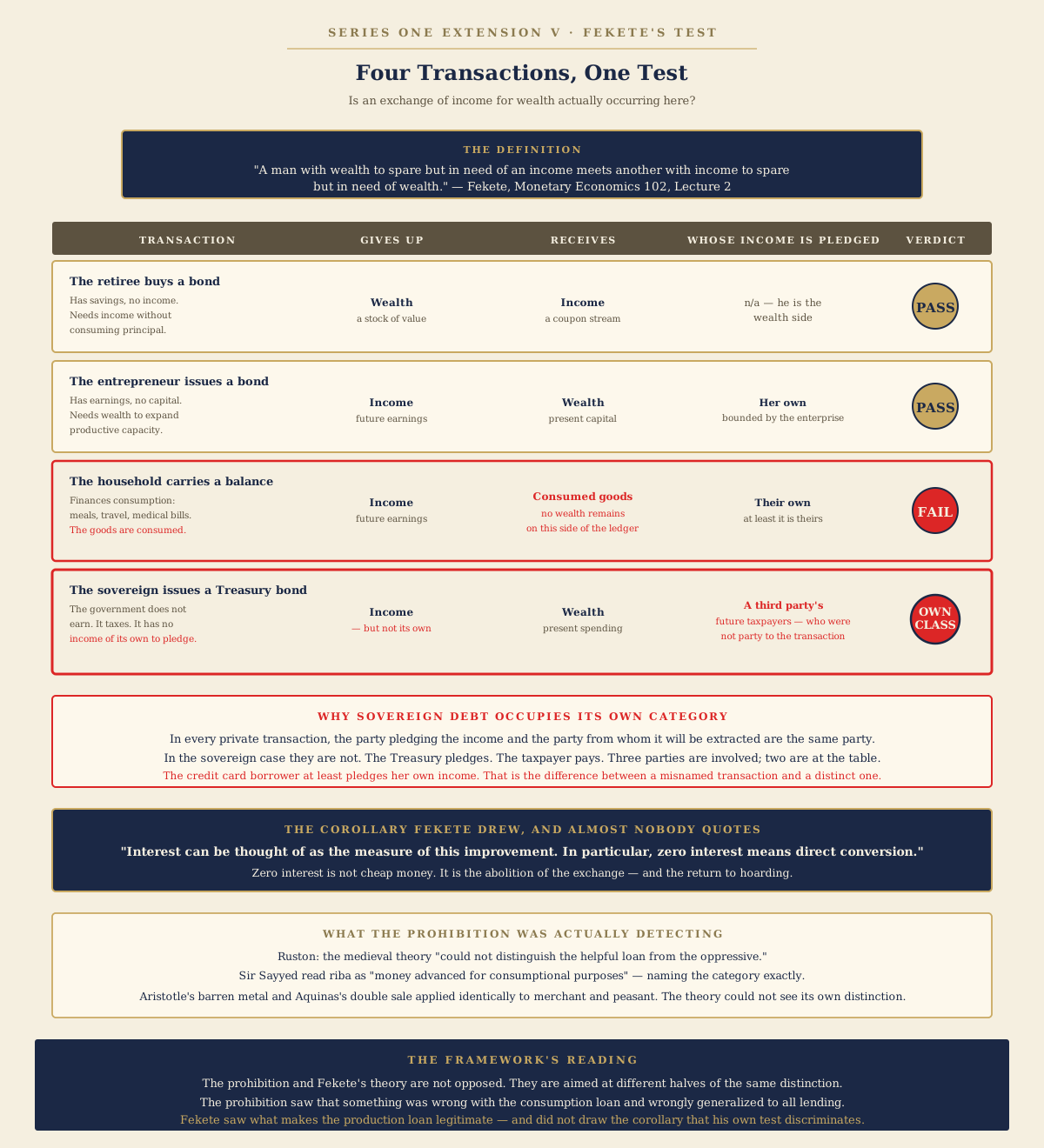
This essay takes Fekete's definition and does something he did not do systematically: uses it as a test. If interest is the price of exchanging income for wealth, then any transaction bearing an interest rate can be examined against a single question. Is an exchange of income for wealth actually occurring here? The answer, applied to four transactions that our legal system groups together as "lending," turns out to be different in each case — and the differences are the subject of everything that follows.
Why this differs from Mises, and from the textbook
The standard Austrian account of interest, developed by Böhm-Bawerk and carried forward by Mises, locates the phenomenon in time preference: human beings prefer a good available now to the same good available later, and interest is the premium that compensates a lender for surrendering present goods in exchange for future goods. The standard mainstream account, in the loanable funds tradition, treats interest as the price that equilibrates the supply of savings against the demand for investment.
Fekete's definition is not a rejection of either so much as a relocation of the phenomenon. Where time preference frames the trade as present goods for future goods — the same commodity, at two different dates — Fekete frames it as wealth for income, which is a trade between two different kinds of economic object. A stock and a flow. That distinction does real analytical work, because a stock and a flow have different properties, and Fekete names them: the disadvantages associated with wealth, he observes, are illiquidity and declining marginal utility. Wealth is hard to convert and yields less satisfaction per unit as you accumulate more of it. Income has neither disadvantage. The trade is not between two dates. It is between two forms.
Fekete's relationship to Mises on this point is worth stating precisely, because this catalog's Article 41 engaged a related divergence and the framework's position should be consistent. Fekete held that Mises came close to the correct theory and missed it for a specific reason. In his 2006 essay "When Atlas Shrugged," treating the marginal bondholder — the agent whose arbitrage between the gold market and the bond market Fekete believed actually regulates the rate of interest — he wrote that Mises had explicitly referred to this arbitrage without using the word, and was therefore "pretty close to discovering the real force driving the rate of interest," but that he went astray because "for him, paper currency was a present good no less than the gold coin," which Fekete called a faux pas.
The disagreement matters for this essay's later sections. Under Fekete's account, the marginal bondholder's choice is between holding the gold coin, a present good, and holding the gold bond, a future good — and he will hold the bond only if the rate of interest sufficiently compensates him for the unequal exchange. If instead he is offered irredeemable paper currency for his bond, Fekete observed, he would be taking zero in exchange for a positive income, which is no protest at all but a leap from the frying pan into the fire. The mechanism that regulates interest under a gold standard therefore has no counterpart under an irredeemable one, because the escape hatch that disciplines the rate — flight into a present good that yields nothing but preserves value — has been welded shut.
One further observation from Fekete's Lecture Six deserves quoting, because it will matter when this essay reaches the national debt. There is, he noted, no market that quotes the rate of interest directly. To learn what the rate of interest is, one must go to the bond market, obtain a price for a bond, and calculate the rate from that price. Interest is not observed; it is inferred from a price. And the bond market, in his framing, is merely the visible tip of something much larger — the epitome, as he put it, of a far more pervasive capital market encompassing all conceivable exchanges of wealth and income, every one of which affects the formation of the rate.
The prohibition
For most of recorded history, in most of the civilizations that produced written law, the transaction this essay has just described was illegal.
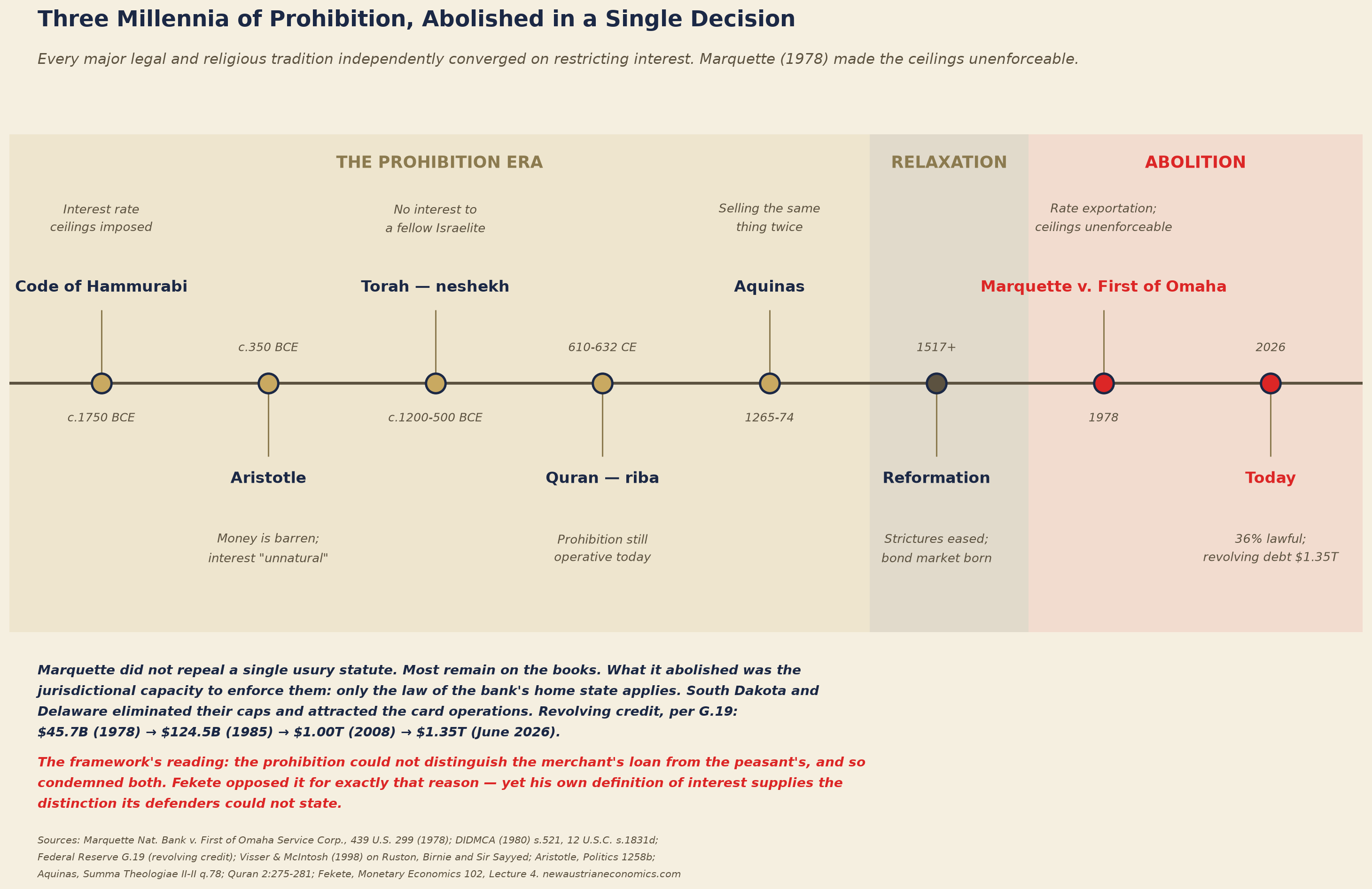
The prohibition is old enough to predate the theoretical apparatus that would later be constructed to defend it. The Code of Hammurabi imposed ceilings on interest rates. The Torah forbids the Israelite from charging interest to a fellow Israelite — neshekh, literally a bite; ribbit is the later rabbinic term — in passages across Exodus, Leviticus, and Deuteronomy, while Deuteronomy permits it in dealings with foreigners, an asymmetry that has occupied commentators for two millennia. Christianity inherited the prohibition and hardened it through canon law across the medieval period. Islam prohibits riba, in terms drawn from the Quran at 2:275-280, and that prohibition remains operative today in a way the others do not, having generated an entire parallel financial architecture built on profit-sharing structures — mudarabah, musharakah — designed to accomplish the economic function of finance without the forbidden form.
The theoretical case against interest was assembled principally from Aristotle, who held in Politics I.10 that money is barren. 8 Coin does not reproduce itself the way livestock or seed reproduce themselves; a metal disc placed in a drawer produces no offspring. To demand a return from money was therefore to demand a yield from something incapable of yielding, which Aristotle regarded as unnatural. Aquinas, working within this inheritance in the Summa Theologiae (II-II, q. 78), supplied a subtler argument: money is a good consumed in its use, and to charge separately for the use of a thing whose use is its consumption is to sell the same thing twice. The formulation preserved in the secondary literature is memorable — it is, in Birnie's phrasing, like selling a loaf of bread and then charging in addition for the use of it.
These are not stupid arguments, and it is worth resisting the modern reflex to treat them as medieval superstition swept away by enlightenment. Aristotle's observation that money does not reproduce is empirically correct. Aquinas's observation that money is consumed in use is also correct. Both men were reasoning carefully from premises that were true. The difficulty was not in their logic. It was that their premises, though true, were not the relevant ones — a distinction this essay will develop shortly.
What the prohibition was actually aimed at is recoverable from the scholarly literature, and it is narrower than the doctrine's formal scope suggests. Ruston's assessment, widely cited in the historical work on usury, is that the original target of the medieval usury laws was the medieval equivalent of the loan shark — and that the medieval theory was unsatisfactory precisely because it could not distinguish the helpful loan from the oppressive one. 9 The same distinction appears in the Islamic tradition from an entirely independent direction: Sir Sayyed's school interpreted riba specifically as the primitive form of money-lending, in which money was advanced for consumptional purposes. 10
Hold that phrase — advanced for consumptional purposes — because it is the hinge on which this entire essay turns.
Fekete's objection, which the framework concedes
This catalog has drawn extensively on Fekete across Articles 33, 41, and 42, and intellectual honesty requires reporting where he stands on the question this essay is examining. He was not an opponent of interest, and he was not a defender of the usury prohibition. He regarded the prohibition as a centuries-long suppression of a legitimate and mutually beneficial exchange, and he credited its repeal with an achievement of the first order.
His account, in "The Principle of Capitalization of Incomes," is explicit. The Reformation, he wrote, eased canonical and secular strictures on interest, narrowed the definition of usury, and eventually repealed the prohibition entirely. Whereas the partnership contract had previously been designed with the concealment of interest in mind — the legal fiction by which medieval merchants accomplished economically what they were forbidden to do openly — it now became possible, for the first time in history, to engage openly in the exchange of income and wealth with the rate of interest freely quoted. And then his conclusion: the bond market was born as a result of these historic changes. The right to income reserved by the bondholder could at last enjoy the same legal protection that the right to rent-charges had enjoyed during the prohibition era. It remained for the Reformation, in his summary, to crown the great economic advances of the Renaissance and to free the exchange of income and wealth from its former fetters.
The framework concedes this fully. A blanket prohibition on interest does not prevent the retiree and the entrepreneur from needing each other; it prevents them from transacting openly, drives the transaction into concealment and legal fiction, raises its cost, and denies the resulting claims the protection of law. The retiree in a society that forbids interest does not thereby become secure. He becomes a hoarder, forced into exactly the direct conversion that Fekete identified as the cumbersome and inefficient alternative. The prohibition does not abolish the underlying economic problem. It abolishes the efficient solution to it.
So the framework does not argue for restoring the usury prohibition, and this essay should not be read as making that argument. What it argues is something different and, the framework will contend, more interesting: that the prohibition's defenders were detecting something real that their own theoretical apparatus could not articulate, and that Fekete's definition — the definition of the man who opposed them — supplies the articulation they lacked.
What the prohibition was actually detecting
Return to Fekete's test. Interest is the price of exchanging income for wealth. Now apply it, carefully, to two transactions that the medieval canonist would have grouped together as a single forbidden act, and that modern law groups together as a single permitted one.
The first transaction. A merchant borrows to finance a shipment of cloth. He receives wealth — capital — and pledges a portion of his future income against it. The cloth is transported, sold, and the proceeds repay the loan. Run the test: on one side, a wealth-holder surrendered wealth and received income. On the other, an income-generator surrendered income and received wealth. Both sides of the exchange are present. The transaction passes.
The second transaction. A peasant, after a failed harvest, borrows to buy food for his family through the winter. He receives money, converts it immediately into bread, and the bread is eaten. Against this he pledges his future labor, his implements, or his land. Run the test: what stands on the borrower's side of the exchange when it is complete? The bread is gone. No wealth was acquired; no income-generating capacity was created. He surrendered future income and received, in return, a consumed good.
These two transactions have the same legal form. They have the same instrument, the same enforcement mechanism, the same arithmetic. Under Fekete's test they are categorically different, because in the first case an exchange of income for wealth occurred, and in the second case it did not. The second is not an exchange of income for wealth. It is a sale of future income, in exchange for present consumption, with nothing on the other side of the ledger when the transaction is complete.
This is what the prohibition was detecting. Sir Sayyed's reading of riba — money advanced for consumptional purposes — names the category exactly. Ruston's observation that the medieval theory could not distinguish the helpful loan from the oppressive one identifies precisely the failure: the canonists possessed the moral intuition that the second transaction was different in kind from the first, but their theoretical apparatus, built on Aristotle's barren metal and Aquinas's double sale, applied identically to both. Barren metal is barren in the merchant's hands and in the peasant's. Money is consumed in its use in both cases. The theory could not see the distinction its own adherents were reaching for, so it condemned both transactions together — and in condemning both, it suppressed the merchant's loan along with the peasant's, which is the substance of Fekete's objection.
The framework's reading is that the medieval prohibition and Fekete's theory of interest are not opposed. They are aimed at different halves of the same distinction. The prohibition correctly identified that something is wrong with the consumption loan and wrongly generalized the finding to all lending. Fekete correctly identified what makes the production loan legitimate and did not develop the corollary — that a transaction which fails his own test is not, on his own definition, an instance of interest at all, but something else wearing the same legal clothing.
That corollary is what this essay develops, and it is the framework's specific contribution here. The test does not merely describe legitimate lending. It discriminates. And what it discriminates against turns out to be, with remarkable consistency, what the world's major religious and legal traditions independently converged on prohibiting.
Marquette, and the abolition of the ceiling
Whatever survived of the usury prohibition in American law was effectively dismantled by a single Supreme Court decision that almost nobody outside banking has heard of. 11
The facts of Marquette National Bank of Minneapolis v. 12 First of Omaha Service Corp., 439 U.S. 299 (1978), are about as dry as it gets. 13 Minnesota's usury law capped interest on credit card accounts at twelve percent. Nebraska's allowed eighteen on balances up to $999.99, and twelve above that. 12 Minnesota banks, constrained by the lower ceiling, made up the difference by charging annual fees on their credit cards. First National Bank of Omaha, operating under Nebraska's more permissive ceiling, began marketing a no-annual-fee card directly to Minnesota residents. Marquette National Bank of Minneapolis, watching its customers depart for a product it could not legally match, sued on the theory that a bank lending to Minnesota residents must obey Minnesota's cap.
The Court, in a decision argued October 31 and handed down December 18, 1978, held otherwise. State anti-usury laws cannot be enforced against nationally chartered banks based in other states. Only the law of the state in which the bank is located applies. The protection of state usury laws, the Court added, is an issue of legislative policy, and any plea to alter the statute "is better addressed to the wisdom of Congress than to the judgment of this Court."
The consequence was immediate and structural. A national bank could now export its home state's interest rate ceiling to borrowers anywhere in the country. Which meant that the effective national ceiling on credit card interest became the ceiling in whichever state was willing to set the highest one — and states, recognizing what had been handed to them, competed. South Dakota and Delaware eliminated their caps outright and attracted the credit card operations of the major national banks. The Depository Institutions Deregulation and Monetary Control Act of 1980 extended the same rate-exportation privilege to federally insured state-chartered banks, closing the remaining gap. 14
The results are visible in the aggregate figures. On the Federal Reserve's G.19 series, total revolving consumer credit stood at $45.7 billion at the end of 1978, the year Marquette was decided. 15 By the end of 1985 it was $124.5 billion. 15 By the end of 2008 it had passed a trillion dollars. It stood at $1.35 trillion in June 2026. 16
What is worth understanding precisely is what Marquette did and did not abolish. It did not repeal a single state usury statute; most remain formally on the books. It did not declare interest ceilings unconstitutional. What it abolished was the jurisdictional capacity to enforce them against the institutions that do most consumer lending. The ceiling still exists in Minnesota law. It simply cannot reach a card issued from Sioux Falls. A rate of thirty-six percent, which would be plainly usurious under the written law of many states, is entirely lawful today provided it is disclosed in the cardholder agreement and the issuing bank is chartered somewhere permissive.
The credit card, tested
Apply Fekete's test to a household carrying a revolving balance at a rate commonly north of twenty percent. 17
Begin with what is being financed, because the test turns on it. Revolving consumer credit finances, in the main, consumption: meals, travel, clothing, electronics, medical bills, groceries in the harder cases. Some portion finances genuine capital formation — tools for a trade, a computer used to generate income — and to that extent the test is passed and the transaction is a production loan wearing a consumer instrument's clothing. But the dominant use is consumption, and consumption is exactly the case the previous section examined.
Run the test on the dominant case. The household pledges future income — real, enforceable, prior to most other claims on that income — and receives in exchange goods that are consumed. When the transaction is complete, the household holds no wealth acquired through it. There is nothing on the borrower's side of the ledger. This is not an exchange of income for wealth in Fekete's sense, because only one of the two things being exchanged is present. It is a sale of future income.
Two clarifications, because the framework's argument here is easy to overstate and the overstated version is wrong.
First, this is not an argument that the transaction is irrational or that the borrower is a victim. A household facing an urgent expense with no reserves may be entirely rational to sell future income to meet a present necessity, and the alternative — going without medicine, or without transport to work — may be far worse. The test does not say the transaction should not occur. It says the transaction is not what its name implies.
Second, this is not an argument that the rate is unjustified by the lender's economics. Unsecured revolving credit carries genuine default risk, genuine funding costs, and genuine servicing expense, and a rate that compensates for those is a rate, not a theft. The framework's point is narrower and prior to the question of justification: the number attached to this transaction is not performing the function that Fekete's definition assigns to the rate of interest. It is not clearing a market between wealth-holders seeking income and income-generators seeking wealth. It is pricing a claim on future labor against the risk that the labor will not materialize.
Those are different economic objects, and calling them both "interest" obscures the difference — which is precisely the obscurity the medieval prohibition was groping toward and could not name.
The asymmetry that Fekete's mechanism requires, and the household does not have
There is a further and more specific problem with the revolving credit case, and it goes to the machinery by which Fekete believed the rate of interest is actually determined.
Recall his account of the marginal bondholder. The rate of interest is regulated, in his framing, by an agent standing at the margin, arbitraging between two options. When the rate falls below his marginal time preference, he sells the bond and takes the present good — under a gold standard, the coin. When it rises above, he sells the coin and buys the bond back. This arbitrage is the mechanism. The rate is not administered by anyone; it is discovered, continuously, by the marginal participant's freedom to be on either side.
Now ask what the marginal participant's alternative is in the revolving credit market. The household carrying a balance at twenty-two percent cannot arbitrage. It cannot, on finding the rate unattractive, move to the other side of the transaction and become a lender of unsecured consumer credit at twenty-two percent. It has no wholesale funding alternative. It generally cannot substitute a secured facility, because it has no collateral, which is why it is in the unsecured market to begin with. Its options are to accept the offered rate or to forgo the transaction, and if the transaction is a medical bill, forgoing it may not be a real option either.
The counterparty faces no such constraint. It funds itself at wholesale rates, in a market where its own marginal participants arbitrage freely and continuously. It can choose its chartering jurisdiction — which, since Marquette, means it can choose its own ceiling. It can price the spread and adjust it.
The framework's reading: when one side of a transaction has access to the arbitrage that Fekete identified as the rate-forming mechanism, and the other side has none, the resulting number is not a discovered price. It is an administered one. Whether it is a fair administered price is a separate question on which reasonable people differ and which this essay does not attempt to settle. What the framework claims is that the machinery Fekete described — the machinery that makes the rate of interest a market price rather than a posted one — is simply absent on one side of this particular market, and that its absence should be named rather than assumed away.
What a coupon actually is
The national debt is discussed constantly and explained almost never. The figure is recited — thirty-nine trillion dollars — and the interest is recited — roughly a trillion a year — and the two numbers float free of any account of what physical or legal object they describe. This section supplies that account, because Fekete's test cannot be applied to sovereign debt until one knows what sovereign debt mechanically is.
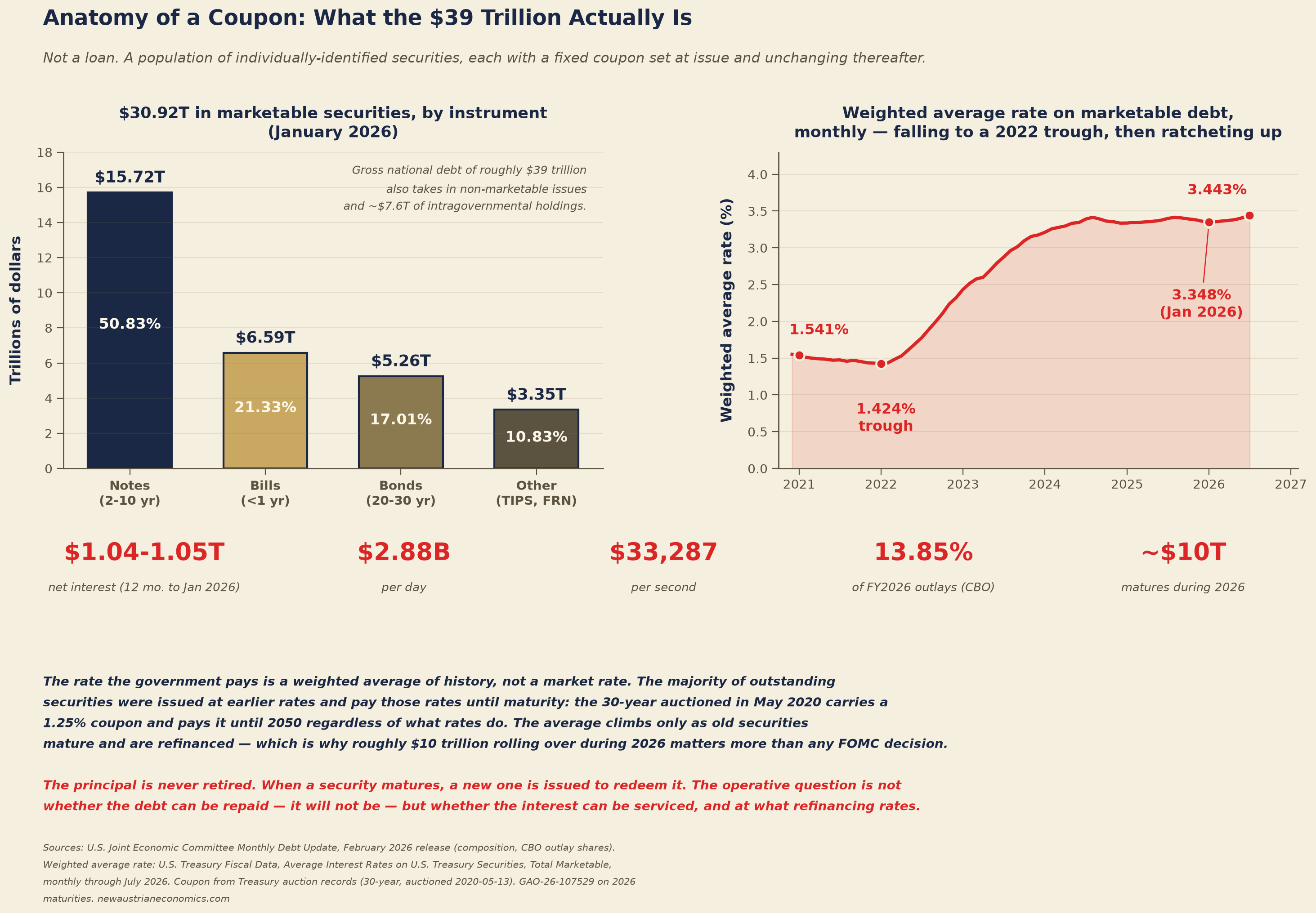
The debt is a stock of securities, not a loan. There is no ledger somewhere recording that the United States owes thirty-nine trillion dollars to a creditor. There is instead a very large population of individual, tradable, individually-identified securities, each with its own issue date, maturity date, face value, and — for most of them — a fixed coupon rate set at the moment of issue and unchanging thereafter. The "national debt" is the sum of the face values of these securities outstanding. As of January 2026, of the $30.92 trillion in marketable securities outstanding — the gross national debt of roughly $39 trillion also takes in non-marketable issues and some $7.6 trillion of intragovernmental holdings — $15.72 trillion, or 50.83 percent, was in notes, $6.59 trillion (21.33 percent) in bills, $5.26 trillion (17.01 percent) in bonds, and the remaining $3.35 trillion (10.83 percent) in other instruments including inflation-protected securities and floating rate notes. 18
The instruments differ by maturity and by payment mechanism. Bills mature in under a year and pay no coupon at all; they are sold at a discount to face value, and the investor's return is the difference between what she paid and the face value she receives at maturity. Notes run two to ten years and bonds twenty to thirty, and both pay semiannual coupons at a fixed rate until maturity, at which point the face value is returned. The thirty-year bond auctioned in May 2020 carries a coupon of one and a quarter percent, and will pay that one and a quarter percent every year until 2050, entirely regardless of what interest rates do in the interim.
Which means the interest the government actually pays is a weighted average of history, not a market rate. This is the single most misunderstood feature of the arithmetic. When commentators observe that the ten-year Treasury yields well over four percent and multiply that by the outstanding debt, they produce a number that is badly wrong, because the great majority of outstanding securities were issued at earlier rates and pay those earlier rates. The correct figure is the weighted average interest rate across all outstanding marketable securities, and as of January 2026 that figure was 3.348 percent. 18
And that average is climbing, mechanically, as old securities mature. Five years earlier, in January 2021, it was 1.541 percent. 18 The trough came a year later still, at 1.424 percent in January 2022, as the last of the zero-rate issuance settled into the average; every month since has been higher. 18 Every low-coupon security issued during the zero-rate era that matures is replaced by a new security issued at today's rates, and the average ratchets upward with each replacement. Roughly ten trillion dollars of Treasury debt matures during 2026 alone — close to a third of the marketable total — and each dollar of it is refinanced at prevailing rates rather than the rates at which it was originally issued. Market commentary on the maturity schedule puts the further drift at another thirty to fifty basis points over the following eighteen months on this mechanism alone, without any further action by the Federal Reserve — an estimate rather than an official projection. 19
The resulting cash cost. At a weighted average of roughly 3.35 percent, net interest on the debt runs approximately $1.04 to $1.05 trillion a year. 18 That is about $2.88 billion per day, or roughly $33,287 per second; over the twelve months through July 2026 the figure reached $1.06 trillion. 11 It is among the largest line items in the federal budget 18 — behind Social Security at $1.65 trillion and Medicare at $1.13 trillion on that same trailing-year basis, ahead of defense at $914 billion, and close enough to income security and veterans' benefits that its exact rank turns on how the categories are grouped. The Congressional Budget Office projected net interest at 13.85 percent of all federal outlays in fiscal 2026, rising to 14.11 percent in 2027 and 14.52 percent in 2028; by August 2026 those projections had been revised to 13.95, 14.25, and 14.94 percent. 18
The rollover, which is the mechanism that matters most. A household that borrows must eventually repay principal. The Treasury does not, and structurally cannot. When a security matures, the Treasury issues a new security to raise the cash to redeem the old one. The principal is never retired; it is perpetually refinanced. This is why the question of whether the debt "can be repaid" is malformed. It is not going to be repaid, was never going to be repaid, and is not designed to be repaid. The operative question is entirely different: whether the interest can be serviced, and at what rates the perpetual refinancing can be accomplished. Treasury manages this explicitly as a tradeoff, advised by the Treasury Borrowing Advisory Committee, which in November 2020 recommended holding bills in a range of fifteen to twenty percent of outstanding debt and later acknowledged the flexibility to run modestly above it — the share stood at 21.7 percent as of January 31, 2026 — because shorter maturities are cheaper but require more frequent refinancing and therefore expose the Treasury to more rapid pass-through of rate changes. 11
Applying the test to sovereign debt
Now run Fekete's test on the transaction just described.
On one side stands the bondholder. She holds wealth and wishes to convert it into income; she surrenders the wealth and receives a coupon stream. Her side of the exchange is clean, and it is exactly the retiree's position from the opening section. Whatever else is true, the bondholder is doing what Fekete's definition describes.
The other side is where the test bites.
When the entrepreneur issues a bond, she pledges her own future income — the earnings of the enterprise the capital will finance. If the enterprise fails, the claim fails with it; the bondholder's recovery is limited to the assets of the business. The income pledged and the wealth received belong to the same economic actor, and the pledge is bounded by that actor's capacity.
When the Treasury issues a bond, the income pledged is not the Treasury's income, because the Treasury has none. The federal government does not earn. It taxes. What is pledged against a Treasury security is future tax revenue, and future tax revenue is a compulsory extraction from the future production of the population within the taxing jurisdiction. This catalog's Article 31 established the classical definition on which the framework's analysis of wealth rests: production is labor applied to land. A Treasury coupon is therefore, traced to its foundation, a claim on the future labor of the population — enforced not by the borrower's promise but by the taxing power.
The distinction is not that the sovereign transaction is fraudulent, and the framework specifically declines that framing. It is that the sovereign transaction has a structural feature no private transaction has: the party pledging the income and the party from whom the income will be extracted are not the same party. The Treasury pledges. The taxpayer pays. And the taxpayer, in the general case, was not a party to the transaction, did not negotiate its terms, and in the case of a thirty-year bond may not have been born when it was struck.
Run the test formally, and sovereign debt occupies a category of its own. The credit card borrower at least pledges her own income, which is why the framework declined to describe that transaction as illegitimate — merely as misnamed. The sovereign pledges income belonging to others. On Fekete's definition, an exchange of income for wealth is occurring; it is simply that the income and the wealth are moving between three parties rather than two, and only two of them are present at the table.
The $1.27 trillion nobody recorded
Article 41 of this catalog developed Fekete's Law of Liabilities: the principle, never codified in accounting standards, that a liability should be carried at its face value at maturity or at its liquidation value — what it would actually cost to extinguish today — whichever is higher. The article's argument was that falling interest rates raise the liquidation value of existing fixed-rate debt, producing a real economic loss to the debtor that conventional accounting does not record, and that this unrecorded loss compounded across the entire 1981-2020 falling-rate era.
The same mechanism runs in reverse when rates rise, and the largest fixed-rate debtor in the world provides the cleanest available measurement of it.
When market interest rates rise above the coupon rates at which outstanding securities were issued, those securities trade below face value. A bond paying one and a half percent is worth less than par when new bonds pay four and a half. And this is not a small effect at the scale of the federal debt: the market value of privately held federal debt has been below its par value in every single month since March 2022. Across the forty-five months through November 2025 the average monthly shortfall was $1.27 trillion, computed from the Dallas Fed's par and market value series; the run has not broken since, and stood at fifty-three months through July 2026. 17
Consider what that figure represents. The United States government owed, at face value, some amount. The market price of that same obligation was, on average, $1.27 trillion less. Had the Treasury repurchased its own outstanding debt at market prices during that window, it could have extinguished its obligations for $1.27 trillion less than their stated value. That is, in the most literal sense available, an unrecorded gain to the debtor — the exact mirror image of the unrecorded loss that Article 41 documented for corporate debtors during the falling-rate decades.
And the corresponding loss fell on the bondholders: pension funds, insurance companies, money market funds, foreign central banks, and the Federal Reserve itself. Some of these — banks holding securities as available-for-sale or held-to-maturity — were permitted by accounting convention not to recognize the loss at all, which is precisely the mechanism that destroyed Silicon Valley Bank in March 2023 when a deposit run forced the recognition all at once.
Neither side booked it. The government did not record a gain; the held-to-maturity holders did not record a loss. The $1.27 trillion existed, was measurable monthly, and appeared on no balance sheet as either. Article 41 argued that this asymmetry is not incidental but is the specific precondition that allows the underlying mechanism to operate for decades without triggering correction. The sovereign case is that argument's largest available confirmation.
Coupons as currency
There is a final structural feature of Treasury debt that separates it from every private obligation examined in this essay, and it bears directly on Fekete's monetary theory.
Treasury securities do not merely represent claims. They function as money within the financial system — not as legal tender for retail transactions, but as the base asset of institutional finance. They are the dominant collateral in the repurchase market, where trillions of dollars of overnight funding are secured against them daily. They constitute the core of High Quality Liquid Assets under the Basel III liquidity framework, which is to say that bank regulators define them as the thing a bank holds in order to be considered liquid. 20 They are the principal reserve asset of foreign central banks. And the yield on the ten-year note is the reference rate against which essentially every other asset in the economy is priced, from mortgages to corporate credit to equity valuation models.
Set this against the real bills doctrine that Article 33 developed as the second pillar of Fekete's Golden Triangle. A real bill is drawn against a specific shipment of consumer goods moving toward final sale. It has a maximum maturity of ninety-one days. And critically, it is self-liquidating: when the goods reach the consumer and are sold, the proceeds extinguish the bill. The bill dies. Nothing rolls over, because the underlying transaction has completed and the credit has been repaid by the very act it financed.
A Treasury security is the structural opposite on precisely this dimension. It finances no specific transaction that generates the proceeds to retire it. It is not self-liquidating and cannot be. It matures into a new security, perpetually, and the ten trillion dollars maturing in 2026 will be refinanced rather than retired. The framework's reading is that a monetary system whose base collateral asset is a perpetually rolled claim on future taxation is structurally different from one whose circulating credit is self-extinguishing commercial paper — and that the difference is not a matter of degree. One system's credit instrument is retired by the completion of production. The other's is retired only by the issuance of more of itself.
The inversion
Assemble the rates this essay has examined and place them side by side.
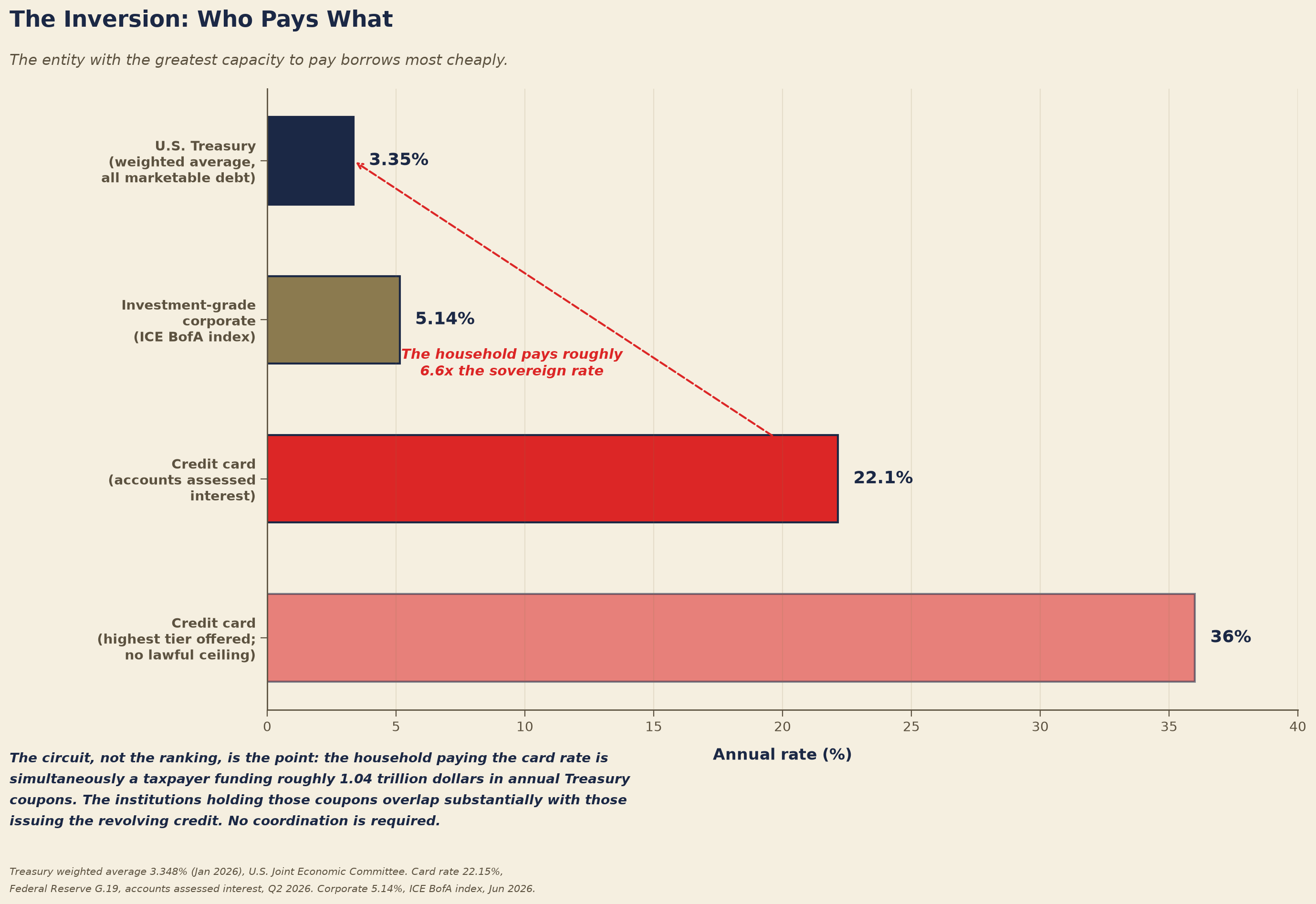
A household carrying a revolving balance pays a rate commonly above twenty percent, and lawfully as high as thirty-six. An investment-grade corporation issuing debt pays something in the range of five percent. The United States Treasury, across all outstanding marketable securities, pays a weighted average of 3.348 percent. 18
The entity with the greatest capacity to pay borrows most cheaply. The entity with the least capacity borrows most dearly. This is not a scandal in itself — it is, in ordinary credit terms, exactly what risk pricing predicts, and the framework does not dispute that a household default is more likely than a sovereign default in a currency the sovereign issues.
What deserves attention is the circuit rather than the ranking. The household paying twenty-two percent on its revolving balance is simultaneously a taxpayer, and its taxes fund the roughly $1.04 trillion in annual coupons that the Treasury pays to bondholders. 11 The institutions holding those Treasury securities — money market funds, insurance companies, banks, pension funds — overlap substantially with the institutions that issue the revolving credit. The same household, in the same year, pays the high rate as a borrower and funds the low rate as a taxpayer, and both payments flow toward a broadly overlapping set of claim-holders.
The framework states this carefully, because the inflammatory version of the observation is both easy to reach and analytically worthless. There is no coordination here, no plan, and no cabal. Every individual transaction in the circuit is voluntary on the private side and lawful on the public side. The structure emerges from the mechanics — from Marquette's jurisdictional holding, from the tax code, from the Treasury's issuance calendar — without anyone needing to have designed it. That is what makes it durable, and it is also what makes it more serious than a conspiracy would be. A conspiracy can be exposed. A structure has to be understood.
Citizens and subjects
The sovereignty question can now be stated in its precise form, and the framework will state it without reaching for the language of enslavement, which is both analytically imprecise and rhetorically self-defeating.
A citizen, in the classical sense this catalog has drawn on since Article 1, consents to the obligations under which he lives. He votes, he participates in the deliberation that produces the law, and the law's claim on him derives its legitimacy from that participation. A subject inherits obligations. The claim on him is valid regardless of his consent, because it was established by an authority whose legitimacy does not run through him.
Consider a thirty-year Treasury bond issued in 2026. Its coupons will be paid from tax revenue collected through 2056. Some meaningful portion of that revenue will be collected from people who are, in 2026, children — and some from people not yet born. Those people will not have voted on the appropriation the bond financed. They will not have been party to the auction. They will nonetheless owe, in the sense that the taxing power will extract from their production the coupons that service the instrument, and the claim will be enforceable against them by an authority they did not authorize.
With respect to that specific obligation, they stand in the position of subjects rather than citizens. Not with respect to the whole of civic life — they will vote, and they may vote to alter tax rates or spending priorities — but with respect to the claim itself, which they inherit as a completed fact. The perpetual rollover extends this indefinitely. Because the principal is never retired but continuously refinanced, there is no terminal date at which the inherited claim is discharged and the inheritance ceases.
This is the rigorous form of the argument, and it is strong enough that it does not require exaggeration. A permanent, non-extinguishing, involuntarily inherited claim on the future production of persons who were not party to its creation is a serious thing, and it is the actual structure of a perpetually rolled sovereign debt. It becomes a weaker argument, not a stronger one, when it is described as slavery — because that description invites the obvious and correct rebuttal that the taxpayer may emigrate, may vote, may organize, and retains a set of freedoms no slave possessed. The citizen-subject distinction survives that rebuttal intact. The slavery framing does not, and the framework has no interest in advancing a claim that collapses on first contact with an informed objection.
What zero interest did
Return, finally, to the sentence from Fekete's second lecture that opened this essay. Interest is the measure of the improvement that indirect conversion represents over direct conversion. Zero interest means direct conversion.
The framework has argued across Articles 41 and 42 that the 1981-2020 collapse in the interest-rate structure destroyed capital through an accounting asymmetry, and that the price of gold across that period was governed by real interest rates rather than by any measure of monetary soundness. Fekete's definition supplies a third and complementary reading of the same era, and it is the one this essay ends on.
If interest is the price at which wealth-holders and income-generators trade, then driving that price toward zero does not make capital abundant. It removes the incentive for the trade to occur at all. The wealth-holder offered nothing for surrendering his wealth retains it — which is to say, he hoards. And the empirical record of the zero-rate decade is precisely a record of hoarding at every level of the system: corporate cash balances accumulating rather than being deployed into capital expenditure, as Article 41 documented alongside the buyback boom; commercial bank reserves sitting at the Federal Reserve rather than financing commercial lending; central banks accumulating gold, as Article 34 documented, at rates unseen in decades. Each of these is direct conversion — the cumbersome, inefficient alternative that Fekete said the exchange of wealth for income exists to improve upon.
The framework's synthesis: the zero-rate era did not flood the economy with capital. It abolished the price at which capital is exchanged for income, and in doing so it collapsed the mechanism back to hoarding, exactly as Fekete's definition predicts. The interest-rate reversal now underway — a weighted average Treasury rate that has climbed from 1.541 percent to 3.348 percent in five years, and a thirty-year yield at its highest since 2007 — is, on this reading, the restoration of a price that had been suppressed to the point of non-function. 18 That restoration is painful for debtors, including the largest one. It is also, on Fekete's terms, the return of the mechanism by which savings become capital.
Whether it persists is the open question this catalog has been tracking since Article 41, and it remains open. What this essay adds is a definition precise enough to say what is at stake in the answer: not the cost of money, but the existence of the exchange that converts one person's accumulated wealth into another person's productive capacity, and back again into the first person's income. That exchange is what interest is. Everything else that carries the name deserves a different one.
This is the fifth installment of Series One Extension, following Article 31 (the classical definition of wealth), Article 33 (the Golden Triangle), Article 37 (personal savings navigation, revised July 2026), and Article 41 (the accounting asymmetry and capital destruction). The test developed here — does a given transaction actually exchange income for wealth? — will be applied in subsequent installments to instruments this essay did not reach, including securitized consumer credit, sovereign debt of currency-issuing versus currency-using states, and the specific question of what a central bank's holdings of its own government's debt represent under Fekete's definition.
Sources
Footnotes
-
Visser, Wayne A.M. and Alastair McIntosh. "A Short Review of the Historical Critique of Usury." Accounting, Business and Financial History 8:2, 1998, 175–189 — for Birnie's double-sale formulation, "like selling a loaf of bread and then charging in addition for the use of it" (Birnie, 1952: 6). ↩
-
Fekete, Antal E. Monetary Economics 102: Gold and Interest, Gold Standard University — Lecture 1, "The Nature and Sources of Interest," 2003. For the marginal bondholder and the frying-pan passage. ↩
-
Fekete, Antal E, Lecture 2, "The Exchange of Income and Wealth", 15 January 2003 — for the reformulated question, direct conversions being "cumbersome and inefficient," "interest can be thought of as the measure of this improvement. In particular, zero interest means direct conversion," and illiquidity and declining marginal utility as the disadvantages of wealth. ↩
-
Fekete, Antal E, Lecture 4, "The Principle of Capitalization of Incomes", 1 January 2004, section "Interest and the Reformation" — for the easing of canonical strictures and "the bond market was born as a result of these historic changes." ↩
-
Fekete, Antal E, Lecture 6, "The Hexagonal Model of Capital", 1 March 2004 — for there being no market quoting the rate of interest directly, and the bond market as "the epitome of a far larger and far more pervasive capital market." ↩
-
Fekete, Antal E. "When Atlas Shrugged," Part Two, 2006 — for Mises coming "pretty close to discovering the real force driving the rate of interest," and the faux pas of treating paper currency as a present good. ↩
-
Weiner, Keith. "Falling Interest Causes Falling Wages", 2015 — for the gloss casting Fekete's two parties as a retiree holding savings without income and an entrepreneur holding income without capital. ↩
-
Aristotle, Politics I.10, 1258b. Thomas Aquinas, Summa Theologiae II-II, q. 78. Code of Hammurabi §§ 88–90, capping interest at twenty percent on silver and thirty-three and a third percent on grain. Quran 2:275–280. ↩
-
Visser, Wayne A — for Ruston's assessment that "the original target of the medieval usury laws was the medieval equivalent of the 'loan shark' [but that] the medieval theory was unsatisfactory because it could not distinguish the helpful loan from the oppressive" (Ruston, 1993: 173). ↩
-
Visser, Wayne A — for Sir Sayyed's school interpreting riba as "the primitive form of money-lending when money was advanced for consumptional purposes" (Ahmad, 1958: 21), and for neshekh, tarbit and the Deuteronomic exception for dealings with foreigners. ↩
-
U.S. Department of the Treasury, Presentation to the Treasury Borrowing Advisory Committee, Q1 FY2026 — bill share of 21.7 percent as of 31 January 2026. TBAC charge, Q3 2024, "Considerations for T-bill Issuance," for the November 2020 recommendation of a fifteen-to-twenty percent range and the later acknowledgment of flexibility above it. ↩ ↩2 ↩3 ↩4
-
Marquette National Bank of Minneapolis v. First of Omaha Service Corp., 439 U.S. 299 (1978) — argued 31 October 1978, decided 18 December 1978. Nebraska's tiered ceiling and Minnesota's twelve percent cap are in the statement of facts; the quoted sentence is from the closing discussion of § 85. ↩ ↩2
-
Congressional Research Service, "Interest Rate Caps on Credit Cards: Policy Issues", IF12861 — on the absence of any federal ceiling on card rates. ↩
-
Depository Institutions Deregulation and Monetary Control Act of 1980 § 521, codified at 12 U.S.C. § 1831d — extending rate exportation to federally insured state-chartered banks. ↩
-
Federal Reserve Board, Consumer Credit — G.19, release of 7 August 2026 (June 2026 data), and the historical seasonally adjusted levels — revolving credit outstanding of $45.7bn (Dec 1978), $124.5bn (Dec 1985), $1,004.0bn (Dec 2008) and $1,351.1bn (Jun 2026). Same release, Terms of Credit: commercial bank credit card rates averaged 22.15 percent on accounts assessed interest and 20.94 percent across all accounts in Q2 2026. ↩ ↩2
-
ICE BofA US Corporate Index effective yield. https://fred.stlouisfed.org/series/BAMLC0A0CMEY — 5.14 percent in June 2026, for the investment-grade comparison. Thirty-year Treasury yields reached 5.31 percent in August 2026, their highest since July 2007. ↩
-
Federal Reserve Bank of Dallas, Market Value of U.S. Government Debt — monthly par and market value series for privately held gross federal debt. The average monthly shortfall across March 2022 to November 2025 is $1,273.6bn, and the series has remained below par in every month through July 2026. ↩ ↩2
-
U.S. Joint Economic Committee, Monthly Debt Update, February 2026 release (January 2026 data) — weighted average interest rate on total marketable debt of 3.348 percent against 1.541 percent five years earlier; the $30.92tn marketable total and its division into notes, bills, bonds and other securities; approximately a third of publicly held marketable debt maturing within twelve months; and CBO's projected net interest shares of federal outlays. The August 2026 release carries revised projections and gross debt of $39.83tn. ↩ ↩2 ↩3 ↩4 ↩5 ↩6 ↩7 ↩8 ↩9
-
Board of Governors of the Federal Reserve System, Review of the Federal Reserve's Supervision and Regulation of Silicon Valley Bank, April 2023 — on the recognition of unrealized losses and the failure itself. ↩
-
Basel Committee on Banking Supervision, Basel III: The Liquidity Coverage Ratio and Liquidity Risk Monitoring Tools, January 2013, paragraph 50 — marketable sovereign securities as Level 1 high-quality liquid assets subject to neither haircut nor cap; implemented in the United States at 12 C.F.R. § 249.20. ↩
Related essays
Why Gold Didn't Spike: A Fekete Diagnosis of the Iran War
During the 2026 Iran war, gold fell rather than rose and central banks turned net sellers in March. Standard gold-bug frameworks cannot explain this. Antal Fekete's backwardation framework predicted exactly this pattern twenty years ago.
Open Market Operations at Light Speed: How AI Converted Fekete's 1922 Warning into a Closed-Loop Capital Destruction Engine
Fekete argued that the illegal introduction of open market operations in 1922 made bond speculation risk-free and destabilized the interest-rate structure. AI-driven algorithmic trading has automated this mechanism and accelerated it to the physical limits of latency. The predicted consequence — systemic capital destruction — is no longer theoretical.
The Saleability Audit of Bitcoin: What Menger Would Say in 2026
Bitcoin maximalists insist Bitcoin is the most saleable monetary good ever created. Skeptics insist it doesn't work for the African villager or the rural Chinese citizen the maximalists invoke. Both positions miss what Menger's framework actually says when applied carefully. The audit produces uncomfortable results in both directions — Bitcoin scores remarkably well on some criteria and remarkably poorly on others — and the actual ground-truth of crypto adoption in emerging markets in 2026 is something neither camp accurately describes.