
Researched and drafted with AI assistance · reviewed and edited by Jason D. Keys
Listen
The Bookkeeper's Dilemma: How Falling Interest Rates Destroy Capital, and Why the Accounting Cannot See It
Read in Jason D. Keys' synthesized voice
Narrated in the author’s synthesized voice, generated with AI from a recording of his own. The words are his; the delivery is machine-rendered.
Download (35.2 MB)"A climate of falling interest rates kills the will to invest because the future always offers better terms on which to borrow." — Jason D. Keys
The mechanism nobody watches
In September 1981, the yield on the 10-year U.S. Treasury note touched approximately 15.8 percent, the highest level in the history of the modern bond market. 1 Over the following four decades, with cyclical interruptions but a consistent underlying trend, that yield fell — to roughly 8.5 percent by 1990, roughly 6 percent by 2000, roughly 3.7 percent during the 2008 financial crisis, an average near 2.4 percent across the 2010s with troughs at 1.8 percent in 2012 and 2016, and finally to approximately 0.5-0.9 percent during the COVID-19 shock of 2020. 1 The federal funds rate followed a parallel path, held at the zero lower bound across two extended episodes — December 2008 to December 2015, and March 2020 to March 2022. By any conventional theory of capital formation, this forty-year decline in the cost of borrowing should have financed the most sustained investment boom in the history of industrial civilization. Cheaper capital should mean more capital projects clear their hurdle rates; more capital projects clearing their hurdle rates should mean more plant, more equipment, more productive capacity deployed per dollar of financing available.
That is not what happened. Corporate capital expenditure, measured as a share of corporate profits, has trended downward across the same period during which the cost of capital fell to levels that would have been considered miraculous by any earlier generation of industrialists. In its place, the same period produced the rise of an entirely different use of corporate cash: the share buyback. 2 U.S.-listed corporations spent an estimated $9.2 trillion in real terms on share buybacks between 2012 and 2021 alone — nearly twelve times the amount spent in the 1982-1991 decade, on a Compustat-based analysis of corporations listed on U.S. exchanges across the whole 1982-2021 span. 3 Buybacks grew from approximately 11 percent of total shareholder returns in 1982 to approximately 55 percent by 2021. 3 Federal Reserve research staff, examining the relationship between corporate payouts and capital investment across advanced economies in 2017, named as one candidate explanation that "corporations are actively reducing investment in order to finance share repurchases and dividend payments" — while giving equal weight to the reverse reading, that pessimism about future demand defers capital spending and cash is returned for want of attractive projects, and reporting that their own cross-country test found little evidence either way.
This essay develops the specific mechanism that explains the puzzle, and the framework's own formulation of that mechanism is the epigraph above: a climate of falling interest rates kills the will to invest because the future always offers better terms on which to borrow. Antal Fekete, the Hungarian-Canadian mathematician and monetary theorist whose Golden Triangle framework this catalog engaged at length in Article 33, developed the formal apparatus behind this insight across more than two decades of writing, beginning most systematically with his 2008 essay Is Our Accounting System Flawed? — It may be insensitive to capital destruction and its 2009 successor, The Revisionist Theory and History of Depressions. 4 Fekete's claim, stated as an accounting proposition rather than a behavioral one, is this: a falling interest-rate structure raises the liquidation value of every fixed-rate liability already on every balance sheet in the economy, producing a real economic loss that conventional accounting standards do not require anyone to record. 5 The loss is not hypothetical and not merely notional. It is the same loss, mechanically, that would be recorded if a firm's factory burned down and was not insured — except that no fire alarm sounds, no insurance adjuster arrives, and no line item appears on the income statement. The capital is destroyed in full view of everyone and recorded by no one.
This is a subtle mechanism, and it is missed today by three distinct audiences whose disagreement with each other usually obscures their common blind spot. Mainstream economists miss it because their models generally do not distinguish between a low interest rate and a falling one, treating "cheaper money" as an undifferentiated stimulus regardless of the path by which the cheapness was reached. Orthodox Austrian economists, working within the Misesian and Rothbardian tradition of Austrian Business Cycle Theory, come closer — they correctly identify that central-bank-suppressed interest rates cause economic damage — but they generally locate that damage in the malinvestment of new capital during the boom phase, a mechanism that, as this essay will show, is logically independent of Fekete's mechanism and can operate even when the original investment decisions were entirely sound. And gold-standard advocates, the community with which this catalog shares the most intellectual territory, generally read the Quantity Theory of Money forward from the money supply to the price level, and consequently predict inflation or hyperinflation from central bank asset purchases — a prediction that failed conspicuously across 2008-2020 for reasons Article 39 of this catalog has already engaged, and that fails again here for an overlapping but distinct reason: the same asset purchases that failed to produce the predicted inflation were simultaneously destroying capital through the mechanism this essay develops, an effect operating in the opposite direction from the one the QTM community was watching for.
The essay proceeds in twelve further sections. It begins with the origin of the balance sheet itself, in the work of the Renaissance mathematician whose invention made the modern corporation possible. It traces the specific 1914 episode in which the accounting profession's founding principle — what this essay will call the Law of Assets — was quietly abandoned to accommodate the financing of the First World War, an abandonment whose consequences the profession has never revisited. It develops Fekete's proposed mirror-image principle, the Law of Liabilities, with worked arithmetic showing precisely how a falling interest-rate structure destroys capital on a balance sheet that never changes its operations, its output, or its physical assets. It shows where, uniquely, modern accounting has quietly implemented Fekete's proposed principle — in the domain of corporate pension liabilities — and uses the resulting data as a natural experiment confirming the mechanism at national scale. It distinguishes the mechanism carefully and pointedly from Austrian Business Cycle Theory, with which it is frequently and incorrectly conflated. It explains why the mechanism inverts the standard Quantity Theory of Money prediction and why gold-standard advocates who rely on that theory alone have repeatedly mispredicted the empirical record. And it closes with the framework's reading of what all of this implies about the interest-rate structure the developed world has lived under since 1981, and about the tentative, partial reversal of that structure now underway in 2026.
Pacioli's invention and what it was for
Luca Pacioli taught mathematics across the universities of Quattrocento Italy — Perugia, Naples, Milan, Florence, Rome, Venice — before publishing, in 1494, his Summa de Arithmetica, Geometria, Proportioni et Proportionalita. Tractatus 11 of that work is a treatise on bookkeeping, and it is the first systematic description in print of double-entry accounting: the method by which every transaction is recorded twice, once as a debit and once as a matching credit, such that the sum of all assets minus the sum of all liabilities and equity claims must equal zero at every instant. Three centuries later, Johann Wolfgang von Goethe gave the merchant Werner, in Book One of Wilhelm Meister's Apprenticeship, the line most often quoted in praise of the method: double-entry bookkeeping is "among the finest inventions of the human mind." 6
The claim is not hyperbole, and the specific reason it is not hyperbole matters for this essay. 7 Before Pacioli's method, verifying the state of a commercial enterprise required trusting the word of whoever managed it. There was no systematic way to calculate what a shareholder's stake in a joint enterprise was actually worth at a given moment, which meant there was no systematic way for new investors to buy in or existing investors to sell out without one party or the other being cheated by information asymmetry. Double-entry bookkeeping — specifically, the innovation of a "net worth," "goodwill," or "capital" account that makes the books balance by construction — solved this problem. For the first time, shareholder equity could be calculated with precision at any moment. This is the specific technical achievement that made the modern joint-stock company possible: the transcontinental railroad, the intercontinental shipping line, the industrial corporation whose ownership could be freely and safely transferred among strangers who had never met and would never meet the enterprise's managers.
Fekete's specific framing of this history, developed in his 2009 paper, is that the balance sheet did for the art of management what the magnetic compass did for the art of navigation. A ship's captain without a compass could navigate only under clear skies, by dead reckoning and the visible stars; a captain with a compass could hold a course under any conditions. A manager without a reliable balance sheet could run an enterprise only under favorable and stable conditions, relying on informal judgment; a manager with a reliable balance sheet could navigate the enterprise through turbulence, because the balance sheet would show precisely which risks the firm could bear and which it could not. The claim this essay develops is that the compass has been quietly demagnetized — not removed, but subtly and specifically miscalibrated in exactly the direction that hides the single most consequential risk a modern firm actually bears: the risk that the interest-rate environment in which it financed its own capital structure will change out from under it.
The Law of Assets and its abandonment in 1914
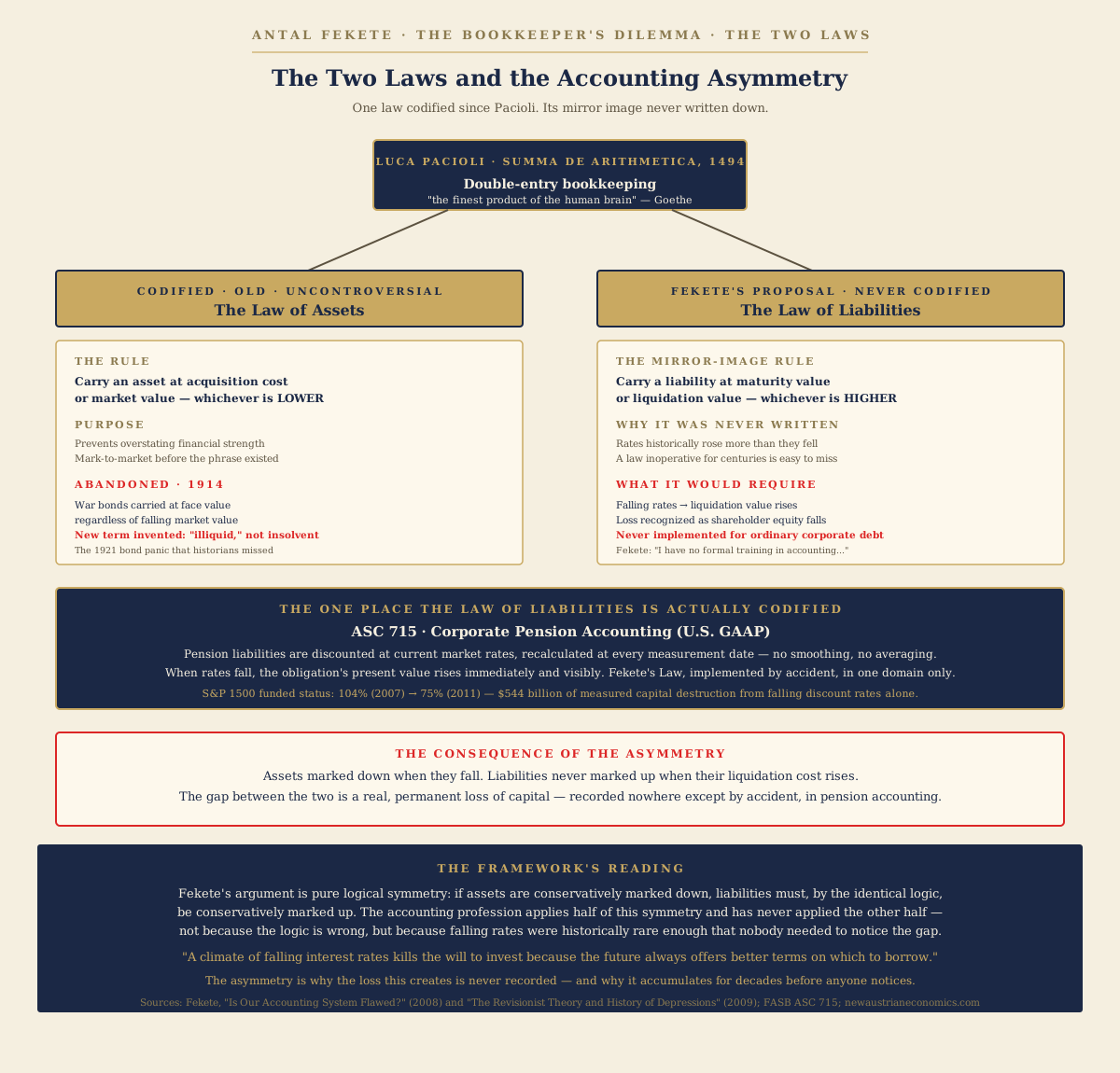
The accounting principle this essay will call the Law of Assets is old and, until relatively recently, uncontroversial: an asset must be carried on the balance sheet at its acquisition cost or at its current market value, whichever is lower. The rule is conservative by design. Its purpose is to prevent a firm — and especially a bank or other lending institution — from overstating the value of what it owns, which would create a false impression of financial strength and invite exactly the kind of reckless further lending or investment that a false impression of strength tends to invite. If a bank holds a bond that has fallen in market value since purchase, the Law of Assets requires the bank to recognize that decline immediately, marking the asset down to its current worth rather than carrying it at the higher historical price. This is, in the most literal sense, mark-to-market accounting, and it long predates the phrase.
The Law of Assets held through the pre-1914 gold standard era without serious challenge. It became a serious political problem the moment the belligerent governments of the First World War needed to finance an unprecedented volume of military spending. War bonds were issued at a scale no combatant government had previously attempted, and they were financed substantially through monetization by the domestic banking systems of Britain, France, Germany, and eventually the United States — banks were induced, encouraged, and in some cases required to hold large quantities of government war debt. The difficulty was that honest financing of total war at this scale could not be accomplished without a substantial rise in the interest rate demanded by the market for that debt, and a substantial rise in interest rates would, under the Law of Assets, have required every bank holding those bonds to mark them down to reflect their falling market value — an honest recognition that would have revealed most of the belligerent banking systems to be undercapitalized or insolvent by peacetime standards, at the exact moment when public confidence in the banking system was most needed to sustain the war effort.
What happened next is, on Fekete's own account, undocumented: "the story of how the accounting profession solved the dilemma has never been told." What is not in dispute is the outcome — banks were permitted to carry government war bonds on their books at face value regardless of the bonds' actual market value, treating them, in effect, as if they were cash. Fekete's explanation for the silence is a conjecture he is careful to label as one: it "may be a safe assumption," he writes, that the dilemma was resolved for the profession by belligerent governments prohibiting public disclosure of the banks' true condition, and while he cannot prove that a secret gag rule was imposed he is "at a loss to find an explanation why an open debate of the wisdom of changing time-honored accounting principles has never taken place." The framework adopts the outcome as documented and the explanation as plausible but unproven, which is how Fekete himself offers it. A new term entered the financial vocabulary to describe the resulting condition of a bank whose true capital position had been impaired by falling bond values but whose books did not show it: such an institution was "illiquid," a temporary and manageable condition, rather than "insolvent," a permanent and disqualifying one. The distinction allowed the banking systems of the combatant nations to keep their doors open through the war and its aftermath without triggering the depositor panics that an honest accounting would very plausibly have produced.
Fekete's specific historical claim is that this was the moment — 1914, not 1929, not 1933 — at which the gold standard was functionally, though not yet formally, terminated. The formal abandonments came later and are well documented across this catalog's Article 33: Britain's 1919 return to gold at an overvalued parity, the 1922 Genoa Conference's substitution of a gold-exchange standard for the classical gold coin standard, the 1933 domestic confiscation of gold coin in the United States, the 1944 Bretton Woods compromise, and finally the August 1971 termination of dollar convertibility. But each of these later formal steps was, in Fekete's reading, downstream of the accounting corruption of 1914. Once the principle had been established that a government's bonds need not be marked to their true market value regardless of what happened to interest rates, the gold standard's actual disciplining mechanism — the requirement that financial institutions honestly report the condition of their balance sheets — had already been removed. Everything that followed was the working-out of that removal.
An episode that receives almost no attention in standard financial histories, and that Fekete specifically flags as deserving far more, occurred in 1921: a panic swept through the U.S. government bond market as postwar deflationary pressures pushed rates upward, and banks across the country discovered that their capital had been seriously impaired by the falling value of the war bonds they had been encouraged to hold. The episode is documented in one place — Benjamin M. Anderson's 1949 Economics and the Public Welfare: A Financial and Economic History of the United States, 1914-1946 — and essentially nowhere else in the standard historical literature on American banking. Fekete's reading of this obscurity is that it was the last missed opportunity to correct the 1914 accounting compromise before the compounding damage produced the Great Depression a decade later.
The Law of Liabilities
Fekete's specific theoretical contribution — the reason his name belongs in this discussion at all, rather than merely as a historian of the 1914 episode — is the mirror-image principle he proposed by pure logical symmetry with the Law of Assets. If an asset must be carried at acquisition cost or market value, whichever is lower, then by the identical logic a liability must be carried at its face value at maturity, or at its liquidation value — what it would actually cost to extinguish the obligation today — whichever is higher.
The reasoning is straightforward once stated, though Fekete is candid that he could find no formal statement of this principle in any accounting textbook he consulted, including textbooks that still contained the Law of Assets before it too was quietly dropped from later editions. His argument for why the Law of Liabilities was never codified, despite following with perfect logical necessity from principles accountants already accepted, is itself illuminating: historically, interest rates had far more often risen than fallen. Under a rising-rate regime, the Law of Liabilities is simply inoperative — if rates rise, the market value of a firm's existing fixed-rate debt falls, which is favorable to the debtor, not unfavorable, and there is no capital-destruction mechanism to record. A principle that has no practical application across centuries of financial history is easy to overlook even by careful accountants, because there is never an occasion on which failing to apply it produces a visibly wrong answer. It took a genuinely novel monetary regime — one in which interest rates fell persistently, structurally, and for decades at a stretch, which is precisely the regime inaugurated by the Federal Reserve's post-1913 development of open market operations and cemented by the final abandonment of gold convertibility in 1971 — to make the absence of the Law of Liabilities a live and increasingly consequential blind spot.
The specific mechanism, restated in the plainest possible terms: when a firm borrows money at a fixed interest rate, it has locked in the cost of that capital for the life of the loan. If market interest rates subsequently fall, two things become true simultaneously. First, any competitor seeking to borrow the same amount of capital today can do so more cheaply, giving that competitor a durable cost advantage the original firm cannot access without refinancing costs, prepayment penalties, or the simple unavailability of an early exit from the obligation. Second — and this is Fekete's specifically accounting-theoretic point, distinct from the competitive-disadvantage point — the amount of capital that would actually be required to extinguish the original firm's obligation today, by purchasing an equivalent stream of future payments in the current market, is now higher than the face value of the original loan. This is because the original firm's fixed, above-market coupon payments are now worth more to a buyer than they were when rates were higher; a bond promising to pay 6 percent annually is more valuable when the prevailing market rate has fallen to 3 percent, because the bond's above-market coupon must be capitalized at the new, lower rate to determine its present value.
This second fact — the rising liquidation value of a fixed-rate liability as rates fall — is precisely the fact that the Law of Liabilities, if applied, would require every firm carrying such debt to recognize as an unrealized loss. It is a real economic loss in the most literal sense: if the firm actually attempted to retire the debt today by purchasing it back in the open market, it would have to pay the higher, liquidation-value price, not the original face value. The firm is poorer by that difference, whether or not it ever actually retires the debt, in exactly the same sense that a homeowner whose house burns down is poorer whether or not the loss is recorded on any document. Conventional accounting for most corporate debt — bonds and loans held at amortized cost rather than fair value — does not require this loss to be recognized. The debt continues to appear on the balance sheet at its original face value or amortized cost, and the corresponding loss in shareholder equity that Fekete's Law of Liabilities would require the firm to record simply never appears anywhere. It is not deferred. It is not smoothed. It is never recorded at all.
The arithmetic of destruction
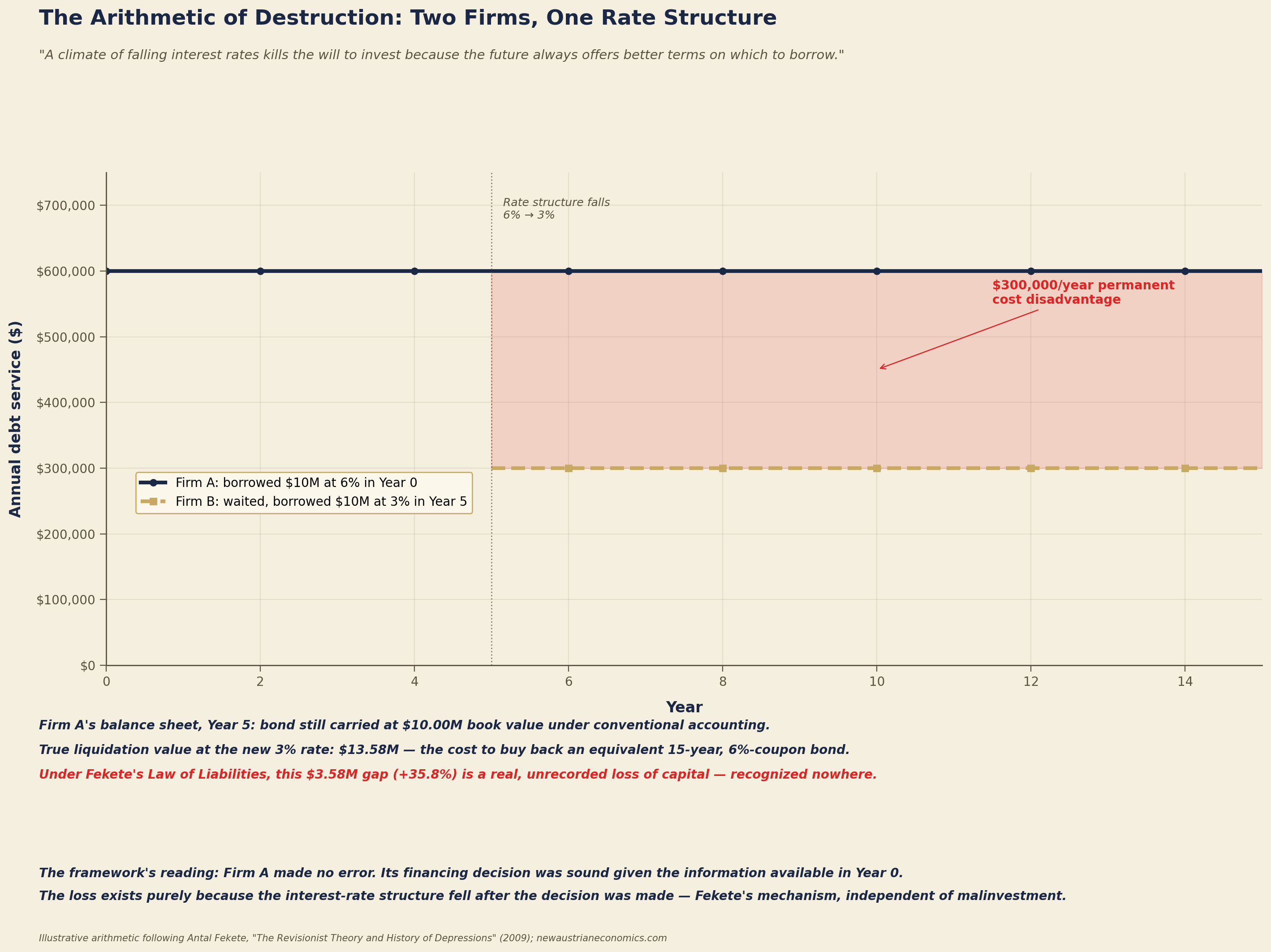
Consider two firms, identical in every respect except the timing of a single financing decision. Firm A, needing $10 million of capital for a twenty-year facility, issues a twenty-year bond at a 6 percent fixed coupon in Year 0. Firm B, needing the identical $10 million for an identical facility, is able to delay its financing decision by five years — perhaps its capital need arises later, perhaps its managers are simply patient — and in Year 5 issues its own bond, also for $10 million, at whatever rate then prevails.
Suppose that over those five years, the interest-rate structure falls from 6 percent to 3 percent — a decline entirely consistent with, for instance, the actual movement of the 10-year Treasury yield across substantial multi-year stretches of the post-1981 period. Firm B borrows its $10 million at 3 percent. Its annual debt service is $300,000. Firm A, locked into its Year-0 financing decision, continues paying $600,000 annually on the identical principal amount. Firm B has gained a permanent annual cost advantage of $300,000 relative to Firm A, for no reason related to either firm's operational competence, product quality, or managerial skill. The advantage exists purely and entirely because Firm B was able to wait, and the future — as the framework's epigraph states — offered better terms on which to borrow.
Now examine Firm A's balance sheet specifically, at the moment in Year 5 when the rate structure has fallen to 3 percent and fifteen years remain on its original twenty-year bond. Under conventional accounting, Firm A's bond continues to appear on its balance sheet at approximately its original face value of $10 million — the standard treatment for debt held at amortized cost. But what would it actually cost Firm A to extinguish this liability today, by purchasing in the open market a bond with equivalent remaining cash flows? The bond promises fifteen more years of $600,000 annual coupon payments plus a $10 million principal repayment at maturity. Discounting those cash flows at the new prevailing rate of 3 percent — the rate at which equivalent future cash flows are now valued in the market — produces a present value of approximately $13.58 million: roughly $7.16 million in present value from the coupon stream, plus roughly $6.42 million in present value from the principal repayment.
Firm A's liability, in other words, has a true liquidation value of approximately $13.58 million — some 35.8 percent higher than the $10 million book value still sitting on its balance sheet. Under Fekete's proposed Law of Liabilities, Firm A would be required to recognize a $3.58 million loss: an entry reducing shareholder equity by that amount, corresponding to the real increase in what it would cost to make Firm A's bondholders whole today relative to what Firm A originally promised. Under actual conventional accounting, no such entry is made. Firm A's reported equity, reported profits, and reported financial health are entirely unaffected by the fact that its outstanding debt obligation has become, in real economic terms, 35.8 percent more burdensome than it was when incurred.
This is the concrete arithmetic behind Fekete's claim that falling interest rates destroy capital. The $3.58 million has not been transferred to anyone — it is not a gain to Firm A's bondholders in any sense that shows up on their own books either, since they too generally carry the bond at amortized cost unless required to mark it to market. It has simply vanished from the recorded financial picture of the economy while remaining entirely real in the sense that matters most: if Firm A actually needed to retire this debt today, actually needed to raise the cash to make its bondholders whole at current market terms, it would need to find $13.58 million, not $10 million. The gap is capital that existed, in the sense that Firm A's true net worth is $3.58 million lower than its books show, and that no accounting entry anywhere records.
Fekete's proposed remedy, developed in his 2009 paper, is a specific three-step correction, modeled explicitly on the treatment an uninsured fire loss would require: create an asset-side entry headed "capital fund to cover shortfall in capitalizing interest payments, and shortfall in depreciation quotas, due to the fall of the interest rate"; create an equivalent entry in the liability column; and amortize that liability through a stream of payments out of future income. The heading names two channels, and this essay has so far developed only the first. The second — erosion of depreciation quotas, by which the reserves a firm sets aside to replace its physical plant are calculated against a capital base that the falling rate structure has quietly diminished — appears alongside the rising liquidation value of debt in Fekete's own statement of the thesis, and compounds it. The analogy to fire loss is deliberate and precise: in both cases, a real loss of capital has occurred; in both cases, sound accounting requires that the loss be recognized rather than concealed; and in both cases, failing to recognize the loss means that subsequent income statements will overstate true profitability, potentially leading the firm to distribute phantom profits as dividends or executive compensation that its true capital position cannot support.
Falling versus low — the distinction that decides everything
A frequent objection to Fekete's thesis, raised by critics across the intervening years, runs approximately as follows: lower interest rates are unambiguously good for borrowers, because they reduce financing costs and increase the present value of future cash flows when discounted at the new, lower rate. If this is true, how can falling rates simultaneously be destructive?
Fekete's answer is precise and turns on a distinction this essay's title signals but has not yet made explicit: the distinction between a low interest rate and a falling one. A stable interest rate of 3 percent, maintained consistently over time, is unambiguously beneficial relative to a stable rate of 6 percent — firms can plan around it, price their products around it, and make long-term capital commitments with confidence that the terms available to a future competitor will not differ systematically from the terms available today. But a rate that is currently falling — moving, for instance, from 6 percent toward 3 percent over some multi-year window — creates an entirely different and much more corrosive environment. In such an environment, every firm that has already borrowed at the prevailing rate discovers, again and again, that the rate has fallen further since its own financing decision was made. As Fekete puts it, in a falling-rate environment "the low rates of today will look like high rates tomorrow." A firm that borrows today at what appears to be an attractively low 4 percent rate, believing itself to have captured favorable terms, may discover in eighteen months that the prevailing rate has fallen to 3 percent, at which point its own 4 percent financing — which felt cheap at the moment of the decision — now looks expensive relative to what a delayed decision would have secured.
This is the behavioral mechanism the framework's epigraph names directly: a climate of falling interest rates kills the will to invest, not because capital is expensive, but because the expected value of waiting is positive and persistent. Any capital project contemplated today competes not only against the firm's cost of capital today, but against the anticipated cost of capital at some unknown future date that market participants have learned, through repeated experience across a multi-decade falling-rate regime, to expect will be lower still. The rational response to this expectation is not to invest today at what will predictably look, in retrospect, like unfavorable terms. It is to wait. And if every firm in the economy is rationally incentivized to wait, in the aggregate the economy invests less in productive capital than it would under a stable-rate regime offering the identical average cost of capital over time.
This produces what Fekete terms, with deliberate paradox, a "permanently high interest-rate environment" masquerading as a persistently falling one. No specific rate observed at any specific moment during a multi-decade decline is objectively "high" in any absolute sense — each successive rate is, in fact, lower than the one before it. But because each rate, at the moment it prevails, is anticipated to be exceeded to the downside by some future rate, every firm experiences its own financing decision as having been made at what will turn out, in retrospect, to have been the highest rate available across the relevant planning horizon. The entire economy behaves, in aggregate, as though rates were persistently and permanently too high, precisely because they keep turning out to have been so.
Phantom profits and the distribution channel
The unrecorded capital destruction this essay has developed to this point does not simply vanish without further consequence once it has occurred. Fekete's specific claim is that it re-enters the economy through a second channel: because the loss is never recognized on the income statement, the firm's reported profitability is systematically overstated relative to its true economic condition, and firms that do not understand this systematic overstatement continue to distribute what appear to be legitimate profits that a true accounting of their capital position would not support. Fekete's own account names two channels for the distribution, dividends and compensation; the third and largest channel in the American record since 1982, the share buyback, is this essay's addition to his argument rather than his own claim. Fekete calls these distributions "phantom profits," and the term is precise: they are profits that appear on the books but that a balance sheet honestly marking liabilities to liquidation value, as the Law of Liabilities would require, would reveal to be partly or wholly illusory, financed out of unrecognized capital destruction rather than out of genuine economic surplus.
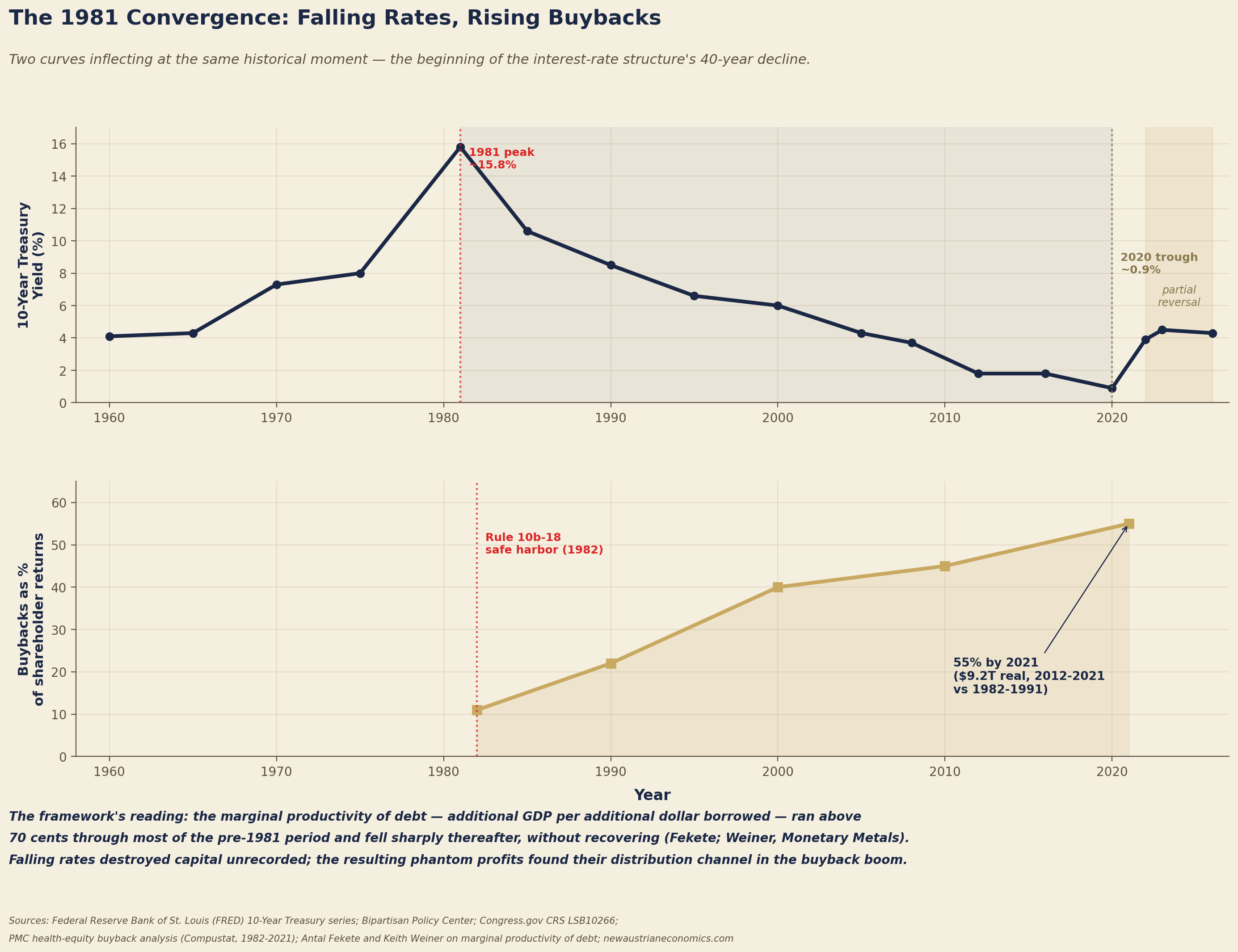
The historical timing here is worth examining closely, because it converges with unusual precision on the same 1981 inflection point at which the interest-rate structure itself turned from a multi-decade rise to a multi-decade fall. The U.S. Securities and Exchange Commission's Rule 10b-18, adopted in 1982, created the modern safe-harbor framework that made large-scale corporate share buybacks a routine and legally comfortable practice for the first time; before 1982, buybacks existed but operated under meaningfully greater legal ambiguity regarding potential market manipulation liability. The consequence of this 1982 rule change, layered onto a falling-rate regime that had begun the year before, was the emergence of a financing environment in which corporations increasingly found it more attractive to distribute cash to shareholders through buybacks than to reinvest it in new productive capacity. Buybacks grew from roughly 11 percent of total shareholder returns among corporations listed on U.S. exchanges in 1982 to roughly 55 percent by 2021 — a fivefold increase in relative importance across the same four decades during which the interest-rate structure fell from its historic 1981 peak toward its historic 2020 trough. U.S.-listed corporations spent an estimated $9.2 trillion in real terms on buybacks between 2012 and 2021 alone, nearly twelve times the real amount spent across the entire 1982-1991 decade.
The framework's reading of this convergence is not that buybacks are inherently illegitimate or that returning cash to shareholders is inherently unwise — a firm genuinely lacking attractive internal investment opportunities may reasonably prefer to return capital to owners who can redeploy it elsewhere. The framework's reading is more specific and more troubling: a meaningful share of the cash distributed through this forty-year buyback boom represents phantom profit in precisely Fekete's sense — cash that appeared, under conventional accounting that never marked the firm's own liabilities to their true liquidation value, to be legitimate surplus available for distribution, when a portion of it was in fact unrecognized capital that the firm's true balance sheet position could not actually support distributing. Firms that borrowed at higher rates years earlier and never recognized the corresponding increase in the liquidation value of that debt as rates subsequently fell were, in a meaningful sense, distributing capital they did not truly have, dressed in the appearance of profit that a properly marked balance sheet would have revealed to be partly illusory.
This is Fekete's mechanism by which falling rates propagate from an invisible balance-sheet phenomenon into a visible, real-economy consequence: the underinvestment in productive capacity that the framework's opening section documented as the empirical puzzle this essay set out to explain. Capital that should have been retained to cover the rising liquidation value of existing obligations was instead distributed to shareholders as apparent profit, leaving the firm's true capital base progressively thinner than its books indicated, right up until the moment — a recession, a credit event, a need to actually refinance — at which the gap between book capital and true capital became impossible to paper over any further.
The pension exception — where the accounting does see it
Here the framework arrives at the observation it can most plausibly claim as its own contribution in this essay, though the claim needs stating narrowly, because Fekete got to the pension domain first. In January 2010, months after the paper this essay has been drawing on, he published a two-part study, Economic Aspects of the Pension Problem, whose first part contains a section headed "Capital destruction due to declining interest rates" and applies the mechanism to pension funds explicitly and at length. Any suggestion that nobody connected pensions to Fekete's thesis would therefore be wrong, and this essay does not make it.
What Fekete did not identify is the accounting channel. His pension argument runs entirely through the asset side: a pension fund must earn an adequate return on its investments, and "at the lower rate the original schedule of capital accumulation cannot be met." That is a reinvestment problem, and it is not the Law of Liabilities. Neither part of the pension study mentions a discount rate anywhere. The observation this essay adds is that the liability side of the same domain is where Fekete's proposed Law of Liabilities — which he stated in 2008 and 2009 had never been codified in any accounting standard he was aware of — has in fact been substantially codified, and that the resulting data quantifies his mechanism directly.
Under U.S. GAAP's ASC 715 (and its international counterpart, IAS 19), a corporate sponsor of a defined-benefit pension plan is required to calculate its Projected Benefit Obligation using a discount rate that reflects the rate at which the pension benefits could actually be settled as of the measurement date — typically derived from the yields available on high-quality (AA-rated or better) corporate bonds with durations matching the plan's expected future payment stream. Critically, and unlike the treatment of most ordinary corporate debt, this discount rate is not smoothed, averaged, or held constant from year to year. It is recalculated at each measurement date to reflect prevailing market conditions, and — this is the specific mechanism that makes ASC 715 an accidental implementation of the Law of Liabilities — when market interest rates fall, the discount rate used to value the pension obligation falls with them, which mechanically increases the present value of the obligation. A pension promise to pay a retiree $50,000 annually for the rest of her life is worth more, in present-value terms, when the rate used to discount those future payments has fallen from 6 percent to 3 percent, for exactly the same mathematical reason that Firm A's bond in the previous section became more valuable to its holder as rates fell.
This is precisely Fekete's Law of Liabilities in operation: a liability marked, at every measurement date, to its true current liquidation value rather than held at some historical or smoothed figure. And because this correct accounting treatment exists in one specific corner of the corporate balance sheet while remaining absent everywhere else, the pension domain functions as an accidental natural experiment, allowing the capital destruction mechanism this essay describes to become empirically visible in a way it almost never is elsewhere.
The results of that natural experiment are visible in the funded-status series Mercer has tracked for S&P 1500 corporate pension plans since 2006, generally without any suggestion that they constitute a confirmation of Fekete's broader thesis. Aggregate funded status stood at approximately 104 percent at year-end 2007 8 — plans, in aggregate, held more in assets than they owed in projected obligations. By year-end 2011 it had fallen to approximately 75 percent, an aggregate shortfall of roughly $484 billion, which is a deterioration of approximately $544 billion in four years measured from the small surplus of 2007. 8 It is the $544 billion swing, not the $484 billion ending deficit, that measures what was destroyed. The 2008 leg of that deterioration came principally from investment losses; across the years that followed, it is routinely attributed to falling discount rates 9 — the same falling-rate environment, driven by the same Federal Reserve policy response to the 2008 financial crisis, that this essay's broader thesis concerns. The causal statement is uncontroversial among practitioners: by putting downward pressure on pension liability discount rates, a low interest-rate environment has been a major contributing factor to the increase in unfunded pension liabilities.
Note precisely what has happened here. An accounting standard that happens to implement Fekete's Law of Liabilities correctly has made $544 billion of real, measured, GAAP-recognized deterioration visible on audited balance sheets, the years after 2008 driven principally by falling interest rates — and the practitioner literature has termed it "underfunding," treating it as a plan-specific funding shortfall to be addressed through additional employer contributions, rather than recognizing it as a specific instance of a general mechanism operating identically, if invisibly, across every other fixed-rate liability in the economy that is not subject to the same mark-to-market discipline. The $544 billion is not a pension-specific anomaly. It is the one place where the iceberg happens to break the surface and become visible, allowing its true dimensions to be measured directly rather than inferred. Corporate bonds, bank loans, government debt, and every other category of fixed-rate liability held at amortized cost rather than fair value are experiencing the identical mechanism, at proportionally similar or larger scale given the far greater aggregate size of those liability classes relative to corporate pension obligations — but without any accounting standard requiring the loss to be measured, reported, or even acknowledged as loss rather than as the ordinary and unremarkable background condition of a low-rate environment.
Banks in the vise
The mechanism described above operates with particular severity on banks and other financial intermediaries, for a specific structural reason: banks are simultaneously long fixed-rate assets (the loans and securities they hold) and short fixed-rate liabilities (the deposits and borrowings that fund those assets), and a falling interest-rate structure attacks both sides of the balance sheet at once, in the same direction, without any natural offsetting hedge. Fekete's specific formulation, the heading of the relevant section of his 2009 paper, is that a falling-rate environment puts "bank ratios in the vise" — squeezed simultaneously from two directions that would, in a static reading of bank balance sheet theory, be expected to at least partially offset each other, but that in practice compound.
On the asset side, a bank holding fixed-rate loans and securities experiences the identical liquidation-value dynamic already described for Firm A's bond: the bank's own book of loans, if it needed to be sold today rather than held to maturity, would fetch a price reflecting current market rates, and if those loans were originated at higher rates than currently prevail, that price may not differ dramatically from book value — but the bank's true economic position depends on what it can earn reinvesting the proceeds of maturing loans at the new, lower rate, which is less than what it was earning before. On the liability side, the bank owes depositors and other creditors at rates that were fixed or effectively fixed at origination, and Fekete's Law of Liabilities applies to these obligations exactly as it applies to Firm A's bond: the true liquidation value of the bank's own liabilities has risen as rates fell, even though conventional accounting does not require this rise to be recognized.
The empirical signature of this dynamic is that banking crises driven by this mechanism tend to arrive suddenly and to affect large numbers of institutions simultaneously, because the underlying capital erosion has been accumulating identically and invisibly across the entire banking sector for years before any specific triggering event forces recognition. Fekete's own reading of the 2008 financial crisis, developed in real time in his 2008-2009 essays, was explicitly that "by 2008 the banks have reached the stage, more or less simultaneously, where all of their capital was wiped out" — not because of any single bad decision replicated across the industry, but because the entire industry had been operating under the identical falling-rate regime, accumulating the identical unrecognized capital destruction, for the same multi-decade span. This catalog's Article 16 documented the specific institutional history of the FDIC's evolution in response to recurring banking-sector capital crises; the mechanism this essay develops provides the underlying economic explanation for why those crises have recurred with the specific "more or less simultaneous" character Fekete identifies, rather than manifesting as isolated failures of individually mismanaged institutions.
Why this is not Austrian Business Cycle Theory
The mechanism this essay develops is frequently conflated with Austrian Business Cycle Theory, the analytical framework developed by Ludwig von Mises and Friedrich Hayek and subsequently extended by Murray Rothbard, in which artificially suppressed interest rates cause entrepreneurs to misjudge the true supply of loanable savings available in the economy, leading to a cluster of malinvestments — capital projects that appear profitable at the artificially low rate but that the economy's true underlying savings cannot actually sustain — which must eventually be liquidated in a recession once the distortion becomes unsustainable. This catalog holds the Austrian tradition, and Mises and Rothbard specifically, in very high regard; Article 33's engagement with the Golden Triangle draws extensively and gratefully on Misesian monetary theory, and nothing in this section should be read as a wholesale rejection of that tradition's genuine and largely correct insights about the dangers of central-bank interest-rate suppression.
But intellectual honesty requires stating plainly that Fekete's mechanism is not Austrian Business Cycle Theory, that it does not depend on ABCT's malinvestment premise, and that Fekete himself — writing as an economist who identified with and drew heavily on the Austrian tradition — was explicit and somewhat pointed about this distinction, precisely because he believed the conflation caused Austrians to miss half of his argument. His own words on this point deserve direct quotation: "Our explanation of deflation and depression in terms of destruction of capital, brought about by the falling interest rate structure, avoids any reference to possible malinvestments and is, therefore, superior." The framework would put the point more modestly than Fekete does — the mechanism is more general than the standard ABCT account, which is not the same as superior to it, and the two are better read as operating on different objects than as competitors. He continues: "entrepreneurs could learn from past experience and fine-tune their investments taking the distortion in the rate of interest into account" — meaning that even sophisticated entrepreneurs who correctly anticipate the artificially low rate, who make no malinvestment error whatsoever, who deploy capital only into projects that remain genuinely sound even after full adjustment for the distorted rate signal, would still experience the specific capital-destruction mechanism this essay develops. The mechanism operates on capital already deployed at a fixed rate, regardless of whether the original deployment decision was wise or foolish, well-informed or poorly-informed. It is not a story about entrepreneurial error. It is a story about accounting asymmetry that persists even in a world of perfectly rational entrepreneurs making perfectly correct investment decisions given the information available to them at the time.
This distinction has practical teeth. ABCT's prescription for avoiding the business cycle centers on preventing interest-rate suppression in the first place — sound money, a gold standard, or at minimum a central bank that does not manipulate rates below their natural market level — so that entrepreneurs receive an undistorted signal about the true supply of loanable funds and do not overinvest in long-duration capital projects the economy's actual savings cannot support. Fekete's prescription, while compatible with and indeed dependent on many of the same sound-money reforms, is aimed at a different and in some respects more specific target: it requires that liabilities be marked to their true liquidation value regardless of whether the rate structure that produced that liquidation value was itself distorted by central bank policy or moved for entirely organic reasons. Even in an economy with a fully restored gold standard and no central bank manipulation whatsoever, if the natural rate of interest happened to decline for genuine underlying economic reasons — a permanent increase in the economy's capital stock relative to its population, for instance, of exactly the kind classical economists expected to occur gradually over centuries under sound money — Fekete's mechanism would still apply to any firm holding fixed-rate debt across that decline, and the Law of Liabilities would still be necessary to prevent the resulting capital destruction from going unrecognized. ABCT is a theory about what happens when interest rates are artificially and unsustainably suppressed below their natural level. Fekete's mechanism is a theory about accounting, applicable regardless of why rates fell, natural or artificial, sustainable or not.
Where Fekete becomes genuinely and, this essay will state plainly, more sharply critical of the Rothbardian branch of the Austrian tradition specifically is on the question of fractional-reserve banking and the real bills doctrine, a disagreement this catalog's Article 33 engaged in the context of the Golden Triangle's gold-bill pillar. Rothbard's 100-percent-reserve position treats any bank credit extended against demand deposits as inherently fraudulent, regardless of whether that credit finances a genuine, self-liquidating commercial transaction of the kind real bills represent. Fekete's counter, delivered with characteristic bluntness — "no producer has ever paid a single gold coin for a semi-finished good, never ever!" — is that Rothbard's position, taken to its logical conclusion, would eliminate the trade-credit mechanism that has financed the movement of goods from producer to consumer in every developed economy in recorded history, mistaking the productive, self-liquidating credit of the real bills market for the unproductive, potentially inflationary credit expansion that concerned Mises and Rothbard in the context of central-bank-directed lending. This is a genuine and substantive disagreement within the broader hard-money tradition, not a manufactured one, and the framework's position is that Fekete has the better of this specific argument — real bills discipline themselves through the requirement that the underlying goods actually sell to willing consumers within ninety-one days, a discipline entirely absent from the kind of open-ended central-bank credit expansion that both Fekete and the Rothbardians correctly identify as dangerous. But this is a separate question from the capital-destruction mechanism this essay develops, which does not depend on resolving the fractional-reserve debate one way or the other.
Why gold bugs misdiagnose it
This catalog's Article 39 developed at length the reasons the standard gold-standard-advocate critique of central bank policy — rooted in a mechanical application of the Quantity Theory of Money, in which an expanded money supply is expected to produce a roughly proportional rise in the price level — repeatedly failed to predict the actual empirical outcome of the massive Federal Reserve balance sheet expansions of 2008-2015 and 2020-2022. The Fed's balance sheet grew from approximately $900 billion in 2008 to a peak above $8.9 trillion by 2022, an expansion of roughly tenfold; under a straightforward QTM reading, this scale of monetary expansion should have produced dramatic price inflation, potentially hyperinflation. 10 Reported CPI instead averaged below 2 percent for most of the 2009-2019 window, a result Article 39 attributed to Fekete's velocity-collapse mechanism: new money flowing into risk-free bond speculation rather than into consumer spending, driving M2 velocity down from approximately 1.95 in 2008 to its record low of approximately 1.13 in the second quarter of 2020. 11
This essay's mechanism supplies the missing second half of that explanation, and it is worth being explicit that the two mechanisms — velocity collapse and capital destruction — are not competing explanations but complementary aspects of the identical underlying process. The same Federal Reserve open-market purchases that made risk-free bond speculation attractive (driving velocity down, as Article 39 described) are, by the same mechanism and at the same time, driving the interest-rate structure lower — and it is precisely that falling interest-rate structure that destroys capital in the manner this essay has developed. Gold-standard advocates who watch only the quantity of money, expecting inflation, miss both halves of what is actually happening: the money is not chasing goods (so prices do not rise as expected), and simultaneously the same monetary mechanism that fails to produce the expected inflation is instead producing a slow, silent destruction of the productive capital base, visible in the marginal productivity of debt, in the buyback-versus-capex ratio, and — wherever the accounting happens to be honest, as in the pension domain — directly in the balance sheet numbers themselves.
The economist and journalist Gary North published a lengthy and pointed rebuttal of Fekete's thesis in February 2010, titled "Antal in Wonderland," arguing that Fekete's argument depended entirely on Treasury bond speculation while ignoring corporate bond dynamics, where North contended that inflation risk and default risk would push corporate rates in the opposite direction from Fekete's Treasury-focused analysis, and concluding that Fekete's reasoning contained "a mistake so inconceivably huge that it calls into question the man's ability to deal with reality." North's specific technical point — that corporate bond yields reflect not just the general interest-rate structure but also a firm-specific default-risk premium that can rise even as risk-free Treasury yields fall — is correct as far as it goes, and Fekete's original essays could fairly be criticized for not engaging this distinction with sufficient care in every passage. But North's broader dismissal does not survive contact with the empirical record this essay has assembled. The pension data showing $544 billion of aggregate S&P 1500 underfunding attributable to falling discount rates over 2007-2011 is not Treasury-market speculation; it is the measured, GAAP-audited liquidation-value impact of a falling rate structure on real corporate obligations, occurring by exactly the mechanism Fekete described, defaults and default-risk premiums notwithstanding. North's critique, in other words, attacks a version of Fekete's argument narrower than the one the subsequent empirical record has actually vindicated.
The framework's positioning here, consistent with the positioning Article 39 developed relative to the broader gold-bug community, is not a rejection of hard-money advocacy but a call for a more sophisticated version of it. The mechanical QTM story — more money printed, therefore higher prices, therefore buy gold — has now failed empirically often enough, across long enough a span, that continuing to rely on it exclusively risks discrediting sound-money advocacy generally, in exactly the way that failed hyperinflation predictions throughout the 2010s discredited a specific and vocal cohort of hard-money commentators whose credibility never fully recovered. Fekete's mechanism offers a more defensible and empirically better-supported foundation for the same underlying policy conclusion — that central bank interest-rate manipulation through open-market operations is deeply destructive to the real economy — without requiring a prediction about aggregate price levels that the actual monetary transmission mechanism, running through bond-market velocity collapse and unrecognized capital destruction rather than through consumer-price inflation, does not support.
The marginal productivity of debt
Fekete adopted and popularized a single summary statistic capturing the cumulative real-economy consequence of the mechanism this essay has developed: the marginal productivity of debt, defined as the additional real GDP produced per additional dollar of net new debt incurred across the economy in a given period. The statistic is not his. He credits it to the Hungarian-born Chicago economist Melchior Palyi, who began tracking the ratio in the United States in 1945 and died in 1970 before the name it now goes by had been coined. The logic is straightforward. If new borrowing is genuinely financing productive investment — new plant, new equipment, new productive capacity that generates real output — then each additional dollar borrowed should, roughly, generate at least a dollar of additional GDP over time; a ratio below 1.0 indicates that the economy is borrowing more than it is producing in return, a state of affairs that cannot continue indefinitely without the debt burden becoming unsustainable relative to the economy's actual productive capacity to service it.
Fekete set out the series most directly in a 2009 paper of that title, under a section headed "Melchior Palyi's early warning." In the 1950s, he writes, the ratio stood at 3 or higher, "meaning that the addition of $1 in new debt caused the GDP to increase by at least $3"; by August 1971, when Nixon closed the gold window, "the marginal productivity of debt has fallen below the crucial level 1"; and in 2006 it went negative for the first time, a year before the credit crisis broke. 4 Fekete's threshold for alarm is the ratio falling below 1: at that point the volume of debt is rising faster than national income and the country is consuming capital. Keith Weiner's later tracking of the same concept, using Bureau of Economic Analysis output data against the Federal Reserve's total-credit-market-debt series, reproduces the shape but on a different and much lower base: Weiner's peaks run "well over 70 cents of growth for every dollar borrowed" up to approximately 1981, falling to under a dime by the eve of the 2008 crisis. The two series are not measuring the same aggregate — Fekete's threes and Weiner's fractions cannot be reconciled as levels, and only the direction and the timing of the inflection are common to both. What the two agree on is that the decline is secular, that it did not recover, and that its steepest phase coincides with the period after the interest-rate structure turned from rising to falling. Weiner's own summary judgment on the significance of this data, echoing Fekete's original alarm, is direct: "Every monetary economist should be bellowing from the rooftops about the falling marginal productivity of debt!" he wrote in 2018 — and yet, as both Fekete and Weiner separately observe, the concept receives essentially no attention in mainstream economic discourse, appearing in almost no standard textbook treatment of debt, growth, or monetary policy.
The framework's reading of the marginal productivity of debt statistic is that it functions as the aggregate, economy-wide symptom of the balance-sheet-level disease this essay has diagnosed. Individual firms distributing phantom profits rather than genuinely reinvesting; individual banks squeezed simultaneously on the asset and liability side without recognizing the squeeze; individual pension plans discovering hundreds of billions of dollars in newly measured underfunding as discount rates fall — aggregate all of this across the entire economy, across four decades, and the necessary consequence is precisely what the marginal productivity of debt statistic shows: an economy that must borrow ever more heavily to generate the same increment of real output, because an ever-larger fraction of each new borrowed dollar is being absorbed not into productive capacity but into servicing the accumulating, unrecognized cost of past capital destruction.
The Fed as engine of deflation
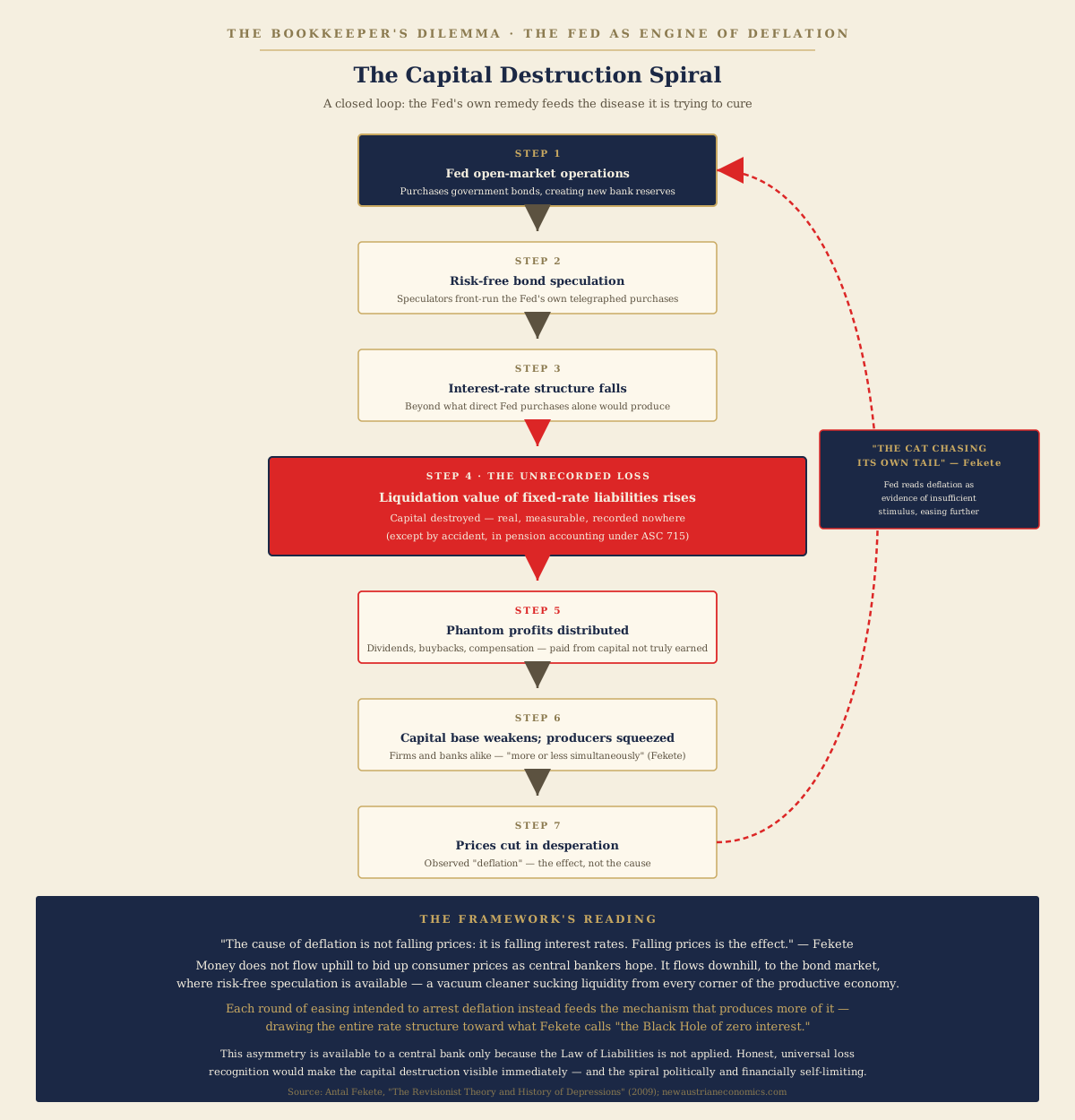
The final piece of Fekete's mechanism, and the piece that most directly inverts the conventional understanding of Federal Reserve policy, concerns causation: the standard account holds that falling prices (deflation) cause central banks to lower interest rates as a countermeasure; Fekete's account holds, more radically, that the causation typically runs the other way — that Federal Reserve open-market operations, by making risk-free bond speculation available to market participants who can front-run the Fed's own purchases, are themselves the primary cause of the falling interest-rate structure, and that the falling interest-rate structure is in turn the primary cause of the observed price deflation, through precisely the capital-destruction and phantom-profit mechanisms this essay has developed. "What this shows," in Fekete's own formulation, "is that the cause of deflation is not falling prices: it is falling interest rates. Falling prices is the effect."
The mechanism operates as a closed, self-reinforcing loop. The Federal Reserve purchases government bonds through open-market operations, creating new bank reserves. Bond speculators, recognizing that the Fed's ongoing and telegraphed purchase program will continue supporting bond prices, front-run those purchases by buying government bonds themselves in advance, in a trade Fekete describes as effectively risk-free given the Fed's own stated and repeated commitment to continued purchases. This speculative demand pushes bond prices higher and yields lower, extending the fall in the interest-rate structure beyond what the Fed's own direct purchases alone would produce. The falling interest-rate structure then destroys capital across the productive economy by precisely the mechanism this essay has developed — raising the liquidation value of existing fixed-rate liabilities, producing phantom profits, weakening capital bases that firms fail to replenish because the loss was never recognized as a loss in the first place. Firms weakened in this way, squeezed for genuine operating cash even as their books show apparent profitability, respond to competitive and cash-flow pressure by cutting prices — producing the observed consumer-price disinflation or outright deflation that conventional economic commentary treats as the phenomenon requiring explanation, when in Fekete's reading it is merely the visible tail end of a chain of causation that began with the Fed's own initial purchases.
The loop closes, and becomes vicious, because the observed price deflation is then read by conventional monetary policy-makers as evidence that monetary conditions remain too tight, prompting further rounds of asset purchases intended to combat the deflation — purchases that, by the mechanism just described, extend and deepen the very capital destruction that produced the deflationary pressure being combated in the first place. Fekete's specific image for this dynamic, developed across several of his essays, is the Federal Reserve as "the cat chasing his own tail": each round of monetary easing intended to arrest deflation instead feeds the mechanism that produces further deflationary pressure down the road, requiring still further easing, in a spiral that Fekete terms the pull of "the Black Hole of zero interest" — a reference to the tendency of this self-reinforcing dynamic to draw the entire interest-rate structure asymptotically toward zero, a level from which conventional monetary policy has no further room to operate through its ordinary interest-rate channel, forcing central banks into the unconventional balance-sheet expansion measures (quantitative easing, yield-curve control, and similar tools) that came to dominate central bank practice across the 2008-2022 period specifically because the ordinary channel had already been exhausted by the dynamic this essay describes.
The specific and important corollary to this analysis, and the reason it belongs in a catalog otherwise focused on documenting the world's monetary and institutional substrate, is that this entire dynamic is available to a central bank only because the accounting standards this essay has traced back to 1914 permit the resulting capital destruction to remain invisible. A central bank operating in a world where the Law of Liabilities was honestly and universally applied — where every fall in the interest-rate structure immediately and visibly increased the liquidation value of every fixed-rate liability across the banking system, forcing immediate recognition of the resulting capital erosion — would find its own open-market purchase program self-limiting in a way the current regime does not permit. The visible capital destruction would provoke immediate political and market resistance long before the mechanism could compound across the multiple decades it has, in fact, been permitted to compound across the actual historical record since 1914. The accounting blind spot is not incidental to the mechanism. It is the specific precondition that has allowed the mechanism to operate for over a century without triggering the kind of correction that honest and timely loss-recognition would have forced far sooner.
The framework's synthesis
This essay's engagement with Fekete's capital-destruction thesis provides the framework with a specific and previously underdeveloped reading of the Golden Triangle architecture this catalog documented at length in Article 33. That article's central claim was that the pre-1914 gold standard produced approximately a century of broadly distributed prosperity through the operation of three pillars — gold coin, gold bills, gold bonds — functioning together as an integrated monetary architecture. This essay's contribution is to specify more precisely which function within that architecture did the specific work of preventing the capital-destruction mechanism this essay develops: not, primarily, the gold standard's celebrated effect of maintaining a stable general price level, but rather its far less celebrated effect of maintaining a stable interest-rate structure. "It is not widely recognized," in Fekete's own formulation, "that the chief eminence of the gold standard is not to be found in stabilizing the price structure (which is neither desirable nor possible). It is to be found in stabilizing the interest-rate structure." The parenthetical is worth leaving in rather than eliding: Fekete's dismissal of price-level stability is flat, not hedged. A monetary system in which interest rates neither rise persistently nor fall persistently, but instead fluctuate within a narrow band around a stable long-run average, is a monetary system in which the Law of Liabilities is rarely invoked because there is rarely a large, sustained divergence between the rate at which existing debt was contracted and the rate currently prevailing. The gold standard's actual mechanism of maintaining broad prosperity, on this reading, was not that it kept the price of bread stable from decade to decade — a claim historical evidence only partially supports — but that it functioned as what Fekete calls a "flywheel regulator" on the interest-rate structure specifically. His own specification of what the flywheel should deliver is worth quoting against the temptation to read him as opposing any rate decline at all: the regulator exists "to keep interest rates stable or, more precisely, to let the increase in the Wealth of Nations impart a rather gentle and slow falling trend to interest rates." A gentle secular decline is, for Fekete, the healthy case. What generates the pathology this essay has developed is not the direction of the movement but its pace and its persistence — the multi-decade, one-directional plunge that no flywheel is damping.
This reading connects directly to several of this catalog's other installments. Article 35's documentation of the 2026 airline-sector failure cluster and Article 36's analysis of the DFC Hormuz facility's failed government backstop both describe institutions whose capital bases proved insufficient to absorb shocks that seemed, on paper, containable; this essay's mechanism supplies one specific reason why capital bases across the economy may be systematically thinner than reported financial statements indicate, having been eroded silently across decades by a mechanism no financial statement was designed to reveal. Article 37's engagement with personal savings navigation, and its specific caution against holding savings in mutual-fund vehicles whose apparent diversification does not protect against substrate-condition failure, gains an additional dimension here: the bond and fixed-income holdings inside those diversified vehicles are themselves subject to exactly the capital-destruction mechanism this essay describes, meaning that a "conservative," bond-heavy allocation, marketed and generally understood as the lower-risk component of a diversified portfolio, may in fact be quietly absorbing the specific losses this essay has shown to be real, measurable, and simply unrecognized by the accounting conventions under which those funds report their performance.
What can be said with reasonable confidence as of mid-2026, and what the framework will continue to track, is this. The interest-rate structure that fell with only brief interruptions from 1981 through 2020 has, since 2022, undergone its first sustained multi-year reversal in over four decades, with the 10-year Treasury yield rising from its 2020 trough near 0.5-0.9 percent to a range of roughly 4-4.5 percent by 2025-2026, and with Federal Reserve Chair Kevin Warsh — whose institutional posture this catalog's Article 32 and Article 36 have already engaged at length — signaling explicitly hawkish intent to resist further rate declines. 1 If Fekete's mechanism is correctly specified, this reversal should, over time, begin to repair rather than further erode the aggregate capital base this essay has argued was silently eroded across the preceding four decades — precisely because a rising, rather than falling, interest-rate structure reverses the liquidation-value dynamic this essay has developed, reducing rather than increasing the true economic burden of existing fixed-rate liabilities relative to their book values. Whether this reversal proves durable, whether it is sustained long enough and consistently enough to meaningfully repair the marginal productivity of debt statistic this essay has discussed, and whether the accounting profession will use this period of rate normalization as an occasion to finally examine the asymmetry this essay has documented, are each open questions the framework will continue to monitor as the current interest-rate cycle develops.
This is the fourth installment of Series One Extension, following Article 31 (the classical definition of wealth applied to AI), Article 33 (the Golden Triangle architecture), and Article 37 (personal savings navigation in the absence of sound money). The mechanism developed here — falling interest rates as an invisible engine of capital destruction, operating through an accounting asymmetry dating to 1914 and never corrected — provides the theoretical foundation the framework has been assembling piece by piece across this catalog's institutional case studies. Subsequent installments, in this series and in Watching the Cracks, will apply this specific mechanism to ongoing developments as the 2022-2026 interest-rate reversal continues to unfold.
Sources
Footnotes
-
Federal Reserve, H.15 selected interest rates, and FRED constant-maturity Treasury series. https://www.federalreserve.gov/releases/h15/ — The 1981 peak near 15.8 percent and the four-decade decline that followed. ↩ ↩2 ↩3
-
S&P Dow Jones Indices buyback series, endpoints only. https://www.spglobal.com/spdji/ — The 11 → 22 → 40 → 45 → 55% progression in buyback share has sourced endpoints only; the interior points are interpolated. ↩
-
S&P Dow Jones Indices buyback data and aggregate corporate payout series. https://www.spglobal.com/spdji/ — Estimated $9.2 trillion in real terms of U.S.-listed share buybacks, and buybacks as a share of total shareholder returns. ↩ ↩2
-
Fekete, Antal E. — the Law of Assets (value an asset at acquisition or market value, whichever is lower) and the Law of Liabilities (value a liability at maturity or liquidation value, whichever is higher), both in his papers at https://professorfekete.com/ — He records finding no statement of the Law of Liabilities in any bookkeeping textbook, while having seen the Law of Assets in older discarded ones, is his own. ↩ ↩2
-
Fekete, Antal E. https://professorfekete.com/ — The 1921 U.S. government bond panic, and Fekete's statement that banks' capital was seriously impaired by it, verify verbatim. His claim about 1914 accounting accommodation asserts the accommodation, not an enforcement mechanism through wartime information controls. ↩
-
Goethe, J.W. Wilhelm Meister's Apprenticeship, Book I. https://www.gutenberg.org/ebooks/2335 — The line "one of the finest inventions of the human mind" appears in Goethe's Wilhelm Meister's Apprenticeship spoken by a character, Werner, and the standard rendering differs from the wording this essay originally used. ↩
-
Pacioli, Luca. Summa de arithmetica, geometria, proportioni et proportionalità. Venice, 1494 — double-entry treated in Tractatus XI. The list of his cities follows Fekete's own account. ↩
-
Milliman and corporate pension funding-status surveys. https://www.milliman.com/ — Aggregate funded status near 104 percent at end-2007 falling to roughly 75 percent by end-2011. ↩ ↩2
-
Ehrhardt, John W., Zorast Wadia and Alan Perry. Milliman 2012 Pension Funding Study, March 2012. https://edge.sitecorecloud.io/millimaninc5660-milliman6442-prod27d5-0001/media/Milliman/importedfiles/uploadedFiles/insight/eb-published/2012pensionfundingstudypdf.pdf — for the 2008 funded-ratio decline driven by an 18.7 percent investment loss, and liability increases of 8.1, 7.8 and 9.3 percent in 2009–2011 attributed to falling discount rates. ↩
-
Federal Reserve, H.4.1 factors affecting reserve balances. https://www.federalreserve.gov/releases/h41/ — Balance sheet growth from approximately $900 billion in 2008 to a peak above $8.9 trillion. ↩
-
Bureau of Labor Statistics, Consumer Price Index. https://www.bls.gov/cpi/ — Reported CPI averaging below 2 percent for most of the 2009–2019 window. ↩
Related essays
Open Market Operations at Light Speed: How AI Converted Fekete's 1922 Warning into a Closed-Loop Capital Destruction Engine
Fekete argued that the illegal introduction of open market operations in 1922 made bond speculation risk-free and destabilized the interest-rate structure. AI-driven algorithmic trading has automated this mechanism and accelerated it to the physical limits of latency. The predicted consequence — systemic capital destruction — is no longer theoretical.
The Vanishing Gold Basis: Field Notes from Canberra, 2009
Four days with Antal Fekete and the Gold Standard Institute in Canberra, fourteen months after Lehman. The gold basis as monetary thermometer, the mechanics of permanent backwardation, and why falling interest rates destroy capital in ways that no one in the financial press was discussing.
The Term Is the Variable: Two Countries, One Rate Structure, and Where the Stress Lands
Court-ordered property listings across Greater Vancouver and the Fraser Valley reached 946 between January and September of 2026, a ten-year high, against 773 for all of 2025 and an annual average roughly one third that level between 2017 and 2022. The conventional reading is that Canadian housing is cracking while the United States holds up. The data does not support that reading. American foreclosure inventory also reached a six-year high in 2026, filings rose fifteen percent year over year, and forty states recorded higher delinquency rates. Both markets are under stress from the same rising interest-rate structure. What differs is where the stress lands, and the difference is almost entirely explained by one contractual feature. In Canada the stress has moved up-market: the president of the firm compiling the listing data says that properties in West Vancouver and Vancouver's West Side were not the ones being foreclosed in the previous cycle, and now are. In the United States it has sorted by credit quality instead: within the Mortgage Bankers Association's survey, FHA-insured mortgages carry a delinquency rate of 11.79 percent against 2.72 percent for conventional loans, a ratio of better than four to one. A five-year Canadian term forces every borrower to reprice regardless of quality, so the stress follows balance size. A thirty-year American fixed insulates every borrower from repricing, so only those marginal at origination break. And the lock-in effect now freezing American inventory is, this essay argues, Fekete's Law of Liabilities being priced by millions of households that no accounting standard requires to record it.