
The delivery mechanism matters as much as the payment
Article 38 of this catalog established the descriptive terrain of the 2026 distribution debate: seven variants of universal distribution being proposed by the tech industry's most prominent voices and by policy advocates across the political spectrum. Article 39 developed the framework's theoretical apparatus for reading those proposals structurally: Antal Fekete's Janus-Face of marketability, the demonstration that universal distribution schemes fail on both faces of marketability (in the large and in the small), and the critique of the standard gold-bug argument that mechanically applies the Quantity Theory of Money to predict hyperinflationary outcomes that empirical evidence has repeatedly contradicted. This concluding installment engages the institutional dimension: what the actual delivery mechanism for universal distribution is likely to be, what that mechanism reveals about the specific institutional consequences of these proposals, and what the framework offers as a positive alternative to the distribution question as currently constructed.
The central analytical claim of this installment: the delivery mechanism matters as much as the payment. A distribution scheme delivered through traditional bank-account transfers has different institutional consequences than the same scheme delivered through central bank digital currency (CBDC) rails with programmable rules embedded in the currency protocol itself. A distribution scheme requiring biometric identity verification through a specific institutional provider has different institutional consequences than a distribution scheme accessible through general citizenship. A distribution scheme with expiration dates that force recipient spending within specific windows has different institutional consequences than a distribution scheme without such restrictions. The debate as currently constructed treats the payment mechanism as a secondary implementation detail — the important thing is the payment amount, the funding source, the eligibility criteria. The framework's reading is different: the delivery mechanism is the mechanism through which the institutional configuration of the distribution scheme becomes operational. Understanding the delivery mechanism is understanding the actual character of the proposal.
UBI meets CBDC — the programmable money reality
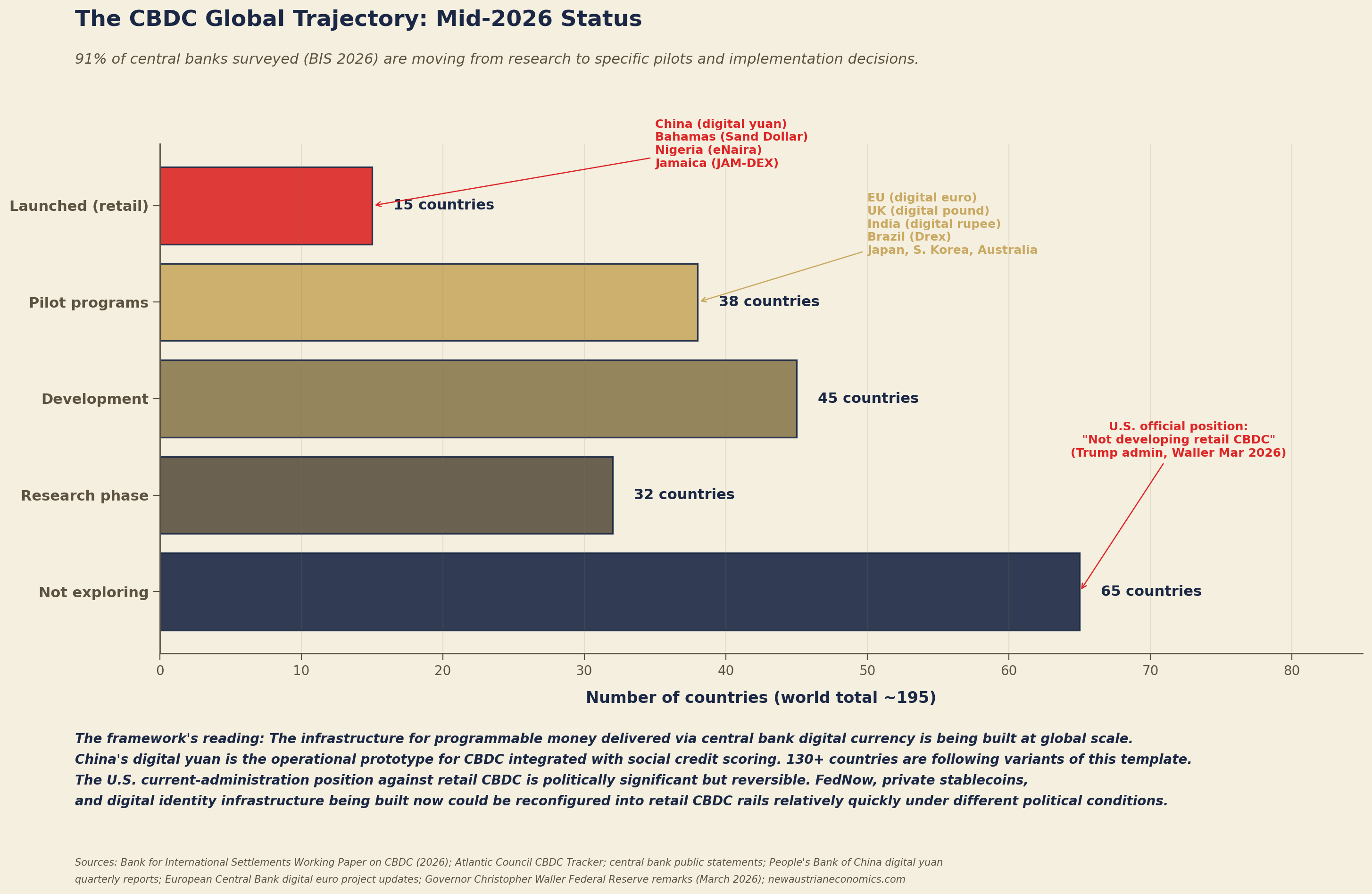
The delivery infrastructure for universal distribution schemes is developing in parallel to the distribution proposals themselves. The specific infrastructure is central bank digital currency (CBDC) — a digital form of national currency issued directly by the central bank rather than by commercial banks, held by end users in accounts custodied by the central bank or by authorized intermediaries, and transferred through payment rails operated or supervised by the central bank. As of mid-2026, according to the Bank for International Settlements, more than 130 countries are actively exploring or piloting CBDC systems. The BIS survey published in early 2026 reported that 91 percent of central banks surveyed are moving from research to specific pilots and implementation decisions. The infrastructure is being built.
The specific features of CBDC that matter for the distribution question. A CBDC is not merely a digital version of physical cash. Physical cash is bearer instrument — the person in possession of the note is the person with the claim, transactions occur peer-to-peer without institutional intermediation, and the state does not have transaction-level visibility into commerce that occurs in cash. CBDC operates on a fundamentally different institutional model. Every transaction in a CBDC system creates a permanent record on the central bank's ledger. Every recipient of CBDC is identified through an account structure that ties the CBDC balance to a specific identity. Every transaction is potentially subject to real-time rules enforcement by the CBDC protocol itself.
The specific programmable features being developed for CBDC systems include expiration dates on stimulus payments (forcing recipients to spend the payments within specific windows or lose them), geographic restrictions (limiting where CBDC balances can be spent, useful for supporting local economies but also for restricting where citizens can transact), merchant category restrictions (limiting spending to specific approved categories such as basic necessities, or excluding specific categories such as gambling, alcohol, or politically disfavored merchants), purchase amount limits (capping individual transactions to prevent large purchases without additional authorization), and behavior-contingent conditions (making continued receipt of payments contingent on specific behavioral compliance such as vaccination status, employment activity, or other criteria the paying institution deems relevant).
None of these features is speculative. All of them are being actively developed and tested in existing CBDC pilots. The European Central Bank's digital euro program has explicitly discussed programmable features for stimulus applications. The People's Bank of China's digital yuan has implemented several of them operationally. The Reserve Bank of India, the Bank of England, and the Central Bank of Brazil are all developing CBDC systems with programmability as core design features rather than optional add-ons.
The Federal Reserve's specific position. The U.S. situation is more complex. The Trump administration has taken a public position against retail CBDC, and the Federal Reserve has slowed its CBDC exploration compared to peer central banks. Governor Christopher Waller stated in a March 2026 speech that "the Federal Reserve is not developing a retail CBDC and I have said several times that I don't see a need for one." At the same time, the Fed's wholesale CBDC research continues, private sector stablecoins (which share many operational features with retail CBDC) are proliferating, and the underlying infrastructure that would enable retail CBDC deployment on relatively short notice — digital identity systems, real-time payment rails, central bank account infrastructure — is being built through parallel initiatives.
The framework's reading of the U.S. situation: the current administration's opposition to retail CBDC is politically significant but should not be interpreted as permanent institutional constraint. Administrations change. Political priorities shift. The infrastructure being built through FedNow, through private stablecoins that operate on Fed-adjacent rails, through the Treasury's various digital dollar initiatives, and through the broader digital identity ecosystem could be reconfigured relatively quickly into a functional retail CBDC system if political conditions warranted. The specific vulnerability the framework identifies: infrastructure decisions being made now under the assumption that "the Fed will not issue a retail CBDC" may create the specific institutional preconditions that make retail CBDC easy to deploy later when the political calculus changes.
China's digital yuan as prototype
The most fully operational example of programmable CBDC integrated with social credit infrastructure is China's digital yuan (e-CNY), which entered pilot deployment in 2020 and expanded to substantial scale across major Chinese cities during 2022-2024. As of mid-2026, the digital yuan is available across most major Chinese urban centers, with over 300 million individual wallets created and cumulative transaction volume exceeding several trillion yuan. The specific institutional configuration of the digital yuan provides the operational template for what programmable CBDC integrated with social credit scoring looks like in practice.
The specific integration with social credit. China's social credit system, developed through the 2010s and increasingly integrated across financial and administrative systems during the 2020s, assigns citizens numeric credit scores based on a combination of financial behavior, legal compliance, and various forms of social and political behavior. Individuals with high social credit scores receive preferential access to services, expedited administrative processing, and reduced regulatory friction. Individuals with low social credit scores experience restrictions on services, delayed administrative processing, and increased regulatory friction. The digital yuan is technically capable of enforcing spending restrictions based on social credit scores — an individual with a low social credit score can be automatically restricted from purchasing certain categories of goods or services, from transacting above certain amounts, or from participating in certain economic activities entirely.
The specific mechanisms include the following. Time-limited spending windows: digital yuan issuances can be programmed to expire within specific timeframes, forcing recipients to spend within those windows or lose the funds. Category restrictions: digital yuan payments can be restricted to specific merchant category codes, effectively limiting what recipients can purchase with those funds. Geographic restrictions: digital yuan spending can be limited to specific administrative regions, useful for stimulating local economic development but also for restricting where citizens can transact. Real-time monitoring: every digital yuan transaction is visible to the People's Bank of China in real time, enabling automated compliance enforcement and pattern analysis.
The operational template. The framework's reading of the digital yuan is not that it represents a specifically Chinese phenomenon that can be dismissed as culturally particular. It represents the operational template for how programmable CBDC integrated with citizen-scoring infrastructure operates when the political system chooses to deploy it. The template exists. The template works. The template has been refined through multiple years of iterative development. The specific question for other jurisdictions is not whether the template can be deployed — it clearly can be — but whether the political system in each specific jurisdiction chooses to deploy it in the same integrated form.
The framework's specific claim. Universal distribution schemes delivered through CBDC infrastructure of the kind demonstrated by China's digital yuan create a structural configuration in which the recipient's access to distributed funds is contingent on maintained eligibility under whatever criteria the paying institution establishes. This is not "helping displaced workers." This is the creation of an institutional dependency relationship in which the citizen's economic participation is subject to administrative approval and can be revoked or restricted through administrative action. The dependency runs directly counter to the individual sovereignty over economic decisions that the framework treats as foundational.
The specific vulnerability: universal distribution proposals as currently discussed do not typically engage the CBDC delivery question in depth. Advocates focus on the payment amount, the funding mechanism, and the eligibility criteria. The delivery infrastructure is treated as a technical implementation detail. But the delivery infrastructure is where the institutional character of the distribution scheme becomes operational. A distribution scheme announced as universal, unconditional, and permanent can be operationally converted into a distribution scheme that is contingent, conditional, and revocable simply by choosing the appropriate delivery infrastructure. The choice of delivery infrastructure — bank accounts vs. CBDC, traditional cash vs. programmable digital currency — is not a technical detail. It is the substantive decision that determines what the distribution scheme actually is.
The abundance-is-scarcity-solved argument, historically read
The rhetorical framing of the tech evangelist proposals — Musk's UHI, Altman's UBW, the broader narrative of AI-driven abundance making traditional scarcity constraints obsolete — has a specific historical parallel that the framework can engage productively. The parallel is to the 20th-century monetary reform rhetoric that culminated in the abandonment of the gold standard: the argument that industrial productivity had rendered gold a "barbarous relic" whose scarcity constraints were incompatible with the abundance that modern manufacturing could generate.
The 20th-century argument as typically formulated. John Maynard Keynes coined the phrase "barbarous relic" in his 1924 book A Tract on Monetary Reform, though the underlying argument had been developing since at least the 1890s and had been articulated in various forms by monetary reformers across the political spectrum. The specific claim: the industrial revolution had transformed the productive capacity of modern economies to such an extent that the constraints imposed by gold — its limited quantity, its geographic distribution, the specific institutional infrastructure required to maintain gold-standard monetary policy — had become anachronistic. Modern economies could produce vastly more real goods and services than the gold-standard monetary supply could accommodate. Monetary discipline based on gold was preventing economies from realizing their full productive potential. The solution was to replace gold-based monetary discipline with political-management-based monetary discipline, in which central banks and treasuries would adjust the money supply to accommodate productive capacity rather than being constrained by the supply of a specific precious metal.
The argument was refined and elaborated across the 1920s, 1930s, and 1940s. Keynes's General Theory (1936) provided the analytical foundation. The Bretton Woods conference (1944) created the specific institutional infrastructure that would replace pure gold standard monetary discipline with a dollar-gold-exchange standard managed by the U.S. Treasury and the International Monetary Fund. The Nixon shock of August 15, 1971 completed the transition by unilaterally terminating dollar convertibility to gold and establishing the fully political-management-based monetary system that has prevailed since.
The historical outcome. The framework's Article 33 (Golden Triangle) engaged the specific historical destruction that occurred across the 1914-1971 period. The outcome of replacing gold-based monetary discipline with political-management-based monetary discipline was not what the reformers predicted. The reformers predicted stable purchasing power maintained through prudent political management. The actual result was persistent monetary depreciation, with the U.S. dollar losing approximately 98 percent of its 1913 purchasing power by 2025. The reformers predicted broad-based prosperity as monetary discipline was released. The actual result was substantial wealth concentration at the top of the distribution and stagnating real wages for the median worker across the post-1971 period. The reformers predicted political accountability for monetary decisions. The actual result was progressive insulation of monetary policy from democratic accountability, with the Federal Reserve becoming one of the least publicly accountable major institutions in the U.S. government.
The parallel to the current abundance argument. The current tech evangelist argument follows the same structural pattern. Just as the 20th-century reformers argued that industrial productivity had made gold's scarcity constraint obsolete, the 21st-century reformers argue that AI-driven productivity is making the scarcity constraint on economic goods generally obsolete. Just as the 20th-century reformers proposed replacing gold-based monetary discipline with political management, the 21st-century reformers propose replacing market-based resource allocation with technology-generated abundance distributed through various administrative mechanisms. Just as the 20th-century reformers promised stable purchasing power, broad prosperity, and democratic accountability, the 21st-century reformers promise universal wealth, work becoming optional, and democratic participation through direct distribution.
The framework's specific concern. The 20th-century argument was structurally similar to the 21st-century argument, and the 20th-century argument produced empirical outcomes substantially different from what its advocates predicted. There is no specific reason to expect that the 21st-century argument will produce outcomes different from what its advocates predict any more than the 20th-century argument did. The specific mechanism by which the 20th-century argument failed — replacing objective monetary discipline (constraint by the supply of a specific precious metal) with subjective political discipline (management by administrative institutions accountable to political pressures) — is the same mechanism the 21st-century argument would deploy. Objective constraints get replaced by administrative discretion. Administrative discretion is subject to institutional capture, political pressure, and the specific incentives of the administering institutions. The outcomes over multi-decade horizons diverge substantially from the outcomes the reformers predicted.
The historical record provides substantial empirical evidence for how these transitions actually unfold. The Weimar Republic (1919-1933) provides one specific case: political-management-based monetary discipline collapsed into hyperinflation as political pressures overwhelmed prudent management. The Bretton Woods system (1944-1971) provides another: the specific institutional infrastructure designed to maintain international monetary discipline eroded progressively until it was formally abandoned. The various failed communist experiments with allocation-based economies (Soviet Union, Maoist China, Cuba, North Korea, Venezuela) provide additional cases. In each historical instance, replacing monetary and market discipline with administrative discretion produced outcomes substantially different from what the reformers predicted, and the divergence typically favored the administrating institutions at the expense of ordinary participants in the economy.
The framework's reading: the 21st-century abundance-is-scarcity-solved argument should be evaluated in light of this historical record rather than in isolation from it. The specific claim that AI-driven productivity will produce abundance sufficient to eliminate the scarcity constraint entirely is unfalsifiable in the short term, but the historical record on similar claims suggests substantial skepticism is warranted.
Who benefits — the third-order beneficiary problem
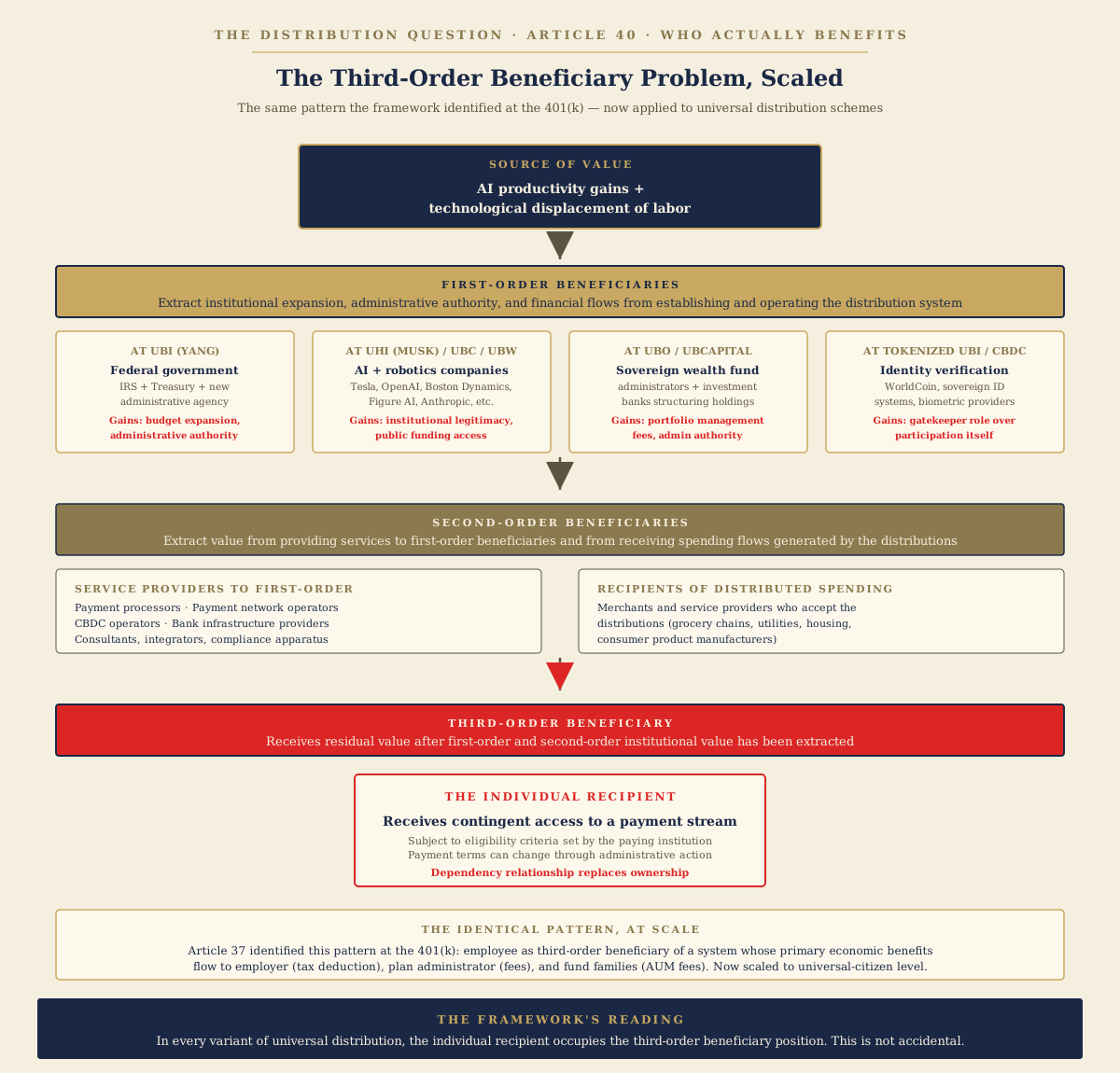
Article 37 of this catalog developed the framework's third-order beneficiary framework for reading the 401(k) system: the employee, who ostensibly is the primary beneficiary of tax-advantaged retirement savings, is in fact the third-order beneficiary of a system whose primary economic benefits flow to the sponsoring employer (through tax deductions), to the plan administrator (through administrative fees), and to the mutual fund families (through management fees on accumulated AUM). The employee benefits from the specific structure only after these prior beneficiaries have extracted their value. This installment extends that analytical framework to the universal distribution proposals, examining who occupies the first-order, second-order, and third-order beneficiary positions in the various proposal architectures.
Universal Basic Income (Yang formulation). The first-order beneficiaries of UBI are the institutional entities that administer the distribution — the federal government agencies that establish and manage the program (IRS, Treasury, and potentially a new administrative agency), the payment processors that handle the transactional infrastructure (banks, or CBDC operators, or payment network operators), and the compliance apparatus that manages eligibility determination and fraud prevention. These entities gain substantial institutional expansion, budget allocation, and administrative authority through the establishment and operation of the program. The second-order beneficiaries are the merchants and service providers who receive UBI-funded consumer spending — grocery chains, housing providers, utility companies, and various consumer product manufacturers. The third-order beneficiary is the individual recipient, whose payment is what enables the primary and secondary flows but who receives the payment only after the administrative infrastructure has been established, funded, and made operational.
Universal High Income (Musk formulation). The first-order beneficiaries of UHI are the humanoid robot manufacturers and AI systems developers whose products are supposed to generate the productivity gains that fund the distributions. Tesla's Optimus program, Boston Dynamics, Figure AI, Sanctuary AI, and various other robotics companies would receive substantial institutional expansion through the deployment of their systems at the scale the UHI framework contemplates. The second-order beneficiaries are the AI systems developers whose software runs the humanoid robots — OpenAI, Anthropic, Google DeepMind, Meta AI, and various other model developers. The third-order beneficiary is the individual recipient of the UHI payments, whose share of the productivity gains depends on the willingness of the first-order and second-order beneficiaries to release those gains into the distribution system.
Universal Basic Compute (Altman formulation). The first-order beneficiary of UBC is OpenAI itself, whose GPT-N compute becomes the productive substrate that all recipients access. OpenAI's institutional position is substantially strengthened by universal reliance on its compute infrastructure. The second-order beneficiaries are the specialized service providers who help recipients use the compute effectively — training providers, consulting firms, and integration specialists. The third-order beneficiary is the individual recipient, whose compute allocation has value only insofar as OpenAI's infrastructure remains operational and its pricing and terms of service remain favorable.
Universal Basic Wealth (Altman token distribution). The first-order beneficiaries of UBW are the coordinating institutions that would need to be established to make the token distribution operational — a new industry consortium, a sovereign administrator, or some form of international coordination body. These institutions gain institutional existence, budget authority, and coordination power through the establishment of the token distribution system. The second-order beneficiaries are the AI-developer companies whose output the tokens represent — the companies gain institutional legitimacy and access to public funding through their participation in the token distribution system. The third-order beneficiary is the individual recipient of the tokens, whose tokens have value only insofar as the coordinating institutions maintain their operation and the AI-developer companies continue to produce output that gives the tokens exchangeable value.
Universal Basic Ownership (Diamandis formulation). The first-order beneficiaries of UBO are the AI-developer companies whose equity is purchased by the sovereign wealth fund. These companies receive institutional liquidity for their existing shareholders (founders, early investors, existing employee equity holders), reducing the specific dependency of the company on public market access and providing exit liquidity that might otherwise be difficult to obtain. The second-order beneficiary is the sovereign wealth fund itself, whose institutional expansion provides administrative authority, employment for fund managers, and coordination power over the aggregate portfolio. The third-order beneficiary is the individual citizen, whose share of the aggregate dividend flow depends on the fund's continued operation, the underlying companies' continued profitability, and the political decisions about how the fund's outputs are distributed.
Universal Basic Capital (Garman formulation). The first-order beneficiaries of UBCapital are the sovereign asset managers who administer the diversified fund. These entities receive substantial administrative authority, budget allocation, and portfolio management fees through the establishment and operation of the fund. The second-order beneficiaries are the various asset managers and financial services providers who transact with the sovereign fund — investment banks that structure the fund's holdings, custodians that hold the assets, various service providers that support the operation. The third-order beneficiary is the individual citizen, whose distribution depends on the fund's continued operation, the political decisions about distribution rates, and the underlying performance of the fund's holdings.
Tokenized UBI with CBDC integration. The first-order beneficiaries of tokenized UBI are the digital identity verification providers (WorldCoin, sovereign identity systems, or specialized biometric verification companies) whose infrastructure is required to establish and maintain recipient eligibility. These entities gain substantial institutional position through their gatekeeping role over the distribution system. The second-order beneficiaries are the central banks or CBDC operators whose infrastructure carries the distributions — these institutions gain direct-to-consumer relationships they have historically not possessed and substantial administrative authority over recipient behavior through the programmable features of the currency. The third-order beneficiary is the individual recipient, whose access to the distributions is contingent on maintained biometric verification, maintained eligibility under whatever criteria the paying institution sets, and continued willingness of the paying institution to make the distributions.
The pattern across all variants. The framework's structural observation: in every variant of universal distribution, the individual recipient occupies the third-order beneficiary position. The specific first-order and second-order beneficiaries differ by variant — federal government agencies, humanoid robot manufacturers, single AI companies, industry consortiums, sovereign wealth funds, identity verification providers — but the recipient is always in the third-order position, receiving whatever value remains after the primary institutional beneficiaries have extracted their institutional expansion, administrative authority, and financial flows.
This is the identical pattern the framework identified at the 401(k) in Article 37, at the DFC Hormuz facility in Article 36, and at the Spirit Airlines failed bailout in Article 35. The pattern is not accidental. It reflects a specific structural feature of the substitute-layer institutional architecture the framework has been documenting across this catalog: institutional intermediaries positioned between the ostensible primary beneficiary and the underlying economic reality extract institutional value from their intermediating position, leaving the ostensible primary beneficiary as the residual claimant on whatever value remains after the intermediation is complete.
The universal distribution proposals differ from the 401(k) case only in the scale of the intermediation. The 401(k) intermediation extracts a few percentage points of assets under management annually across tens of millions of participant accounts. The universal distribution intermediation would extract institutional value across hundreds of millions or billions of participants, at scales that would potentially concentrate institutional power to a degree not previously seen in modern economic history.
The framework's positive alternative
The framework's engagement with the distribution question thus far has been substantially critical — identifying structural problems with the seven variants, developing the theoretical apparatus that reveals those problems, and mapping the institutional beneficiaries that would extract value from the proposed distribution systems. The framework's constructive positioning requires equal engagement. If the current variants are inadequate, what alternatives exist? What does the framework actually propose in response to the specific empirical problem — technological displacement creating economic distress for some workers — that motivates the current proposals?
The framework's positive alternative operates at multiple levels. The substrate level engages the underlying monetary architecture. Within that architecture, three specific mechanisms — real bills as social circulating capital, the labor-market implications of the real bills doctrine, and citizens' regulation of the money supply through voluntary hoarding — provide answers to the specific concerns the universal distribution proposals purport to address. Alongside the substrate level, the framework's alternative also operates at the ownership level (broad distribution of productive capital), the delivery level (preservation of permissionless transaction rails), and the individual level (extending Article 37's savings principles).
The substrate level: restoration of sound money. The foundational problem the framework identifies in the current distribution debate is that the money being proposed for distribution is not money in the framework's precise sense. It is currency whose marketability has been degraded on both faces (Article 39). No amount of adjusting the distribution mechanism, refining the delivery rail, or expanding the eligibility criteria fixes this foundational problem. The problem requires substrate-level restoration of sound money — the architecture that Article 33 (Golden Triangle) engaged in detail.
The specific restoration involves three components. First, gold coin in actual circulation as the substrate of monetary settlement, restoring the marketability-in-the-large function that has been progressively degraded since 1971. Second, gold bills (Fekete's "real bills") clearing 91-day commercial transactions, providing the marketability-in-the-small function for wholesale commerce that has been substantially destroyed since the Federal Reserve's Depression-era pivot from bill discounting to Treasury-security operations. Third, gold bonds providing long-term capital structure and the mechanism for retiring sovereign debt, restoring the long-term saving and investment function that has been undermined by persistent monetary depreciation. The framework does not argue that this substrate-level restoration is politically achievable in the short term. What the framework argues is that this is the correct problem to be engaging. Distribution schemes that operate within the current substrate-fragile environment will continue to produce the specific pathologies the framework has documented. Only substrate-level restoration addresses the underlying issue that creates the demand for distribution schemes in the first place.
Real bills as social circulating capital. Article 33 introduced real bills as the second pillar of the Golden Triangle. The specific analytical work Fekete developed around real bills — most substantially in his New Austrian Economics Manifesto (2013) and across his lectures at the San Francisco School of Economics — establishes a foundation that the current distribution debate does not engage but that directly addresses the concerns the debate ostensibly is about.
A real bill in Fekete's precise formulation is a short-term commercial paper drawn by a producer or wholesaler on a downstream buyer, representing an actual specific shipment of consumer goods flowing from production toward final retail sale. The bill's maximum maturity is 91 days — corresponding to the seasonal cycle of retail turnover for most consumer goods. The bill self-liquidates through the sale of the underlying goods to consumers within that window. The bill is not a promise to pay in the future without underlying economic activity; it is a specific claim on goods that are in physical motion toward markets where consumers have already established demand.
Fekete's specific analytical claim: real bills constitute what he termed social circulating capital. The three terms deserve separate engagement. Capital: the bills represent working capital financing the production and distribution activity that produces final consumer goods. This is distinct from fixed capital (buildings, machinery, land), which the Golden Triangle's third pillar — gold bonds — finances. Circulating: the capital represented by a bill circulates through the payment system, moving between merchant, wholesaler, producer, and bank as the underlying goods flow toward final sale. Unlike fixed capital, which stays in place, circulating capital constantly turns over. A one-year period may see four turnovers of the same underlying capital, financing four successive rounds of production and consumption. Social: the capital is social in the specific sense that only bills drawn on goods with actual consumer demand can circulate — the market disciplines what can and cannot become a bill. A bill drawn on goods that consumers do not want will not be accepted in the payment system; it cannot circulate; it dies. The system's discipline emerges from the aggregate consumer preferences of the population, not from any central authority's decisions about what should be produced.
The specific mechanism by which real bills provide social circulating capital is worth engaging concretely. Consider a wheat farmer in September, harvesting wheat that will be milled into flour, baked into bread, and sold to consumers over the following weeks. The farmer sells the wheat to a miller, receiving payment in the form of a bill drawn on the miller — the miller promises to pay the farmer, from the flour's sale proceeds, within 91 days. The miller mills the wheat into flour and sells the flour to a baker, receiving payment in the form of a bill drawn on the baker. The baker bakes bread and sells it to consumers, receiving gold coin in payment. The bill from baker to miller is paid off. The bill from miller to farmer is paid off. Everyone in the chain has received their share of the value created by moving wheat from field to consumer table. The financing that enabled the chain was self-liquidating: no external lender was required beyond what the merchants themselves could provide by accepting bills, and the entire chain settled within 91 days.
The framework's specific claim about this mechanism: it constitutes a form of financing that is fundamentally different in character from current commercial credit. Current commercial credit depends on bank lending, which requires the bank to maintain capital ratios and to comply with regulatory requirements set by the central bank. When bank credit contracts (as it did during 2008-2009 and 2020), otherwise productive commercial activity cannot obtain financing regardless of underlying consumer demand. Real bills, by contrast, are not constrained by bank capital ratios. Their capacity to circulate is constrained only by the underlying consumer demand for the goods on which they are drawn. If consumers want goods, real bills can be drawn to finance the production and distribution of those goods. The financing follows the demand directly, without the intermediation of institutional credit expansion.
The zero-unemployment claim. Fekete's most striking claim about real bills follows directly from their character as social circulating capital. His argument, most fully developed in Real Bills Doctrine essays and in Gold and Interest lectures: under the Golden Triangle with real bills operational, involuntary unemployment approaches zero. Anyone able and willing to work can find employment in the production or distribution of goods for which real bills can be drawn.
The mechanism operates as follows. Consumer demand is essentially unlimited across any reasonable time horizon — people always want more goods, better goods, additional variety, higher quality. There is no state of the world in which consumers have exhausted their wants. If real bills can be drawn on any goods with actual consumer demand, and consumer demand is essentially unlimited, then there is always financing available for productive activity meeting genuine consumer demand. The constraint on employment is not "not enough demand" — it is "not enough credit reaches the enterprises trying to meet demand." Real bills, as a form of self-liquidating short-term credit anchored in actual consumer demand rather than in institutional balance sheets, remove that constraint.
This is fundamentally different from the current employment situation. Under the current system, employment depends on several intermediating channels. Bank credit availability is constrained by the bank's balance sheet, capital ratios, and Federal Reserve policy. Sovereign debt-financed government spending is constrained by political willingness, debt ceilings, and inflation concerns. Private equity and venture capital require substantial return expectations that limit them to specific high-margin activities. Public equity markets require companies to reach certain scale and profile before their equity becomes marketable. Each of these channels has its own institutional dynamics that can produce credit contraction independent of underlying consumer demand.
Under real bills, the intermediating channels are largely bypassed. A producer with genuine consumer demand can obtain financing for that production immediately by drawing a bill on the goods flowing to consumers. A distributor moving goods from producer to consumer can obtain financing by drawing a bill on the goods in transit. A retailer selling goods to consumers can obtain financing by drawing a bill on the goods in inventory. The financing follows the goods through the economy, disciplined by the fact that the bills self-liquidate only if consumers actually purchase the underlying goods. The mechanism does not require political intermediation, does not require bank credit expansion, and does not require anyone to make a discretionary judgment about who should receive credit.
The framework's specific reading of this mechanism for the distribution debate: what the UBI proposals purport to solve — economic distress from technological displacement — is more directly addressed by restoring the credit mechanism that enables broad-based employment than by distributing currency to citizens whose labor is being displaced. The problem is not that people cannot pay for goods; the problem is that the credit mechanisms that would fund productive activity meeting genuine consumer demand are constrained by institutional dynamics unrelated to that demand. Real bills, as social circulating capital, address the underlying credit constraint. The distribution proposals address only the symptomatic manifestation of the constraint.
There is an important qualification the framework must engage carefully. Fekete's zero-unemployment claim assumes that displaced workers can and will move into new productive activity as old activities become uneconomical. Some workers cannot make this transition — due to age, health, geographic constraints, or specific skill mismatches. The real bills mechanism does not automatically solve their specific problem. What it does is remove the credit constraint on the underlying labor market, so that the number of workers unable to find any productive employment is minimized. Targeted support for the specific subset of workers who cannot transition into new activities is a separate policy question that the framework's substrate-level alternative does not attempt to preclude — it simply argues that this targeted support should not be conflated with universal distribution schemes covering the entire population.
Citizens' regulation of the money supply through voluntary hoarding. The third specific mechanism that operates within the Golden Triangle architecture is a form of monetary regulation that is genuinely democratic in a sense that the current monetary system cannot approximate. Under the Golden Triangle, gold coin circulates freely in the economy. Citizens hold gold in various proportions of their savings and liquidity — some as coin in transactional circulation, some as coin in domestic hoards (safes, jars, safe deposit boxes), some in bank deposits redeemable in gold, some in interest-bearing instruments denominated in gold. The aggregate distribution of gold across these categories reflects the aggregate judgment of citizens about monetary and credit conditions.
The specific mechanism operates as follows. When citizens perceive that monetary or credit conditions are deteriorating — for example, if commercial banks are expanding credit imprudently, if the government is attempting to inflate the currency, or if specific institutional actors are extending credit that appears unlikely to be repaid — citizens can withdraw gold from circulation into private hoards. This action reduces the effective money supply, constrains the ability of banks to expand credit further, and imposes discipline on institutional actors who might otherwise expand credit beyond prudent levels. Conversely, when citizens perceive that monetary or credit conditions are improving — that credit is again being extended on sound principles, that institutional actors are behaving prudently — citizens can return gold from hoards to circulation, providing additional liquidity and enabling further productive activity.
The framework's specific claim: this hoarding-dehoarding cycle constitutes an automatic, distributed, democratic regulation of the money supply. No central authority can override it. The aggregate hoarding decisions of millions of citizens acting on their own perception of monetary conditions provide the regulator. When institutional actors attempt to expand credit imprudently, citizens' hoarding constrains them. When institutional actors withdraw credit excessively, citizens' dehoarding provides relief. The system is self-correcting in a way that no discretionary central bank policy can approximate, because no central bank can aggregate the local information that millions of individual citizens have about their own specific circumstances.
This mechanism is what centralized administration of the money supply — whether through the Federal Reserve's discretionary policy or through CBDC-mediated programmable currency — actively destroys. Under Fed discretion, monetary conditions are set by a small committee of governors who cannot know the specific circumstances of the population they are setting policy for. Under CBDC, citizens cannot even passively hoard because the currency itself is programmable and can be made to expire, to be tracked, or to be revoked. The distributed regulatory mechanism that gold-standard monetary architecture provides is not merely absent from CBDC — it is actively opposed by CBDC's design features.
The framework's specific reading of this mechanism for the distribution debate: the current debate treats monetary policy as necessarily centralized — the only question is how the central authority should distribute the currency it creates. The Golden Triangle framework reveals an alternative in which the currency creation itself is distributed across the population, subject to distributed regulation through the hoarding mechanism, with no central authority required. The distribution question does not require universal administration by a central paying institution; it can be resolved through a monetary architecture in which currency circulation and productive credit are already distributed as an emergent property of the system.
The ownership level: broad distribution of productive capital. The specific demand that universal distribution proposals attempt to address — the sense that citizens should benefit from the productivity gains of AI and automation — is a genuine demand that requires genuine response. The framework's alternative to the various distribution schemes is broad distribution of productive capital ownership rather than distribution of payment claims. The distinction is fundamental. Payment claims depend on the continued willingness of the paying institution to make the payments. Productive capital ownership does not depend on any specific institution's continued operation; it is a direct claim on productive capacity that the owner can deploy, sell, or hold independently of institutional developments elsewhere.
The specific mechanisms for broad ownership distribution include several categories. Direct equity ownership in productive enterprises — not through intermediated fund structures that the 401(k) analysis of Article 37 documented as producing third-order beneficiary problems, but through direct ownership of specific enterprises where the owner has meaningful information about and influence over the underlying operations. Direct ownership of productive real estate — farmland, income-producing rental properties, commercial properties — where the owner receives the actual cash flows from operations rather than mediated distributions from a fund structure. Direct ownership of monetary metals — physical gold and silver held in direct possession or in fully-allocated custody outside the fractional-reserve banking system, providing the substrate-level exposure to actual money that the framework's Article 37 identified as essential to personal savings navigation.
None of these mechanisms is universally accessible to all citizens under current institutional conditions. Direct equity ownership requires capital to acquire, information to evaluate, and time to manage. Direct real estate ownership requires substantial capital and management capacity. Direct monetary metals ownership requires storage infrastructure and acceptance of the specific tradeoffs (no cash flow, 28% collectibles tax, custody responsibility). The framework's positive alternative is not that these mechanisms should be made universally accessible through administrative distribution — that would reintroduce the substitute-layer intermediation the alternative is designed to escape. The positive alternative is that the institutional environment should be restructured to enable broader access to these mechanisms over multi-decade horizons through the substrate-level restoration engaged above (which enables broad-based employment through real bills and enables broad-based savings through sound money) and through the delivery-level and individual-level restoration engaged below.
The delivery level: preservation of permissionless transaction rails. The current trajectory of financial infrastructure development points progressively toward permissioned transaction rails in which every transaction requires institutional approval, every participant is identified through mandatory identity verification, and every payment is subject to real-time rules enforcement. The CBDC development documented in the first sections of this installment is the most prominent example, but the underlying trajectory extends further: FedNow's operational deployment, the various private stablecoin systems that operate on Fed-adjacent infrastructure, the digital identity systems being developed to support both government and commercial use cases.
The framework's alternative at this level is preservation and expansion of permissionless transaction rails. Specific components: physical cash as a functional means of transaction (not merely as a museum piece), with active preservation of the specific institutional infrastructure that supports cash usage (retail acceptance, cash access through ATMs and bank branches, absence of arbitrary limits on cash transactions). Direct precious metals exchange, both bullion transactions and coin transactions, without requirements for institutional intermediation. Cryptographic transaction systems that operate genuinely peer-to-peer without requiring institutional gatekeeping, with specific attention to the sub-set of cryptocurrency systems that maintain permissionless character rather than the sub-set that have progressively adopted permissioned features. These transaction rails do not need to displace the institutional payment systems for most purposes; they need to remain available as alternatives that citizens can access when the institutional systems become problematic. Their availability is what preserves the citizens' hoarding option that the substrate-level analysis identified as the distributed monetary regulator — if citizens cannot access their gold or their cash without institutional permission, they cannot effectively hoard, and the distributed regulation mechanism collapses.
The individual level: sovereignty over economic decisions. The framework's most concrete positive contribution operates at the individual level, extending the principles developed in Article 37. Individual citizens can, through their own savings decisions and their own institutional choices, position themselves to be less dependent on the institutional configurations that the universal distribution proposals would create. The specific principles from Article 37 apply: capture the employer match but analyze beyond it, hold cash only for genuine liquidity requirements, evaluate housing as consumption plus local bet rather than investment, understand mutual fund holdings as diversification within not against the substitute layer, use self-directed structures where eligible, hold meaningful percentages in physical monetary metals, apply technical analysis to substitute-layer portions of portfolios, define exit strategies at position purchase, and maintain individual sovereignty over decisions rather than delegating them entirely to institutional actors.
Extended to the distribution question specifically: individual citizens can recognize that the distribution proposals being advanced by the tech industry's most prominent voices are structurally designed to serve those voices' institutional interests, that participating in the proposed distribution systems would create specific dependency relationships that citizens may or may not want to accept, and that the alternative — building individual ownership of productive capital across time through disciplined saving and appropriate allocation — is available to citizens with the means and the willingness to pursue it. The framework's positioning here is not that everyone can escape the distribution debate through individual action; some citizens will lack the means, and even citizens with the means may face institutional pressures that constrain their choices. But the framework can name the choices that exist, can identify the specific mechanisms through which those choices can be exercised, and can equip readers to make more informed decisions about their own participation in whatever institutional configurations develop.
The framework's synthesis of the alternative. The distribution question as currently constructed treats a central paying institution as the unavoidable intermediating structure — the only question is what specific institution should do the paying and on what specific terms. The framework's Golden Triangle alternative reveals this framing as unnecessarily constrained. Under sound money, real bills provide social circulating capital that finances broad-based employment through the direct credit mechanism that follows consumer demand. Citizens' hoarding regulates the money supply through distributed democratic action. Broad ownership of productive capital gives citizens direct claims on productive capacity rather than contingent claims on payment streams. Permissionless transaction rails preserve the individual sovereignty that programmable-currency systems actively suppress. Individual savings principles extended from Article 37 give citizens the analytical tools to navigate the current environment while the substrate-level restoration develops.
None of this is a claim that the Golden Triangle can be restored on any specific political timeline. It is a claim that the correct answer to the distribution question is at the substrate level, that the substrate level has a specific historical architecture that has been documented in this catalog, and that the current debate is engaging the wrong question when it treats centralized administration as unavoidable. The correct question is not "how should we distribute the wealth AI generates?" — it is "what monetary and institutional substrate would enable individuals to own productive capacity broadly enough that the distribution question does not require centralized administration in the first place?" The framework's answer to that question is the substrate-level restoration engaged above and across this catalog, and the specific mechanisms — real bills as social circulating capital, citizens' regulation of the money supply through voluntary hoarding, broad ownership of productive capital — that operate within that restored substrate.
What to watch
The framework's engagement with this debate will continue through the Watching the Cracks series as specific developments unfold. Several specific milestones warrant particular attention.
The H.R. 5830 trajectory. The Guaranteed Income Pilot Program Act of 2025 remains in the House Ways and Means Committee as of mid-2026. If it advances to committee markup, floor consideration, or Senate action, the framework will engage the specific developments and update the analysis. If it stalls indefinitely, that outcome itself is analytically informative — indicating specific political constraints on federal UBI legislation regardless of the tech evangelist advocacy.
Sam Altman's continued evolution. Altman's intellectual trajectory across the 2020-2025 period was analytically significant (Article 39). His continued evolution will provide additional evidence about what leading tech advocates are discovering as their positions develop. Specific developments to watch: further proposals beyond UBW/universal extreme wealth, specific implementation mechanisms proposed for the token distribution, and Altman's public engagement with the framework's specific concerns about routing through single institutional intermediaries.
Musk's UHI framing evolution. Musk's April 2026 UHI endorsement at Riyadh was significant as public positioning. Whether the endorsement is followed by specific proposals, specific funding commitments, or specific political advocacy will determine whether UHI becomes a substantive policy proposal or remains a rhetorical position. The framework will track the trajectory.
CBDC pilot developments internationally. China's digital yuan expansion, the European Central Bank's digital euro program, the various emerging-market CBDC pilots, and the specific programmable features being deployed in each will provide additional evidence about the operational template that programmable money delivered through CBDC infrastructure produces. The framework will document specific implementations and specific institutional consequences as they emerge.
U.S. digital dollar developments. The current administration's opposition to retail CBDC is politically significant but potentially reversible. The specific developments to watch: the continued deployment of FedNow, the trajectory of private stablecoin adoption, the specific digital identity infrastructure being built through government and commercial initiatives, and the specific legislative and regulatory developments that could enable rapid deployment of retail CBDC if political conditions changed.
AI displacement empirical data. The actual empirical picture of AI-driven labor market displacement will continue to develop. Whether the mass-unemployment framing that has justified the UBI advocacy proves empirically accurate, or whether the more modest Goldman Sachs / Federal Reserve projections prove more accurate, will substantially affect the political viability of universal distribution proposals over the coming years. The framework will track the empirical developments and update the analysis accordingly.
The framework's closing observation
The distribution question as currently constructed in 2026 policy debate engages the wrong question. The question being asked is: how should we distribute the wealth AI generates to citizens whose labor will no longer be economically necessary? The question implicit in the debate but not usually named is: what institutional configurations should we accept as the price of receiving those distributions? The question the framework proposes as the correct question is: what monetary and institutional substrate would enable individuals to own productive capacity broadly enough that the distribution question does not require centralized administration in the first place?
The framework's positioning is not opposition to helping displaced workers. Displaced workers deserve genuine institutional support during periods of technological transition, and existing infrastructure (unemployment insurance, retraining programs, means-tested welfare programs, targeted regional economic development) provides a substantial foundation for that support that can be improved and extended without requiring the specific universal distribution mechanisms that the tech evangelists have proposed. What the framework opposes is the specific mechanisms being proposed — mechanisms that route distributions through institutional intermediaries in ways that concentrate power, create dependency relationships between recipients and paying institutions, and reproduce the substitute-layer pathologies the framework has been documenting across this catalog.
The three installments of The Distribution Question — Article 38's descriptive engagement with the seven variants, Article 39's theoretical apparatus grounded in Menger and Fekete, and this installment's institutional analysis and constructive positioning — provide the framework's analytical engagement with what has become one of the most prominent policy debates of the current cycle. The debate will continue to develop. The framework will continue to document its trajectory. And the specific question the framework proposes as the correct question — what substrate-level restoration would enable broad ownership of productive capital without requiring centralized administration — will continue to be engaged in subsequent installments as the framework's apparatus and the empirical evidence develop.
The catalog now contains forty essays across roughly 195,000 words. The framework's analytical apparatus has been developed sufficiently to engage the major policy debates of the current cycle with specific analytical claims that can be tested against empirical developments as they unfold. The work continues.
This is the concluding installment of "The Distribution Question." The series has engaged the seven variants of universal distribution being proposed in 2026 (Article 38), the theoretical apparatus that reveals their structural problems (Article 39), and the institutional analysis and positive alternative (this installment). Framework predictions recorded across the series will be tested against empirical developments over the coming 12-24 months. Subsequent installments in other framework series will engage related developments as they emerge — the continued evolution of the tech evangelist rhetoric, the trajectory of CBDC infrastructure deployment, the empirical picture of AI-driven labor market displacement, and the specific institutional decisions that will determine which of the framework's structural claims prove empirically most accurate.
Related essays