
Researched and drafted with AI assistance · reviewed and edited by Jason D. Keys
The framework's apparatus
Article 38 of this catalog established the descriptive terrain of the 2026 distribution debate: the seven variants being proposed (UBI, UHI, UBC, UBW, UBO, UBCapital, tokenized UBI), the specific proponents advancing each, the funding mechanisms proposed, and the substantial gap between the mass-unemployment rhetoric that justifies these proposals and the actual empirical picture of AI-driven labor market displacement. That installment closed with four questions the framework would bring to its subsequent analytical engagement: whether the proposals are actually proposing what they claim to propose; whether the empirical claims are actually being empirically tested; who benefits from the specific institutional configurations these proposals would create; and what alternatives exist that are not being seriously debated.
This installment engages the first of those questions through the framework's theoretical apparatus. The theoretical apparatus in question is Carl Menger's concept of Absatzfähigkeit — the differentiated saleability of commodities that Menger identified in his 1892 essay On the Origin of Money as the foundational insight from which the entire theory of money must proceed — and Antal Fekete's specific development of that concept into what Fekete termed the Janus-Face of marketability. The framework will use this apparatus to read the universal distribution proposals structurally, asking not whether they are politically desirable but whether they operate on a sound theoretical foundation.
The framework's engagement with Menger and Fekete in this catalog has been developed across the Series One installments (Articles 1-6), extended in the Series One Extension pieces (Articles 31, 33, 37), and applied to specific empirical phenomena throughout the Watching the Cracks installments. The Atlas concept pages provide the framework's most accessible reference material on these foundational thinkers. The current essay assumes familiarity with the framework's basic apparatus — the distinction between money and currency (Atlas: Money vs. Currency), the concept of saleability (Atlas: Origin of Money), the theory of marginal utility (Atlas: Marginal Utility), and the Golden Triangle architecture of coin, bills, and bonds (Article 33). What follows extends that apparatus to the distribution question specifically.
Menger's Absatzfähigkeit — the fundamental insight
Carl Menger published On the Origin of Money in the June 1892 issue of the Economic Journal (volume 2, issue 6, pages 239-255). 1 The essay was originally written in German and translated by Caroline A. Foley for publication in English. It is one of the most important essays in the history of monetary theory, though it is less widely read today than Menger's more famous Principles of Economics (1871). The essay's foundational claim: money is not an invention of the state and not the product of legislative decree; it is an emergent institution that arises spontaneously from the differential saleability of commodities as economic agents pursue their individual self-interest in exchange.
The specific mechanism Menger identifies is the following. In any economy characterized by division of labor, individuals produce specialized goods and services and must exchange them to acquire the goods and services they need for consumption. Direct barter — the exchange of one specialized good directly for another specialized good — requires what economists after W. Stanley Jevons — who named the difficulty in his 1875 Money and the Mechanism of Exchange, not Menger — call the "double coincidence of wants": the individual seeking to trade Good A for Good B must find a counterparty who both possesses Good B and desires Good A. This coincidence is difficult to achieve; the more specialized the goods, the more difficult the coincidence becomes.
Menger's key observation: not all commodities are equally difficult to exchange. Some commodities can be exchanged more easily than others because they possess a set of characteristics that make them acceptable to a wider range of counterparties. Menger termed this differential capacity for exchange Absatzfähigkeit — variously translated into English as "saleability," "salableness," "marketability," or "vendibility." Commodities with high Absatzfähigkeit can be sold at any convenient time at prices corresponding to the general economic situation; commodities with low Absatzfähigkeit can be sold only with difficulty and often at prices substantially below their theoretical value.
The rational trader recognizes this asymmetry and adjusts behavior accordingly. Rather than seeking to exchange his specialized good directly for the goods he ultimately wants, the trader seeks intermediate exchange through commodities with higher Absatzfähigkeit. He accepts these more saleable commodities not because he wants to consume them but because he anticipates being able to exchange them subsequently for the goods he actually wants. As this behavior generalizes across the economy — as more traders come to prefer holding highly saleable commodities during intermediate stages of exchange — those commodities become progressively more saleable through a positive feedback loop. The commodity with the highest Absatzfähigkeit eventually becomes universally acceptable as a medium of exchange. That commodity is money.
The framework's Atlas: Origin of Money page provides the visual apparatus for this argument. Menger identified specific factors that determine Absatzfähigkeit: the number of persons for whom the commodity is desirable; the purchasing power of those persons; the extent to which the commodity is divisible and adjustable to individual customers' needs; the development of the market and speculation in that commodity; and the political and social limitations on exchange of the commodity. Historically, precious metals — particularly gold and silver — scored highly on all of these factors. They were desired across virtually every culture and every historical period; they were divisible into small units without losing their essential properties; they had well-developed markets across all major civilizations; and their exchange was rarely subject to significant political or religious restrictions.
Fekete's Janus-Face — two kinds of marketability
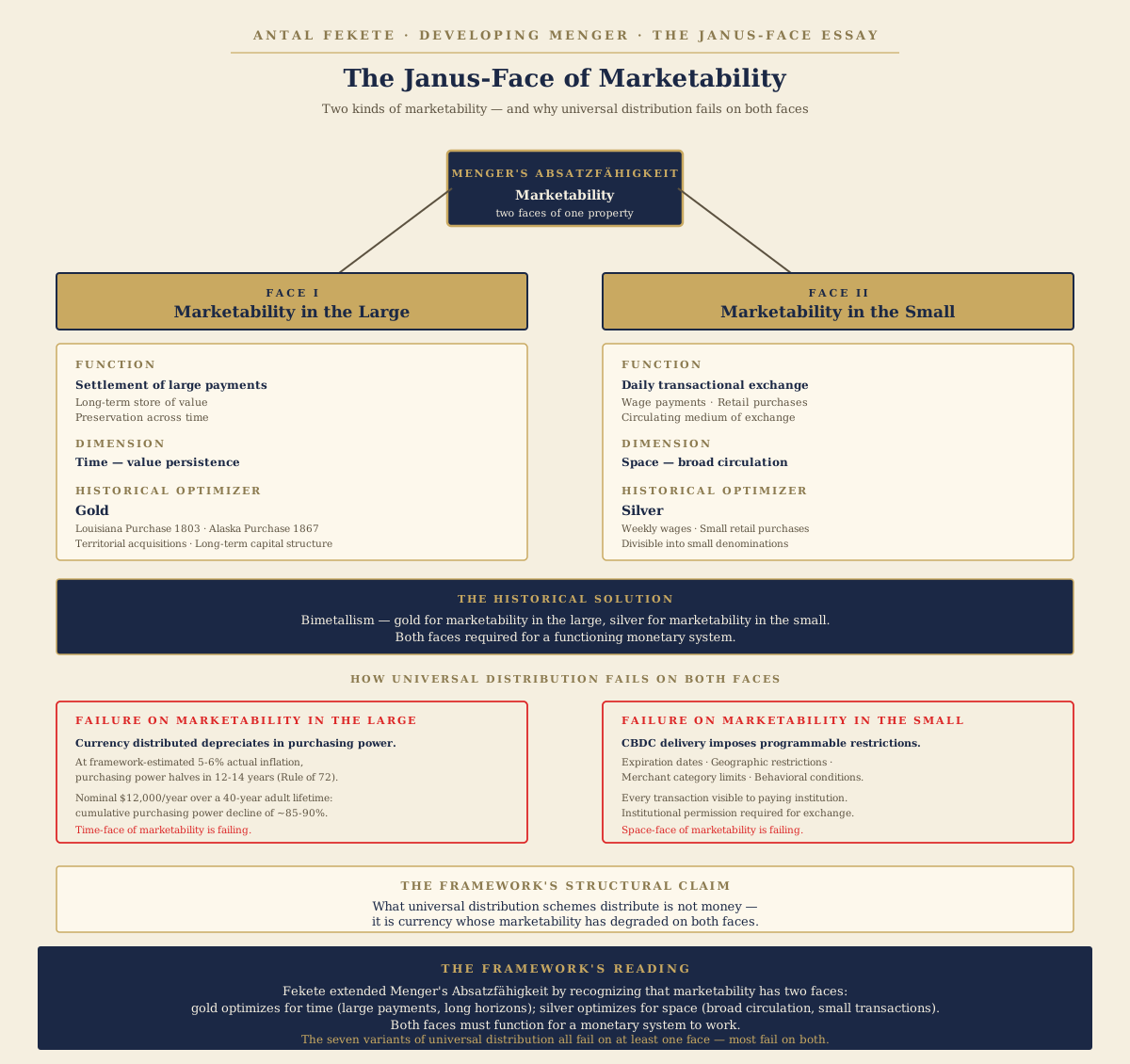
Antal Fekete's engagement with Menger's Absatzfähigkeit was more sustained and analytically more developed than any other 20th-century monetary theorist. Fekete's specific contribution was to observe that Absatzfähigkeit is not a single unified concept but a compound of two distinct dimensions that operate somewhat independently and that can be optimized separately by different commodities. Fekete termed these two dimensions the Janus-Face of marketability, after the two-faced Roman god who looked simultaneously in opposite directions.
One terminological caution before the two faces are set out, because it is what makes the distinction easy to get backward. Fekete's own names for the two faces are salability and hoardability, and he regards the conventional pair — "means of exchange" and "store of value" — as unfit for the purpose: those phrases, he writes, "have long been used in listing the various functions of money. Yet these terms are far too imprecise to be useful in a scientific discourse. One should use terms such as marketability in the large (also called salability) and marketability in the small (also called hoardability)." The functional descriptions below are the framework's gloss; where they use store-of-value language, Fekete's more precise terms are the ones that govern.
The two faces of marketability, in Fekete's formulation:
Marketability in the large refers to the capacity of a monetary asset to settle large payments, preserve value across long time horizons, and function as a store of wealth. This face of marketability is what matters for major transactions — Fekete's specific examples included the Louisiana Purchase of 1803 (the United States acquiring approximately 828,000 square miles of North American territory from France for approximately $15 million, or approximately $18 per square mile) and the Alaska Purchase of 1867 (the United States acquiring approximately 586,000 square miles of Arctic territory from Russia for $7.2 million, or approximately $12.30 per square mile). Fekete uses the two purchases to make a point about need rather than about settlement mechanics: "there is need for money for making large payments, for example, purchasing territories such as Louisiana and Alaska; and there is need for money to make small purchases and to pay the wages of day laborers." The framework follows him only that far. Neither transaction was a simple delivery of metal — Louisiana was financed substantially through bond issues placed in London and Amsterdam, and the assumption of French debt — and the audit could not establish that either was "settled in gold" in any direct sense. What the examples establish is the requirement: a monetary asset whose marketability in the large is adequate to the scale of the payment.
Marketability in the small refers to the capacity of a monetary asset to settle daily transactions, pay wages, and function as a circulating medium of exchange for small purchases. This face of marketability is what matters for ordinary commerce — the baker paying his flour supplier, the day laborer receiving his weekly wage, the shopkeeper making change for a customer's purchase. This face requires the monetary asset to be divisible into small units, portable in convenient quantities, and stable enough in value that participants in small transactions can rely on its acceptance. Historically, silver optimized for marketability in the small — silver coins in various denominations circulated as the primary medium of exchange for wages and small purchases in virtually every civilization that had developed metallic money.
Space-time duality. Fekete emphasized that the two faces had complementary dimensions in space and in time, and his assignment runs the opposite way from the one intuition suggests. "The Janus-face of marketability can be observed if we contemplate that gold is the preferred agent when one has to transfer value over space," he writes. "The preferred agent in transferring value over time is silver." Salability — marketability in the large — is the capacity to be sold, anywhere, to anyone, which is a claim about space; gold's density and universal acceptance are what make it the agent for moving value across distance. Hoardability — marketability in the small — is the capacity to be held, which is a claim about time; silver is the metal that carries value forward in a hoard. Fekete grounds the pairing in the observation that "space and time are absolute categories of human thought," and traces the duality back through monetary history to cattle money against salt money. 2
Why both faces are required. A monetary system that optimized only for marketability in the large would fail to serve the transactional needs of ordinary commerce. Gold coins in $10,000 denominations would be useless for paying weekly wages of $200. A monetary system that optimized only for marketability in the small would fail to serve the long-term settlement and storage needs of major economic activity. Silver denominations sufficient for daily transactions would be impractical for settling the purchase of large territories or funding long-term capital projects. The historical solution — which prevailed across most of recorded economic history until silver was demonetized in the 1870s — was bimetallism: gold for marketability in the large, silver for marketability in the small. One qualification matters: Fekete does not endorse a fixed exchange rate between the two metals. He calls fixing the ratio "a grave mistake, as was done in the U.S. when Congress enacted the Coinage Act of 1792," and describes the 1873 demonetization of silver as foolish. His bimetallism is two metals circulating at market ratios, not a legislated parity.
The framework's Article 33 (Golden Triangle) engaged the pre-1914 monetary architecture that operated on this basis. The specific insight from Fekete that framework readers will recognize: the Golden Triangle's three pillars (gold coin, gold bills, gold bonds) served distinct functions that mapped onto the two faces of marketability. Gold coin in daily circulation served marketability in the small at the retail level. Gold bills clearing 91-day commercial transactions served marketability in the small at the wholesale level. Gold bonds providing long-term capital structure served marketability in the large. The architecture worked because it deployed monetary instruments optimized for the specific marketability requirements of different transaction scales.
Why universal distribution fails on both faces
The framework's central analytical claim in this installment: universal distribution schemes fail on both faces of marketability, because what they distribute is not money in the framework's precise sense but currency whose marketability has been degraded on both faces.
The distinction between money and currency, applied. The framework's Atlas: Money vs. Currency page establishes the fundamental distinction Ingo Bischoff's San Francisco School of Economics, founded 2006, has developed. Money is that kind of wealth which has a constant or nearly constant marginal utility — gold, silver, other hard assets whose usefulness to the holder does not decline substantially as holdings increase. Currency is a medium of exchange in the form of money or notes, redeemable or irredeemable. Gold is money. The dollar is currency. This distinction is not semantic; it is the foundation of the framework's monetary analysis, and it applies with particular force to the universal distribution question.
When Andrew Yang proposes the Freedom Dividend of $1,000 per month, what is being distributed is dollars — currency, in the framework's precise sense. 3 When Elon Musk proposes universal high income, what is being distributed is again dollars, at some larger magnitude. When Sam Altman proposes universal basic compute, what is being distributed is compute credits denominated in some claim on OpenAI's infrastructure. When the tokenized UBI proposals speak of distributions, what is being distributed is programmable currency delivered through CBDC or blockchain rails. In none of these cases is what is being distributed money in the framework's precise sense. The distributions are of currency, or of claims on productive capacity, or of contingent access to payment streams — none of which possess the constant marginal utility that defines money.
Failure on marketability in the large. The currency being proposed for distribution has been documented across this catalog to be degrading in its marketability in the large. Article 20 documented the specific ways in which reported CPI understates actual purchasing-power inflation. Article 37 documented the Rule of 72 implications of that understated inflation for savers across multi-decade horizons: at framework-estimated actual purchasing-power inflation of 5-6 percent, purchasing power halves in 12-14 years. A recipient of $12,000 per year in UBI payments, receiving those payments over a 40-year adult lifetime, would experience the cumulative purchasing power of those payments decline by approximately 85-90 percent across that span at framework-estimated inflation rates. The nominal payments would be delivered; the actual purchasing power delivered would be substantially less than what the nominal announcements imply.
The Altman token distribution proposal fails on marketability in the large through a different mechanism. Even if AI systems produce twenty quintillion tokens per year, the marketability of those tokens depends on the willingness of counterparties to accept them in exchange for goods and services. Tokens whose purchasing power depends on continued willingness of a specific set of AI companies (or a specific set of AI-using enterprises) to accept them are contingent claims, not money. Their marketability in the large — their capacity to preserve value across long time horizons — is contingent on the future behavior of the specific institutions that back them. A one-billion-token allocation received today has unknown purchasing power in ten years or thirty years, because the future acceptability of the tokens depends on institutional developments the recipient does not control.
Failure on marketability in the small. The currency being proposed for distribution also fails increasingly on marketability in the small, particularly as CBDC delivery rails are introduced. Physical cash — the traditional embodiment of currency's marketability in the small — is being progressively de-emphasized in advanced economies. Digital payment systems require intermediaries (banks, payment processors, or in the CBDC case, central banks themselves) that can restrict, block, or condition transactions. Programmable money — currency with software logic embedded in its underlying protocol — can impose expiration dates, geographic restrictions, merchant category limits, and behavior-contingent conditions on recipient use. Universal distribution delivered through such rails becomes universal distribution contingent on maintained eligibility under whatever terms the paying institution sets.
Article 40 of this series will engage the CBDC dimension in detail. For present purposes, the framework's observation is structural: currency's marketability in the small depends on its being freely transferable between counterparties without the requirement for institutional permission. When the currency being distributed can only be used within a specific set of approved transactions, or only during specific time windows, or only with counterparties who meet specific criteria, its marketability in the small has been substantially degraded. It has become not currency in the neutral sense but conditional access to a payment system whose terms are set by the paying institution.
The Janus-Face reading of the seven variants. Applying the Janus-Face framework to each variant cataloged in Article 38:
- UBI (Yang): Distributes currency (dollars). Fails on marketability in the large through documented purchasing-power inflation. Fails on marketability in the small to the extent that delivery rails become programmable.
- UHI (Musk): Distributes currency at greater magnitude. Same failures as UBI on both faces, at greater scale.
- UBC (Altman): Distributes claims on OpenAI's compute infrastructure. Fails on marketability in the large because the claims depend on OpenAI's institutional continuity. Fails on marketability in the small because compute credits are not readily accepted for daily transactions with counterparties who do not use OpenAI's services.
- UBW (Altman): Distributes AI-generated tokens. Fails on marketability in the large because the tokens depend on the AI industry's aggregate acceptance. Fails on marketability in the small because the tokens are not physically portable and their acceptance depends on the counterparty's infrastructure.
- UBO (Diamandis): Distributes equity ownership stakes in AI companies. Fails on marketability in the large through the volatility of the underlying equities. Fails on marketability in the small because equity stakes are not accepted for daily transactions.
- UBCapital (Garman): Distributes cash flows from a sovereign fund. Currency-denominated distributions, so subject to the same failures as UBI on both faces, plus the additional dependency on sovereign fund solvency and management.
- Tokenized UBI: Distributes programmable currency through CBDC/blockchain rails. Fails on marketability in the small most severely because the programmability itself introduces institutional restrictions that undermine free circulation.
The framework's structural observation: every variant fails on at least one face of marketability, and most fail on both. The seven variants differ in specific mechanisms and delivery rails but share the common feature that what is being distributed is not money in the framework's precise sense. The distribution question cannot be resolved by adjusting the mechanism or refining the delivery rail; the question is at the substrate level of what is being distributed.
The Quantity Theory of Money and its limitations
The standard critique of universal distribution proposals from gold-standard advocates — a critique the framework must engage carefully because it comes from adjacent intellectual territory — is that these proposals will produce hyperinflation. The critique rests on the Quantity Theory of Money (QTM), formalized in the equation of exchange: MV = PQ, where M is the money supply, V is the velocity of money, P is the average price level, and Q is the real quantity of goods and services transacted. Under the QTM, if velocity is stable and real output is roughly constant, an increase in the money supply must produce a proportional increase in the price level. Distributing $12,000 per year to every adult in a country of 330 million people (as Yang's Freedom Dividend proposes) would inject approximately $3.2 trillion of new money into circulation annually. 3 Under a straightforward application of the QTM, this magnitude of monetary injection should produce substantial inflation.
The QTM has substantial intellectual pedigree. It was developed in various forms by David Hume, John Stuart Mill, and Irving Fisher, and became the theoretical foundation of monetarism as developed by Milton Friedman and the Chicago School. Friedman's 1963 dictum — "inflation is always and everywhere a monetary phenomenon" — captures the QTM's central empirical claim. The theory guided monetary policy in the United States and other advanced economies from the late 1970s through the 1990s and remains a standard reference framework in academic economics.
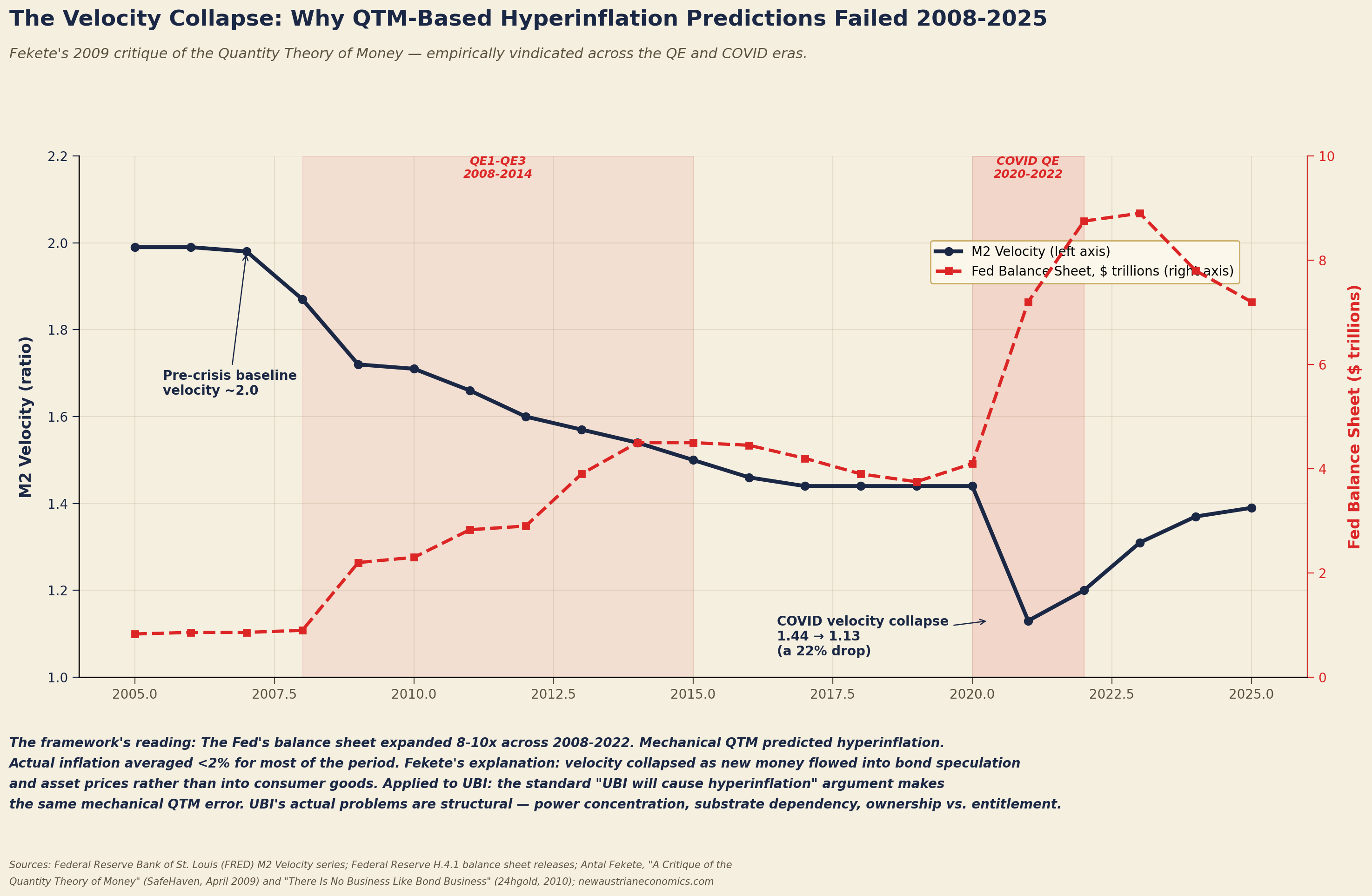
The framework's engagement with the QTM is not a rejection of its analytical validity as an accounting identity. As an identity, MV = PQ is uncontroversial. What is controversial is the additional empirical claim that velocity is stable or reliably predictable, which is what monetarist policy prescriptions require. Fekete's specific contribution — developed most fully in his 2009 essay A Critique of the Quantity Theory of Money and elaborated across his subsequent writing — was to demonstrate that velocity is not stable, that it can collapse under specific conditions, and that the collapse can produce empirical outcomes precisely opposite to what QTM-based predictions would anticipate.
Fekete's specific mechanism. The 2008 financial crisis and its aftermath provided the empirical vindication of Fekete's velocity critique. Between September 2008 and December 2019, the Federal Reserve's balance sheet expanded from approximately $900 billion to approximately $4.2 trillion — a nearly fivefold increase in the Fed's own balance sheet, which is related to but not identical with the monetary base. 4 Standard QTM analysis (as applied by many gold-standard advocates and monetarist economists during this period) predicted that such an expansion would produce dramatic price inflation, potentially hyperinflation. The actual empirical outcome was substantially different: reported CPI averaged approximately 1.6 percent per year over 2009-2019, below the Federal Reserve's 2 percent target and dramatically below the hyperinflationary outcomes that mechanical QTM predictions had anticipated. 5 Money velocity, as measured by the ratio of nominal GDP to M2 money supply, collapsed from approximately 1.95 in 2008 to approximately 1.44 by end 2019 — a 26 percent decline that offset most of the balance sheet expansion. 5
Fekete's explanation of this outcome, published in his 2009 essay and refined in subsequent writing: money-creation by the Federal Reserve has a deflationary side-effect that operates through the bond market. When the Fed creates new money through open market operations (purchasing Treasury securities from primary dealers), the new money enters the economy as bank reserves and as increased liquidity in the bond market. Bond speculators, observing that the Fed's ongoing purchases will keep bond prices rising, purchase additional bonds in anticipation of continued price appreciation. The bond market thus absorbs a substantial portion of the new money that QTM analysis would predict flowing into consumer prices. The pocketing of what Fekete calls the bond speculators' "risk-free profits" eclipses the propensity to consume that QTM analysis assumes. The paired formulation is the framework's, built from Fekete's vocabulary — "risk-free profits" and "propensity to consume" are both his, but he does not set them against each other in those words.
The vicious spiral. Fekete's further insight: this dynamic creates a self-reinforcing spiral. As bond prices rise (in response to Fed purchases and to bond speculator anticipation), interest rates fall. Falling interest rates make bond speculation even more profitable in the short term (through capital gains as bond prices continue rising) while simultaneously reducing the incentive to invest in productive capital (which requires positive real returns to justify the risk). Money flows increasingly into bond speculation and away from productive investment. Velocity collapses further. The Fed responds to the resulting economic weakness by expanding the monetary base further, which accelerates the spiral. The empirical outcome: rather than the hyperinflation that QTM predicts, the economy experiences a specific combination of asset price inflation (bonds, equities, real estate) and consumer price disinflation, with substantial capital destruction occurring beneath the reported statistics.
Application to universal distribution. The framework's specific claim: applying QTM mechanically to UBI proposals produces the same category error that produced failed hyperinflation predictions during 2010-2020. Distributing $12,000 per year per adult may or may not produce inflation, and the answer depends on how the distribution actually flows through the economy — which depends on recipient behavior, on the delivery mechanism, and on the institutional environment in which the distribution occurs.
Consider the specific case of UBI delivered through CBDC with programmable restrictions. If the CBDC rails impose expiration dates that force recipient spending within specific time windows, velocity would likely be pushed higher, and the inflationary pressure would potentially materialize. If the CBDC rails impose merchant category restrictions that channel spending only into specific approved categories (basic necessities, local businesses, government-preferred consumption), velocity might be constrained and the inflationary pressure limited to those specific categories while other categories experience disinflation. If recipients hoard the distributions rather than spending them, velocity may remain low and inflation may not materialize. The framework had previously offered the OpenResearch study as evidence that this is what happens, and must withdraw the claim: the study found the opposite. Recipients spent more — on food, rent and transport — increased their support to friends and family by $22 a month, and worked modestly fewer hours while remaining in the workforce. 6 Whether that spending would raise velocity at scale is a separate question the study does not answer, but it cannot be cited for hoarding.
The framework's more accurate reading: the standard gold-bug argument that "UBI will cause hyperinflation" is potentially wrong for the same reason 2010-2020 hyperinflation predictions were wrong. The QTM mechanically applied ignores the specific institutional and behavioral dynamics that determine how new currency actually flows through the economy. The problems with UBI are real but they are not primarily inflationary problems; they are problems of power concentration, substrate dependency, and the structural failure of currency distribution to substitute for money ownership.
Why gold bugs misdiagnose UBI
The framework's positioning relative to the broader gold-standard and hard-money advocacy community is worth engaging explicitly. This catalog draws substantially on Menger, Fekete, Mises, and the broader Austrian tradition. Framework readers may be sympathetic to gold-standard advocacy on other grounds and may be surprised at the framework's engagement with the standard gold-bug critique of UBI. The engagement is specific: the framework agrees that UBI is problematic; it disagrees with the specific reasoning by which the gold-bug community typically arrives at that conclusion, and it argues that the wrong reasoning produces the wrong policy responses.
The gold-bug argument as typically formulated. The standard argument runs approximately as follows. UBI requires the federal government to create substantial new currency (either through direct Treasury issuance or through Federal Reserve monetization of Treasury debt). Under the Quantity Theory of Money, this new currency creation produces inflation proportional to the increase in the money supply. Inflation destroys the purchasing power of savings, punishes prudent savers, and rewards imprudent borrowers. Therefore UBI is inflationary redistribution from savers to non-savers, financed by monetary debasement, and represents an assault on the monetary foundations of a free society. The policy prescription: return to a gold standard that constrains the ability of the government to create new currency, thereby making UBI impossible.
Why the argument is at least partially wrong. The argument depends critically on the QTM assumption of stable velocity. As documented above, this assumption failed empirically during 2008-2019. It may fail again in the UBI implementation scenario. If UBI is delivered through CBDC with programmable restrictions, velocity may be constrained by the restrictions themselves. If recipients hoard the payments, velocity may not increase. If the distribution displaces existing transfers, the net increase in currency creation may be smaller than the headline UBI number suggests. Yang's Freedom Dividend is structured this way, though as an opt-in choice rather than a consolidation: a recipient of cash-like benefits — SNAP, TANF, SSI, WIC — would choose between them and the dividend, keeping the existing benefit where it is worth more. It stacks on top of Social Security, healthcare programs, and housing assistance rather than replacing them. The inflationary consequences the gold-bug argument predicts may or may not materialize; they cannot be predicted purely from the aggregate distribution amount.
Why the argument matters for the framework's analysis. If the gold-bug community focuses its critique on inflation and the inflation does not materialize (or materializes only modestly), the critique will lose credibility just as the 2010-2020 hyperinflation predictions did. The gold-bug community will find itself in the position of having predicted a specific empirical outcome that did not occur, which will undermine the broader case for hard money. Meanwhile, the actual problems with UBI — the power concentration, the substrate dependency, the failure of currency distribution to substitute for money ownership — will proceed without being effectively named or opposed.
The framework's specific claim: the gold-bug community can and should oppose UBI, but on the correct grounds. The correct grounds are structural, not inflationary. The correct grounds engage with the framework's Menger-Fekete apparatus rather than with the QTM apparatus that has repeatedly produced empirical failures. The correct grounds identify what universal distribution actually does at the institutional level — concentrating power in the paying institution, degrading the marketability of the currency being distributed on both faces, creating dependency relationships between recipients and paying institutions — rather than making empirical predictions about aggregate price levels that may or may not materialize.
The framework's positive positioning is thus: not a rejection of the gold-bug critique of UBI, but a refinement and improvement of it. Sound money advocacy in 2026 requires a more sophisticated analytical apparatus than mechanical QTM application. Fekete's velocity critique and Menger's Absatzfähigkeit framework provide that more sophisticated apparatus, and the framework's engagement with the distribution question demonstrates how they can be applied.
Currency distributed is not money owned
The framework's central structural claim, restated in the most direct form possible: what universal distribution schemes distribute is not what universal distribution schemes claim to distribute. The rhetoric of these proposals speaks of "distributing the wealth AI creates" or "ensuring everyone benefits from technological abundance" or "providing ownership of AI-generated value." The mechanical reality is that these proposals distribute currency, or contingent claims on payment streams, or ownership stakes in specific institutional intermediaries — none of which is equivalent to ownership of productive capital in the framework's precise sense.
The Article 37 apparatus, applied. Article 37 of this catalog engaged the distinction between ownership and entitlement in the context of personal savings. A 401(k) balance is not ownership of productive capital; it is entitlement to a payment stream conditional on the continued institutional infrastructure of the plan administrator, the fund families, the tax code, and the withdrawal rules. Physical gold held in direct possession is ownership of productive capital in the framework's sense: it does not depend on any specific institution's continued operation, it can be exchanged with any willing counterparty, and its marginal utility is stable across time in ways that fiat currency's is not. The framework's principles for personal savings emphasized the importance of holding some portion of savings outside the substitute-layer environment entirely, in the form of actual money rather than currency-denominated claims.
The identical apparatus applies at the universal distribution scale. UBI distributions are entitlement, not ownership. They can be revoked, restricted, expired, or made conditional on behavioral compliance by the paying institution. They depend on the continued institutional infrastructure of the federal government, the Federal Reserve, the payment rails, and whatever eligibility criteria are established. They are subject to change through administrative action, legislative amendment, or executive order without recipient consent. The recipient does not own the payment stream; the recipient has contingent access to it under terms that are not primarily under the recipient's control.
Ownership of productive capital, by contrast, does not depend on any specific institution's continued operation. A person who owns physical gold owns it regardless of whether the federal government maintains its current policies, whether the payment rails continue to function, or whether specific eligibility criteria are maintained. A person who owns productive farmland owns the capacity to produce food from that land regardless of what happens to the fiat currency system. A person who owns a share of a specific productive enterprise (through direct equity ownership, not through mediated fund structures) owns a stake in the productive output of that enterprise regardless of institutional developments elsewhere.
The specific case of the Altman token distribution. Sam Altman's proposal to distribute one billion AI-generated tokens per person annually is worth engaging as a specific case, because it purports to distribute ownership rather than entitlement. The proposal is closer in spirit to ownership than the traditional UBI proposals — the tokens represent claims on the productive output of AI systems, and Altman explicitly frames them as ownership shares rather than as cash transfers.
But the framework's analysis reveals that Altman's proposal still fails to distribute ownership in the framework's precise sense, for two specific reasons. First, the tokens represent claims on aggregate AI industry productive output, which requires coordination among AI-developer companies and among the broader institutional infrastructure that would need to accept the tokens. This is not ownership; it is contingent claim on a coordination outcome that may or may not materialize. Second, and more fundamentally, even if the coordination outcome materializes and the tokens function as marketed, they route through specific institutional intermediaries — OpenAI's infrastructure, or a consortium of AI-developer companies, or a sovereign administrator of some kind. The tokens are not held in the recipient's possession in the way that physical gold or productive land or direct equity ownership can be held.
The Sadat substack analysis (referenced in Article 38) captured this precisely: "Sam Altman isn't proposing Universal Access to Compute; he's proposing universal access to his product." The same critique applies to the token distribution: Altman is not proposing universal ownership of productive capital; he is proposing universal access to a specific claim structure whose value depends on institutional developments the recipient does not control.
The framework's structural observation: any distribution scheme that routes through a specific institutional intermediary — whether federal government, sovereign wealth fund, single AI company, or coordinated industry consortium — reproduces the substitute-layer dependency the scheme was ostensibly designed to escape. The recipient becomes third-order beneficiary of a structure whose primary benefits flow elsewhere, in the same pattern the framework identified at the 401(k) in Article 37 and at the DFC Hormuz facility in Article 36. Article 40 of this series will engage this pattern in detail, extending the third-order beneficiary framework to the universal-citizen scale.
The Altman diagnostic
Sam Altman's specific evolution across the 2020-2025 period provides a distinctive diagnostic that the framework can read as evidence of what universal distribution advocates are unintentionally discovering as their positions evolve. Altman began the period as a straightforward UBI advocate, funded the largest randomized UBI experiment ever conducted, and used the study's positive findings on recipient welfare to advocate for federal implementation. He then moved past UBI in May 2024 with his universal basic compute proposal. He moved further by August 2025 with his universal basic wealth and universal extreme wealth formulations. The intellectual trajectory is not accidental; it reflects a specific engagement with the problems Altman encountered as his thinking developed.
What Altman appears to be discovering. The universal basic income proposal, as Altman came to understand it, has a specific limitation: it distributes purchasing power without distributing productive capacity. Recipients receive cash flows but do not receive any stake in the productive assets that generate those cash flows. This creates a structural dependency: recipients depend on the continued willingness of the funding source to provide the cash flows, and the funding source (whether the federal government or a consortium of AI companies) retains full ownership and control of the underlying productive capacity.
Altman's shift to universal basic compute addresses this limitation directly. Distributing compute rather than cash means distributing the underlying productive capacity of the AI systems, not just claims on their output. The recipient, in Altman's words on the podcast where he floated the idea, would "own like part of the productivity" — everybody getting "a slice of GPT-7's compute" to use, resell, or donate — rather than just a share of the cash flows the productivity generates. In principle, this is a more genuine form of distribution — it distributes actual capital (in the form of compute capacity) rather than just entitlement to future payments.
Altman's subsequent shift to universal basic wealth extends this insight further. Rather than distributing compute (which is tied to a specific technology and would become obsolete as AI systems evolve), UBW distributes tokens that represent claims on aggregate AI output regardless of the specific technology producing that output. The recipient would gain, in Altman's words, "an ownership share in whatever the AI creates" — the phrase he used in a conversation with the comedian Theo Von, reported in late August 2025 — rather than a share tied to any specific AI system or company.
Where Altman still gets it wrong. The framework's engagement with Altman's evolution is not that he is discovering the wrong things. He is discovering the right things — the specific insights about ownership vs. entitlement, about distributing productive capacity rather than just cash flows, that the framework's apparatus makes explicit and systematic. The problem is that Altman's implementation of these insights still routes through specific institutional intermediaries.
Universal basic compute routes through OpenAI's infrastructure specifically. If OpenAI is superseded by a competitor, the compute allocation becomes worthless. If OpenAI changes its terms of service, recipients face contingent access to a product whose availability depends on institutional developments they do not control. Universal basic wealth routes through some form of industry coordination or sovereign administration to make the token distribution work at scale. The recipient still does not hold the tokens in the way that physical gold or productive land can be held; the tokens exist as claims within an institutional infrastructure that could be modified, restricted, or eliminated by administrative decision.
The framework's diagnostic reading. Altman's evolution demonstrates that even the most thoughtful universal distribution advocates are converging on positions that the framework's apparatus identifies as inadequate. The convergence is significant: it suggests that the framework's structural analysis is correct at least in its identification of the ownership-vs-entitlement distinction. Altman is not simply advocating cash distribution because he doesn't know better; he is progressively moving toward more genuine forms of distribution because he understands that cash distribution alone is insufficient. But his available options within the current institutional environment all route through intermediaries that reintroduce the substitute-layer dependency he is trying to escape.
The framework's positive contribution: what Altman is looking for exists, but it is not the specific proposals he has been advancing. It is the substrate-level restoration of sound money and broad ownership of productive capital that Article 33 (Golden Triangle) engaged and that Article 40 of this series will develop as the framework's positive alternative to the distribution question. Altman's trajectory is analytically significant precisely because it demonstrates a leading tech advocate rediscovering the framework's insight without yet arriving at the framework's conclusion.
The framework's closing synthesis
This installment has developed the framework's theoretical apparatus for reading universal distribution proposals. The apparatus is Menger's Absatzfähigkeit extended by Fekete's Janus-Face of marketability. The apparatus reveals that universal distribution schemes fail on both faces of marketability, because what they distribute is currency (or contingent claims on payment streams) rather than money in the framework's precise sense. The apparatus also reveals that the standard gold-bug critique of UBI — based on mechanical Quantity Theory of Money application — is at best partially correct and at worst empirically wrong for the same reasons that 2010-2020 hyperinflation predictions were wrong.
The framework's specific claim: the problems with universal distribution are structural, not primarily inflationary. The structural problems are (1) that currency distributed is not money owned; (2) that distribution through institutional intermediaries reintroduces substrate-layer dependency; (3) that the recipient becomes third-order beneficiary of an institutional structure whose primary benefits flow elsewhere; and (4) that the specific institutional configurations the proposals would create concentrate power in ways that undermine individual sovereignty over economic decisions.
Article 40 of this series will engage the institutional analysis of these structural problems in detail. It will develop the CBDC delivery mechanism issue that this installment has referenced but not fully engaged. It will develop the third-order beneficiary framework at the universal-citizen scale. It will engage the specific parallel to 20th-century "gold is a barbarous relic" arguments that ended at replacing monetary discipline with political discipline. And it will develop the framework's positive alternative — the substrate-level restoration that Article 33 engaged, extended to the specific question of what individuals and policy-makers can do given the current environment.
The framework's positioning throughout this series is not opposition to helping displaced workers. Displaced workers deserve genuine institutional support during periods of technological transition. What the framework opposes is the specific mechanisms being proposed, which the framework's analytical apparatus reveals to be structurally inadequate to their stated purposes and structurally problematic in their institutional consequences. The alternative to inadequate mechanisms is not no mechanism; it is better mechanisms grounded in a more sophisticated understanding of what money is, what ownership means, and what individual sovereignty over economic decisions actually requires.
This is the second installment of "The Distribution Question." The concluding installment, Article 40, will engage the institutional analysis of delivery mechanisms (particularly CBDC), the third-order beneficiary problem at the universal-citizen scale, the historical parallel to 20th-century monetary reform rhetoric, and the framework's positive alternative to the distribution question. Together the three installments provide the framework's analytical engagement with what has become one of the most prominent policy debates of the current cycle.
Sources
Footnotes
-
Menger, Carl. "On the Origin of Money." Economic Journal 2, June 1892, translated by Caroline A. Foley. https://monadnock.net/menger/money.html — Note the singular title. See also Principles of Economics, 1871: https://oll.libertyfund.org/title/menger-principles-of-economics. ↩
-
Fekete, Antal E. Monetary Economics lecture series. https://professorfekete.com/ — The Janus-Face of marketability is his term and a lecture title. Gold transfers value across space in large magnitudes; silver serves the small transactions of daily, time-bound exchange. ↩
-
Yang, Andrew. The Freedom Dividend, 2020 campaign platform. https://web.archive.org/web/2020/https://www.yang2020.com/policies/the-freedom-dividend/ — $1,000 per month to every adult citizen, the proposal the annual figure and the aggregate are computed from. ↩ ↩2
-
Federal Reserve, H.4.1 factors affecting reserve balances. https://www.federalreserve.gov/releases/h41/ — Balance sheet growth from approximately $900 billion in September 2008 to $4.2 trillion by December 2019. ↩
-
Bureau of Labor Statistics, Consumer Price Index, and FRED M2 velocity series. https://fred.stlouisfed.org/series/M2V — Reported CPI across the period against the balance-sheet expansion, and the fall in money velocity. ↩ ↩2
-
GiveDirectly and associated randomized-evaluation literature on unconditional cash transfers. https://www.givedirectly.org/research-at-give-directly/ — Recipients increasing spending on food, rent and transport and raising earnings, against the assumption of reduced work. ↩
Related essays
The Mengerian Stress Index: From Spec to Live Dashboard
Article 3 of this series proposed a quantifiable extension of Menger's saleability spectrum. This essay turns the proposal into a working framework: each of the five marketability proxies is defined precisely, the composite Mengerian Stress Index (MSI) is motivated, and the marketability half-life is operationalized as a regime-classification tool. The specific weights and calibration that drive the live MSI dashboard are deliberately not published; current readings live on the dashboard itself.
The Decay Function of Marketability: Toward a Computable Menger-Fekete Framework
Menger argued that saleability is a spectrum; Fekete developed the gold basis to measure it for one commodity. This essay proposes a generalizable decay function of marketability, measurable across every modern financial instrument, that renders Menger's core insight computable for the first time.
The Saleability Audit of Bitcoin: What Menger Would Say in 2026
Bitcoin maximalists insist Bitcoin is the most saleable monetary good ever created. Skeptics insist it doesn't work for the African villager or the rural Chinese citizen the maximalists invoke. Both positions miss what Menger's framework actually says when applied carefully. The audit produces uncomfortable results in both directions — Bitcoin scores remarkably well on some criteria and remarkably poorly on others — and the actual ground-truth of crypto adoption in emerging markets in 2026 is something neither camp accurately describes.