Researched and drafted with AI assistance · reviewed and edited by Jason D. Keys
The third essay of this series, The Decay Function of Marketability, proposed a quantifiable extension of Menger's saleability spectrum. The proposal was that every transformation between a directly-held physical asset and its derivative paper substitutes imposes a measurable saleability haircut, that the cumulative haircut is invisible in normal conditions but observable as spreads under stress, and that those spreads — tracked across five specific market proxies — together constitute a Mengerian dashboard that would lead conventional crisis indicators by several weeks. 1
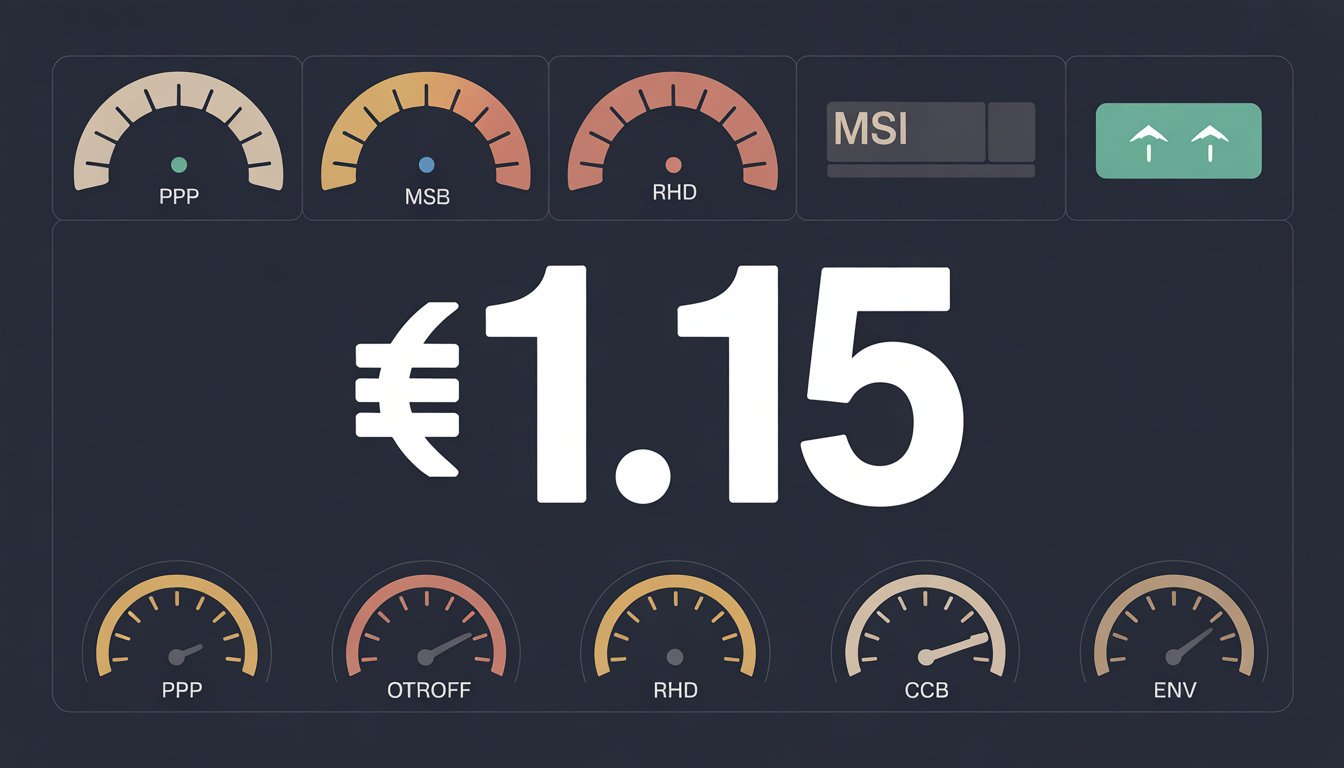
The proposal was theoretical. 2 This essay is its public-facing engineering pass: precise definitions for each of the five proxies, the composite Mengerian Stress Index (MSI) that aggregates them, and the marketability half-life concept that turns instantaneous readings into a regime-classification tool. The live MSI itself runs at /toolkit/mengerian-stress-index/, updated continuously. The specific weights, calibration windows, and operational details that drive that live index are not described here — they sit behind the dashboard, where they belong, and will be refined as more crisis data arrives.
Menger gave us the concept. Fekete gave us the first instance for a single market. The work of generalization has been done abstractly across the rest of this series. What follows is the public definition layer of the live framework.
Premise: what the index measures, and what it does not
Before specifying the components, it is worth restating precisely what the MSI is designed to capture and what it deliberately ignores.
The MSI measures the spread between paper substitutes and their underlying physical or near-physical referents, aggregated across multiple asset classes, normalized to a stress-period baseline. It is a measure of substitute-layer integrity, not a measure of liquidity, not a measure of volatility, and not a measure of credit risk in any conventional sense. A market can have low volatility, narrow bid-ask spreads, abundant liquidity, and stable credit conditions, while the MSI is rising — because the index is measuring a different variable than any of those.
The relationship between the MSI and conventional risk metrics is asymmetric. When the MSI rises, conventional risk metrics typically remain calm for a period (often weeks to months) before catching up. When the MSI is calm, conventional risk metrics may be elevated for reasons unrelated to substitute-layer integrity — geopolitical tension, idiosyncratic credit events, sentiment-driven volatility — without indicating any structural saleability stress. The MSI is, in this sense, a complement to standard risk dashboards rather than a substitute for them.
The framework's claim is that the MSI's signature is causally upstream of major financial crises in the post-1971 monetary regime. The 2008 crisis showed visible signatures in the gold basis, the FX basis, and the ETF NAV-discount data weeks before the equity market broke. 3 The 2020 COVID liquidity event showed the same pattern in a compressed timeframe, most legibly in the ETF component: LQD closed at a 5.35% discount to net asset value, AGG at 4.43% and BND at 6.17% in mid-March 2020, against average investment-grade credit ETF discounts near 3.4% and some products beyond 8%. 1 The 2023 banking stress (SVB, First Republic, Credit Suisse) is the weakest case in the set: tri-party haircuts on Treasury collateral held almost uniformly near 2% through the period on the New York Fed's own statistics, and the documented repo anomaly going into it was the opposite of dispersion — roughly 74% of hedge fund repo borrowing transacted at zero or negative haircuts as of December 2022. 1 The framework reads 2023 as a duration-and-deposit event of the kind Article 8 describes rather than as an RHD-led one, and does not claim RHD called it. None of this is observable in retrospect to anyone who was not specifically tracking these proxies; it is fully observable to anyone who was. The MSI is the formalization of "what would have led these crises if anyone had been watching the right variables."
Component 1: the paper-physical premium in precious metals (PPP)
The first proxy is the most direct successor to Fekete's original gold basis concept, generalized to include silver and to use spot-versus-physical retail data rather than spot-versus-futures. 4
Definition. The paper-physical premium is the spread between the spot market price of a precious metal and the delivered retail price of physical bullion at major institutional dealers, expressed as a percentage of the spot price.
Formula.
where is the median delivered price across a panel of major bullion dealers for a standard one-ounce sovereign coin, and is the corresponding LBMA fix or COMEX continuous-contract reference. Silver is computed identically against its own retail and spot references.
Normalization. PPP is normalized to a rolling-baseline Z-score; what counts as a soft, hard, or regime-shift signal is calibrated empirically against the historical record and lives inside the live dashboard. The pre-2008 baseline runs in the mid single digits for gold and materially higher in percentage terms for silver, where fabrication and dealer markup are a much larger share of a much lower unit price. Those costs are essentially fixed in normal conditions, which is what makes the baseline stable enough to normalize against.
Current readings, baselines, and component charts: /toolkit/paper-physical-premium/.
Component 2: the on-the-run / off-the-run Treasury spread (OTROFF) — planned
The second proxy measures the saleability differential between the most recently-issued Treasury at a key maturity (the on-the-run benchmark) and the immediately preceding issue (the off-the-run), which carries near-identical credit and duration characteristics. 5 The observable yield differential between the two is dominated by the market's pricing of saleability, though the framework notes that the literature also attributes part of the spread to repo specialness and financing advantage rather than to liquidity preference alone.
Definition. The OTROFF spread is the yield difference between the on-the-run 10-year Treasury note and the immediately preceding off-the-run 10-year, both adjusted to identical maturity through standard term-structure interpolation.
Formula.
The maturity adjustment is necessary because the off-the-run is typically a few months shorter in remaining maturity than the on-the-run; the adjustment uses the slope of the local term structure to project both onto a common maturity reference. A companion metric — the ratio of on-the-run daily volume to off-the-run daily volume — confirms that any observed spread reflects saleability rather than other factors, since under stress, flow concentrates dramatically in the most-current issues.
Status. OTROFF is in scope for the framework but not yet live in the dashboard. The bottleneck is data: there is no freely-available per-CUSIP secondary-market yield feed, and the bench-quality OTROFF reading requires inputs that currently sit behind paid fixed-income subscriptions. The component placeholder lives at /toolkit/otroff-spread/ and will be wired into the composite MSI once a viable data path is secured.
Component 3: repo haircut dispersion (RHD)
The third proxy is the most analytically valuable and the most operationally difficult to measure. It captures the distribution of haircuts that dealers demand against different classes of collateral in tri-party repo markets. In calm conditions, haircuts on similar-quality collateral cluster tightly. Under stress, the distribution widens dramatically as dealers price differential saleability into otherwise-similar collateral.
Definition. The RHD is the cross-sectional standard deviation of haircuts across asset classes within a given quality tier in tri-party repo, computed at the highest frequency the available data supports.
Formula. For a set of asset classes within a quality tier (e.g., AAA-rated long-duration paper):
where is the median haircut for asset class on day and is the cross-sectional mean.
Normalization. Pre-2008 RHD across investment-grade tiers ran in a tight band. Gorton and Metrick's haircut index for non-Treasury repo collateral rose from approximately zero in early 2007 to nearly 50% at the crisis peak in late 2008, with several collateral classes refused entirely — an effective 100% haircut — while Treasury haircuts barely moved. 1 Dispersion, not level, is what that record describes. The live component normalizes against this historical reference and against a rolling recent baseline. The composition of the dispersion is often more informative than the level: when haircuts on agency MBS widen relative to comparable Treasuries, that asymmetry is a duration-stress signature consistent with the diagnosis advanced in Article 8.
Current reading and dispersion decomposition: /toolkit/repo-haircut-dispersion/.
Component 4: FX cross-currency basis (CCB)
The fourth proxy measures deviations from covered interest parity (CIP) — the no-arbitrage condition that should tie spot exchange rates, forward exchange rates, and interest rate differentials together. 6 Persistent deviations indicate that one party's synthetic dollar funding (assembled through derivatives) costs differently than its direct dollar funding (obtained in cash markets), which is a saleability signal in the dollar's own payment infrastructure.
Definition. The cross-currency basis at maturity for currency pair (USD, X) is the spread that must be added to the non-dollar floating leg of an FX swap to make it equivalent to direct dollar borrowing.
Formula. Following the standard literature:
where and are the relevant interest rates at maturity in currency and USD, is the forward exchange rate, and is the spot rate. A negative basis indicates that synthetic dollar borrowing is more expensive than direct — a signal of dollar scarcity in the swap market.
Normalization. The pre-2008 baseline was within a few basis points of zero, consistent with CIP holding. Bases diverged from zero in 2008, peaked during the 2012 European debt crisis, narrowed through 2013 and early 2014, and widened again from the second half of 2014 — with the deviations concentrated in contracts spanning quarter-end reporting dates, which Du, Tepper and Verdelhan read as evidence of a causal effect of bank regulation on the arbitrage. The live component treats the post-2014 negative regime as the working baseline and detects stress against it rather than against zero. The dashboard computes the basis across major USD pairs at short maturities; the dispersion across pairs is often more informative than any single reading.
Current readings across pairs: /toolkit/cross-currency-basis/.
Component 5: ETF NAV deviation in stress windows (ENV)
The fifth proxy measures the spread between an exchange-traded fund's market price and its calculated net asset value (NAV) during periods of underlying-market stress. Under normal conditions, the creation/redemption arbitrage mechanism keeps ETF prices within a few basis points of NAV. Under stress — especially for ETFs whose underlyings become difficult to trade — the spread can widen substantially, and the depth and duration of those discounts directly measure how the ETF wrapper's marketability has decayed relative to its constituents.
Definition. The ENV is computed for a panel of stress-relevant ETFs spanning investment-grade credit, high-yield credit, agency MBS, emerging-market debt, leveraged loans, and a Treasury control, as the absolute discount of market price to NAV.
Formula.
with indexing the panel and taken at the official close. Intraday discounts can be computed against the indicative NAV (iNAV) for additional resolution when the underlying market is open.
Normalization. Normal-period absolute discounts are tight across the panel. The interesting signal is differential: when credit-quality-sensitive ETFs trade meaningfully wider than government-paper controls, that asymmetry is a substitute-layer stress signature even when the panel aggregate looks calm.
Current panel readings: /toolkit/etf-nav-deviation/.
The composite Mengerian Stress Index
The components above are aggregated into a single composite index through a weighted Z-score combination.
General form.
with the components being PPP, RHD, CCB, ENV — and OTROFF, once its data path is solved.
The weights are not equal. They are calibrated empirically from the historical signal-quality of each component during the four stress episodes for which we have full data: 2008, 2011, 2020 and 2023. The framework treats the weight vector as a tunable internal parameter that should evolve as more data accumulates, not as a published constant; the live dashboard carries the current calibration. Conceptually, components with cleaner lead-time relative to subsequent crisis events carry more weight than components whose signal-to-noise is dominated by idiosyncratic events.
Current MSI reading and component breakdown: /toolkit/mengerian-stress-index/.
Marketability half-life: regime classification
The instantaneous MSI reading is one signal. A more diagnostic signal is the marketability half-life — the time required for an MSI elevation to compress back to half its peak deviation from the pre-stress baseline. This metric distinguishes between two different classes of substitute-layer stress that look similar in their initial readings.
Definition. Given an MSI peak of achieved at time and a pre-stress baseline of , the marketability half-life is the time required for the MSI to return to:
A short half-life (weeks) indicates a transient liquidity event whose substrate properties were not actually impaired. A long half-life (multiple quarters) indicates structural impairment that monetary intervention has compressed but not resolved. An infinite or indeterminate half-life — where the MSI does not return to half-peak before a new stress event begins — indicates a permanent regime shift in substitute-layer integrity.
Historical pattern. Across those four documented episodes, the half-life trajectory tells a consistent story: each successive episode has a shorter half-life than the previous one, but the baseline MSI level steps up between episodes. The framework's interpretation is that the post-2008 monetary regime has produced progressively shorter MSI half-lives because central-bank intervention has become more aggressive and more rapid — but the half-life compression is purchased at the cost of permanently elevated baseline stress. The mathematical limit of that trajectory is a vanishing half-life with a permanently elevated baseline: the system flickers in and out of acute stress on shorter and shorter timescales while never returning to pre-2008 normalcy.
The single most important reading the dashboard provides is therefore not the instantaneous MSI but the baseline drift — the rolling mean of the MSI across non-acute periods. That drift is the framework's quantification of the secular saleability decay in the dollar substitute layer, decoupled from any specific event-driven stress.
Current half-life decomposition: /toolkit/marketability-half-life/.
What the dashboard reveals
A live dashboard implementing the above definitions, run continuously, produces several observations that are difficult to surface from any single conventional risk metric.
The structural baseline is elevated and has been drifting. The MSI baseline is not a function of any specific crisis; the drift is the framework's quantification of the gradual saleability decay across the dollar substitute layer described qualitatively in the previous essays of this series. The drift is observable in multiple components simultaneously, which is the signature of a regime shift rather than a component-specific phenomenon.
The components are not perfectly correlated. PPP and CCB tend to move together; OTROFF and ENV (where available) tend to move together; RHD tends to lead the others by a meaningful interval. This decomposition is informative because it allows the dashboard to distinguish between equity-market-driven stress (which manifests first in OTROFF and ENV), currency-driven stress (PPP and CCB), and funding-market-driven stress (RHD). The framework's most consistent prediction is that the next major event will be funding-market-driven, and RHD is the component to watch for early warning of that scenario.
The cross-asset signal is consistent when the diagnosis is right. When the framework's diagnosis is correct, the components elevate together (potentially with characteristic phase lags). When the diagnosis is wrong — when stress is actually idiosyncratic rather than systemic — the components elevate independently. Synchronized elevation across the panel is the configuration the framework treats as confirmation that the underlying phenomenon is substitute-layer decay rather than any specific market-segment dysfunction.
Limitations and what's still uncertain
The framework is honest about what the MSI does and does not capture, and where the live implementation has known weaknesses.
The component weights are empirically estimated from four crisis episodes. This is a small sample. The weights may not generalize to crisis configurations not represented in the historical record. In particular, a cryptographic-substrate failure of the kind described in Article 6 would manifest in components the historical record does not reflect, and the MSI as currently specified might miss it. The weights should — and will — evolve as more episodes accumulate.
The RHD component is operationally weak for non-institutional implementations. The best real-time repo data is behind paid subscriptions. The usable public series is the New York Fed's Tri-Party/GCF Repo Statistics, published monthly since May 2010, which gives the median and range of haircuts by asset class — reasonable, but a monthly snapshot taken on the seventh business day rather than a live reading, and silent on the non-centrally-cleared bilateral market where dispersion is widest. A genuinely real-time RHD requires institutional access. Future versions of the framework should explore on-chain repo equivalents (which are publicly observable) as a substitute or supplement.
OTROFF is not yet live. Per-CUSIP secondary-market yield data is paid-only, and the framework will not publish numbers it cannot defend with reproducible inputs. The component re-enters the composite when a viable data path arrives.
The dashboard does not capture saleability stress in instruments without paper-physical analogs. Equity markets, for example, do not have a "physical share" analog in the same sense that gold has bullion. The framework's claims about saleability still apply to equity, but the proxies above will not detect equity-specific stress until it propagates into the credit-market or funding-market components.
Thresholds are reference points, not laws. The threshold levels embedded in the live dashboard are calibrated against historical episodes whose underlying conditions may not exactly recur. The framework treats the MSI as a trajectory indicator rather than a level indicator: the rate of change and the persistence of elevations matter more than whether a specific threshold is crossed.
The framework's predictions are not falsifiable in any clean Popperian sense. The MSI predicts that elevated readings precede crisis events, but the timing and specific trigger of those events are not predicted. A skeptic can always argue that an elevated MSI was a false positive that simply preceded a crisis happening for unrelated reasons. The framework's response is that across multiple historical episodes, the MSI lead-time is consistent enough that the alternative explanation (that all of these events happened to coincide with elevated MSI readings by chance) is implausible. But the framework does not claim more than this.
The dashboard is the artifact
The previous essays of this series produced the conceptual apparatus — Menger's spectrum, Fekete's basis, the decay function, the substitute-layer diagnosis. This essay defines the public face of the instrument that operationalizes that apparatus. The instrument itself — the calibrated weights, the alert thresholds, the half-life decompositions — lives at /toolkit/mengerian-stress-index/ and the component pages linked above, updated continuously and refined as more data accumulates.
What the framework treats as proprietary is not the concept — Menger and Fekete have a century's claim on that — but the calibration: which weights, against which baselines, with which thresholds, produce a useful early-warning signal in 2026 conditions rather than 2008 conditions. That calibration is the work product, and the dashboard is where it lives.
With this essay the series has now produced both the diagnostic apparatus (the framework, the proxies, the live dashboard) and the constructive proposals (the housing trilogy, the on-chain assessment). Future essays will return to specific applications as conditions warrant — the next event in the global financial system, the next regulatory development, the next AI-mediated structural change. The framework exists to make sense of those events as they arrive. The dashboard exists to read their early signals. The work continues.
Sources
Footnotes
-
Gorton, Gary and Andrew Metrick. Securitized Banking and the Run on Repo. NBER Working Paper 15223, 2009. https://www.nber.org/papers/w15223 — The repo haircut index runs from ~0% in early 2007 to nearly 50% by late 2008, with some collateral classes refused entirely. Public haircut distributions by asset class are published monthly since May 2010 at https://www.newyorkfed.org/data-and-statistics/data-visualization/tri-party-repo (tri-party only; bilateral repo is not covered). ↩ ↩2 ↩3 ↩4
-
Menger, Carl. "On the Origin of Money." Economic Journal 2, 1892. https://monadnock.net/menger/money.html — The saleability spectrum the index attempts to instrument. ↩
-
Fekete, Antal E. Backwardation That Shook the World, 2008. https://professorfekete.com/articles/AEFBackwardation.pdf — The basis as futures-versus-cash with the carrying charge as its upper bound, and the vanishing-basis thesis this dashboard generalises. See also The Rise and Fall of the Gold Basis: https://www.professorfekete.com/articles/AEFTheRiseAndFallOfTheGoldBasis.pdf. ↩
-
LBMA precious metal prices. https://www.lbma.org.uk/prices-and-data/precious-metal-prices — Benchmark series. Pre-crisis retail gold coin premiums ran in the mid single digits, with silver coin premiums far higher in percentage terms. ↩
-
Du, Wenxin et al., and the Treasury benchmark-premium literature. https://www.newyorkfed.org/research — The Treasury benchmark premium is dominated by saleability pricing, but the literature also attributes part of the spread to repo specialness and financing advantage rather than to liquidity preference alone. ↩
-
Du, Wenxin, Alexander Tepper and Adrien Verdelhan. "Deviations from Covered Interest Rate Parity." Journal of Finance 73(3), 2018. https://www.jstor.org/stable/26653247 — Divergence from 2008, peak 2012, narrowing to early 2014, renewed widening from H2 2014, quarter-end concentrated. Component calibration across the 2008, 2011, 2020 and 2023 episodes rests on unpublished framework work. ↩
On the record
This essay logged one dated prediction
It has not reached its resolution window yet. It is logged with explicit criteria, and will be scored as the evidence arrives — right or wrong.
Related essays
The Decay Function of Marketability: Toward a Computable Menger-Fekete Framework
Menger argued that saleability is a spectrum; Fekete developed the gold basis to measure it for one commodity. This essay proposes a generalizable decay function of marketability, measurable across every modern financial instrument, that renders Menger's core insight computable for the first time.
The Janus-Face of Marketability: What Menger and Fekete Reveal About Universal Distribution
This essay is the theoretical core of *The Distribution Question* series. [Article 38](/forum/38-rhetoric-reality-2026-distribution-debate) established the descriptive terrain — the seven variants of universal distribution being proposed in 2026 (UBI, UHI, UBC, UBW, UBO, UBCapital, tokenized UBI), their proponents, their proposed funding mechanisms, and the substantial gap between the mass-unemployment rhetoric that justifies them and the empirical labor market data. This installment develops the framework's theoretical apparatus for reading those proposals structurally. The central analytical apparatus is Antal Fekete's concept of the Janus-Face of marketability — the observation that marketability (Menger's *Absatzfähigkeit*) has two distinct faces that must both function for a monetary system to serve its purpose. Marketability in the large refers to the capacity of a monetary asset to settle large payments, preserve value across long time horizons, and function as a store of wealth. Marketability in the small refers to the capacity of a monetary asset to settle daily transactions, pay wages, and function as a circulating medium of exchange for small purchases. Gold historically optimized for marketability in the large; silver optimized for marketability in the small; a functioning monetary system required both. This essay applies the Janus-Face framework to the universal distribution proposals: what is being distributed is not money in the framework's precise sense but currency whose marketability has been degraded on both faces. The essay also engages the Quantity Theory of Money critique — the standard gold-bug objection that UBI will produce hyperinflation depends on assumptions about money velocity that Fekete demonstrated to be unreliable. The framework's specific reading: the problems with universal distribution are not primarily inflationary; they are about power concentration, substrate dependency, and the failure of currency distribution to substitute for money ownership. The essay closes by reading Sam Altman's evolution from UBI to universal basic compute to universal basic wealth as unintentional rediscovery of the framework's insight that ownership beats distribution — an insight Altman still gets partially wrong because his proposed ownership vehicles route through single institutional intermediaries.
The Saleability Audit of Bitcoin: What Menger Would Say in 2026
Bitcoin maximalists insist Bitcoin is the most saleable monetary good ever created. Skeptics insist it doesn't work for the African villager or the rural Chinese citizen the maximalists invoke. Both positions miss what Menger's framework actually says when applied carefully. The audit produces uncomfortable results in both directions — Bitcoin scores remarkably well on some criteria and remarkably poorly on others — and the actual ground-truth of crypto adoption in emerging markets in 2026 is something neither camp accurately describes.