
Researched and drafted with AI assistance · reviewed and edited by Jason D. Keys
The moment being read
Asked how societies should respond to the mass unemployment that artificial intelligence would produce, Elon Musk's answer has been direct and unqualified: universal high income. 1 Not universal basic income — "universal high income, not universal base income," as he puts it — funded by the wealth that increasingly autonomous AI systems and humanoid robots would generate, with "no shortage of goods or services." He puts a specific number on it: "I think the benign scenario is probably the most likely — probably 80% likely if you ask my opinion," the benign scenario being one in which "probably none of us will have a job." The remaining probability he has generally declined to elaborate on. 1
The chronology is worth setting down precisely. Musk addressed a Saudi-US Investment Forum in Riyadh in May 2025; the 2025 forum that drew the most coverage was held in Washington that November; and the universal-high-income formulation, with the eighty percent figure attached to it, dates to the middle of 2025. He returned to the theme in April 2026, describing the payments as federal government checks funded by an increase in the money supply — the more analytically consequential version, because it names a funding mechanism.
Two weeks earlier, on April 3, 2026, the DFC-Chubb $40 billion maritime reinsurance facility for the Strait of Hormuz had been doubled from its initial $20 billion capacity — an event this catalog documented in Article 36. 2 Three months before that, in January 2026, the Trump administration had taken office for its second term. In the interval between the inauguration and the Musk statement in Riyadh, several substantial policy developments had unfolded that this catalog has documented across the Watching the Cracks series: Warsh's confirmation as Federal Reserve chair with his first FOMC meeting on June 17 (Article 32); Spirit Airlines' liquidation on May 2 as the first major U.S. airline shutdown in twenty-five years (Article 35); the Trump-Pezeshkian Memorandum of Understanding signed at the G7 in France on June 17 establishing a 60-day peace framework for the Middle East conflict (Article 36); and the ongoing evolution of Chinese physical-clearing architecture for precious metals documented in Article 34.
Within this specific institutional environment, the distribution debate has intensified. In October 2025, the Guaranteed Income Pilot Program Act of 2025 (H.R. 5830) was introduced in the U.S. House of Representatives with eleven Democratic co-sponsors, authorizing $495 million annually for fiscal years 2026 through 2030 to fund a three-year pilot program, administered by the Department of Health and Human Services in consultation with the Internal Revenue Service — an annual figure rather than a total, as this catalog previously implied. 3 The bill was referred to the Ways and Means Committee where it remains. Its congressional findings enumerate what its authors characterize as the precariat — workers experiencing income volatility, employment instability, and structural obstacles to upward mobility — and propose the pilot program as a mechanism for evaluating direct cash transfers to a defined population of eligible individuals aged 18 to 65.
Concurrently, U.S. municipal and state-level guaranteed income pilots have multiplied since Stockton, California ran the first in 2019. Mayors for a Guaranteed Income, launched with the Economic Security Project in June 2020, has drawn around a hundred mayors, and by the most commonly cited count more than 150 cities now operate a program of some kind; Cook County, Illinois ran the largest, $42 million of federal pandemic funds paying 3,250 residents over two years from 2022. 4 These pilots have typically paid between $500 and $1,500 per month for one to three years, in Stockton, Chicago, St. 5 Paul, San Diego, Tacoma, Los Angeles, Shreveport and dozens of other cities. Two claims previously made in this paragraph do not survive checking and are withdrawn. Ontario has not announced any expansion of basic income: its pilot was canceled by the Ford government in July 2018, one year into a three-year program, and the province has since been defending a class action over the cancellation. 6 And the framework could locate no European Union framework to incorporate basic-income elements into social policy by 2030. Japan's exploration of UBI components in response to demographic pressure and automation is real but the audit could not establish its official status.
The evolution of the intellectual case for these programs has moved through several distinct phases. Andrew Yang's Freedom Dividend during the 2020 Democratic primary campaign proposed $1,000 per month to every American adult, funded principally by a ten percent value-added tax on goods and services, and framed as the appropriate policy response to widespread technological unemployment. 5 Yang's campaign generated substantial public awareness of the UBI concept and sparked serious policy discussion across the political spectrum, though his candidacy itself did not advance beyond the primary phase. From November 2020 to October 2023, Sam Altman's OpenResearch ran the largest randomized unconditional-cash experiment conducted in the United States: 3,000 participants, of whom 1,000 received $1,000 a month and 2,000 formed a control group receiving $50. 7 The study's principal finding was that recipients did not stop working, and they used the payments to cover necessities and stabilize household finances. The framework has previously added that they increased their labor market participation, and must withdraw that: recipients worked slightly fewer hours, spent more time on leisure, and earned less. The participation finding that does hold is narrower and about human capital rather than hours — recipients were 3.3 percentage points more likely to have pursued education or job training in the program's final year, a 14 percent increase over the control group. 8 Altman published the findings in 2024 and used the study's conclusions as the empirical basis for his subsequent proposals.
Beginning in May 2024, Altman announced on the All-In podcast that he was moving past traditional UBI. His new proposal was "universal basic compute" — every person on the planet would receive an allocation of GPT-7's compute capacity, which they could use directly, resell, or donate for research. Fifteen months later, in a conversation with the comedian Theo Von reported by late August 2025, Altman had moved further. He advocated "universal basic wealth — better than universal basic income" and then, moments later, "I want, like, universal extreme wealth for everybody" — a formulation he described as wanting "an ownership share in whatever the AI creates." His specific mathematical proposal: if AI systems produce twenty quintillion tokens per year, twelve quintillion would flow through the existing capitalist system while eight quintillion would be distributed equally to the world's approximately eight billion people, yielding one billion tokens per person annually. Individuals could use, sell, or pool these tokens as they wished, creating what Altman characterized as a form of universal basic wealth powered by AI.
Musk's April 2026 UHI endorsement in Riyadh occurred within this evolving intellectual landscape. Additional variants have entered the debate: Peter Diamandis, founder of the XPrize Foundation, has advocated "universal basic ownership" — every person owning a stake in the companies driving the AI revolution. Mark Garman, professor of finance emeritus at UC Berkeley, has proposed "universal basic capital" — income-producing assets and dividends distributed through a sovereign superfund modeled on Norway's Government Pension Fund Global. Various proposals have emerged for "tokenized UBI" — payments delivered through programmable blockchain rails that can enforce spending restrictions, geographic constraints, and expiration dates. Alongside these, proposals for a "compute tax" 9 — a 0.05 percent levy on every trillion tokens generated by large-scale AI inference — have been advanced as funding mechanisms.
This essay is the first installment of a new framework series titled The Distribution Question. The series addresses a specific class of policy proposals that share a common structural feature — the response to AI-driven economic displacement through some form of direct or indirect wealth distribution to individuals — and reads them through the framework's analytical apparatus developed across this catalog's prior thirty-seven installments. The series proceeds in three parts. The current installment (Article 38) establishes the descriptive terrain: what is being proposed, by whom, on what empirical basis, and what the gap between the rhetoric and the reality reveals. Article 39 will engage the theoretical apparatus: Menger's Absatzfähigkeit and Fekete's Janus-Face of marketability, and what these reveal about universal distribution schemes at the structural level. Article 40 will engage the institutional analysis of delivery mechanisms (specifically the CBDC dimension), the third-order beneficiary problem that these proposals share with the 401(k) analysis of Article 37, and the framework's positive alternative to the distribution question.
The framework's position throughout this series is analytical rather than partisan. The framework does not argue that displaced workers should be abandoned to poverty. It argues that the specific mechanisms being proposed — UBI, UHI, UBC, UBW, universal basic ownership, universal basic capital — have specific institutional consequences that their advocates typically do not engage seriously, and that the alternatives available to individuals and to policy-makers are broader than the current debate acknowledges. What follows in this installment is the descriptive foundation on which the analytical work of Articles 39 and 40 will build.
The variants and their proponents
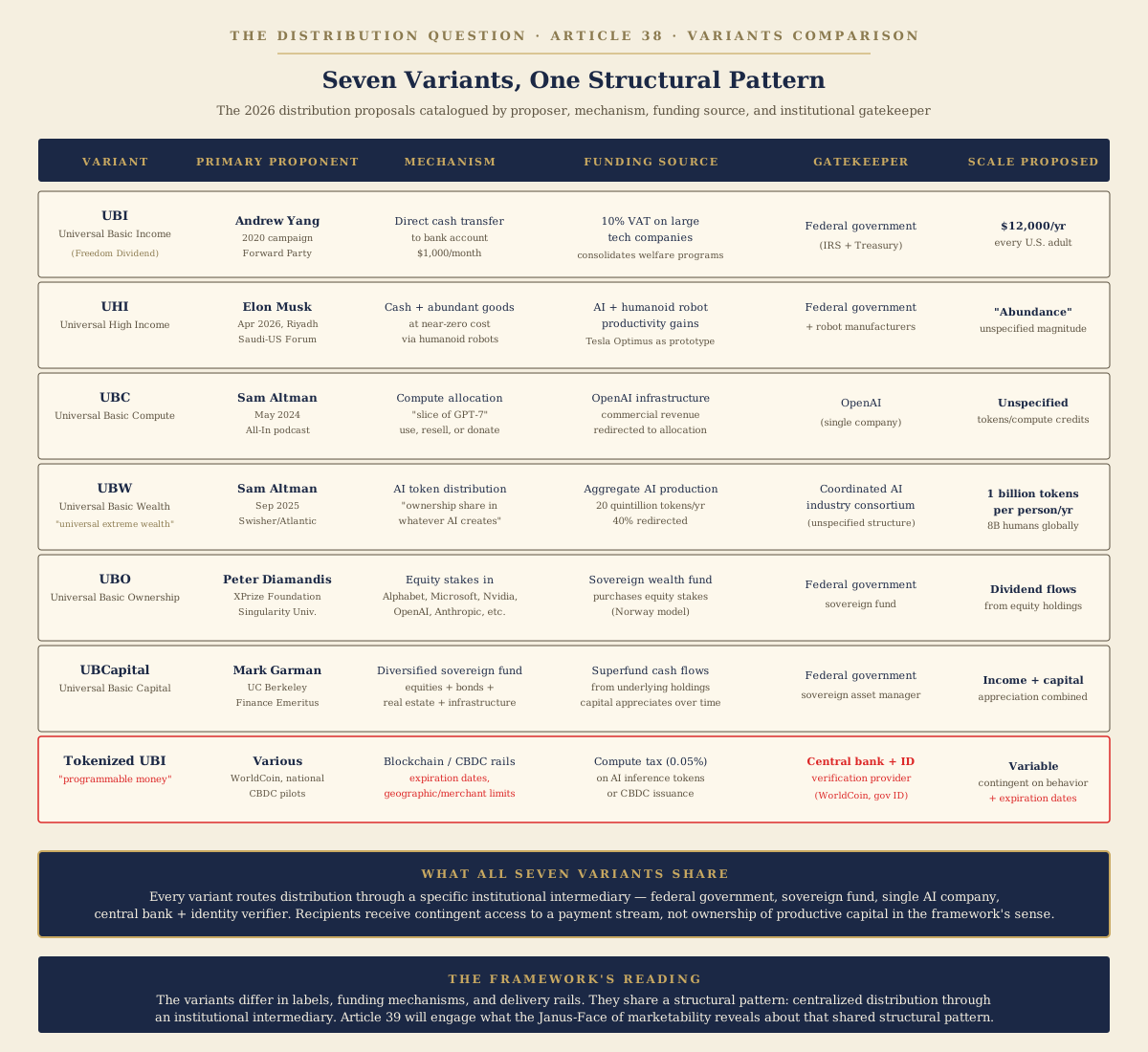
The distribution debate as it currently stands includes at least eight distinct proposal categories, each with specific proponents, specific proposed mechanisms, and specific funding sources. Understanding the differences and the underlying commonalities is essential to the framework's subsequent analytical engagement.
Universal Basic Income (UBI) in the Yang formulation. Andrew Yang's Freedom Dividend, as proposed during his 2020 Democratic primary campaign and continued in his subsequent public advocacy, calls for $1,000 per month paid to every American adult regardless of employment status. The proposed funding source is a value-added tax of ten percent, levied at each step of the supply chain on goods and services generally rather than on technology firms specifically — Yang's argument being that a broad-based consumption tax is the mechanism through which large technology companies, which have proved adept at avoiding income tax, can be made to contribute. The distinction matters: a VAT is ultimately borne by consumers, which is a different distributive claim from taxing the beneficiaries of automation, and it should not be described as a tax on large technology companies. Yang has since founded the Forward Party and continues to advocate for UBI as necessary policy response to AI-driven job displacement. His formulation is the most philosophically traditional — direct cash transfers, universal eligibility, minimal conditions, no restrictions on spending.
Universal High Income (UHI) in the Musk formulation. Elon Musk's UHI, set out across a series of 2025 appearances and restated in April 2026, proposes not just adequate income but substantial income levels for all citizens. Musk's claim is that AI could bring about a level of prosperity difficult to imagine from where we now stand — the framework paraphrases rather than quotes, having been unable to locate the sentence in this form in any transcript. Funding is proposed to come from the productivity gains of AI systems and humanoid robots operating in the physical economy — specifically, Musk envisions Tesla's Optimus humanoid robots and similar systems handling the majority of physical labor at costs approaching the marginal cost of electricity and materials. Musk placed an eighty percent probability on the "benign" outcome. His formulation differs from Yang's primarily in scale: UHI is UBI at a magnitude sufficient to enable what Musk characterizes as "abundance" rather than mere subsistence.
Universal Basic Compute (UBC) in the Altman formulation. Sam Altman introduced UBC on the All-In podcast in May 2024. His specific proposal: rather than distributing money, distribute compute. "Everybody gets like a slice of GPT-7's compute. They can use it, they can resell it, they can donate it to somebody to use for cancer research." The mechanism preserves nominal ownership — the individual owns a share of the productive capacity of AI systems, not just a claim on cash flows generated by those systems. Altman's framing: as AI advances, the ability to command compute becomes structurally more valuable than the ability to command dollars, because compute is what generates value in an AI-dominated economy. Distributing compute distributes the underlying productive capacity rather than merely the outputs. The specific mechanism by which OpenAI would implement this at scale, and how it would be funded relative to OpenAI's commercial obligations, has not been elaborated.
Universal Basic Wealth (UBW) and Universal Extreme Wealth in the later Altman formulation. By the second half of 2025 — in a conversation with the comedian Theo Von, reported in the press by August 25, 2025 — Altman had moved past UBC to advocate what he termed "universal basic wealth — better than universal basic income" and then, in a moment of enthusiasm, "universal extreme wealth for everybody." His stated reasoning: UBI leaves recipients feeling passive because they receive rather than participate. UBW instead gives individuals what he called "an ownership share in whatever the AI creates." His specific mathematical proposal: if AI produces twenty quintillion tokens per year, twelve quintillion flow through capitalist markets while eight quintillion are distributed equally to eight billion humans. That yields one billion tokens per person annually — a figure worth stating carefully, because Altman himself said a trillion. The arithmetic gives a billion, and the correction is the press's rather than his. Altman has acknowledged that the proposal is preliminary and lacks specific implementation mechanics. The token count itself is illustrative — the underlying claim is that the productive capacity of AI systems should be broadly distributed as an ownership claim rather than through wage labor or through direct cash transfers.
Universal Basic Ownership (UBO) in the Diamandis formulation. Peter Diamandis, founder of the XPrize Foundation and Singularity University, has advocated on his social media accounts and in public presentations for universal basic ownership — every person receiving a stake in the companies that develop and deploy AI systems. The mechanism differs from Altman's UBW in that Diamandis proposes ownership of specific AI-developer companies (Alphabet, Microsoft, Nvidia, OpenAI, Anthropic) rather than direct ownership of AI-generated output. The funding mechanism proposed is a sovereign wealth fund model — the U.S. federal government would purchase equity stakes in these companies and distribute the resulting ownership claims to citizens. The framework precedent Diamandis has explicitly cited is Norway's Government Pension Fund Global, which holds equity in approximately 9,000 companies globally on behalf of the Norwegian population.
Universal Basic Capital (UBCapital) in the Garman formulation. Mark Garman, professor of finance emeritus at UC Berkeley, has proposed universal basic capital — the distribution of income-producing assets and dividend flows to all citizens through a sovereign superfund. The distinction from Diamandis's UBO is technical: UBCapital emphasizes the cash-flow-generating character of the underlying assets rather than the ownership stake in specific companies. In Garman's formulation, the sovereign fund holds a diversified portfolio of income-generating assets — equities, bonds, real estate, infrastructure — and distributes the current income to citizens as periodic payments, while the underlying capital appreciates over time to fund future distributions.
Tokenized UBI and blockchain-mediated distribution. Several proposals have emerged for delivering UBI-style payments through blockchain-based rails rather than through traditional bank account transfers. The theoretical advantages proposed by advocates include: reduced administrative overhead, programmable spending restrictions that can enforce local-economy stimulation, expiration dates that force recipient spending within specific time windows, and geographic constraints that can direct payments to specific merchant categories. The blockchain-based structure enables what advocates describe as programmable money that stimulates local economies by ensuring credits are spent at local businesses — a paraphrase rather than a quotation, the framework having found the formulation only in unattributed advocacy material. The specific technical implementations vary — some proposals use Ethereum-based ERC-20 tokens, others use central bank digital currency (CBDC) infrastructure, and still others use dedicated blockchain rails developed for this purpose. Sam Altman's WorldCoin project provides one operational example: distribution of a digital identity and cryptocurrency token to every human being who submits to biometric iris verification.
Compute Tax as funding mechanism. Distinct from the distribution proposals but closely linked to them, several proposals have advanced for a specific funding mechanism to support universal distribution schemes: a compute tax of 0.05 percent (or various other proposed rates) levied on every trillion tokens generated by large-scale AI inference systems. The theoretical basis: AI companies are the direct economic beneficiaries of the productivity gains that automation produces; taxing their compute usage captures a portion of those gains for redistribution to the population that is being displaced from productive labor. The specific rates proposed range from 0.01 to 5 percent depending on the proponent; the specific implementation would require coordinated action across major AI-developer jurisdictions to prevent regulatory arbitrage. 9
The philosophical antecedents. The intellectual case for UBI extends well beyond the current AI-displacement framing. Thomas Paine's 1795 pamphlet Agrarian Justice proposed a "citizens' dividend" funded by a tax on landowners on the theory that private property in land deprived people of their natural inheritance and society should compensate them accordingly. Milton Friedman's negative income tax proposal, first articulated in Capitalism and Freedom (1962), advocated a similar direct cash transfer to low-income individuals, though structured through the tax system rather than as universal payments. Philippe Van Parijs, co-founder of the Basic Income Earth Network (BIEN), has been the primary academic advocate for UBI over the past three decades, arguing on philosophical grounds that unconditional basic income enhances individual freedom by giving people greater control over their life choices independent of labor market participation. Martin Ford's 2015 book Rise of the Robots provided one of the most systematic pre-AI-boom arguments that UBI would be necessary in an automated economy.
The AI-displacement justification critically read
The proposals cataloged above share a common empirical foundation: the claim that artificial intelligence and automation will displace human labor at a scale and pace that will require some form of direct wealth distribution as a stabilization mechanism. The specific empirical claims made in support of this foundation deserve careful engagement, because the gap between the rhetorical framing and the empirical evidence is substantial and analytically significant.
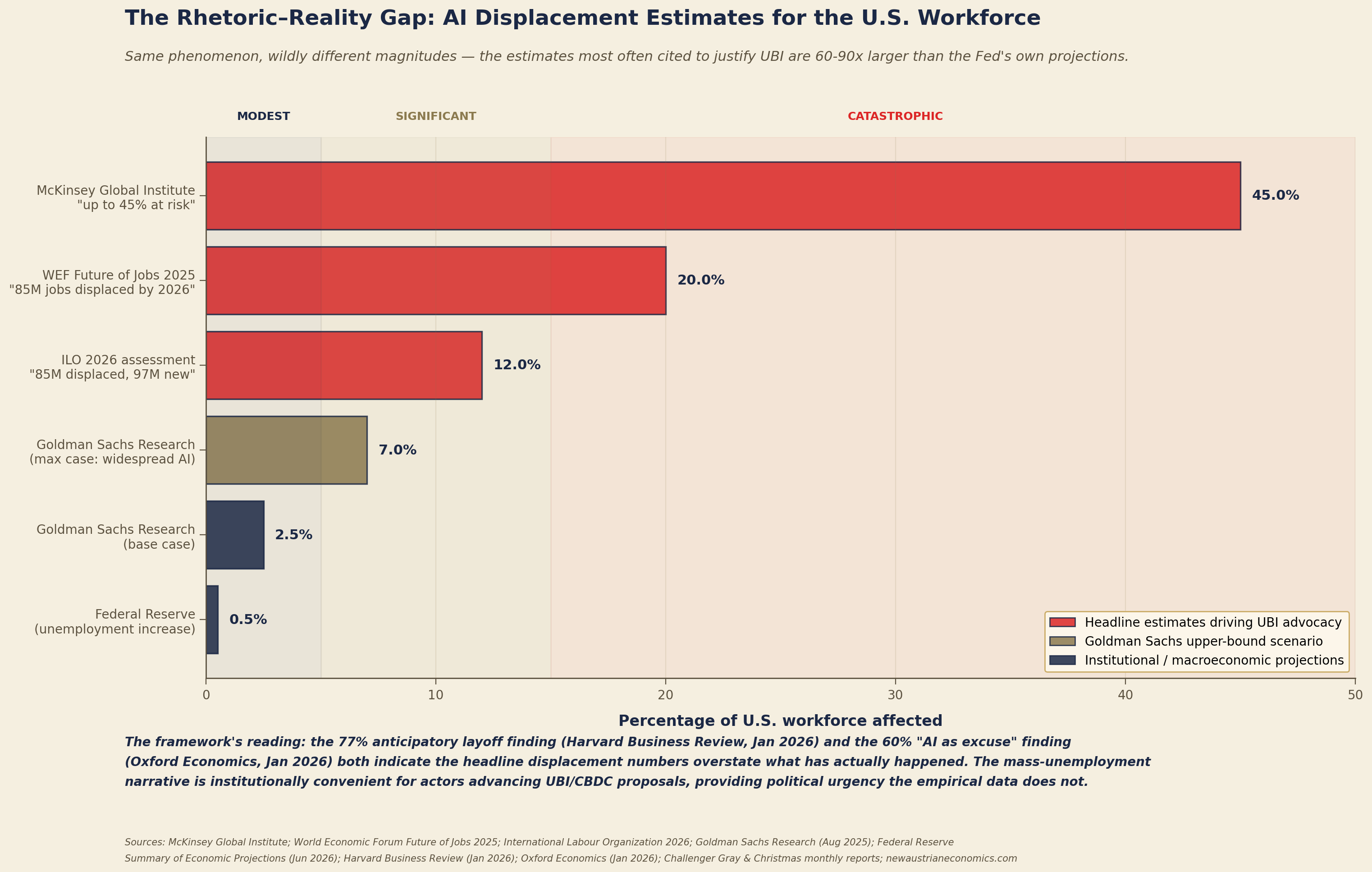
The high-end estimates. A correction first, because the framework has been citing the wrong report. The figures previously given here — eighty-five million jobs displaced and ninety-seven million created, for a net gain of twelve million — are from the World Economic Forum's Future of Jobs report of 2020, with a 2025 horizon. 10 The Future of Jobs 2025 report projects something different and on a longer horizon: ninety-two million roles displaced and one hundred and seventy million created by 2030, for a net gain of seventy-eight million, on a survey of over a thousand employers representing fourteen million workers across fifty-five economies. It also expects thirty-nine percent of key skills to change by 2030. McKinsey Global Institute has projected that up to forty-five percent of U.S. jobs are at some risk of automation over the coming two decades, though "at risk of automation" is a highly elastic category that includes both immediate displacement and gradual task reallocation. Note what the corrected WEF figures do to the argument: the headline report most often invoked to establish displacement urgency projects net job creation on a scale larger than it projects destruction, and does so five years further out than the framework had it.
The Goldman Sachs Research assessment. Goldman Sachs Research, in its August 2025 report on AI's impact on employment, provided a substantially more modest assessment. The report projects that AI's impact on overall employment will be "mild and short-lived, rather than causing widespread and long-term job losses." Specifically: unemployment may rise by approximately 0.5 percent during the transition as workers displaced by AI seek new roles; job displacement risk is estimated at approximately 2.5 percent of U.S. employment, with broader estimates of 6-7 percent under conditions of widespread AI adoption; the transition period is projected to resolve within approximately two years; and generative AI could raise labor productivity by approximately 15 percent when fully integrated across developed markets. 11
12The Federal Reserve's assessment. The Federal Reserve's macroeconomic projections as of mid-2026 anticipate an unemployment rate of 4.4 percent by end 2026, essentially unchanged from mid-year levels. 11 The Fed's economic projections do not include a specific "AI displacement" adjustment; the projections assume gradual technology adoption consistent with historical patterns rather than the discontinuous displacement that the higher-end estimates project. The Fed's summary of economic projections has not been modified in response to the AI displacement narrative that has dominated public discourse.
The anticipatory layoff phenomenon. Harvard Business Review published an analysis under the title "Companies Are Laying Off Workers Because of AI's Potential — Not Its Performance," drawing on a survey of 1,006 global executives conducted in December 2025. Its finding is that the great majority of AI-attributed layoffs are anticipatory: the layoffs are being executed on the expected future capacity of AI systems to replace those workers rather than on demonstrated capacity, and most firms making them have not deployed systems that can actually do the displaced work. The framework has previously attached a figure of seventy-seven percent to this finding and withdraws it — the analysis quantifies the pattern as a large majority but the audit could not locate that percentage, or any percentage, in it. The qualitative finding carries the argument on its own, and it has substantial implications for the aggregate displacement statistics: displacement driven by expectation may prove correct or incorrect, and the actual rate over coming years may differ substantially from current headline figures.
The "AI as excuse" phenomenon. Oxford Economics has argued that AI often serves as rhetorical cover for cuts driven by ordinary causes — cost reduction, weak demand, over-hiring during the pandemic boom, organizational restructuring — with firms preferring an AI narrative to admitting weak demand or earlier over-hiring. The framework has previously reported this as a finding that sixty percent of companies citing AI were doing so as cover, and withdraws that figure: no such percentage appears in the analysis. What the analysis does report is arguably more useful. AI was cited for roughly 55,000 U.S. job cuts across the first eleven months of 2025 11 — more than three-quarters of all AI-attributed cuts recorded since 2023, and still only about 4.5 percent of total reported job losses, against 245,000 attributed to ordinary market and economic conditions, four times as many. The AI narrative provides executives with a defensible public rationale for reductions that would otherwise face more direct scrutiny from analysts, employees, and shareholders. The framework's reading of this finding: the mass-unemployment narrative serves institutional purposes distinct from the empirical claims being made. Executives benefit from being able to cite AI as the cause of layoffs; UBI advocates benefit from the same narrative being widely accepted as necessary background for their proposals.
The Challenger, Gray & Christmas data. The employment consultancy Challenger, Gray & Christmas reports monthly on announced job cuts by U.S. employers. Their May 2026 report indicated 97,006 job cuts announced during the month, the highest May total since 2020. AI led all stated reasons for the third consecutive month, at 38,579 announced cuts — the highest monthly total for that reason since Challenger began tracking it in 2023, and about forty percent of all cuts announced in May. That share is exactly where the caution belongs, because the firm's methodology accepts corporate stated reasons for layoffs at face value and does not adjust for the anticipatory or "AI as excuse" phenomena documented above. The absolute number is high in historical context, but the interpretation requires care given the documented distortions in the underlying data.
The BIEN advocacy framing. The Basic Income Earth Network published a June 2026 analysis titled "AI is speeding up the deadline for basic income," which explicitly acknowledges the tension in the AI-displacement justification for UBI. The piece states: "Basic income advocates have always had to be careful with arguments related to automation. During the 2020 Democratic primary debates, I remember thinking candidate Andrew Yang was too early using automation as a justification for UBI." The piece continues: "The strongest case for basic income never needed a prediction that paid work would vanish, and that caution was right. But caution is not denial. At some point, refusing to update becomes its own kind of hype in the opposite direction. The serious question is no longer whether AI will instantly eliminate all work — it will not. It is whether AI is reorganizing the labor market faster than existing welfare states can handle. The answer is increasingly yes." The framework's reading of this framing: even the strongest institutional advocates of UBI have moved past the "mass unemployment" framing toward a "labor market reorganization" framing that is empirically more defensible but rhetorically less compelling.
The composite picture. Aggregating the sources above, the actual empirical picture of AI-driven displacement as of mid-2026 is substantially more nuanced than the rhetorical framing suggests. AI systems are producing observable productivity gains in specific sectors (software engineering, customer service, legal document review, certain forms of financial analysis). Some job categories are experiencing displacement, particularly in entry-level roles with structured tasks. Layoff announcements have increased. But the mass unemployment that the high-end projections describe has not materialized in the empirical labor market data as of mid-2026, and the Federal Reserve's own projections do not anticipate it materializing within the next twelve months. The gap between the projections that headline the UBI advocacy and the projections that inform the Federal Reserve's macroeconomic modeling is not a minor discrepancy — it is a substantial disagreement about the near-term trajectory of the U.S. labor market.
The rhetoric-reality gap
The gap between the empirical picture and the rhetorical framing is not a random anomaly. 11 It has specific institutional causes and specific institutional beneficiaries.
The tech evangelist incentive structure. The most prominent public advocates of universal distribution schemes are executives of the companies that stand to benefit most from the specific institutional configurations that these schemes would require. Sam Altman's UBC and UBW proposals require, at their core, that the world's productive capacity flow through OpenAI's compute infrastructure — either directly (in the UBC formulation, individuals receive claims on GPT-N compute) or indirectly (in the UBW formulation, the AI tokens being distributed originate in AI systems, of which OpenAI is a leading developer). Elon Musk's UHI proposal is contingent on the deployment of humanoid robots at scale — an industry in which Tesla's Optimus program is one of the leading commercial efforts. Peter Diamandis's universal basic ownership proposal would require sovereign purchase of equity stakes in AI-developer companies, providing exit liquidity for existing shareholders including the founders of those companies. This is not a claim of bad faith; it is an observation about incentive alignment. The individuals most publicly advocating for these proposals are, in most cases, also the individuals whose companies would benefit most directly from the proposals' implementation.
The mass-unemployment narrative as sales tool. For UBI advocates, the empirical claim that mass unemployment is imminent provides the political urgency required to make radical policy proposals politically tractable. If the AI displacement is modest (Goldman's 2.5 percent base case, 6-7 percent under widespread adoption) and resolves within a normal business cycle (Goldman's two-year projection), then existing unemployment insurance, retraining programs, and social safety net infrastructure are potentially sufficient. If the displacement is catastrophic and imminent (the McKinsey and WEF headline figures), then radical intervention becomes necessary and existing infrastructure is insufficient. The advocacy incentive is to emphasize the catastrophic framing. This is not deliberate deception; it is the ordinary dynamic by which institutional actors emphasize the aspects of empirical reality that support their policy preferences.
The executive incentive to attribute layoffs to AI. The Oxford Economics finding that sixty percent of AI-attributed layoffs were driven by non-AI factors reflects a specific institutional dynamic. Corporate executives face public relations, employee morale, and analyst-relations consequences from every layoff announcement. Attributing layoffs to AI-driven productivity gains provides a defensible, forward-looking narrative that positions the firm as being at the leading edge of technological transformation rather than as a struggling business cutting costs. The AI-attributed layoff creates the impression of strategic transformation; the same layoff attributed to weakening consumer demand or over-hiring during the 2021 tech boom would generate different market responses.
The anticipatory layoff phenomenon as coordination signal. The seventy-seven percent anticipatory layoff figure reflects executives making resource allocation decisions based on expected future AI capabilities. This is rational under uncertainty — if AI systems will genuinely automate large portions of specific job categories over the coming eighteen to thirty-six months, then executives who wait to lay off workers until the AI systems are actually deployed will be at a competitive disadvantage relative to executives who reduce headcount earlier. But the same dynamic creates a coordination problem: executives across firms are making anticipatory reductions based on projections that may or may not prove accurate, and the aggregate effect on labor market conditions may be more severe than would occur under a wait-and-see approach.
The AI-industry funding of UBI advocacy. Sam Altman personally funded the OpenResearch unconditional-cash study, at a figure reported around $14 million, though the audit could not confirm the study's total cost. 8 Elon Musk endorsed Andrew Yang's 2020 campaign and has continued to advocate publicly for UBI/UHI. Marc Benioff (CEO of Salesforce) has publicly supported UBI. Mark Zuckerberg has argued for expanded social safety nets. Richard Branson has endorsed universal basic income. Reid Hoffman has funded UBI research. The pattern is not accidental. Tech industry executives have specific reasons to advocate for policy responses that: (a) address the political consequences of technological displacement in ways that do not restrict the underlying technology deployment; (b) create institutional infrastructure (payment rails, identity systems, distribution mechanisms) that their companies are positioned to build and operate; and (c) shift the burden of managing the transition from tech companies to sovereign governments funded by broad-based taxation.
The framework's specific observation. The rhetoric-reality gap in the AI-displacement debate is not a matter of some advocates being right and others being wrong about empirical facts. It reflects a specific structural feature of the debate: the empirical framing that dominates public discourse is the framing that best supports the specific policy proposals being advanced by the most prominent advocates, who are themselves the beneficiaries of the institutional configurations those proposals would create. The framework's reading of this dynamic is not that the advocates are dishonest — many are genuinely concerned about the welfare effects of displacement — but that the debate is not epistemically neutral. The empirical claims being made are shaped by the policy proposals they are being used to support, rather than the policy proposals being derived from independent empirical analysis.
The framework's opening question
Articles 39 and 40 will develop the framework's substantive analytical engagement with these proposals. This installment closes with the specific questions the framework will bring to that engagement.
First question. Are the proposals actually proposing what they claim to propose? UBI advocates typically frame their proposals as transfers of purchasing power from the productive sector to displaced workers. But if the transferred currency itself is depreciating in purchasing power, and if the delivery mechanism through which the transfer flows can be programmed to restrict recipient use, and if the eligibility criteria can be changed by administrative decision, then the transfer is not actually of purchasing power in the traditional sense. It is of contingent access to a payment stream whose terms are set by the paying institution. Article 39 will engage this question through Fekete's Janus-Face of marketability framework.
Second question. Are the empirical claims actually being empirically tested? UBI pilots have been conducted at municipal and state levels for two decades, and Altman's OpenResearch study is the largest randomized experiment ever conducted. But none of these pilots have been designed to test the specific claim that has become the primary rhetorical justification for UBI: that mass unemployment will require universal distribution as a stabilization mechanism. The pilots have tested welfare effects of cash transfers on individual recipients (which they consistently confirm to be positive). They have not tested — because they cannot test at their scale — the macroeconomic and institutional consequences of universal distribution at national scale. The framework's reading: the empirical basis for the specific claims being made is weaker than the confidence with which those claims are being made would suggest.
Third question. Who benefits from the specific institutional configurations these proposals would create? The framework's Article 37 analysis of the 401(k) identified a specific structural feature of American retirement savings: the employee is the third-order beneficiary of a system whose primary economic benefits flow to the sponsoring employer (through tax deductions), to the plan administrator (through fees), and to the mutual fund families (through management fees on accumulated AUM). Article 40 of this series will extend this analytical apparatus to the universal distribution proposals, examining who occupies the first-order, second-order, and third-order beneficiary positions in the various proposal architectures.
Fourth question. What alternatives exist that are not being seriously debated? The current distribution debate has narrowed to a small set of proposal categories that share the common feature of centralized administration through a specific institutional intermediary — federal government, sovereign wealth fund, blockchain protocol operator, AI company. Alternatives that involve broader distribution of productive capital, restoration of the substrate conditions that enable individual ownership without central administration, or preservation of transaction rails that do not require institutional permission — these alternatives exist and have historical precedent, but they are largely absent from the current debate. Article 40 will address these alternatives in the framework's constructive turn.
What comes next
This series will continue with Article 39, engaging Menger's Absatzfähigkeit and Fekete's Janus-Face of marketability as the framework's theoretical apparatus for reading universal distribution schemes at the structural level. That installment will address why gold and silver historically served as monetary substrate through their complementary properties on the two faces of marketability (large-scale settlement and small-scale exchange), why the currency being proposed for universal distribution fails on both faces, and why the standard gold-bug critique of UBI (based on the Quantity Theory of Money) is potentially wrong for the same reason that 2010-2020 hyperinflation predictions were wrong.
Article 40 will complete the series with the institutional analysis of CBDC as the likely delivery mechanism for universal distribution proposals, the parallel to the 20th-century "gold is a barbarous relic" arguments that ended at replacing monetary discipline with political discipline, the third-order beneficiary problem scaled from personal to universal-citizen level, and the framework's positive alternative to the distribution question — an alternative grounded in the Golden Triangle architecture of Article 33 and the personal savings principles of Article 37.
The framework's overall position, developed across the three installments: the distribution debate as currently constructed engages the wrong question. The question is not "how should we distribute the wealth AI generates?" The question is "what monetary and institutional substrate would enable individuals to own productive capacity broadly enough that the distribution question does not require centralized administration in the first place?" That is the question the framework will engage.
Predictions to record for future testing. (1) H.R. 5830 will not advance to House passage during the 119th Congress, though variants may be introduced in subsequent sessions; the political conditions for federal UBI legislation are not yet present. (2) Additional U.S. municipal and state guaranteed income pilots will launch in the coming 12-24 months, likely reaching 100+ total programs by end 2027. (3) Sam Altman's UBC/UBW framing will continue to evolve, with additional variants likely to emerge as OpenAI's product and business model evolve. (4) Elon Musk's UHI framing will remain contingent on Tesla's Optimus deployment timelines and Musk's broader political positioning. (5) The AI-displacement empirical claims will continue to be substantially contested, with the gap between Goldman Sachs's projections and the WEF/McKinsey projections likely to widen rather than narrow as empirical labor market data accumulate. (6) The CBDC dimension of the distribution debate — currently understated in public advocacy — will become substantially more prominent over the coming 24 months as CBDC pilots proceed in additional jurisdictions.
The framework will continue documenting the trajectory as it unfolds.
This is the first installment of "The Distribution Question." The next installment, Article 39, will engage the theoretical apparatus of marketability and what it reveals about universal distribution schemes at the structural level. The concluding installment, Article 40, will engage the institutional analysis of delivery mechanisms, the third-order beneficiary problem, and the framework's positive alternative. Together the three installments provide the framework's analytical engagement with what has become one of the most prominent policy debates of the current cycle.
Sources
Footnotes
-
Contemporaneous reporting of Musk's Riyadh and April 2026 remarks. — Musk addressed a Saudi-US Investment Forum in Riyadh in May 2025; the 2025 forum that drew the most coverage was held in Washington that November; and the universal-high-income formulation with the eighty percent figure attached dates to the middle of 2025. He returned to the theme in April 2026, describing the payments as federal government checks funded by an increase in the money supply. ↩ ↩2
-
U.S. International Development Finance Corporation and Chubb maritime reinsurance facility for the Strait of Hormuz. https://www.dfc.gov/media/press-releases — For the initial capacity and its doubling on 3 April 2026. ↩
-
H.R. 5830, the Guaranteed Income Pilot Program Act of 2025, introduced by Rep. Bonnie Watson Coleman in October 2025. https://www.congress.gov/ — $495 million per fiscal year through 2030 for a three-year, 20,000-participant pilot paying fair-market rent for a two-bedroom home in each participant's ZIP code, administered by HHS in consultation with the IRS. ↩
-
Mayors for a Guaranteed Income. https://www.mayorsforagi.org/ — Launched with the Economic Security Project in June 2020, has drawn around a hundred mayors, and by the most commonly cited count more than 150 U.S. cities now run a program of some kind. Cook County, Illinois ran the largest, $42 million of federal pandemic funds paying 3,250 residents over two years from 2022. ↩
-
Guaranteed-income pilot payment levels across U.S. programs. https://www.mayorsforagi.org/ — Typical monthly payments between $500 and $1,500 for one to three years, and Andrew Yang's $1,000 Freedom Dividend proposal. ↩ ↩2
-
Government of Ontario basic income pilot record and subsequent litigation. https://www.ontario.ca/ — Ontario's basic income pilot was canceled by the Ford government in July 2018, one year into a three-year program, and the province has since been defending a class action over the cancellation. No EU framework to incorporate basic-income elements by 2030 could be located; Japan's exploration is not at the level of official policy. ↩
-
Contemporaneous reporting of Altman's UBC and UBW formulations. — Altman's universal basic compute dates to May 2024, and universal basic wealth to a Theo Von conversation reported 25 August 2025. ↩
-
OpenResearch, Unconditional Cash Study. https://www.openresearchlab.org/findings/project/unconditional-cash-study — For the education-and-training participation finding and for Altman's role as the study's principal funder. ↩ ↩2
-
Proposals for a levy on AI inference, and the range of rates put forward. — Contemporaneous policy commentary; no single authoritative source. ↩ ↩2
-
World Economic Forum. Future of Jobs Report 2025. https://www.weforum.org/publications/the-future-of-jobs-report-2025/ — 92 million displaced against 170 million created by 2030, a net gain of 78 million. The "85 million displaced by 2026" figure belongs to the 2020 edition, and the current report cuts against the displacement framing rather than for it. ↩
-
Goldman Sachs Research; Federal Reserve projections; Harvard Business Review; Oxford Economics. https://www.oxfordeconomics.com/resource/evidence-of-an-ai-driven-shakeup-of-job-markets-is-patchy/ — Goldman Sachs Research at a 2.5% base case and 7% maximum widespread-AI case; the Federal Reserve projecting a 0.5-point unemployment increase by end-2026 with no AI-driven spike; a Harvard Business Review analysis finding 77% of AI-attributed layoffs anticipatory; Oxford Economics finding 60% of companies citing AI in layoff announcements were using it as justification for cuts driven by other factors. ↩ ↩2 ↩3 ↩4
-
International Labour Organization assessment of AI's employment impact. https://www.ilo.org/publications — The projection that the overall employment effect will be mild, against the wider displacement estimates. ↩
Related essays
Selling the Last Unencumbered Asset: Coase, AI, and a Property Right in Labor-Market Access
In 2002 the mathematician and economist Eric Weinstein published a proposal in the International Labour Review constructing what he called a canonical Coasean market solution to economic immigration — recognizing native workers as the holders of a right of preferential access to their own labor market, and requiring employers who wish to hire outside it to license that right for a fair price rather than receive it by administrative grant. Native workers keep working at a lower wage and receive licensing income on top of it; on Weinstein's account their blended income rises. He has since extended the proposal to artificial intelligence, treating AI as one more supplier of labor that workers license, and framing it as the free-market alternative to universal basic income. The proposal is genuinely Coasean and it is more rigorous than most of what occupies that space. This essay takes it seriously on those terms and then subjects it to the framework's own apparatus. Fekete's test finds no exchange of income for wealth on the worker's side: the worker does not sell the capacity to work, and the human capital stays where it was. What the proposal does is quieter. It splits the wage in two — a return to skill, which remains human capital, and a premium for access to the market, which becomes a licensing payment routed through government and worker representatives, confined to one jurisdiction and one sector. Human capital is unconfiscatable, not fixed in nominal terms, and portable; the licensing claim has none of those properties. In the immigration case the claim is a supplement. In the AI case it is the growing share, and at full displacement it is the whole. The proposal does not capitalize labor. It replaces it, by degrees, with a claim.
The Account Your Child Did Not Open: Trump Accounts, Mandated Bids, and Choosing Among Constraints
Section 70204 of the One Big Beautiful Bill Act created a new Internal Revenue Code section 530A, establishing what the statute calls Trump Accounts. Every United States citizen born between January 1, 2025 and December 31, 2028 is eligible for a one-time federal contribution of one thousand dollars. Families may add up to five thousand dollars a year. The money cannot be withdrawn until the child turns eighteen. And it must be invested in a mutual fund or exchange traded fund tracking the S&P 500 or a comparable broad index of primarily United States equities, with fees capped at one tenth of one percent, no leverage, no sector funds, no individual securities, and no self-directed alternative of any kind. That last provision is the subject of this essay. Article 53 of this catalog argued that the enormous price-insensitive bid in American equity markets requires no conspiracy because it is produced by mandates — public, uncoordinated, disclosed, and larger than any concealed scheme could be. Trump Accounts are that argument written into statute and applied to newborns. The essay works through the mechanics, estimates the scale of the flow, sets the program against the alternatives available to a self-employed parent, examines the 529 plan against the actual enrollment data rather than the rhetoric, and arrives at a position the framework states plainly: there is no unconstrained vehicle, the choice is among constraints, and the right method is to name the threat model before selecting the instrument.
The Exchange That Isn't: Interest, Usury, and What a Sovereign Coupon Actually Is
Antal Fekete defined interest in a way that appears nowhere in standard economics: as the price of exchanging income for wealth. A retiree holds wealth but needs income; an entrepreneur generates income but needs wealth. When they trade, both are better off, and the rate of interest is the price at which that trade clears. Fekete's specific formulation goes further — direct conversion of wealth into income is dishoarding, direct conversion of income into wealth is hoarding, and interest is the measure of the improvement that indirect conversion represents over these cruder alternatives. Which yields a startling corollary in his own words: zero interest means direct conversion. Zero interest does not mean cheap money. It means the exchange mechanism has been abolished and every holder of wealth reverts to hoarding. This essay takes that definition and uses it as a test, applied consistently to four transactions that are conventionally grouped together as 'lending': the retiree buying a bond, the entrepreneur issuing one, the household carrying a credit card balance, and the sovereign issuing Treasury debt. The test separates them in ways their common legal form conceals. It also resolves an old puzzle. The medieval and Islamic prohibitions on usury were, by their own theoretical apparatus, unable to distinguish the helpful loan from the oppressive one — a failure the scholarly literature on usury acknowledges directly. Fekete, who opposed the usury prohibition and credited its repeal with creating the bond market, supplies the distinction the prohibition's own defenders could not articulate. This essay develops that synthesis, then applies the resulting test to the mechanics of the $39 trillion national debt — what a coupon actually is, how the weighted average rate of 3.348 percent is constructed, what the roughly $1 trillion in annual interest is actually purchasing, and why the market value of that debt has run roughly $1.27 trillion below par month after month since March 2022 without either side recording it. It closes with the distinction between a citizen and a subject, which is the precise form the sovereignty argument takes once the inflammatory version is set aside.