Introduction
Introduction — Economics and Praxeology
Ludwig von Mises · Human Action (1949) · A New Austrian Reading
"Economics is the youngest of all sciences." — Ludwig von Mises, Human Action, Introduction
Introduction — Economics and Praxeology
What Mises argues
The Introduction sets the terms for everything that follows. Mises' claim is radical and simple: economics is not a branch of the natural sciences, nor a collection of statistical regularities, but a division of a broader discipline he calls praxeology — the general theory of human action.
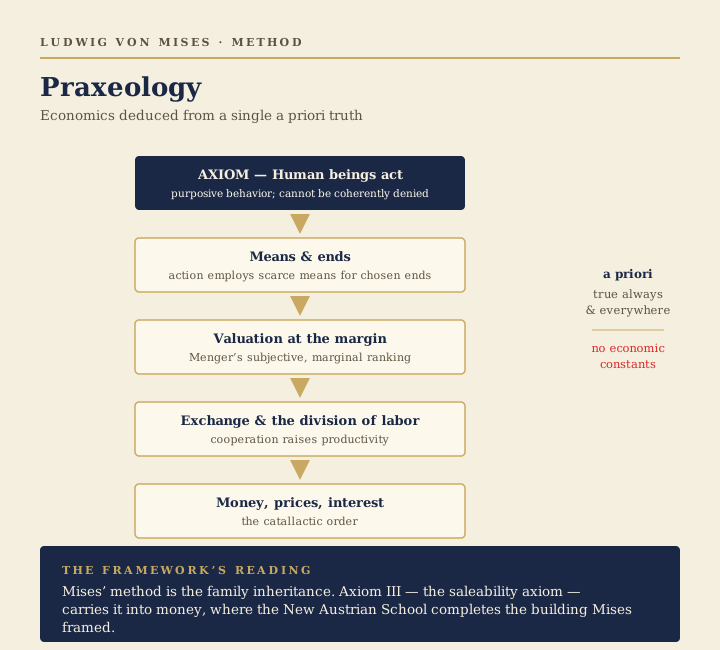
The core move is methodological. The natural sciences proceed by observation, hypothesis, and experiment; their laws are contingent, revisable, and known a posteriori. Praxeology proceeds differently. Its fundamental proposition — that human beings act, that they employ means to attain chosen ends — is not a hypothesis awaiting confirmation. It is a category of the mind, something we cannot even coherently deny, because the act of denying it is itself a purposive action. From this single self-evident starting point, Mises argues, the entire structure of economic theory can be deduced with the certainty of logic rather than the probability of measurement.
This yields what Mises calls methodological dualism: the study of nature and the study of action require different tools, and the attempt to import the methods of physics into economics — to make it "empirical" in the way chemistry is empirical — is a category error. Economic laws are exact laws, true always and everywhere action occurs, but they are not quantitative laws in the manner of the natural sciences. There are no economic constants.
Mises situates this against the intellectual currents of his time. He treats the reduction of economics to history or statistics (the German Historical School), and the reduction of thought itself to class or race interest (what he calls polylogism — the doctrine that different groups reason by different logics), as forms of a broader "revolt against reason." Praxeology is his answer: a universal logic of action, valid for all actors, that no appeal to group interest can relativize away.
Economics, then, is the best-developed part of praxeology — the part dealing with action under the division of labor and monetary exchange. It is young as a formal science, but its subject is as old as humanity.
The lineage
Mises did not invent this out of nothing. The taproot is Carl Menger. Menger's Principles (1871) had already located economic value not in labor or cost, as the classical economists held, but in the subjective valuations of acting individuals ranking means against ends at the margin. Menger's method was already anti-holist, already individualist, already about the logic of choice rather than the mechanics of aggregates.
What Mises adds is the philosophical elevation: he takes Menger's subjectivism and makes its foundational proposition aprioristic and universal. Where Menger described how individuals value, Mises argues that the fact of valuation is a necessary truth about action as such. The Introduction is where Austrian economics stops being one school among several and stakes its claim to be a demonstrative science.
The Framework's Reading
The Framework affirms the Introduction almost without qualification. This is the ground the whole tradition stands on, and Mises' statement of it has never been bettered. The New Austrian School is not a revolt against praxeology — it is praxeology carried into monetary territory Mises left half-mapped.
Two observations matter for what comes later.
First, the axiomatic move is the family inheritance, not a Misesian peculiarity. The New Austrian School's own foundation — the Three Axioms in the Atlas — is built in exactly the spirit of this Introduction. Axiom I (human beings act purposively) and Axiom II (action is subjective and marginal) are Menger and Mises restated. The distinctively New Austrian contribution, Axiom III, extends the same aprioristic style into the theory of money: it asserts that the market discovers a most-saleable good, and that this saleability is itself a marginal, subjective magnitude subject to the same logic of action. The Framework does not abandon Mises' method when it later corrects his monetary conclusions. It uses his own method against his own results — which is the most Austrian thing one can possibly do.
Second, "there are no economic constants" is a bill the Framework later collects on. Mises insists, correctly, that economics has no measurable constants like the natural sciences. The Framework takes this seriously in a way even many Misesians do not: it treats the modern habit of managing the economy by a single administered interest rate as a violation of Mises' own principle — an attempt to set, by decree, a magnitude that only the market process can discover. When we get to Chapter XIX, this is the deep reason the Framework sides with Fekete: a centrally set interest rate is precisely the "economic constant" Mises said could not exist, imposed by fiat rather than found by clearing.
There is no divergence here. There is only a promissory note. Everything Mises establishes in the Introduction, the Framework accepts and intends to hold him to.
The traditional Austrian reply
The Misesian–Rothbardian mainstream would accept everything in this section and add only that the Framework overstates the discontinuity to come. On their reading, Mises' monetary economics is a faithful application of the praxeological method, and the later Fekete corrections are not "Mises using Mises' own method" but a departure dressed in Austrian clothing. Whether the divergences are extensions of Mises or breaks from him is, in a sense, the argument of the whole series. The Introduction is common ground; the disagreement begins only where money does.
Cross-references
- Atlas: The Three Axioms — where Axiom III makes the New Austrian move Mises' method invites
- Forward to: Chapter XIX — The Rate of Interest, where the "no economic constants" principle becomes a live dispute
- Menger: Principles of Economics (1871), the subjectivist foundation Mises elevates to a priori status