Part One: Human Action
Chapter I — Acting Man
Ludwig von Mises · Human Action (1949) · A New Austrian Reading
"Human action is purposeful behavior." — Ludwig von Mises, Human Action, Ch. I
Chapter I — Acting Man
What Mises argues
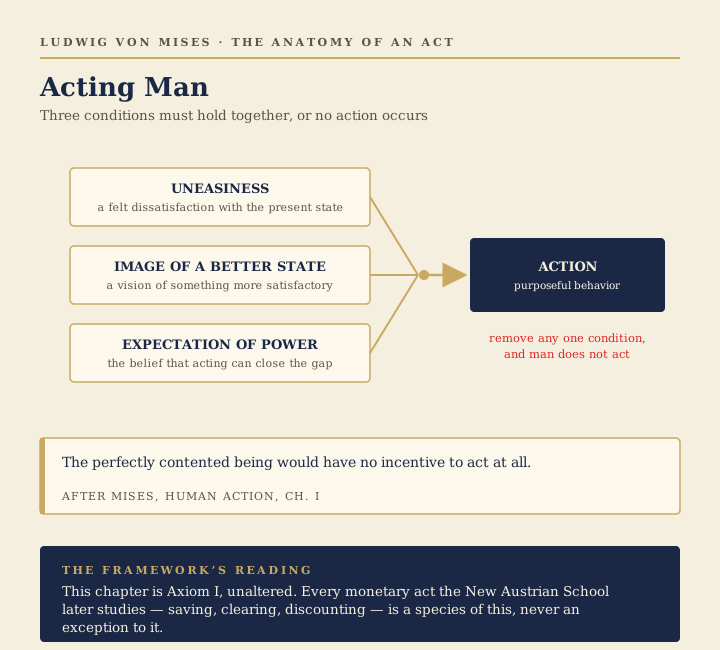
Mises opens the system proper by dissecting the act itself. Action, he says, is purposeful behavior — conscious conduct aimed at ends, as distinct from the reflexive or vegetative processes of the body. Three conditions must hold together for anyone to act. There must be uneasiness: a felt dissatisfaction with the present state. There must be an image of a more satisfactory state that could replace it. And there must be the expectation that one's own purposeful conduct has the power to reduce the uneasiness. Remove any one and action does not occur — the perfectly content being would never act at all.
From this Mises draws a hard corollary about rationality. All action is, by definition, rational: reason is simply the faculty by which a person selects means for ends, and to call an action "irrational" is only to disagree with the actor's ends or his choice of means, not to describe a different category of behavior. Economics does not judge ends; it takes them as given and studies the employment of means.
He closes with the problem of other minds — the alter ego. We know other people act because we recognize in their behavior the same purposive structure we know in ourselves. This recognition, not laboratory observation, is the ground on which the sciences of action stand.
The lineage
The acting individual is Menger's unit of analysis carried to its philosophical root. Where Menger began his Principles with the individual economizing among wants, Mises begins one step earlier, with the bare fact of purposive conduct as such — the stratum beneath all economizing.
The Framework's Reading
This chapter is simply Axiom I. The Framework adds nothing and subtracts nothing: human beings act purposively, and everything monetary the New Austrian School later builds — saleability, clearing, the discount — is a species of purposive action, not an exception to it. When later chapters diverge from Mises, they never diverge from this.
The single point worth flagging forward: because action always aims at replacing a less satisfactory state with a more satisfactory one, it is inherently forward-looking and time-bound. That structure is the seed of time preference (Ch. XIX) — and, the Framework will argue, of the propensity to consume that governs the discount rate Mises left unnamed.
The traditional Austrian reply
No dispute. Chapter I is common ground for every branch of the tradition.
Cross-references
- Atlas: The Three Axioms
- Forward to: Chapter V — Time and Chapter XIX — The Rate of Interest