Part One: Human Action
Chapter II — The Epistemological Problems of the Sciences of Human Action
Ludwig von Mises · Human Action (1949) · A New Austrian Reading
"Praxeology is a theoretical and systematic, not a historical, science." — Ludwig von Mises, Human Action, Ch. II
Chapter II — The Epistemological Problems of the Sciences of Human Action
What Mises argues
Here Mises sets out the theory of knowledge behind the whole book. The sciences of human action divide into two: praxeology, the theoretical science that deduces the necessary features of action a priori, and history, which studies the concrete, contingent, once-only events of the human past. They are complementary, not rival.
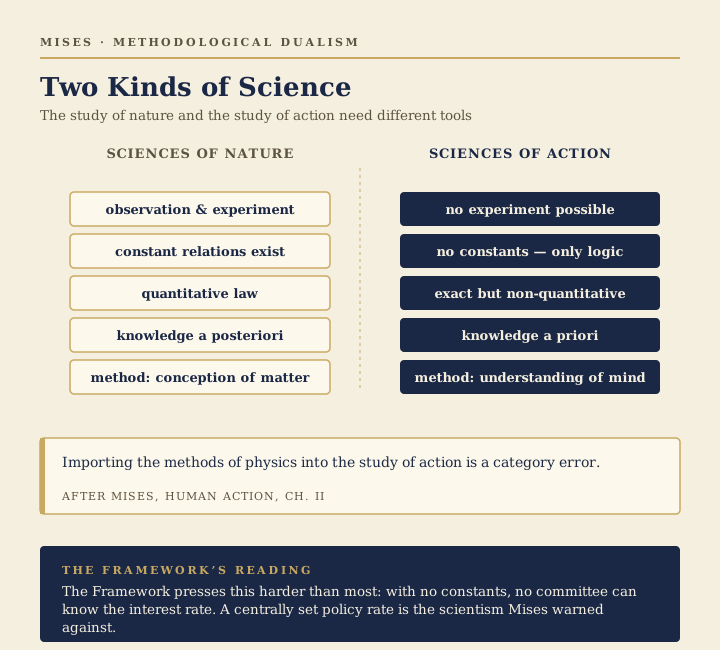
The governing principle is methodological dualism. The natural sciences confront a world of constant relations that can be isolated in experiment and expressed as quantitative law; they proceed a posteriori. The sciences of action confront acting minds, where there are no experiments and no constants, only the intelligible logic of purpose. To study action we need two distinct tools: conception (Begreifen) — the a priori reasoning of praxeology — and understanding (Verstehen) — the historian's grasp of the meaning actors gave their situation. Importing the methods of physics into the study of action ("scientism") is a category error that has repeatedly derailed economics.
The lineage
This is Mises' own contribution more than an inheritance — the philosophical scaffolding he erected to defend Menger's subjectivism against the German Historical School and the positivists.
The Framework's Reading
The Framework affirms methodological dualism without reservation, and then presses it harder than most who profess it. If there are no constants in the sciences of action, then no committee can know the rate of interest — it can only be discovered by the market process. The Framework treats the modern regime of an administered policy rate as the scientism Mises warned against: a natural-science fantasy of a settable constant, imposed on a domain that has none.
This is why the interest chapters (XIX, XX) are not a betrayal of Mises but an application of Chapter II. Fekete's two market-discovered prices — interest and discount — are more dualist than a single rate, not less.
The traditional Austrian reply
Full agreement on the epistemology. The mainstream would only note that Mises himself considered his monetary conclusions to be faithful applications of exactly this method — so invoking Chapter II does not, by itself, settle the later disputes.
Cross-references
- Back to: Introduction
- Forward to: Chapter XIX — The Rate of Interest