Part One: Human Action
Chapter III — Economics and the Revolt Against Reason
Ludwig von Mises · Human Action (1949) · A New Austrian Reading
"The logical structure of mind is uniform with all men." — Ludwig von Mises, Human Action, Ch. III (paraphrased for length)
Chapter III — Economics and the Revolt Against Reason
What Mises argues
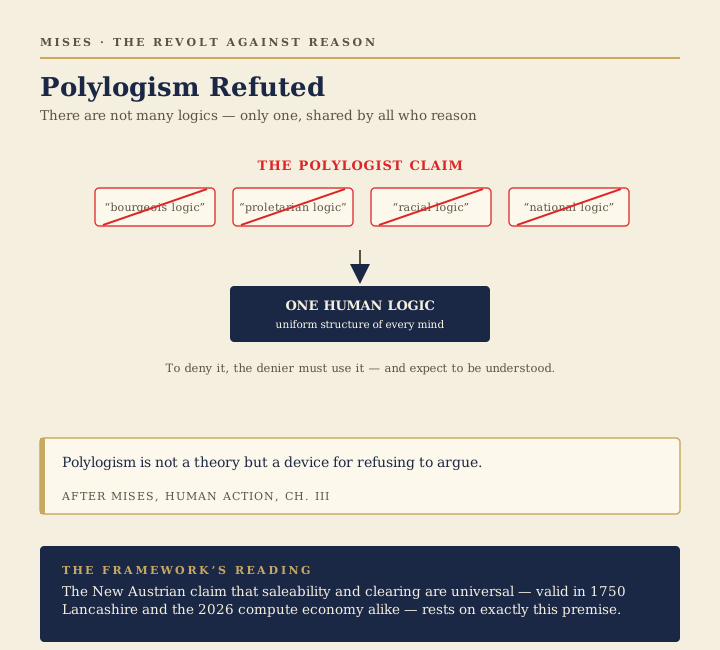
Mises confronts the most dangerous intellectual current of his century: the attempt to escape uncomfortable economic conclusions not by refuting them but by denying the universality of reason itself. He calls this polylogism — the claim that there is no single human logic but many, determined by class (the Marxian version: "bourgeois" versus "proletarian" logic) or by race (the National Socialist version).
His refutation is decisive and simple. Anyone asserting that another group reasons by a different logic must still use some logic to make the assertion, and to expect to be understood — which presupposes the very shared logic being denied. No one has ever specified the actual rules of the alleged alternative logic, because there are none. Polylogism is not a theory; it is a device for refusing to argue. Economic law, being a product of the uniform logical structure of the human mind, holds for all people regardless of class or origin.
The lineage
Mises' own polemic, aimed at the historicists, Marxists, and racial theorists of his day.
The Framework's Reading
The Framework affirms this chapter and takes a quiet lesson from it. The New Austrian claim — that Menger's saleability and Fekete's clearing describe universal features of monetary order, valid in eighteenth-century Lancashire and in the twenty-first-century compute economy alike — rests on exactly Mises' premise: the logic of action does not vary by era, technology, or tribe. If it did, there could be no monetary theory at all, only monetary history.
The traditional Austrian reply
No dispute. This chapter is universally held across the tradition.
Cross-references
- Atlas: The Three Axioms
- Back to: Chapter II