Part One: Human Action
Chapter IV — A First Analysis of the Category of Action
Ludwig von Mises · Human Action (1949) · A New Austrian Reading
"Acting man is eager to substitute a more satisfactory state for a less satisfactory." — Ludwig von Mises, Human Action, Ch. IV (paraphrased for length)
Chapter IV — A First Analysis of the Category of Action
What Mises argues
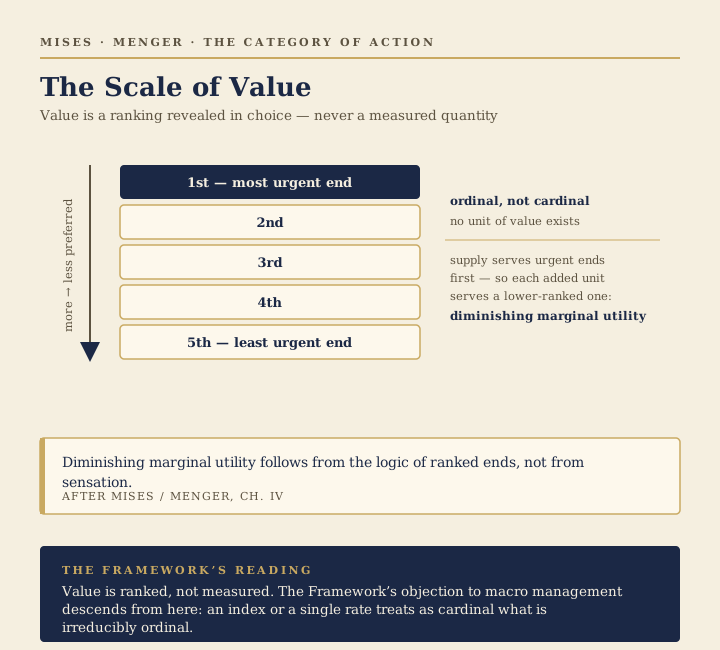
Mises now unfolds the internal structure of action. Every act ranks a chosen end above the ends forgone; choice is the revelation of a preference. From this he draws the nature of value: value is not a quality inhering in things, nor a measurable magnitude, but the ordinal ranking an actor assigns by preferring one state to another. There is no unit of value, no cardinal scale — only "more preferred" and "less preferred," shown in the act of choosing.
This yields the scale of value and the scale of needs, always ordinal, always revealed rather than introspected. And it yields the law of marginal utility as a praxeological necessity, not a psychological hypothesis: because a supply of a good is applied first to the most urgently ranked use and last to the least, each additional unit serves an end ranked lower than the one before. Diminishing marginal utility follows from the logic of ranked ends, not from any law of sensation.
The lineage
This is Carl Menger stated with praxeological rigor. Menger's 1871 breakthrough — that value flows from the subjective ranking of wants at the margin, dissolving the classical labor and cost theories — is here re-derived as a feature of the category of action itself. The Water–Diamond paradox that the Atlas renders visually is resolved exactly here: abundance drives water's marginal use down the value scale, though its total usefulness is supreme.
The Framework's Reading
This chapter is Axiom II — action is subjective and marginal — and the Framework holds it as bedrock. Its importance for what follows is the insistence that value is ranked, not measured. The New Austrian critique of macroeconomic management descends directly from this: aggregates that purport to measure value (a price index, a single interest rate) are treating as cardinal what is irreducibly ordinal. The gold basis, by contrast, measures not "value" but saleability — an observable market ratio, not a psychic quantity — which is why the Framework treats it as legitimate where an index is not.
The traditional Austrian reply
No dispute. Ordinal, subjective, marginal value is shared foundation across the whole school.
Cross-references
- Atlas: Marginal Utility · The Three Axioms
- Menger: Principles of Economics (1871)