Part One: Human Action
Chapter V — Time
Ludwig von Mises · Human Action (1949) · A New Austrian Reading
"The notion of change implies the notion of temporal sequence." — Ludwig von Mises, Human Action, Ch. V (paraphrased for length)
Chapter V — Time
What Mises argues
Time, for Mises, is not a backdrop to action but a category of it. To act is to seek to exchange a present state for a future one; action therefore always looks forward, from a now that is itself slipping into the past even as one acts. He distinguishes the philosopher's abstract, homogeneous time from praxeological time — the lived sequence of before, now, and after as it appears to an actor deciding what to do.
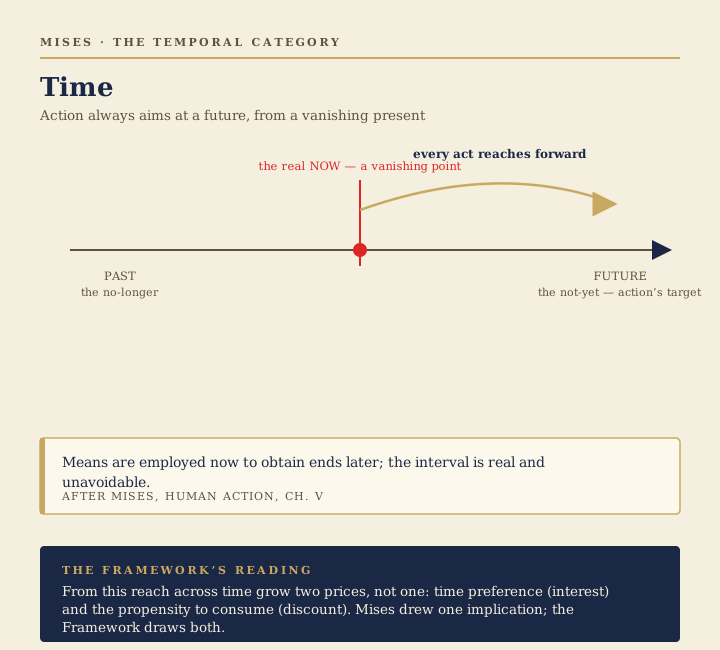
Two consequences follow. First, action is irreversibly sequential: means are employed now to obtain ends later, and the interval between them is real and unavoidable. Second, the present is a boundary, not a duration one can occupy at leisure; the "real now" is the vanishing point at which the not-yet becomes the no-longer. Every act is a wager placed across time.
The lineage
Mises' own analysis, though it prepares the ground Böhm-Bawerk had cleared for the theory of interest.
The Framework's Reading
The Framework affirms Chapter V and marks it as the quiet hinge of the later dispute. Because action reaches across time, there is a discount of the future against the present — this is the germ of time preference (Ch. XIX). But there is a second temporal fact Mises does not develop here: the eagerness of consumers to bring future satisfaction into the present by taking goods off the market now. That eagerness is the propensity to consume, and in Fekete's system it governs the discount rate. Both prices, interest and discount, are rooted in the temporal structure this chapter describes. Mises drew one implication from it; the Framework draws two.
The traditional Austrian reply
The chapter itself is uncontested. The mainstream would resist only the forward-reference to a distinct propensity to consume, on the grounds that Chapter V grounds time preference and nothing more.
Cross-references
- Atlas: Theory of Interest
- Forward to: Chapter XIX — The Rate of Interest