Part One: Human Action
Chapter VI — Uncertainty
Ludwig von Mises · Human Action (1949) · A New Austrian Reading
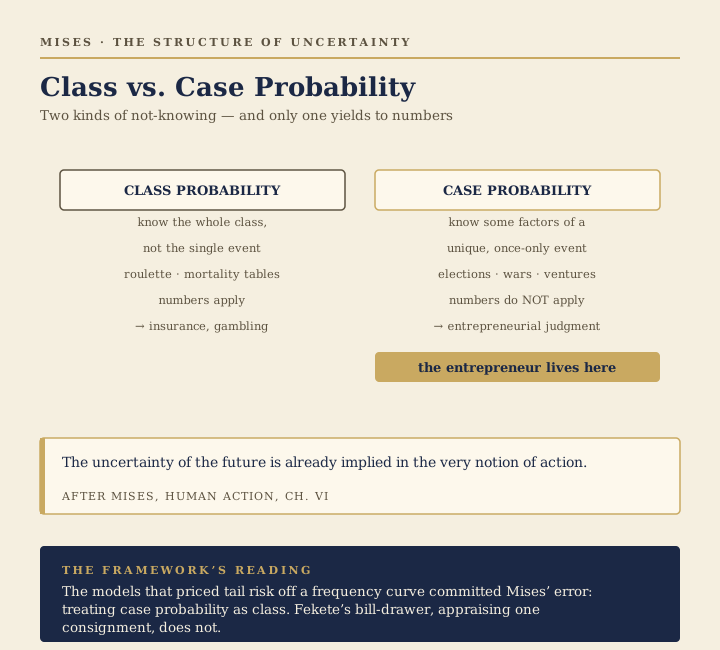
"The uncertainty of the future is already implied in the very notion of action." — Ludwig von Mises, Human Action, Ch. VI (paraphrased for length)
Chapter VI — Uncertainty
What Mises argues
Because action aims at a future that cannot be known, uncertainty is woven into action itself. Mises makes a distinction that is one of the most useful in the book: between class probability and case probability.
Class probability applies where we know everything about the behavior of a whole class of events but nothing about the individual event — the roulette wheel, the mortality table. Here the numerical calculus of probability works, and insurance and gambling operate on it. Case probability applies where we know some of the factors bearing on a particular, unique event but the event belongs to no homogeneous class — an election, a war, a business venture. Here numbers do not apply; there is no frequency to compute. The entrepreneur lives in the world of case probability. His judgment — Mises calls it understanding — is not calculation but the appraisal of a singular situation.
The lineage
Mises' own contribution, sharpening a distinction later associated also with Frank Knight's separation of risk from uncertainty.
The Framework's Reading
The Framework affirms this chapter and puts it to sharp modern use. The great financial catastrophes of the paper era — the models that assumed housing prices could not fall together, the risk engines that priced tail events off a Gaussian curve — are Chapter VI violations: they treated case probability as class probability, forcing unique, non-repeatable configurations into a frequency calculus that does not fit them. The entrepreneur who knows he is appraising a singular case is on firmer epistemic ground than the quant who believes he has measured it. Fekete's real-bill drawer, judging whether a specific consignment of goods will clear within the season, is exercising case-probability understanding of exactly the kind Mises describes.
The traditional Austrian reply
No dispute. The class/case distinction is shared across the tradition.
Cross-references
- Forward to: Chapter XIX — The Rate of Interest (the entrepreneurial component)