Part One: Human Action
Chapter VII — Action Within the World
Ludwig von Mises · Human Action (1949) · A New Austrian Reading
"Means are necessarily always limited, i.e., scarce." — Ludwig von Mises, Human Action, Ch. VII (paraphrased for length)
Chapter VII — Action Within the World
What Mises argues
This chapter closes Part One by placing the acting individual in a world of scarce means and giving two of the governing laws of that world.
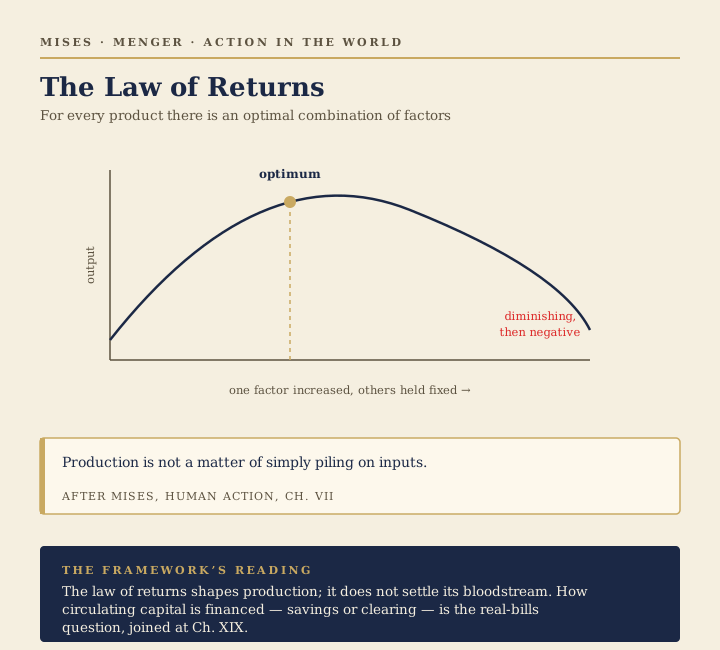
The law of marginal utility, already derived in Chapter IV, is here set on its full footing: the value of a unit of a good is the value of the least urgent end its total supply lets the actor pursue, so larger supplies mean lower marginal value. The law of returns governs production: for any product requiring the cooperation of several factors, there exists an optimum combination; departing from it — adding more of one factor while holding the others fixed — yields diminishing and eventually negative returns. This is why production is not a matter of simply piling on inputs.
Mises also situates human labor as a means with a peculiar character: it is scarce, it is disutility-bearing (leisure is itself a good), and it is the universal factor entering every line of production. Labor's supply and allocation obey the same praxeological laws as any other means.
The lineage
Menger's marginal principle and the classical–Austrian theory of production converge here. The law of returns points forward to the Böhm-Bawerk–Hayek structure of production rendered in the Atlas.
The Framework's Reading
The Framework affirms the chapter and flags one forward connection. The law of returns tells us production is bounded by the optimal cooperation of factors — but it does not settle how the working capital that keeps goods moving through those stages is financed. Mises' answer, throughout the book, is: out of savings. Fekete's answer (developed at Ch. XIX–XX) is that a large share of that circulating capital is financed not by savings but by clearing — self-liquidating bills that move goods to the consumer without drawing down the pool of saved resources. The law of returns describes the shape of production; the real-bills dispute concerns its bloodstream. Both matter, and they are not the same question.
The traditional Austrian reply
The chapter is uncontested. The mainstream parts company only at the forward claim that circulating capital can be financed by anything other than genuine savings — the central real-bills disagreement, joined later.
Cross-references
- Atlas: Marginal Utility · Structure of Production
- Forward to: Chapter XIX — The Rate of Interest