Part Two: Action Within the Framework of Society
Chapter VIII — Human Society
Ludwig von Mises · Human Action (1949) · A New Austrian Reading
"Society is concerted action, cooperation." — Ludwig von Mises, Human Action, Ch. VIII
Chapter VIII — Human Society
What Mises argues
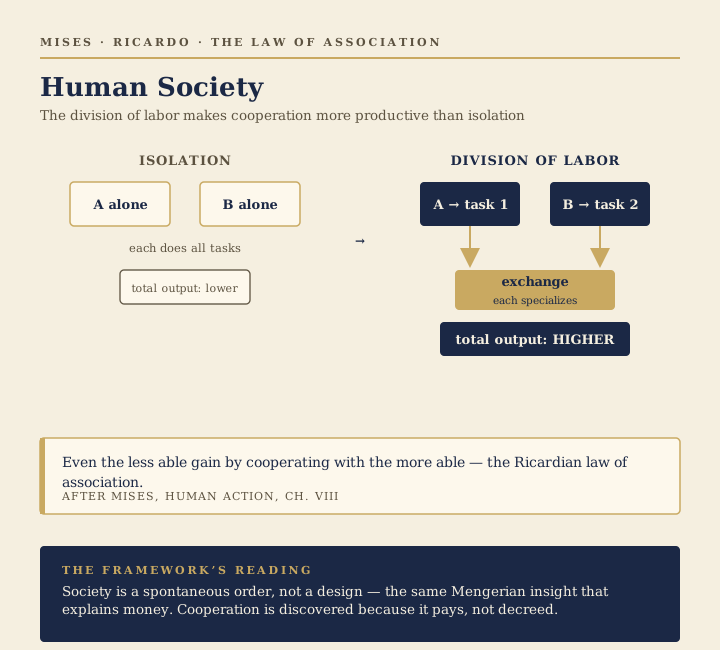
Society, for Mises, is nothing mystical: it is the outcome of individuals acting together under the division of labor. Men cooperate because cooperation is more productive than isolated self-sufficiency — the same quantity of effort yields more when tasks are specialized and their products exchanged.
The decisive proof is the Ricardian law of association (Mises' generalization of comparative advantage). Even when one party is more efficient at every task, both still gain by specializing according to their comparative strengths and trading. Cooperation does not require equality of ability; it requires only that people be differently productive, which they always are. This is why society expands rather than fragments, and why Mises rejects both the collectivist claim that society is an organism above its members and the notion that social bonds rest on altruism rather than mutual advantage.
The lineage
This is Menger's spontaneous-order thinking applied to society as a whole, fused with Ricardo's comparative advantage. Society, like language, law, and money, is an institution that arose without anyone designing it.
The Framework's Reading
The Framework takes the same lesson it takes from Menger on money: the important human institutions are discovered, not designed. Society coheres because cooperation pays, exactly as gold became money because it was the most saleable good. The New Austrian project is at bottom the study of these undesigned orders — and of what happens when authority tries to override them.
Cross-references
- Atlas: Origin and Nature of Money
- Menger: the spontaneous-institutions thread running from language to law to money