Part Three: Economic Calculation
Chapter XI — Valuation Without Calculation
Ludwig von Mises · Human Action (1949) · A New Austrian Reading
"Judgments of value do not measure; they arrange, they grade." — Ludwig von Mises, Human Action, Ch. XI (paraphrased for length)
Chapter XI — Valuation Without Calculation
What Mises argues
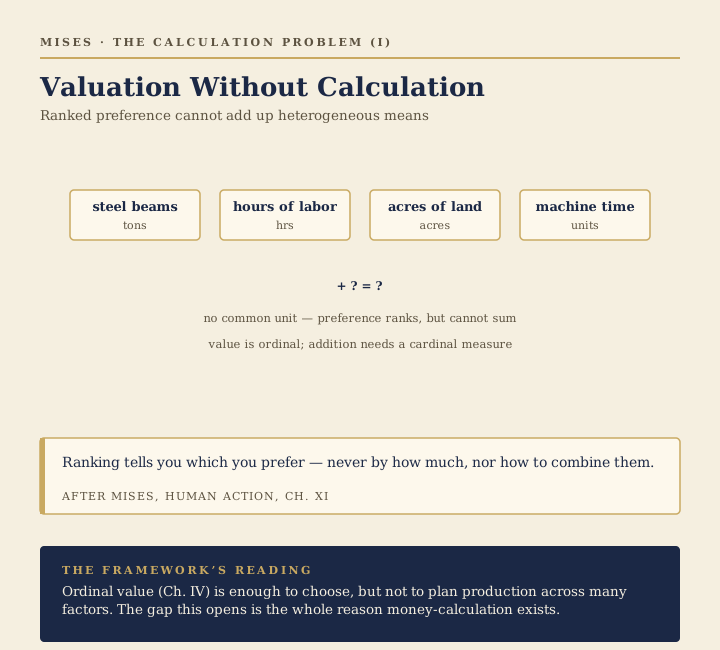
Value, established in Chapter IV, is ordinal: it ranks, it does not measure. This is enough for a person choosing between whole alternatives. But it is not enough for the complex problem of production, where an actor must compare and combine great numbers of heterogeneous means — tons of steel, hours of labor, acres of land, machine time — none of which shares a common unit. Preference can tell you that you would rather have one finished house than another, but it cannot tell you whether a particular combination of inputs is the least wasteful way to build it, because you cannot add tons to hours.
Mises' point is that unaided valuation hits a ceiling exactly where modern production begins. Without some way to reduce heterogeneous means to a common term, rational economizing across a complex structure of production is impossible — not merely hard, but logically impossible.
The lineage
A direct consequence of the Mengerian ordinal theory of value: its very strength (subjectivity) is what prevents it from doubling as a measuring rod.
The Framework's Reading
The Framework affirms this and notes where it points. The gap Chapter XI opens — ranking cannot sum — is the gap money-prices will fill (Ch. XII–XIII). It is also the deep reason the quality of the monetary unit matters: if calculation is only as good as the common term it uses, then a debased or manipulated unit corrupts every calculation built on it. Sound money is not a preference; it is a precondition of economic reason.
Cross-references
- Atlas: Marginal Utility
- Forward to: Chapter XII