Part Three: Economic Calculation
Chapter XII — The Sphere of Economic Calculation
Ludwig von Mises · Human Action (1949) · A New Austrian Reading
"Monetary calculation is the guiding star of action under the division of labor." — Ludwig von Mises, Human Action, Ch. XII (paraphrased for length)
Chapter XII — The Sphere of Economic Calculation
What Mises argues
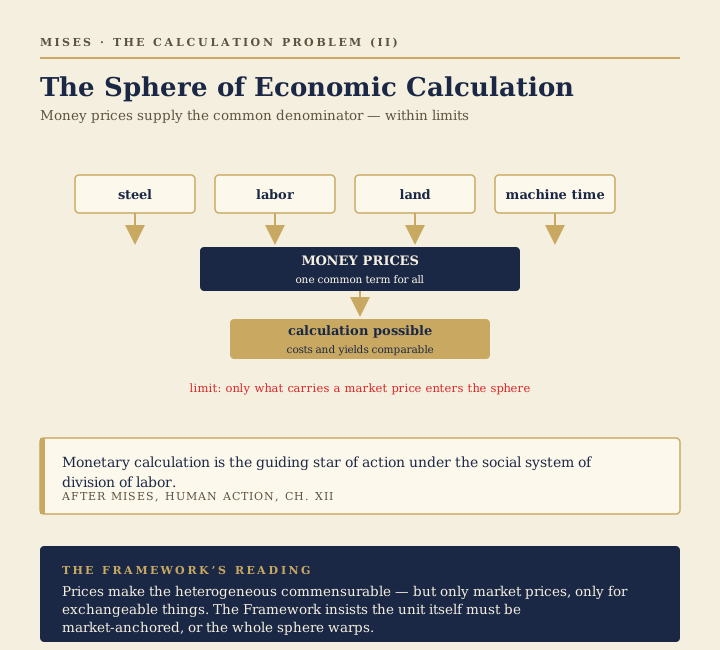
The solution to Chapter XI's impasse is money prices. Because all exchangeable goods and services are traded against money, their money prices furnish a common denominator: heterogeneous means become commensurable, and an actor can at last compare the total money cost of a production plan with the total money value of its expected product. This is economic calculation, and Mises argues it is the indispensable mental tool of the market economy — the thing that makes rational large-scale production possible at all.
But the sphere has boundaries. Calculation reaches only what carries a market price: things exchanged against money by acting people. It cannot price what is never traded (unowned nature, sentiment, the priceless), and its numbers are only as meaningful as the prices are genuine. Money prices are not measurements of intrinsic value; they are historical exchange ratios, recording past acts of valuation, useful precisely because they are real market data.
The lineage
Mises' own architecture, building on the theory of money (Ch. XVII) that makes prices possible in the first place.
The Framework's Reading
The Framework affirms the chapter and drives home its unstated condition. If calculation depends on money prices, and money prices depend on the monetary unit, then the integrity of the unit is the integrity of all calculation. This is where the money-versus-currency distinction bites: calculation conducted in a currency whose value is administered and drifting is calculation on a rubber ruler. Every miscalculated boom is, in part, a calculation performed in a corrupted unit. Sound money is the hidden premise of Chapter XII.
Cross-references
- Atlas: Money vs. Currency
- Back to: Chapter XVII — Indirect Exchange
- Forward to: Chapter XXVI — The Impossibility of Calculation Under Socialism