Part Four: Catallactics
Chapter XIV — The Scope and Method of Catallactics
Ludwig von Mises · Human Action (1949) · A New Austrian Reading
"The method of economics is the method of imaginary constructions." — Ludwig von Mises, Human Action, Ch. XIV (paraphrased for length)
Chapter XIV — The Scope and Method of Catallactics
What Mises argues
Catallactics is the theory of the market economy — of exchange ratios, prices, and the market process. Its characteristic method is the imaginary construction: a mentally built, deliberately unreal scenario used to isolate a single factor by removing all others.
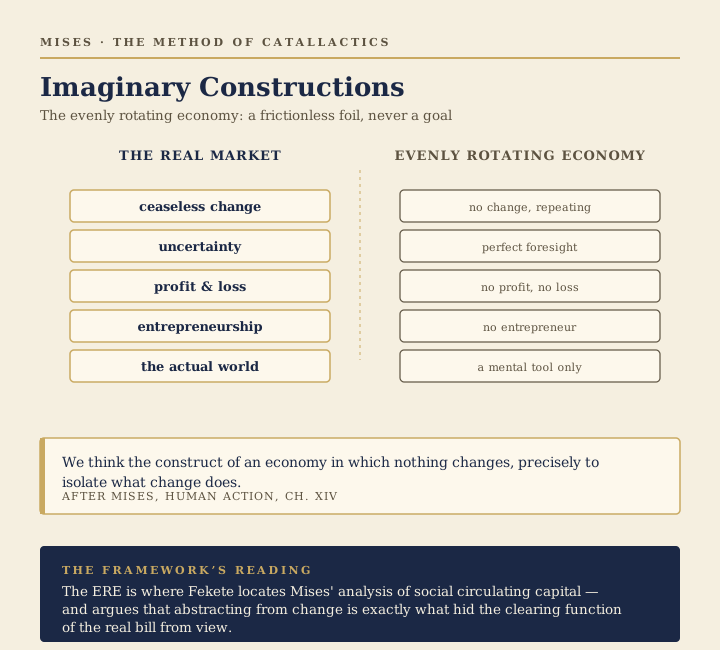
The central construction is the evenly rotating economy (ERE) — an economy in which the same transactions repeat endlessly, all foreseen, nothing ever changing. In the ERE there is no uncertainty, no profit or loss, and, strictly, no entrepreneur, because there is nothing to appraise. Mises is emphatic that the ERE is not an ideal to strive for and not a description of reality; it is a tool. By comparing the real, restless market against this frictionless foil, we see exactly what change, uncertainty, and entrepreneurship do. Related constructions — the plain state of rest, the stationary economy — serve the same isolating purpose.
The lineage
Mises' own methodological contribution, refining the equilibrium constructs of earlier economics into explicitly auxiliary mental tools rather than states to be realized.
The Framework's Reading
The Framework affirms the method and flags a consequential subtlety. The ERE is precisely where Mises situates his account of the social circulating capital — and Fekete's charge is that reasoning about circulating capital inside a changeless construct is what hid the clearing function from view. In a world that never changes, there are no seasons, no goods rushing to urgently-demanding consumers, no ninety-one-day bills self-liquidating against consumer gold. Abstract away change and you abstract away the real bill. The tool is valid; used on the wrong question, it can blind.
Cross-references
- Forward to: Chapter XIX and Chapter XX