Part Four: Catallactics
Chapter XV — The Market
Ludwig von Mises · Human Action (1949) · A New Austrian Reading
"The market process is the adjustment of individual actions to the requirements of mutual cooperation." — Ludwig von Mises, Human Action, Ch. XV (paraphrased for length)
Chapter XV — The Market
What Mises argues
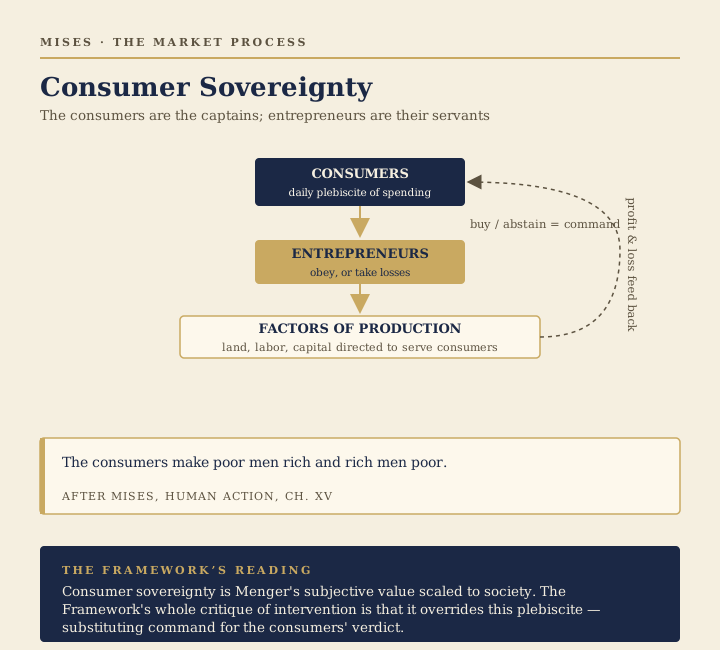
The market is not a place or a thing but a process — the continuous interplay of the actions of all who buy and sell. Its driving force is consumer sovereignty. Consumers, by choosing to buy or abstain, cast a daily plebiscite that determines what is produced, in what quantities, and by whom. Entrepreneurs are not masters but servants: those who anticipate consumer wants earn profit; those who misjudge suffer loss and are stripped of their command over resources. Even the wealthiest producer holds his position only so long as he keeps serving the consumers better than his rivals.
From this Mises derives the roles of competition (a discovery procedure, not a static condition), of profit and loss (the steering signal), of prices (the coordinating information), and of the inequality of wealth (a consequence of differential success at serving consumers, and the engine of capital accumulation). The market has no central plan and needs none; coordination is an emergent property of dispersed action under private property.
The lineage
This is Menger's subjective theory of value carried to its social conclusion. If value flows from the rankings of individuals, then the aggregate of those rankings — expressed in spending — must be sovereign over production. Consumer sovereignty is subjectivism at the scale of society.
The Framework's Reading
The Framework affirms this chapter as the beating heart of the market case, and treats it as the standard against which every intervention is judged. Each later criticism — of price controls, of credit manipulation, of a fixed gold price — reduces to the same charge: the measure overrides the consumers' plebiscite, substituting a planner's command for the market's verdict. Consumer sovereignty is also why the Framework watches saleability so closely: a money losing its saleability is a money the consumers are, act by act, beginning to depose.
Cross-references
- Atlas: The Price Signal
- Menger: Principles of Economics (1871)