Part Four: Catallactics
Chapter XVI — Prices
Ludwig von Mises · Human Action (1949) · A New Austrian Reading
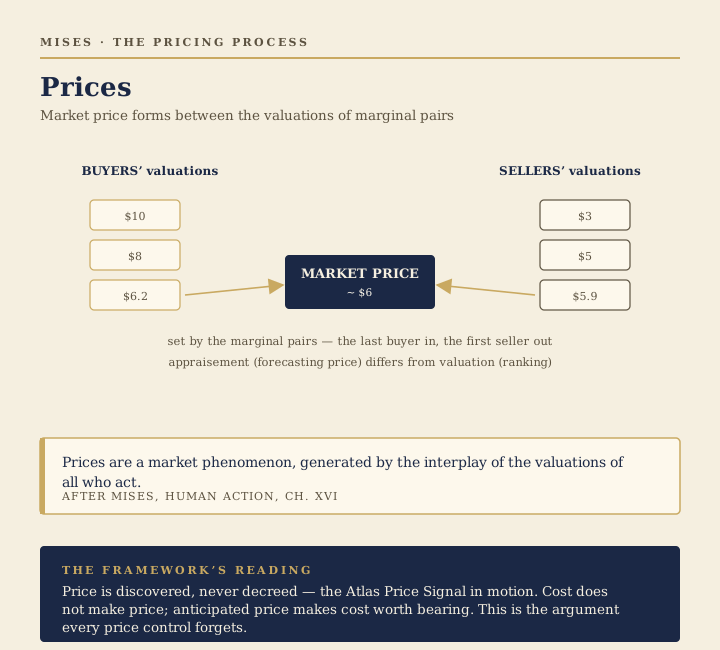
"Prices are determined between extremely narrow margins: the valuations of the marginal pairs." — Ludwig von Mises, Human Action, Ch. XVI (paraphrased for length)
Chapter XVI — Prices
What Mises argues
Prices emerge from the interplay of subjective valuations. For any good, buyers can be arrayed by the maximum they will pay and sellers by the minimum they will accept. The market price settles between the valuations of the marginal pairs — the least eager buyer who still trades and the least eager seller who still trades. It is not an average and not a measure of intrinsic worth; it is the ratio at which the marginal participants clear.
Two clarifications are central. First, valuation (ranking what one has) differs from appraisement (forecasting the price something will fetch): entrepreneurs live by appraisement. Second, Mises overturns the cost theory of price. Costs do not determine prices; rather, anticipated prices determine which costs are worth incurring. The prices of factors of production are derived from the appraised prices of the consumer goods they will make — the logic runs backward from the consumer, not forward from the input.
The lineage
Pure Menger and Böhm-Bawerk: marginal-pair pricing and the imputation of factor values back from consumer goods are Austrian signatures, here given Mises' systematic statement.
The Framework's Reading
The Framework affirms this chapter wholesale and treats it as the Atlas Price Signal shown in the act of forming. Two consequences matter for the series. The "cost does not make price" theorem is the standing refutation of every cost-plus rationalization for price controls and administered rates. And the imputation logic — factor prices derived from anticipated consumer prices — is exactly what a manipulated interest rate corrupts: distort the rate and you distort the appraisement of every higher-order good, which is the mechanism of the boom to come in Chapter XX.
Cross-references
- Atlas: The Price Signal · Marginal Utility
- Forward to: Chapter XXX — Interference with the Structure of Prices