Part Four: Catallactics
Chapter XVII — Indirect Exchange
Ludwig von Mises · Human Action (1949) · A New Austrian Reading
"Money is a medium of exchange." — Ludwig von Mises, Human Action, Ch. XVII
Chapter XVII — Indirect Exchange
What Mises argues
This is the monetary heart of Human Action, and one of the great chapters in the literature. Mises builds the theory of money entirely out of the logic of action, without recourse to any aggregate or any appeal to the state.
Direct versus indirect exchange. In direct exchange (barter), each party wants the specific good the other offers. Barter is crippled by the need for a double coincidence of wants. Indirect exchange solves this: a person accepts a good he does not want for its own sake, because he expects to trade it onward more easily. A good acquired for this purpose is a medium of exchange. The medium that comes to be accepted generally is money.
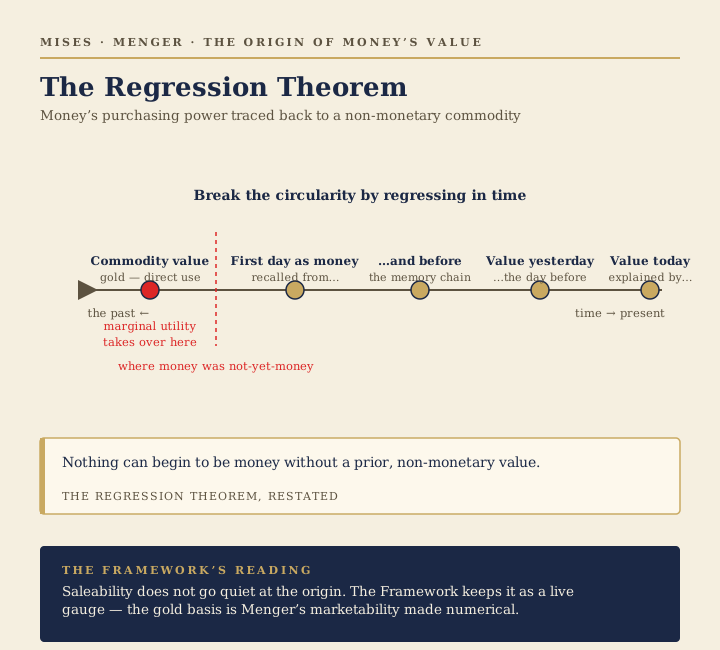
The regression theorem. Mises' signature contribution. The purchasing power of money today is explained by its purchasing power yesterday — people value money because of the exchange-value they remember it having. But this seems circular: today's value depends on yesterday's, which depended on the day before. Mises breaks the circle by regressing backward in time to the moment the money-good was not yet money — when it was valued only for its direct, non-monetary uses (gold for ornament, say). At that point ordinary marginal-utility theory takes over, and the chain is grounded. Money's value is thus traced, step by historical step, back to a commodity valued for itself. The theorem has a hard consequence: nothing can begin to be money without a prior, non-monetary market value. Money cannot be conjured by decree from nothing.
The money relation and the neutrality question. Mises analyzes changes in purchasing power as arising either from the money side or the goods side. Crucially, new money does not enter the economy evenly. It enters at particular points, with particular people, and ripples outward — the Cantillon effect. Those who receive new money first buy at old prices; those who receive it last find prices already risen. Inflation is therefore never neutral: it redistributes wealth from late receivers to early ones. Money is not a veil.
Money-substitutes and fiduciary media. A claim to money, instantly redeemable and trusted, can circulate in place of money — a money-substitute. Where the substitute is fully backed by money in reserve, Mises calls it a money-certificate; it changes nothing. Where substitutes circulate beyond the money actually held in reserve — the unbacked portion — he calls them fiduciary media. This category is the hinge of his entire monetary economics: fiduciary media are how the banking system expands the money supply, and their over-issue is what sets up the trade cycle of Chapter XX.
The lineage
Every load-bearing idea in this chapter is Mises finishing a building Carl Menger designed.
Menger's On the Origin of Money (1892) had already given the definitive account of how money emerges: not by legislation, not by social contract, but by an undesigned market process. Individuals seeking to trade gravitate toward the most saleable (marketable) goods — the goods that can be sold at any time with the least loss. As more people accept the most-saleable good for onward trade, its saleability compounds, until one good outruns all rivals and becomes the general medium. Money is a spontaneous institution, discovered rather than invented.
Mises' regression theorem is the temporal completion of Menger's logical account. Menger explains why a most-saleable good is selected; Mises explains how that good's purchasing power is determined once it is money, and grounds the whole chain in Menger's own marginal-utility theory at the historical origin. The two theorems are one continuous argument spanning twenty-one years.
The Framework's Reading
This is where the Framework's foundation and Mises' text sit closest together — and precisely for that reason it is where the New Austrian vocabulary does its quiet, decisive work. Mises gives money a flawless theory. The Framework gives money a diagnostic: it turns Menger's saleability from a historical explanation into a live measurement of monetary health, and it draws from that measurement the distinction Mises never quite made explicit — money versus currency.
Three points.
First, saleability is not just an origin story — it is a gauge. Menger explained how money was selected. The Framework insists that saleability keeps operating after selection, continuously, and can be watched. A monetary good with deep, symmetric saleability across time and space is healthy money; a good whose saleability is thinning — sellable in size only at widening discounts, or only into a paper derivative rather than the physical article — is money in decay. This is the analytical engine behind the Atlas concepts of the gold basis and co-basis: the basis is saleability made numerical. Mises had no such instrument because for him money's marketability was settled at the origin. The Framework treats it as a vital sign, monitored daily.
Second, the money-versus-currency distinction is latent in Mises and explicit in the Framework. Mises distinguishes money, money-certificates, and fiduciary media. The Framework sharpens this into a categorical divide the modern reader needs. Money is a most-saleable good with no counterparty — its value is intrinsic and its properties affirmative (gold: durable, divisible, no one's liability). Currency is a claim, a liability, whose acceptance is contingent on trust and, ultimately, on law (the dollar: someone's promise, backed by legal tender status). Mises' fiduciary media are the mechanism by which currency detaches from money. The Framework simply names the endpoint Mises was describing: a pure fiduciary regime is one where currency has floated free of money entirely — where the regression theorem's commodity anchor has been cut, and the memory of the anchor is all that is left.
Third, the regression theorem is the Framework's answer to every "new money." The theorem is not a museum piece. It is the test the Framework applies to every candidate money that arrives — including Bitcoin. Anything claiming to become money must either have a prior non-monetary use-value (Mises' strict reading) or must be shown to have bootstrapped saleability by some route the theorem can accommodate. The New Austrian audit of cryptocurrency is, at bottom, Chapter XVII applied to a case Mises never saw.
None of this contradicts Mises. It is Menger's marketability and Mises' regression theorem, kept as tools rather than filed as conclusions. The divergence in this chapter is not one of doctrine but of use: the Framework refuses to let money's saleability go quiet after the origin.
The traditional Austrian reply
The Misesian mainstream would largely welcome this reading, with one caution: it would resist any suggestion that the money/currency distinction licenses a positive role for fiduciary media. For the strict Misesian–Rothbardian line, all fiduciary media are inflationary and destabilizing, full stop — the 100 percent reserve position. The Framework's later sympathy (Ch. XX, XXXI) for one specific class of circulating paper — the self-liquidating real bill — is exactly the point the traditional school regards as a dangerous concession. That argument is joined in the interest and cycle chapters; here it is only foreshadowed. On Chapter XVII itself, the two schools are near-allies.
Cross-references
- Atlas: Origin and Nature of Money · Money vs. Currency · Gold Basis and Co-Basis
- Menger: On the Origin of Money (1892) — the saleability account Mises completes
- Forward to: Chapter XIX — The Rate of Interest and Chapter XX, where fiduciary media become the trade cycle — and where the Framework's real divergence begins