Part Four: Catallactics
Chapter XVIII — Action in the Passing of Time
Ludwig von Mises · Human Action (1949) · A New Austrian Reading
"Capital goods are intermediary stations on the way to a definite goal." — Ludwig von Mises, Human Action, Ch. XVIII (paraphrased for length)
Chapter XVIII — Action in the Passing of Time
What Mises argues
This chapter sets the temporal groundwork for the theory of interest. Because production takes time, an actor must value goods according to when they will yield satisfaction, and must decide how much present want-satisfaction to forgo for the sake of future provision. Time preference — the discount of the future against the present — pervades every such decision.
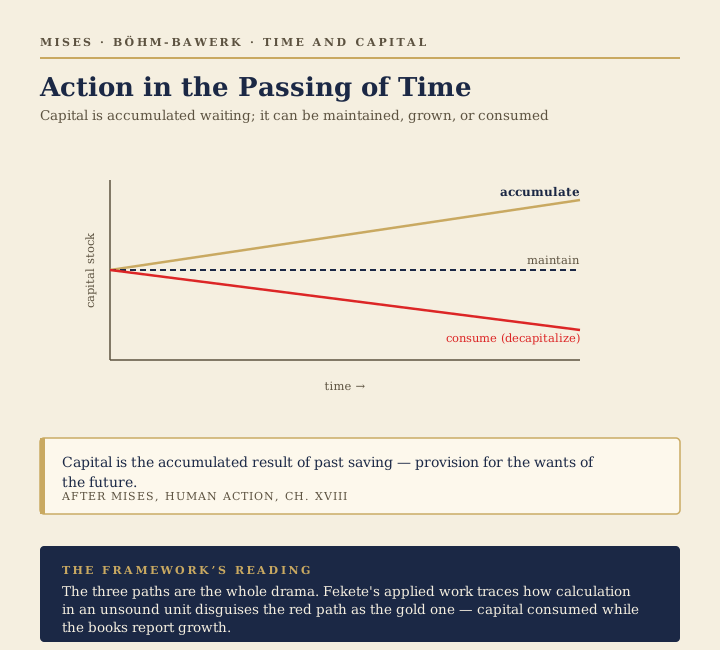
Capital, in this light, is not a heap of machines but accumulated waiting: the embodiment of past savings directed toward future ends. Mises analyzes the convertibility of capital goods (they are more or less specific, more or less redeployable), and the three things an actor or a society can do with a capital stock: maintain it, accumulate more, or consume it (live off the substance — decapitalization). Which path is taken depends on saving, and saving depends on time preference.
The lineage
Böhm-Bawerk's theory of roundabout production and waiting, restated in praxeological form. This is the platform on which Chapter XIX builds interest.
The Framework's Reading
The Framework affirms Chapter XVIII and points to the drama in its three paths. The distance between accumulating and consuming capital is the difference between a rising and a declining civilization — and, crucially, it can be hidden. Because capital is a money-value magnitude (Ch. XIII), calculation in a depreciating unit can dress the red path in the colors of the gold one: a society consuming its capital while its accounts report growth. This concealed decapitalization is one of Fekete's central applied themes, and it is why the Framework treats the soundness of the unit as inseparable from the theory of capital.
Cross-references
- Atlas: Structure of Production · Theory of Interest
- Forward to: Chapter XIX — The Rate of Interest