Part Four: Catallactics
Chapter XIX — The Rate of Interest
Ludwig von Mises · Human Action (1949) · A New Austrian Reading
"Originary interest is the ratio of the value assigned to want-satisfaction in the immediate future and…the remoter future." — Ludwig von Mises, Human Action, Ch. XIX (paraphrased for length)
Chapter XIX — The Rate of Interest
What Mises argues
Mises' theory of interest is the purest expression of Austrian subjectivism applied to time — and, for the Framework, it is the chapter where that purity becomes a limitation.
Originary interest is time preference, and only time preference. Mises' central claim is that interest is not a price of money, not a payment for the productivity of capital, and not a reward for abstinence. It is the necessary consequence of a category of action: acting man values a satisfaction available now more highly than the same satisfaction available later. This is time preference, and it is universal — it holds for every actor, in every conceivable economy, as a matter of praxeological necessity. The ratio at which present goods exchange against future goods is originary interest.
Interest is not specifically monetary. Because it springs from time preference, originary interest would exist even in a pure barter economy with no money and no loans at all. It is embedded in the price spread between factors of production (future goods) and the consumer goods they will become (present goods). The loan market merely makes visible, as an explicit rate, a discount that pervades the entire price structure.
The market rate and its components. The rate actually observed on loans is originary interest plus two additions: an entrepreneurial component (a risk premium reflecting the uncertainty of the particular venture) and a price premium (an adjustment for expected changes in the purchasing power of money). Strip these away and the pure rate — time preference — remains underneath.
Interest cannot be abolished. Since time preference is a category of action, no policy can drive originary interest to zero. Attempts to force the market rate below the rate that time preference dictates do not eliminate interest; they only distort the structure of production and set up the cycle. This sets the stage directly for Chapter XX.
The lineage
Mises inherits the problem from Eugen von Böhm-Bawerk, whose Capital and Interest had already located interest in the higher valuation of present over future goods and in the greater productivity of more roundabout (time-consuming) methods. Böhm-Bawerk gave three grounds for interest; Mises' contribution was to purify the theory — to strip out the productivity ground as a cause and rest interest solely on time preference, treating productivity as something that operates through the price system rather than as an independent source of the rate. Mises regarded this as tightening Böhm-Bawerk into praxeological rigor.
The Framework's Reading
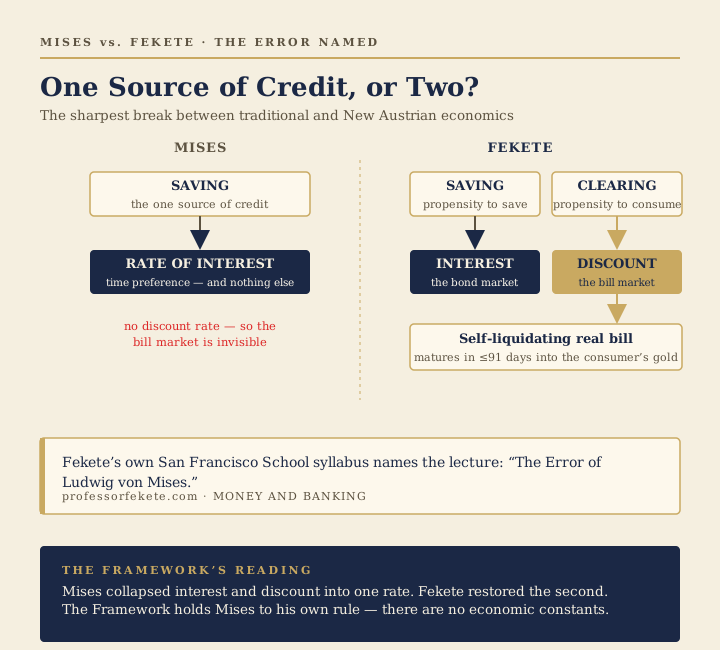
This is the seam. Everywhere else in Human Action the Framework reads Mises as a builder to be completed. Here it reads him as a great economist who made a specific, consequential error — and it does so not on Keynesian or empiricist grounds, but on the authority of the man who spent his career finishing the Austrian theory of money: Antal E. Fekete. Fekete's own San Francisco School syllabus states the charge without euphemism, in a lecture titled The Error of Ludwig von Mises.
The error, in one sentence: Mises collapsed the rate of interest and the rate of discount into a single magnitude, and thereby lost the theory of the bill market.
Here is the structure of the correction.
There are two sources of credit, not one. Mises' framework has a single source of credit: saving — the abstention from present consumption that frees present goods to be lent against future goods. Fekete argues there is a second, wholly distinct source: clearing. When a wholesaler ships goods to a retailer against a bill payable in ninety days, credit has been extended — but not one cent of anyone's savings has been touched. The credit is created by, and extinguished by, the movement of goods toward the consumer. It is self-liquidating: the bill matures into the gold coin the final consumer pays, and then it vanishes. Clearing credit and saving credit are different in origin, different in duration, and different in what governs them.
Therefore there are two prices, not one. Saving credit is priced by the rate of interest, which is governed by the propensity to save — Mises' time preference, correctly describing this half of the picture. Clearing credit is priced by the rate of discount, which is governed by the propensity to consume — the eagerness of consumers to take goods off the market. These are two different rates, set by two different psychological propensities, in two different markets (the bond market and the bill market). The discount rate makes a real bill an appreciating asset: it gains value with each passing day toward maturity, which is why it is in constant demand and why it circulates spontaneously as near-money.
Mises had no discount rate — so he could not see the real bill. Because Mises grounded all credit in time preference, he had no conceptual room for a price governed by the propensity to consume rather than to save. He acknowledged that bills drawn on urgently demanded consumer goods could circulate — he had seen it in the historical record — but he filed the phenomenon under "circulation credit," treated it as just another fiduciary medium, and moved on. He never named self-liquidating credit as a distinct category, because his one-source theory left no shelf to put it on. Fekete's judgment is that this was not a small omission: it is the reason Mises misclassified the real bill (Ch. XX, XXXI) as inflationary, when by its construction it cannot be.
Why the Framework sides with Fekete here — and it is a Misesian reason. Recall the promissory note from the Introduction: there are no economic constants. A single interest rate, set for the whole economy, is exactly the kind of administered magnitude Mises said the market alone could discover. Fekete's two-rate theory is more market-discovered than Mises', not less: it says the economy is continuously finding two prices through two clearing processes, and that fusing them — as both central banks and, inadvertently, Mises' own theory do — destroys information. The Framework does not reach for Fekete to soften Mises. It reaches for Fekete to hold Mises to his own standard.
The Framework keeps Mises' time-preference theory of interest intact. It denies only that time preference is the whole story of credit. Half the map was drawn correctly; the other half — the bill market — Mises left blank.
The traditional Austrian reply
This is the most contested claim in the entire series, and the traditional Austrian objection is serious and must be stated at full strength.
The Misesian–Rothbardian line rejects Fekete's correction outright. On their reading, there are not two sources of credit: all credit, including credit extended via bills, ultimately draws on the pool of real savings, and the appearance of "clearing credit" costlessly financing production is an illusion. When bills are monetized by banks, they add to the money supply like any other fiduciary media and are therefore inflationary — the Real Bills Doctrine is, in this view, a centuries-old inflationist fallacy that Mises decisively refuted, and its revival by Fekete is a step backward. Critics such as Robert Blumen (writing in the Rothbardian tradition) argue that Fekete must smuggle in fresh money to make the system work, and that a genuine 100 percent gold standard has no room for a distinct, non-savings "discount" rate at all. Mises, on this account, did not miss the discount rate; he correctly saw that there is nothing there to miss.
The Framework's rejoinder — that clearing credit is extinguished in under ninety-one days by consumer gold and so never adds permanently to the money stock — is developed in the Real Bills chapters (XX and XXXI), where the dispute properly belongs. The honest summary for Chapter XIX is this: whether Fekete corrected Mises or misunderstood him is the central open question dividing traditional from New Austrian economics. The Framework takes a side. It does not pretend the other side is unreasoned.
Cross-references
- Atlas: Theory of Interest — the Mises-linear versus Fekete-hyperbolic contrast, with the zero-rate singularity · Real Bills Doctrine
- Fekete: The Gold Problem Revisited and the San Francisco School lecture The Error of Ludwig von Mises (professorfekete.com) — the interest/discount distinction stated directly
- Back to: Introduction — the "no economic constants" principle the Framework collects on here
- Forward to: Chapter XX (Interest, Credit Expansion, and the Trade Cycle) and Chapter XXXI (Currency and Credit Manipulation), where the real-bills dispute is settled on its merits