Part Four: Catallactics
Chapter XX — Interest, Credit Expansion, and the Trade Cycle
Ludwig von Mises · Human Action (1949) · A New Austrian Reading
"The boom produces impoverishment. But still more disastrous are its moral ravages." — Ludwig von Mises, Human Action, Ch. XX (paraphrased for length)
Chapter XX — Interest, Credit Expansion, and the Trade Cycle
What Mises argues
This is the celebrated Austrian theory of the business cycle (ABCT), the payoff of the interest theory in Chapter XIX. Mises distinguishes the originary rate (time preference) from the gross market rate actually charged, which also contains the entrepreneurial and price-premium components. The cycle begins when the banking system expands credit by issuing fiduciary media — money-substitutes beyond the money actually held in reserve — and thereby pushes the gross market rate below the rate that time preference and real savings would sustain.
That artificially low rate is a false signal. It tells entrepreneurs that more resources have been saved and released for future-oriented projects than actually have been. They lengthen the structure of production, launching long-term, higher-order investments — the boom. But the savings to complete these projects do not exist; the low rate was a monetary illusion, not a real change in time preference. Sooner or later the shortage of real resources reveals itself: costs rise, projects prove unfinishable, and the malinvestments must be liquidated — the bust. If the banks respond by accelerating credit expansion to postpone the reckoning, the currency itself can be destroyed in a final crack-up boom (flight into real goods). The depression is not the disease; it is the painful but necessary correction of the boom's malinvestment.
The lineage
Mises' own theory, developed with Hayek (whose structure-of-production triangle, rendered in the Atlas, shows exactly which stages the false rate distorts). It is the jewel of traditional Austrian economics and the basis of the Mises Institute's analysis of every modern boom.
The Framework's Reading
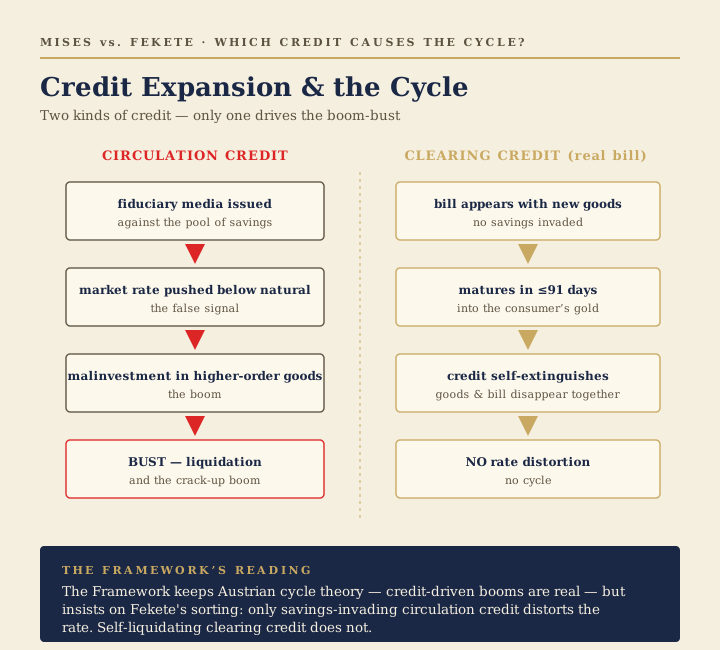
The Framework keeps the ABCT — credit-driven booms are real, and the account of malinvestment and liquidation is correct. But this is the second Fekete divergence, and it follows directly from the first (Ch. XIX). Because Mises had no discount rate and only one category of credit, he swept all circulating credit into the single bin of cycle-causing "fiduciary media" — including the self-liquidating real bill.
Fekete's correction is a sorting, not a rejection. There are two kinds of credit, and they behave oppositely in the cycle. Circulation credit created against the pool of savings — fiduciary media proper — does exactly what Mises says: it pushes the rate below the natural level and seeds malinvestment. Clearing credit — the real bill — does not. It appears only when new consumer goods appear, invades no one's savings, distorts no interest rate, and self-extinguishes in under ninety-one days as the consumer's gold retires it. Lumping the two together, Fekete argues, is why Mises mislocated the cycle's cause and why the tradition condemned a clearing mechanism that was never inflationary.
The Framework's cycle theory is therefore sharper than Mises', not softer: it condemns the same monetary sin (savings-invading credit at a suppressed rate) while acquitting the one instrument Mises wrongly accused.
The traditional Austrian reply
The Rothbardian mainstream rejects the acquittal. On its view there is no benign category: any bank credit issued beyond 100 percent reserves — monetized real bills included — adds to the money supply, distorts the rate, and feeds the cycle, exactly as Chapter XX describes. The "self-liquidation" of a bill, they argue, does not prevent it from expanding the money stock while it circulates, so the real bill is simply fiduciary media with a shorter fuse. This is the same fault line as Chapter XIX, now drawn through the cycle: whether the real bill is benign clearing or disguised inflation is the open question, and the Framework and the mainstream answer it differently.
Cross-references
- Atlas: The Business Cycle · Real Bills Doctrine · Theory of Interest
- Back to: Chapter XIX — The Rate of Interest
- Forward to: Chapter XXXI — Currency and Credit Manipulation
- Fekete: Real Bills Revisited and The Gold Problem Revisited (professorfekete.com)