Part Seven: The Place of Economics in Society
Chapter XXXIX — Economics and the Essential Problems of Human Existence
Ludwig von Mises · Human Action (1949) · A New Austrian Reading
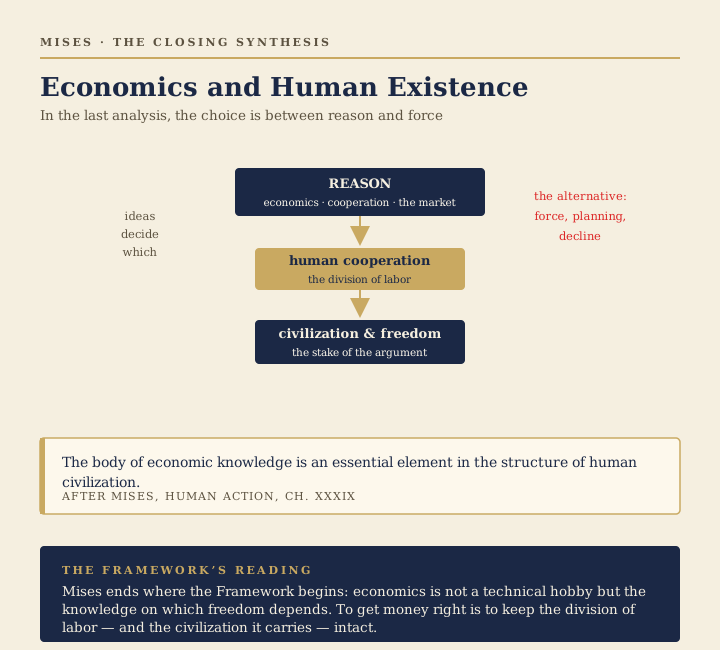
"The body of economic knowledge is an essential element in the structure of human civilization." — Ludwig von Mises, Human Action, Ch. XXXIX (paraphrased for length)
Chapter XXXIX — Economics and the Essential Problems of Human Existence
What Mises argues
The book closes by lifting its eyes to the stakes. Economics is not one specialty among many; it is an essential element in the structure of civilization, because civilization itself rests on the peaceful division of labor, and the division of labor can be understood, defended, and preserved only through economic reasoning. The ultimate alternative facing humanity, Mises argues, is between social cooperation grounded in reason — the market, contract, the recognition of mutual advantage — and conflict grounded in force — planning, command, the war of each against all. Which prevails is decided by ideas (Ch. IX): if the ideas that sustain cooperation are lost, the material civilization built upon them cannot survive.
The responsibility this places on economics — and on the citizen who must judge economic policy — is therefore civilizational. To think clearly about human action is to defend the conditions of a free and prosperous life; to think carelessly is to risk them. The book ends not with a technical result but with a charge.
The lineage
The synthesis of the whole Austrian tradition — Menger's discovered orders, Böhm-Bawerk's capital and time, Mises' praxeology — bent toward a defense of freedom itself.
The Framework's Reading
Mises ends exactly where the Framework begins. If economics is the knowledge on which freedom depends, and if the monetary order is the load-bearing wall of the division of labor, then getting money right is not a scholarly refinement — it is part of keeping civilization intact. The New Austrian School's whole wager is that the surviving Austrian tradition, completed with Menger's saleability and Fekete's clearing, gives the sharpest available account of how to keep that wall standing: sound money with two legs, a rate of interest and a rate of discount both discovered by the market, and a citizenry that can read the cracks before they widen.
Human Action is the foundation. The Framework is the attempt to build the next storey on it — faithful to the method, honest about the three divergences, and pointed at the monetary problem Mises left one distinction short of solving.
Cross-references
- Atlas: The Three Axioms · Origin and Nature of Money
- The three divergences: Ch. XIX · Ch. XX · Ch. XXXI
- Back to: Introduction