Part Seven: The Place of Economics in Society
Chapter XXXVIII — The Place of Economics in Learning
Ludwig von Mises · Human Action (1949) · A New Austrian Reading
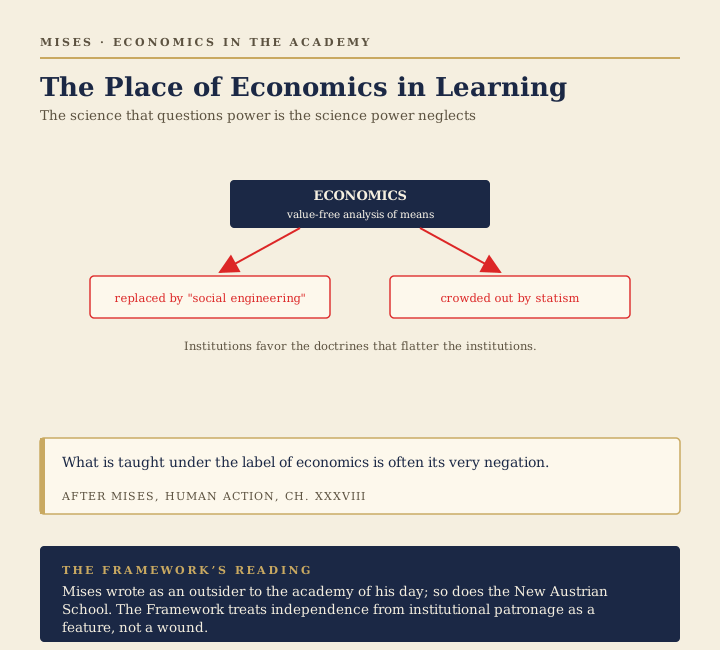
"What is taught under the label of economics is often its very negation." — Ludwig von Mises, Human Action, Ch. XXXVIII (paraphrased for length)
Chapter XXXVIII — The Place of Economics in Learning
What Mises argues
Mises observes, with some bitterness earned in exile, that the institutions of learning have not been kind to economics proper. Universities and governments favor the doctrines that flatter them — the theories that justify expanded state direction and cast the economist as a social engineer advising the planners. Genuine economics, which sets limits to what planning can achieve, is inconvenient to that project and tends to be marginalized, rebranded, or replaced by its opposite under the same name. The result is that much of what is taught as "economics" is the negation of the value-free, market-analyzing science Mises has spent the book building.
He does not counsel despair. Because economic truth is a priori and accessible (Ch. XXXVII), it survives outside institutional favor, carried by whoever will think clearly — and public opinion can still be reached over the heads of the official experts.
The lineage
Mises' commentary on the sociology of his profession, reflecting his own career at the margins of the academy.
The Framework's Reading
The Framework affirms this and takes a certain resolve from it. The New Austrian School — Menger's line through Fekete — has always worked at the edge of, or entirely outside, the institutional mainstream, and Chapter XXXVIII explains why that is to be expected rather than lamented. Independence from institutional patronage is a feature, not a wound: it is precisely the economics that questions the monetary authorities that those authorities will never house. The Framework's home is a website and a body of essays, not a chair — by necessity, and, per Mises, by a kind of vindication.