Part Seven: The Place of Economics in Society
Chapter XXXVII — The Nondescript Character of Economics
Ludwig von Mises · Human Action (1949) · A New Austrian Reading
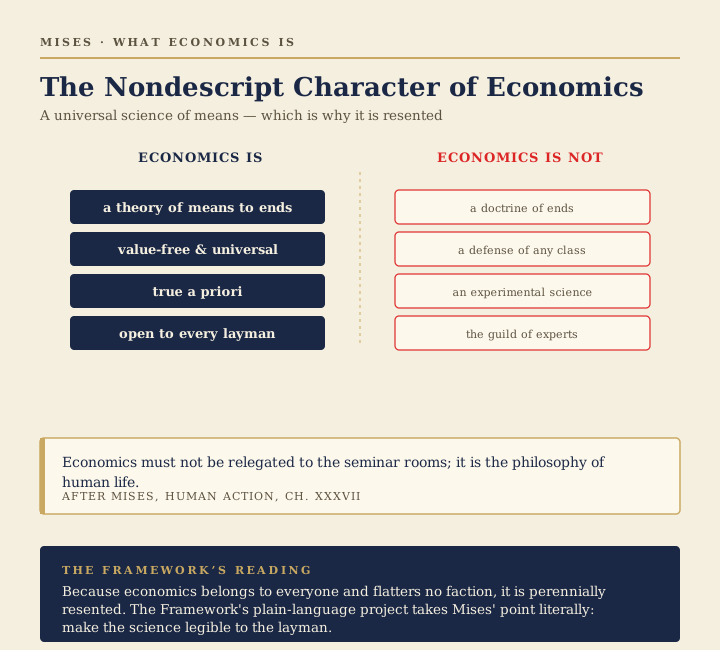
"Economics deals with society's fundamental problems; it concerns everyone." — Ludwig von Mises, Human Action, Ch. XXXVII (paraphrased for length)
Chapter XXXVII — The Nondescript Character of Economics
What Mises argues
Economics fits none of the conventional categories, which is why, Mises says, it is so often misunderstood and resented. It is not a doctrine of ends — it does not tell people what to want — but a value-free theory of the means by which whatever ends people hold may be pursued. It is not experimental like the natural sciences, but a priori. It is not the property of a guild of experts; its fundamental truths are accessible to any thinking layman, and indeed every citizen who votes on economic policy is, willy-nilly, doing economics. And it belongs to no class: it is not, as its enemies charge, an apologetics for capital, because it describes universal features of action.
This universality is exactly what makes economics unwelcome. It refuses to bless any faction's program with the authority of science, and it exposes the hidden costs of cherished illusions. A science that tells everyone unwelcome truths and belongs to no one has few institutional patrons.
The lineage
Mises' reflection on the nature and reception of his own discipline.
The Framework's Reading
The Framework affirms this and takes its practical instruction seriously. If economics belongs to the layman and if policy is decided by public opinion (Ch. IX), then the task is to make the science legible — not to guard it in seminar rooms but to translate it for the citizen who will vote the monetary regime up or down. newaustrianeconomics.com is an attempt to act on Chapter XXXVII: sound economics, and especially sound monetary economics, written to be understood.
Cross-references
- Atlas: The Three Axioms
- Back to: Chapter IX — The Role of Ideas