Part Six: The Hampered Market Economy
Chapter XXXVI — The Crisis of Interventionism
Ludwig von Mises · Human Action (1949) · A New Austrian Reading
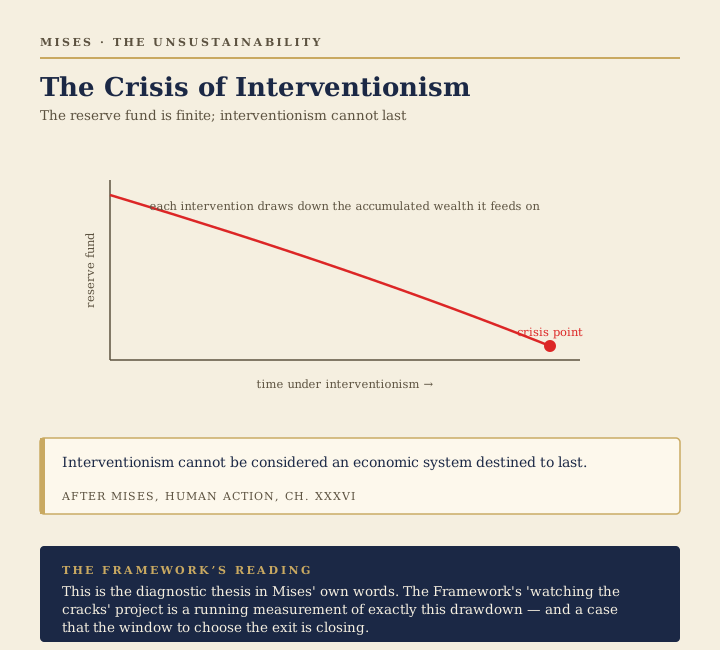
"Interventionism cannot be considered an economic system destined to last." — Ludwig von Mises, Human Action, Ch. XXXVI (paraphrased for length)
Chapter XXXVI — The Crisis of Interventionism
What Mises argues
Mises draws Part Six to its conclusion. Interventionism appears to work for a time, but only because it lives off a reserve fund — the capital accumulated under the freer conditions of the past. Each intervention (a price control, a subsidy, an inflation) consumes a portion of that inherited wealth to finance its promises. Because the fund is finite and the interventions impair its renewal, the system is running down a stock it cannot replenish. It is therefore not a permanent system but a transitional one, headed for a crisis in which the society must choose: press on into full socialism (and the calculation problem of Chapter XXVI), or turn back to the market.
The crisis is not accidental or a matter of poor administration; it is inherent in the interventionist logic itself. The longer the drawdown continues, the sharper the eventual choice.
The lineage
The culmination of Mises' theory of interventionism, and one of the most prophetic passages in the book.
The Framework's Reading
The Framework affirms this chapter with unusual force — it is, in effect, the thesis statement of the whole diagnostic project. The Watching the Cracks series is a running attempt to measure the drawdown Mises describes: to read, in the gold basis, in the structure of debt, in the erosion of real wages, how much of the reserve fund remains and how near the choice-point stands. Where Mises stated the principle, the Framework tries to put a gauge on it. The claim that animates newaustrianeconomics.com — that a window to choose the exit is open but closing — is Chapter XXXVI read as a clock, not just a law.