
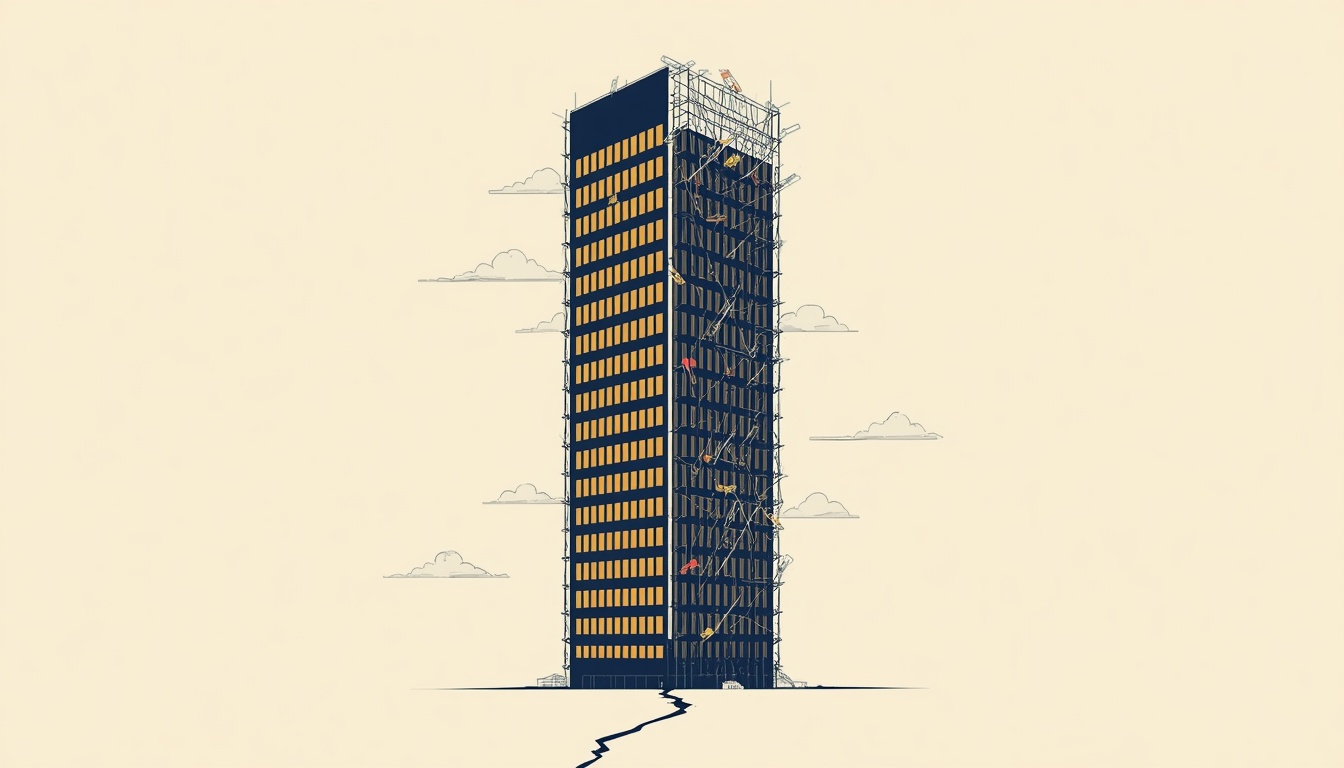
Extend, Pretend, Foreclose
Through the first five months of 2026, a Chicago office building changed hands at a 94% loss from its decade-prior value, a Denver complex at 97%, eight floors of a Mid-Market San Francisco tower at 92%, the former GSA building in Washington DC at 76%. Meanwhile Worldwide Plaza ($940M loan), One New York Plaza ($835M, extended to 2028), and 620 Eighth Avenue ($515M, modified five times since 2020) sit in special servicing rather than enter the same fire-sale market. CMBS office delinquency hit an all-time high in January, then 'dropped' 114 bps in February because lenders modified loans rather than recognize losses. The framework's CRE prediction from Issue #003 is operationally here — and the regional banks holding 70% of CRE loans are the substrate that will absorb what the special servicers cannot defer.
Full analysis: newaustrianeconomics.com/forum/27-extend-pretend-foreclose-cre
Welcome to Issue #007 of The Dispatch. Each Monday, this letter takes one situation from the week's news and reads it through the lens of Carl Menger and Antal Fekete — paired with a foundational concept, this week's dashboard readings, the framework's prediction record, and a piece from the archive. If someone forwarded this to you, subscribe here.
The Lens
In October 2025, an investor named Marc Calabria purchased a long-vacant eight-story office building at 401 South State Street in Chicago's Loop for $4.2 million. The building had last traded in 2016 at $68.1 million. The price decline: 94%. Calabria's plan, announced the following February with the vertical-farming firm Farm Zero, is to convert the 1891 Jenney-designed former Siegel, Cooper & Co. store into an urban farming and food innovation center. In September 2025, Asher Luzzatto bought the Denver Energy Center at 1625 and 1675 Broadway — 900,000 square feet, 18% occupied — for $5.25 million against a $176 million valuation in 2013, a 97% decline. In Washington DC, Hossein Fateh's Dalian Development bought the GSA Regional Office Building at 301 7th St SW in March 2026 for $24.26 million — just over $25 a square foot across 940,000 square feet, in a federal surplus sale, with the building vacant since DHS left in March 2025. No prior appraisal is on the public record, so no percentage decline can be stated for it. In San Francisco, an affiliate of CW Capital Asset Management acquired the bottom eight floors of 1155 Market Street at a February 2026 foreclosure auction for $4 million against a $48 million CMBS loan — a recovery against debt rather than a decline from a prior sale price.
These transactions are not anomalies. They are the visible surface of a much broader pattern that is now operationally arriving in commercial real estate after three years of extend-and-pretend — the strategy by which lenders and borrowers cooperated to defer recognition of losses by extending maturing loans and modifying terms rather than forcing default or sale. The strategy worked, in the limited sense that it kept reported delinquency rates lower than the underlying credit quality warranted, while everyone waited for interest rates to fall and for office demand to recover. Interest rates did not fall enough. Office demand did not recover enough. By the start of 2026, the strategy was no longer viable for an increasing share of the affected loans.
Issue #003 (Two Failures a Year) named the configuration that produced this moment. Issue #004 (The Metro Saleability Map) named the geographic surface where it would propagate. The cascade is now operationally here. The named-property data tells one part of the story. The CMBS time series itself tells the other.
Lead Essay: The Two-Mode Market
The 2026 commercial office market is clearing in two operationally distinct modes simultaneously, and the distinction is the framework's central observation.
Mode one is forced clearing. The fire-sale transactions above are the canonical examples. The buyers do not plan to operate these buildings in their original use. Calabria's "urban farming center" is structurally typical: the buyer acquires the physical structure at a price that allows them to absorb the cost of converting it to a use the current market actually wants — residential conversion where regulations permit, light industrial or maker-space, specialty uses. Mode-one transactions are the saleability discovery process operating without the substitute layer of lender forbearance. The buyer pays what the asset is worth in its physically-deliverable form, not what the prior monetary regime's pricing infrastructure said it was worth.
Mode two is continued deferral. The marquee loans — the ones large enough that institutional considerations dominate disposition — remain in extend-and-pretend status. Worldwide Plaza in Manhattan ($940 million CMBS loan) went to special servicing in September 2024 when Cravath's 617,000 sf lease expired and the tower fell to 63% occupied; it was modified in March 2025, a 2025 appraisal cut $1.4 billion from its 2017 value, and senior lenders filed a $940 million foreclosure suit in 2026. It has not been resolved through sale. One New York Plaza ($835 million) was modified and extended to January 2028 — kicked nearly two full years down the road. The U.S. Steel Tower in Pittsburgh ($245 million) was sent to special servicing in March. 620 Eighth Avenue — the former New York Times Building, $515 million mortgage — took five twelve-month extensions from a December 2020 maturity and exhausted them in December 2025; the loan went to special servicing that November, and the restructuring now covers roughly $750 million including additional debt.
The framework's central observation: these two modes are operating on the same underlying asset class, in the same economic environment, often in the same metropolitan areas, with disposition outcomes determined primarily by the size of the loan and the institutional considerations of the lenders involved. This is not market efficiency. It is institutional dispensation operating to protect specific balance-sheet positions while the broader market clears around the protected loans.
The data itself shows the mechanism. In January 2026, the Trepp CMBS office delinquency rate hit 12.34% — an all-time high. In February, it "dropped" 114 basis points to 11.20%. Per Trepp's own reporting, the decline was the result of "the execution of modifications and extensions of five large, matured office loans and four large mall loans," with office extensions ranging from "one month to almost three years." Roughly 40% of newly delinquent loans in February had been classified as "performing matured balloon" the prior month — loans that had reached maturity, been extended into performing status, then crossed back into delinquency when the extension proved insufficient. The published delinquency rate is not a measure of how many loans are in genuine distress. It is a measure of how many loans are in distress that the special servicers have chosen not to modify within the reporting period.
Research from Hinzen, Severino and Van Nieuwerburgh examining bank CRE portfolios found that "reported delinquencies understate risks from undercollateralized loans by a factor of four" — a finding measured on bank-held CRE loans, from a loan-level dataset built out of county records. Crossing that multiplier onto the published 11.20% February office CMBS delinquency is the framework's own extrapolation, not the paper's: on that basis the implied "true" credit stress reading would be in the 40–45% range. That is the rough magnitude of the office sector's underlying problem, masked by the modification machinery.
The cascade will not be contained to CRE. Federal Reserve data shows that small and mid-sized banks (under $250 billion in assets) hold approximately 70% of all outstanding U.S. CRE loans. The largest banks hold approximately 5% as a percentage of their balance sheets. Regional banks ($1B–$10B in assets) hold an average of 35% of total assets in CRE loans; federal regulators flag CRE-to-equity ratios above 300% as excessive, and many regional banks operate at or above this threshold. The research — Too-Many-to-Ignore: Regional Banks and CRE Risks, by Franz Hinzen and Felipe Severino of Tuck with Stijn Van Nieuwerburgh of Columbia — is explicit that the regional banks are "already lowering lending standards to roll over distressed loans" — the same extend-and-pretend dynamic visible in the CMBS data, operating at the bank level where the consequences flow to depositors, shareholders, and ultimately the FDIC.
The fiscal dimension extends the cascade. A 2026 NYU Stern study projects an "urban doom loop": falling commercial property tax assessments → lower municipal revenue → service cuts → migration → further depressed values → further revenue loss. The 401 South State Street building in Chicago was assessed at a value substantially higher than its $4M sale price; the new owner has standing to appeal the assessment downward, and they will. The framework's prediction: Boston, New York, San Francisco, Chicago, and Los Angeles face meaningful budget pressure and potential credit-rating downgrades through 2026–2027.
This is, in framework terms, the slow-motion Minsky moment in commercial real estate specifically — the recognition no longer fully deferrable, the accumulated fragility eventually exceeding the system's absorptive capacity through the slow grind of expired extensions, exhausted patience, and individual properties whose specific economics made further deferral impossible. None of it required a single sudden crisis. It required only that the substitute layer's absorptive capacity be reached.
→ Read the full analysis: Extend, Pretend, Foreclose: The Commercial Real Estate Collapse the Framework Predicted Is Operationally Here — The Forum
Concept in Focus: The Substitute Layer
Issue #003 introduced the framework's concept of the substitute layer: the stack of paper claims, accounting conventions, central-bank backstops, supervisory forbearance, and special-servicer modifications that sit between an asset's underlying productive value and the prices, claims, and balance-sheet positions reported against it. A healthy monetary system contains substitute claims that compress in stress and expand in calm. The pathology arises when the substitute layer is used not to absorb ordinary fluctuations but to suppress signals that would otherwise force underlying assets to revalue.
The 2023 SVB pathology — Treasury bonds carried at par when their market value was substantially lower — was the canonical recent example. The 2026 CRE situation is the same pathology in a different sector. CMBS office loans are being modified, extended, and re-classified to keep reported delinquency rates lower than the underlying credit quality warrants. The substitute layer is doing the same work it did in 2008 (agency MBS conduits), in 2011 (European sovereign debt extend-and-pretend), in 2020 (COVID forbearance), and now in 2026 (the office CRE modification machinery).
The framework's broader catalog reads this as a cumulative pattern across sectors. Forum #8 develops the original case (the $9 trillion agency MBS market as paper substitute for structurally illiquid single-family housing). Forum #16 showed the substitute layer at work in the FDIC failure count. Forum #24 showed it at work in COMEX paper-physical decoupling. Forum #27 — this week's lead essay — shows it at work in the CMBS time series itself. The same mechanism, in different markets, with the same eventual recognition trajectory.
The Atlas page on the Austrian Business Cycle covers the underlying theory of how substitute-layer suppression accumulates into the cyclical patterns the framework's diagnostic apparatus is calibrated to read.
The Scorecard
A new public page at /scorecard now tracks the framework's time-bounded predictions against subsequent outcomes. Every numbered prediction recorded in the Dispatches and the Forum essays is logged with its date, its scope, and the empirical test that will resolve it.
The first major resolution is from Issue #003 (Two Failures a Year, published 2026-05-11), which made specific advance predictions about the FDIC's Q1 2026 Quarterly Banking Profile. That release dropped on May 19. The framework's predicted bands:
| Metric | Framework prediction | Q1 2026 actual | Result |
|---|---|---|---|
| Problem bank list | 62–66 banks | 64 banks | within band |
| Unrealized losses (top 100 banks) | $310–340 billion | $324 billion | within band |
| Bank-held CRE delinquency | ≥1.58% | 1.78% | confirmed |
All three predictions resolved within the framework's recorded ranges. This is not a celebration — substrate-fragility predictions resolving within predicted ranges means the structural reading is operating with appropriate precision, not that the situation is contained. The point of the Scorecard is the discipline: making time-bounded testable claims, recording them publicly before they resolve, and engaging the results honestly when they arrive.
The next major resolution drops Tuesday: the May 2026 CPI release on June 10 is the first major data point that should reflect meaningful Hormuz transmission per Issue #006's propagation timeline. Whatever the print shows — confirming the framework's trajectory or surprising it — will be engaged honestly on the Scorecard.
The Actionable
The framework's specific operational observations for households in light of the CRE cascade:
- Regional bank exposure deserves direct examination. Households with substantial deposits at regional banks ($1B–$50B in total assets) should examine the specific institution's CRE concentration. The data is publicly available through the FFIEC's Call Report system. CRE-to-equity ratios above 300% are flagged by federal regulators as excessive. Such banks are not immediately at risk of failure — they are structurally exposed in ways that will produce meaningful capital pressure over the next 18–36 months. FDIC insurance covers deposits up to $250,000 per depositor, per insured bank, per ownership category; deposits exceeding the threshold should be distributed across institutions.
- Municipal credit matters for fixed-income holdings. Households holding municipal bonds from major cities with high commercial property tax dependence (Boston, New York, San Francisco, Chicago, Los Angeles) should review the specific issuers' revenue diversification and rainy-day fund positions. The urban doom loop is a multi-year process; meaningful credit deterioration is likely over the next 24–36 months in the most exposed municipalities.
- Office REIT exposure may continue repricing. The repricing of publicly traded office REITs over the past several years has not fully absorbed the extend-and-pretend distortions visible in the underlying CMBS data. Households with office REIT exposure should understand the office sub-sector specifically faces continued downside as the substitute-layer mechanisms exhaust further. Industrial, multifamily, and data-center REITs operate under different supply-demand conditions and should not be evaluated as a single class with office. Educational content only — not investment advice.
From the Archive
"The financial instability that first surfaced with full force in 2008 is the result of a deteriorating condition in world finance going back 40 years. Worse still, that deterioration is continuing and threatens with an historically unprecedented world-wide credit collapse... Any other means of payment, including Federal Reserve credit, however useful in international trade or otherwise, could not extinguish debt. It could only shift debt from one debtor to another (ultimately, to the U.S. government)."
— Antal Fekete, Sources and Remedies of Financial Instability (May 2011)
Fekete's 2011 essay identifies the post-1971 monetary architecture's central deficiency: without gold bonds as the ultimate extinguisher of debt, every "resolution" of credit stress reduces to shifting debt from one debtor to another rather than extinguishing it. Extend-and-pretend is the operational form this shifting takes at the asset level. The borrower's distressed loan is shifted to the special servicer's modification process; the modification shifts the recognition event into a future quarter; the future quarter's recognition shifts the loss onto the lender's balance sheet; the lender's balance-sheet capacity shifts the eventual cost onto depositors, taxpayers, or the FDIC. The mechanism is sixteen years old by Fekete's clock and a century old by the architecture's. The 2026 CRE situation is the latest sector to make it operationally visible.
→ Read the full essay in the Fekete Archive
Also This Week
- New from The Forum: The Saleability of Human Hours: Labor, AI, and the Mengerian Inversion Already Underway — the framework's first direct application to labor markets. April BLS jobs print of 115K masking a structural inversion: tech-sector Q1 layoffs of 45K (~20% attributed to AI substitution), while Ford reports 5,000 open mechanic positions at salaries reaching $120,000, data-center electricians earn $280,000, and the construction sector is short 349,000 workers in 2026 alone. Menger's six saleability criteria applied to labor itself, with direct engagement of Anthropic CEO Dario Amodei's "white-collar bloodbath" prediction.
- Toolkit — new instrument: Silver Basis Monitor is now live. Pairs with the Gold Basis Monitor to provide the bimetallic substrate-trust reading that Issue #001 and Issue #005 established as foundational diagnostics. The silver basis is structurally distinct from gold's because of silver's industrial demand component and the post-January-30 substrate event the framework documented.
- Toolkit infrastructure: the live dashboard at /toolkit/dashboard now refreshes every 15 minutes (was daily). The homepage now carries a live-readings strip. Methodology blocks have been added across the operational toolkit pages — explicit description of each instrument's data source, calculation, baseline calibration, and known limitations. The transparency layer is now publicly readable.
- Machine-readable framework: the catalog is now available at /llms.txt, /llms-full.txt, and /llms-full-archive.txt. Designed for AI agents that may need the framework as analytical context. The full Fekete archive is included in the archive variant.
- Atlas: The Austrian Business Cycle — the underlying theory of how substitute-layer suppression produces the apparent calm that precedes recognition.