
The saver in 2026 opens their 401(k) statement against a week of mixed signals. The June CPI print came in below the framework's predicted band — headline +3.5% versus a 4.5–5.5% Q3 forecast. Meanwhile the Hormuz interim deal has been operationally revoked less than a month after it was signed, with three commercial vessels attacked on July 7 and the U.S. Treasury pulling General License X. And Kentland Federal Savings and Loan — at $3.7 million the smallest standalone bank in America — became the third U.S. bank failure of 2026 on July 10. Everyone alive has spent their entire economic life operating within the post-1971 substitute-layer environment. Forum #37 turns the framework's apparatus toward the individual saver's decision under those conditions.
Featured essay: read the full analysis →
Researched and drafted with AI assistance · reviewed and edited by Jason D. Keys
Listen
Issue #012 — The Saver's Problem
Read in Jason Keys' synthesized voice
Narrated in the author’s synthesized voice, generated with AI from a recording of his own. The words are his; the delivery is machine-rendered.
Download (6.8 MB)Welcome to Issue #012 of The Dispatch. Each Monday, this letter takes one situation from the week's news and reads it through the lens of Carl Menger and Antal Fekete — paired with a foundational concept, the dashboard, the framework's prediction record, and a piece from the archive. If someone forwarded this to you, subscribe here.
The Lens
The individual saver in 2026 opens their 401(k) statement against a week whose institutional signals were mixed in ways that do not reconcile.
The June CPI print came in below the framework's predicted band. Released Tuesday July 14, headline CPI declined −0.4% month-over-month and rose +3.5% year-over-year — the largest monthly decline since April 2020. Energy prices dropped −5.7% MoM, also the biggest since April 2020. The framework's Forum #26 predicted headline CPI reaching 4.5–5.5% through Q3; May came in at 4.2% (tracking the low end); June came in at 3.5% — below the band entirely. This is a partial miss on the trajectory that requires honest engagement in the Scorecard below.
The Hormuz interim deal has been operationally revoked less than a month after it was signed. The Trump–Pezeshkian MOU signed June 17 at Versailles opened a 60-day window; General License X authorized Iranian oil exports through the same window. Shipping recovered rapidly — 596 vessels transited between the MOU and July 8, with a peak day of 54 transits on June 24. Then on July 7, Iran attacked three commercial vessels transiting the strait. The U.S. Treasury revoked General License X, ending the brief authorization and returning to "maximum economic pressure." The DFC $40B facility documented in Forum #36 remains at zero policies.
Kentland Federal Savings and Loan failed Friday July 10 — the third U.S. bank failure of 2026. At $3.7 million in assets, Kentland is the smallest standalone bank in America; its failure cost the FDIC's Deposit Insurance Fund approximately $1.2 million. The scale is diagnostic rather than material — a single tiny bank does not shift the systemic picture — but the count is now three, moving above the two-per-year baseline Forum #16 established as the recent norm.
The institutions have no working model for the substrate condition. The 401(k) contribution the saver made this month will flow into mutual funds that hold sovereign debt of a unit whose purchasing power depreciates by design. The Federal Reserve's stated target for annual inflation is 2 percent. Two percent per year for a saving lifetime of forty years is a cumulative purchasing-power decline of approximately 55 percent, at the stated target. Actual inflation across the 1971–2026 window has averaged closer to 4 percent, cumulating to a purchasing-power decline of approximately 85 percent.
Everyone alive has spent their entire economic life operating within this environment. Forum #37 turns the framework's apparatus toward the individual saver's question of how to navigate it.
Lead Essay: The Post-1971 Saver
The pre-1971 saver operated under a different institutional architecture. From 1879 through 1914, the U.S. dollar was defined as a specific weight of gold — 25.8 grains, nine-tenths fine. That weight comes from the Acts of 1834 and 1837 and was codified by the Gold Standard Act of 1900; the Coinage Act of 1873 is the statute that demonetized silver, not the one that set the weight. A dollar held in cash could be exchanged at par for that gold on demand. A twenty-year-old in 1890 saving cash through 1914 experienced no systemic inflation loss on their savings. Extending that window to 1930 does not work: prices rose roughly 70% between 1913 and 1929, and the First World War is the break. The unit of account did the store-of-value work automatically because the underlying monetary architecture was sound.
The 2026 saver does not have that architecture. The Golden Triangle — real bills for short-term trade credit, gold coin for the monetary substrate, savings-financed long-term capital formation — has been absent for more than a full working lifetime. Every tool available for personal savings is a substitute-layer instrument. Bank deposits are claims on fractional-reserve banks that hold sovereign debt as reserves. Money market funds are claims on short-term paper instruments. Bonds are long-term claims on future currency payments in a depreciating unit. Stocks are claims on future corporate earnings denominated in a depreciating unit. Mutual funds and ETFs are aggregated claims on the above. Real estate provides indirect purchasing-power exposure with substantial illiquidity and transaction costs. Precious metals — the historical form of money — are complicated by the derivative-market apparatus documented across Forum #24, Forum #33, and Forum #34.
The Rule of 72 is the tool most contemporary financial advice under-uses. Divide 72 by the annual rate to get the doubling time (for growth) or halving time (for purchasing power). At the Fed's stated 2% target, purchasing power halves in 36 years. At the 4% actual reported CPI average across 2020–2026, it halves in 18 years. At the framework's estimated actual purchasing-power inflation of 5–6%, it halves in 12–14 years. The saver's real return equals nominal return minus actual inflation. A bond fund yielding a 5% nominal return in a 6% actual-inflation environment produces a negative real return; the saver's purchasing power does not double, ever. This arithmetic is not controversial. It is largely absent from mainstream retirement-planning advice.
The 401(k) is the dominant tax-advantaged savings vehicle available to most American workers, and it is an institutional artifact worth naming precisely. It was established as a footnote to the Revenue Act of 1978 — Section 401(k) of the Internal Revenue Code — and interpreted in the early 1980s to permit employee salary-deferral contributions. It was designed as a supplement to defined-benefit pensions, not a replacement. Across the subsequent four decades, it has become the primary retirement vehicle for most workers, with defined-benefit pensions largely eliminated outside of government employment. The tax deferral is real. The employer match, where offered, is real. The 30–40 year lockup with limited investment options in mutual funds and target-date funds is also real.
The self-directed Solo 401(k) via LLC structure is the specific escape valve most 401(k) participants don't know exists. Any worker with 1099 income — freelance, consulting, side business, contract work — is eligible to establish a Solo 401(k) for that income stream. The self-directed structure permits investment in real estate, private equity, physical precious metals held in allocated custody, cryptocurrency, and other alternative assets that traditional 401(k) menus do not offer. It requires administrative work (LLC formation, custodian selection, prohibited transaction awareness) but the structural flexibility is substantial. For savers whose W-2 employer plan is limited to a mutual fund menu, the Solo 401(k) is often the operational path to hard-asset allocation without triggering current-year tax.
Hard-asset diversification is the framework's central prescription for the substitute-layer portion of the saver's problem. Physical precious metals — gold and silver bullion held in direct possession or allocated custody outside the fractional-reserve banking system — are money in Menger's and Fekete's precise sense: the historical form of the monetary unit, the asset whose marketability remains most nearly constant across regime change, the substrate of the pre-1971 architecture. The tradeoffs are real: no cash flow, storage costs, 28% collectibles tax on gains outside qualified accounts. The diversification is real too: preservation across regime change, fungibility, exposure to the substrate condition rather than to a specific issuer.
The full framework — with the Rule of 72 chart, the choice architecture SVG, the detailed treatment of Chris Vermeulen's Asset Revesting framework for the tactical portion, and the framework's principles for navigation — lives in Forum #37. The core structural map:
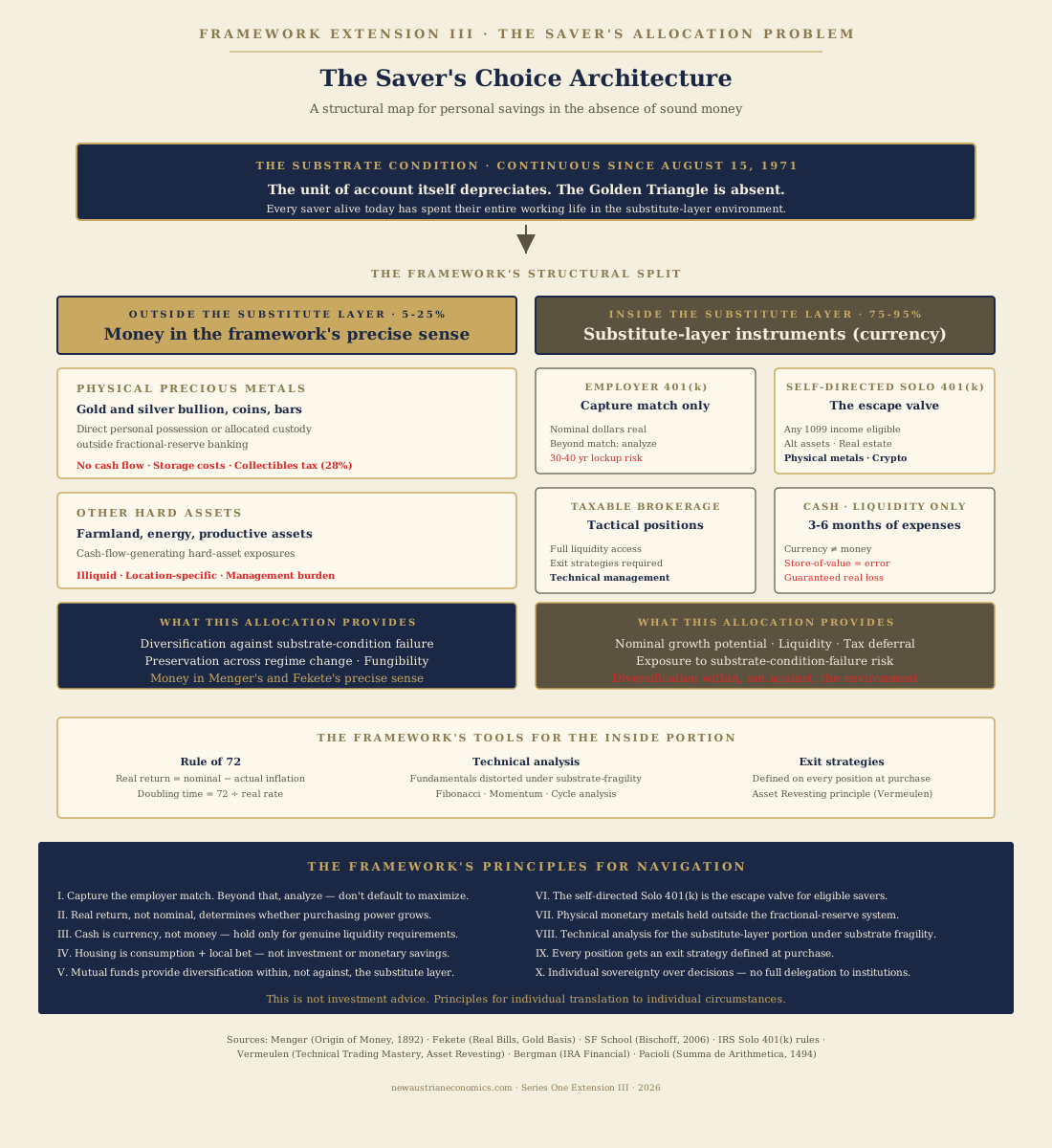
The saver's problem in 2026 is not solved by picking better mutual funds or getting the timing right. It is navigated by understanding the substrate condition explicitly, allocating a meaningful position outside the substitute-layer environment as diversification against substrate-condition failure, capturing the employer match where offered, using the self-directed Solo 401(k) escape valve where eligible, evaluating real returns rather than nominal, and defining exit strategies at purchase for every position taken inside the substitute layer.
→ Read the full analysis: Navigating the Substitute Layer: A Framework for Personal Savings in the Absence of Sound Money — The Forum
Concept in Focus: The Saver's Choice Architecture
The Saver's Choice Architecture, shown in the SVG above, is the framework's structural map for allocating financial capital under the post-1971 substrate condition. It is not a portfolio recommendation. It is a diagnostic frame for reading any specific portfolio against the substrate condition it operates within.
The critical distinction is between diversification within the substitute layer and diversification against the substitute-layer environment. A traditional balanced portfolio — 60% equities, 40% bonds, rebalanced quarterly — is diversified within the substitute layer. Both asset classes are claims on future currency payments in a depreciating unit; both are held through custodians who operate within the fractional-reserve banking system; both are subject to the same substrate risks. When the substrate condition stresses (as documented across the catalog's 37 prior essays), both asset classes are exposed to correlated impairment. The traditional 60/40 does not provide diversification against substrate failure; it provides diversification within the substrate.
The framework's proposed allocation — 5–25% outside the substitute layer (physical precious metals, other hard assets) and 75–95% inside (401(k) match, Solo 401(k), taxable brokerage, minimum cash) — is designed to provide meaningful diversification against the substrate condition while retaining the nominal-growth, liquidity, and tax-advantaged features of the substitute-layer instruments most savers cannot practically abandon.
The Atlas page on the Origin of Money covers Menger's saleability spectrum that grounds the framework's treatment of precious metals as money in the precise sense — the historical form of the monetary unit, distinct from the substitute-layer instruments that circulate as currency.
The Scorecard
Two significant Scorecard events this week require honest engagement.
Forum #26 Hormuz lag — the June CPI print came in below the predicted band. The framework's recorded prediction was that headline CPI would reach 4.5–5.5% through Q3 2026 as Hormuz energy-channel transmission completed. May came in at 4.2% (tracking the low end). June came in at 3.5% — below the band entirely, and the largest monthly headline decline since April 2020. The energy component fell 5.7% MoM, the largest since April 2020.
The framework's mechanism explanation: the June 17 Trump–Pezeshkian MOU enabled a brief shipping recovery (596 vessels transited between the MOU and July 8; peak 54 transits on June 24), which temporarily compressed energy prices during the mid-June through early-July window that the June CPI sample period captured. The July 7 vessel attacks and the U.S. Treasury revocation of General License X reverse that dynamic. The framework's updated forward prediction for testing: the July CPI print (released mid-August) re-accelerates in line with the Hormuz re-escalation. If July also comes in subdued, the framework's Q3 4.5–5.5% band requires revision downward. If July re-accelerates into or through the band, the framework's calibration held despite the June miss. This is a genuine framework moment that will be resolved by the July print.
Forum #36 DFC facility — validated by General License X revocation. The framework's recorded prediction was that the DFC Maritime Reinsurance Facility "will not write meaningful policy volume through mid-August 2026, when the Trump–Pezeshkian MOU expires; if the facility is renewed or expanded after MOU expiration, structural conditions preventing utilization are unlikely to have materially changed absent successful geopolitical resolution." The MOU has now been operationally revoked well before its formal expiration. The DFC facility remains at zero policies. The prediction is tracking on schedule.
Forum #16 banking diagnostics — third bank failure, still below systemic threshold. Kentland Federal Savings and Loan ($3.7M in assets) failed Friday July 10 in an FDIC-assisted transaction, becoming the third U.S. bank failure of 2026. The scale is diagnostic rather than material, but the count now moves above the two-per-year baseline that has characterized 2024–2025. The FDIC's Q2 2026 Quarterly Banking Profile releases in mid-August; this will be the next major test of the Forum #16 predictions.
Next major resolutions on the ledger: July CPI release mid-August (June miss test); July 24 ICBC deadline (10 days from this issue); July 29–30 FOMC (Warsh's second, first durability test of the June institutional pivot); mid-August MOU formal expiration; Q2 2026 FDIC QBP mid-August.
The Actionable
Household savings principles drawn directly from Forum #37 and calibrated to this week's mixed signals:
- Use the Rule of 72 as a standing personal-finance heuristic. Divide 72 by your realistic actual-inflation estimate to get the halving time for cash and cash-equivalent holdings. At the framework's 5–6% estimate, that is 12–14 years. This arithmetic should inform every allocation decision. Real return equals nominal return minus actual inflation; nominal-only thinking systematically understates the saver's problem.
- Capture the employer 401(k) match but analyze beyond it. The employer match is nominal dollars real, delivered in exchange for a manageable payroll deduction into a limited mutual fund menu. Take the match. What comes after the match — the additional voluntary contribution up to the annual limit, the choice of employer-plan funds versus alternative vehicles, the rollover strategy at employment separation — is where the framework's analytical apparatus applies.
- If you have 1099 income, learn about the self-directed Solo 401(k) via LLC. Any freelance, consulting, or side-business income makes you eligible. The structural flexibility (real estate, physical precious metals in allocated custody, alternative assets) is substantial. The administrative work is real but not prohibitive. Qualified professionals — accountants, tax attorneys, self-directed custodians — do the mechanical work; you supply the strategic decisions.
- Hold a meaningful allocation outside the substitute layer. The framework's 5–25% range is broad because circumstances differ. Physical precious metals held in direct possession or allocated custody outside the fractional-reserve banking system provide diversification against substrate-condition failure that no allocation within the substitute layer can provide.
- Watch the July CPI print (mid-August) and the July 29–30 FOMC. Both are near-term resolution events on the framework's ledger. The July CPI print will tell whether the June miss was a temporary MOU-enabled compression or a genuine calibration issue. The FOMC will tell whether the Warsh institutional pivot from Issue #009 is durable or performative.
Educational content only — not investment advice.
From the Archive
"Keynesians, through half a century of hard work, ably assisted by their Friedmanite comrades, have developed a highly efficient system to embezzle, unobserved, superfluous savings in an antiseptic way. Their sophisticated contra-saving devices through currency debasement anesthetize those bastard savers so that they can be pilfered and plundered without touching a raw nerve... Saving always and everywhere had to precede consumption. Saving has always been primary and consumption secondary, like it or not."
— Antal Fekete, That Accursed Propensity to Save (March 2009)
Fekete's 2009 essay is a direct refutation of Keynes's paradox of thrift from the New Austrian perspective. The argument: saving is not a macroeconomic vice but the foundation of all genuine prosperity. Under a working monetary architecture, saving flows into productive investment through the interest rate mechanism; under the post-1971 substitute-layer environment, this mechanism has been severed and the propensity to save is structurally punished through currency debasement. The framework's Forum #37 is the applied application of Fekete's analytical apparatus to the 2026 household saver: the debasement is continuing, the punishment is structural, and the saver's task is to navigate it explicitly rather than pretend it is not happening.
→ Read the full essay in the Fekete Archive
Also This Week
- Airline cluster continues: Jetflite, the Finnish charter operator, ceased operations at the start of July — another data point for the Forum #35 global airline failure cluster. The pattern remains concentrated in low-cost, charter, and regional carriers exposed to elevated jet fuel costs and thin operating margins.
- Hormuz re-escalation: The July 7 attacks on three commercial vessels and the U.S. Treasury revocation of General License X mark the operational end of the June 17 MOU window well before its formal expiration. The DFC $40B facility documented in Forum #36 remains at zero policies. The framework's forthcoming Watching the Cracks installments will engage the July 29–30 FOMC and the mid-August formal MOU expiration.
- New discoverability infrastructure: the /diagrams gallery launched last week is a visual index of every original SVG the framework has produced. For readers who navigate visually, this is a new entry point to the catalog. Forum #37's Saver's Choice Architecture SVG — shown in this issue's Lead Essay — is now part of that gallery.
- Atlas: The Origin of Money — Menger's saleability spectrum, the foundation underneath the framework's treatment of precious metals as money in the precise sense that this issue's Lead Essay develops.
The Dispatch — New Austrian Economics
Get this in your inbox every Monday
Free weekly analysis through the Menger–Fekete framework. No jargon without definition.
Educational content only. Nothing in The Dispatch constitutes investment advice, financial advice, or a recommendation to buy or sell any security or asset. All analysis is provided for educational and informational purposes within the New Austrian Economics framework. Consult a qualified financial adviser before making any investment decisions.