
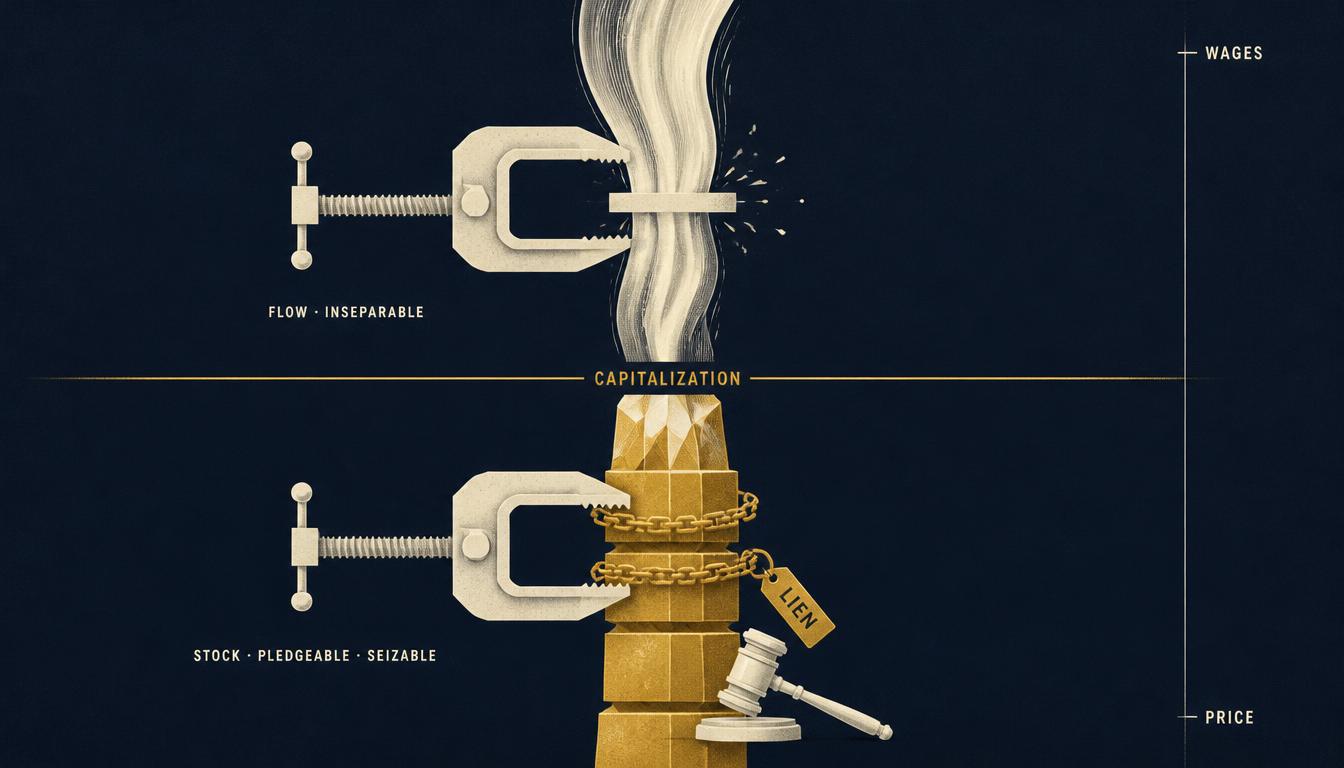
The Last Unencumbered Asset
In 2002 Eric Weinstein published a proposal in the International Labour Review recognizing native workers as the holders of a right of preferential access to their own labor market, and requiring employers who wish to hire outside it to license that right for a fair price rather than receive it by administrative grant. Workers keep working at a lower wage and receive licensing income on top; on his account their blended income rises. He has since extended it to artificial intelligence, treating AI as one more supplier of labor that workers license, and offers it as the free-market alternative to universal basic income. The proposal is genuinely Coasean and more rigorous than most of what occupies that space. Forum #56 takes it seriously on those terms and then runs the framework's own test against it. Fekete's question — does this transaction actually exchange income for wealth? — returns no: the worker sells nothing, and human capital stays where it was. What the proposal does is split the wage in two. The return to skill remains human capital: unconfiscatable, not fixed in nominal terms, portable. The premium for market access becomes a licensing claim, paid through government and worker representatives, bound to one country and one sector, with none of those properties. In the immigration case the claim is a supplement. In the AI case it is the share that grows, and at full displacement it is the whole.
Full analysis: newaustrianeconomics.com/forum/56-selling-the-last-unencumbered-asset
Welcome to Issue #019 of The Dispatch. Each Monday, this letter takes one situation from the week's news and reads it through the lens of Carl Menger and Antal Fekete — paired with a foundational concept, the dashboard, the framework's prediction record, and a piece from the archive. If someone forwarded this to you, subscribe here.
The Lens
The displacement debate has produced exactly two answers, and both are compensation schemes.
One is universal basic income: a transfer, administered, paid to people whose labor the system no longer needs. The other arrived in 2002 and has been given a second life by artificial intelligence. In the International Labour Review, Eric Weinstein argued that native workers hold a right of preferential access to their own labor market, and that an employer wishing to hire outside it should license that right from them rather than receive it by administrative grant. Workers keep working, at a lower wage, and are paid a licensing fee on top. He now describes the idea as "potentially the most important idea for labor surviving, coexisting and thriving with AI," and argues that "UBI is a crude dehumanizing welfare tool which should be abandoned in favor of a Coasian free market solution."
This catalog examined the first family of answers across the Distribution Question series and found them defective in a specific way: they pay people for being outside the labor market, through a structure whose first beneficiaries are the institutions administering it. Weinstein's proposal pays people for being inside it, and the framework takes it seriously for that reason.
Forum #56 checks the Coase invocation, finds it sound, credits the argument on three counts — and then runs the framework's own test and arrives somewhere its author would not.
Lead Essay: The Wage, Divided
In 2002 the International Labour Review published Eric Weinstein's "Migration for the benefit of all," a paper he describes as having "called for and constructed a canonical Coasian market solution" to economic immigration. The structure: the main reason a native worker out-earns a prospective migrant is a right of preferential access to the domestic labor market, and that right is exactly what is transferred when a migrant program opens. Today it is transferred for nothing, through visa quotas that employers lobby to expand. Weinstein prices it. Employers buy work permits; the government deducts its costs and pays the remainder to the sector's native workers as licensing fees; the permits then trade among employers. The paper's own phrase is that native workers are "the canonical licensors."
The worker does not stop working. The paper's premise is that natives should accept lower wages if, and only if, their total compensation rises. Weinstein put it plainly on The Diary of a CEO this week: "my wage income will go down, my licensing income will go up, and my blended income will increase." In the AI version, AI is one more supplier of labor, and the workers license it.
Forum #56 checks the invocation and finds it sound. Coase's 1959 spectrum paper took a resource distributed by administrative grant, defined a property right in it, and let it trade; his 1960 paper, which Weinstein cites, supplies the pollution-licensing logic the proposal follows. Weinstein is not misusing Coase. The essay also corrects a common misreading along the way: Coase never regarded the zero-transaction-cost world as descriptive, but constructed it as a benchmark that does not exist, precisely to direct attention to the cases where transaction costs are positive, which is all of them.
And the essay credits the proposal on three counts before objecting. It identifies a genuine subsidy — employer lobbying for expanded work authorization is itself evidence that access has value, and transferring something valuable without payment is a transfer whatever it is called. It keeps the recipient in the market: licensing income goes to the workers of a sector and is relinquished by leaving it, where the schemes Forum #40 examined pay people for being out of it. And it is honest about displacement in a way most answers are not.
Then the framework runs its own test. Forum #45 developed it from Fekete's definition of interest as the price at which income is exchanged for wealth: ask of any transaction whether such an exchange is actually occurring. Here it is not. The worker sells nothing and keeps the skill; wage income falls and licensing income replaces it. Income for income. The human capital is untouched.
But the test forces the question of what each stream is. Articles 37 and 44 identified human capital as the dominant asset across most of a working life, with three properties no instrument in the substitute layer shares. It is unconfiscatable — a state can seize gold, freeze an account and pesify a deposit, but cannot seize a capacity that is not separable from the person. It is not fixed in nominal terms — wages reprice, imperfectly and with lag. It is portable — skills cross borders, deposits do not.
After the license, the worker is paid two ways, and only one of them keeps those properties. The wage is still the return to the worker's own skill. The licensing fee is the premium for market access, taken out of the wage and paid separately — through the government, which deducts its costs first, and through representative bodies, on a schedule that an institution sets and can reset. It is bound to one country and one sector. It is a claim, reachable by everything that reaches claims, including the resolution regime Forum #54 documented.
The ratio is what AI changes. In the 2002 model migrant numbers are bounded and the fee is a top-up. In the AI version nothing bounds the supply in the same way: the wage falls toward the value of whatever AI cannot do, the licensing share rises to fill the gap, and at full displacement in an occupation the worker holds no wage in it at all — only a claim on fees paid by a few AI firms, collected by the state. The paper's own design then forces a choice. Keep the rule that licensing income belongs to active workers, and the displaced lose it when the wage goes. Drop it, and the payment is a transfer with a better-grounded entitlement.
The essay's central finding: the proposal does not capitalize labor. It carves the access premium out of the wage and turns it into a claim — and in the case it is now offered for, the claim is the part that grows.
→ Read the full analysis: Selling the Last Unencumbered Asset: Coase, AI, and a Property Right in Labor-Market Access — The Forum
Concept in Focus: Wage and Claim
The distinction between a wage and a claim is the kind that sounds like accounting pedantry until it decides something.
A wage is produced. It is paid to the person who does the work, reprices when that person bargains, quits or moves, and travels wherever the person goes. Nothing stands between the worker and it except the employer on the other side of the trade.
A claim is owed. It is paid by an institution on a schedule, to a holder of record, under rules the institution administers. Everything that can be done to a claim — assignment, offset, garnishment, means-testing, repricing by decree — can be done without touching the holder.
Two incomes of the same size can be different things. A household earning the same total from a wage and from a scheduled payment is exposed to entirely different risks, and the difference does not show in the total. That is the point the framework presses about Forum #56: a proposal can raise a worker's income and still change what the worker is exposed to, by moving part of the income from the first category into the second. The size of the payment does not settle that question.
This is the same structure the catalog has now found three times running from a different direction. Forum #54 found that bail-in authority already exists and that what a programmable settlement layer changes is execution latency. Forum #55 found that an identity credential nobody is compelled to hold becomes universal through an acceptance obligation on everyone else. Here, a proposal that genuinely benefits workers relative to the alternatives does so by moving a growing share of their income from the one asset they hold outside the system to a claim inside it. In each case the mechanism is disclosed, argued on its merits, and adopted for reasons that are mostly good. What goes unexamined is the scope.
The Atlas page on the Origin of Money covers Menger's saleability framework, which supplies the essay's second reading: what would happen if the licensing entitlement were ever made individually saleable.
The Divide
A new section is live under Learn. The Divide presents six questions on which the major schools of economics genuinely disagree — not strawman disagreements, but conflicts traced through primary texts, with the points of real incompatibility identified and the framework's own position stated plainly.
- What Is Money? — Menger's 1892 account of money emerging undesigned from differential saleability, against Knapp's 1905 claim that money is a creature of law, with Keynes endorsing Knapp, Mises adding the regression theorem, and Modern Monetary Theory reviving chartalism with taxes as the demand mechanism. Four accounts that disagree about whether money is discovered or decreed — including the respect in which the chartalists have been empirically vindicated for more than fifty years.
- What Is Interest? — four schools, four incompatible answers to a question that sounds simple.
- What Does Credit Expansion Do? — Mises and Hayek on malinvestment, against the orthodox account.
- What Does a Falling Rate Structure Do to Capital? — where the orthodox answer is so nearly unanimous that most economists would not recognize it as contested. This catalog's Article 41 argues the opposite.
- Can You Measure Any of This? — every preceding question assumed the quantities are observable. This one asks whether they are.
- What Should a Central Bank Do? — where every prior disagreement produces an incompatible recommendation.
The section exists because the framework's positions are contested ones, and a reader is owed the strongest version of the other side before being asked to accept any of them.
The Dashboard
Readings from the live toolkit as of October 14, 2026. The composite is withheld while its components are recalibrated against their own histories. The individual readings below stand on their own.
- Silver / Gold Ratio — 73.99, against 67.82 three weeks ago. Silver has weakened sharply against gold — spot $55.64 to gold's $4,082.84. On a board where nothing else is moving, this is the one reading that is. → /toolkit/silver-gold-ratio
- Gold Basis — +4.55% annualized at constant 90-day maturity, the curve interpolated between the October and December contracts to a fixed horizon and measured against live spot. Contango, at the firm end of its range. Gold is priced for carry, not scarcity. → /toolkit/gold-basis
- Silver Basis — +2.63% annualized, same construction. Ordinary contango. The ratio move is a price move, not a scarcity signal in the silver curve. → /toolkit/silver-basis
- Cross-Currency Basis — 18.5 bps mean absolute across four pairs. EUR/USD −7.3, GBP/USD −0.1, USD/CHF −34.8, USD/JPY −32.0. Negative on three of four, which is the ordinary state: synthetic dollars via the FX swap market cost marginally more than borrowing them directly. No dollar scarcity. → /toolkit/cross-currency-basis
- ETF NAV Deviation — 13.7 bps across the six-member bond-ETF panel, newly reporting. GOVT 1.6 bps at the liquid end, through LQD 6.8 and MBB 3.0, to HYG 22.3, EMB 22.5 and BKLN 26.3. The ordering tracks the liquidity of what each fund holds, which is what the measure is for. → /toolkit/etf-nav-deviation
- OTROFF (10Y On/Off-the-Run Treasury Spread) — +1.81 bps, maturity-adjusted. An ordinary premium for the most-current ten-year issue. → /toolkit/otroff-spread
- COMEX Deliveries — 695 contracts stopped on October 13 across four contracts. → /toolkit/comex-paper-physical
The framework's reading: one thing moved, and it was a price. Silver fell hard against gold, taking the ratio from 67.8 to 74.0 in three weeks. What did not move is as informative: silver's own basis is in ordinary contango, so the decline is a repricing rather than a scarcity signal. Had physical silver tightened, the curve would say so, and it does not.
Everything else is unremarkable. Dollar funding is ordinary and slightly negative, which is its normal state. The bond-ETF panel is dispersed exactly as liquidity would predict. The Treasury market's premium for its newest issue is under two basis points. There is no stress in this board, and a letter that found some every week would not be reading conditions, it would be reading itself.
The Scorecard
Forum #55's nearest dated test is ten weeks out. December 24, 2026 is a hard obligation on all twenty-seven EU member states to provide at least one certified European Digital Identity Wallet. Whether all twenty-seven meet it is a clean, falsifiable test of how binding these published timetables are in practice, and the framework will score it.
Forum #16 banking diagnostics — the count holds at 6. No new U.S. bank failure this week. Six for 2026 against two in each of 2024 and 2025.
Next major resolutions on the ledger: the October FOMC, first test of whether September's hike to 3.75–4.00 percent begins a sequence or stands alone; the EUDI Wallet deadline on December 24; and the Q3 FDIC Quarterly Banking Profile, against a failure count now triple the prior two years' baseline.
The Actionable
The framework's operational observations calibrated to Forum #56:
- Judge a payment by what kind of income it is, not only by its size. A wage and a scheduled claim of the same amount carry different risks. A proposal that raises total income while moving part of it from the first category to the second is doing two things, and only one of them shows in the total.
- The three properties worth protecting are unconfiscatability, nominal non-fixity, and portability. Any arrangement that moves income from an asset holding all three to one holding none of them is doing something structurally large, regardless of how favorable the price is. Price and structure are separate questions and the first does not settle the second.
- Judge a distribution proposal by who sits between the recipient and the thing, and by whether it keeps the recipient in the market. Forum #40's test — count the intermediaries who capture a fee or a gatekeeping position — still applies; Weinstein's design has a government and representative bodies in the chain. What sets it apart is that it pays people for working rather than for having stopped. That is why the framework takes it seriously enough to object on other grounds.
- Separate a price move from a scarcity signal. Silver fell nine percent against gold this week while its own forward curve stayed in ordinary contango. A metal getting cheaper and a metal getting scarce look identical in a price chart and different in a basis. The curve is the discriminating instrument, and it says this was the former.
Educational content only — not investment advice.
From the Archive
"What has been hailed as a heroic job-creation program appears, in the present light, as a miserable effort at damage control by the same government that has destroyed those jobs in the first place."
— Antal Fekete, A Revisionist Theory and History of Money: Real Bills and Employment
Fekete's subject is the wage fund. Workers producing consumer goods are paid long before those goods reach a buyer, and under the gold standard that gap was financed by the real bill — a self-liquidating claim on a good already on its way to a consumer. His argument is that destroying the bill market destroyed the mechanism that paid those wages, that mass unemployment followed, and that the welfare state was erected to manage a condition the monetary architecture had itself produced.
The relevance to this week is structural rather than historical. Both answers currently on offer to the displacement question are compensation schemes. Universal basic income compensates with a transfer; the Coasean proposal compensates with a licensing fee for the right that was taken. Each takes as given that labor's position has deteriorated and argues about the form of the payment. Fekete's analysis points somewhere neither goes: ask what destroyed the wage fund before deciding how to compensate for its absence. A compensation scheme is a judgment that the underlying arrangement will not be revisited — and the choice between two of them is narrower than it looks.
→ Read the full essay in the Fekete Archive
Also This Week
- Forum #55 — Three Layers, One Window, the lead of Issue #018, remains the companion piece to this week's essay. Its finding — that an identity credential nobody is compelled to hold becomes the default through an acceptance obligation on everyone else — is the same structure Forum #56 identifies in a licensed labor market: the mechanism is disclosed and defensible, and the scope is what goes unexamined.
- The COMEX delivery reader is reporting again after an outage, and appears in the Dashboard above for the first time. Four contracts, 496 stopped on October 12.
- Atlas: The Origin of Money — Menger's saleability framework, which supplies Forum #56's second reading of how a labor-access right would actually trade.