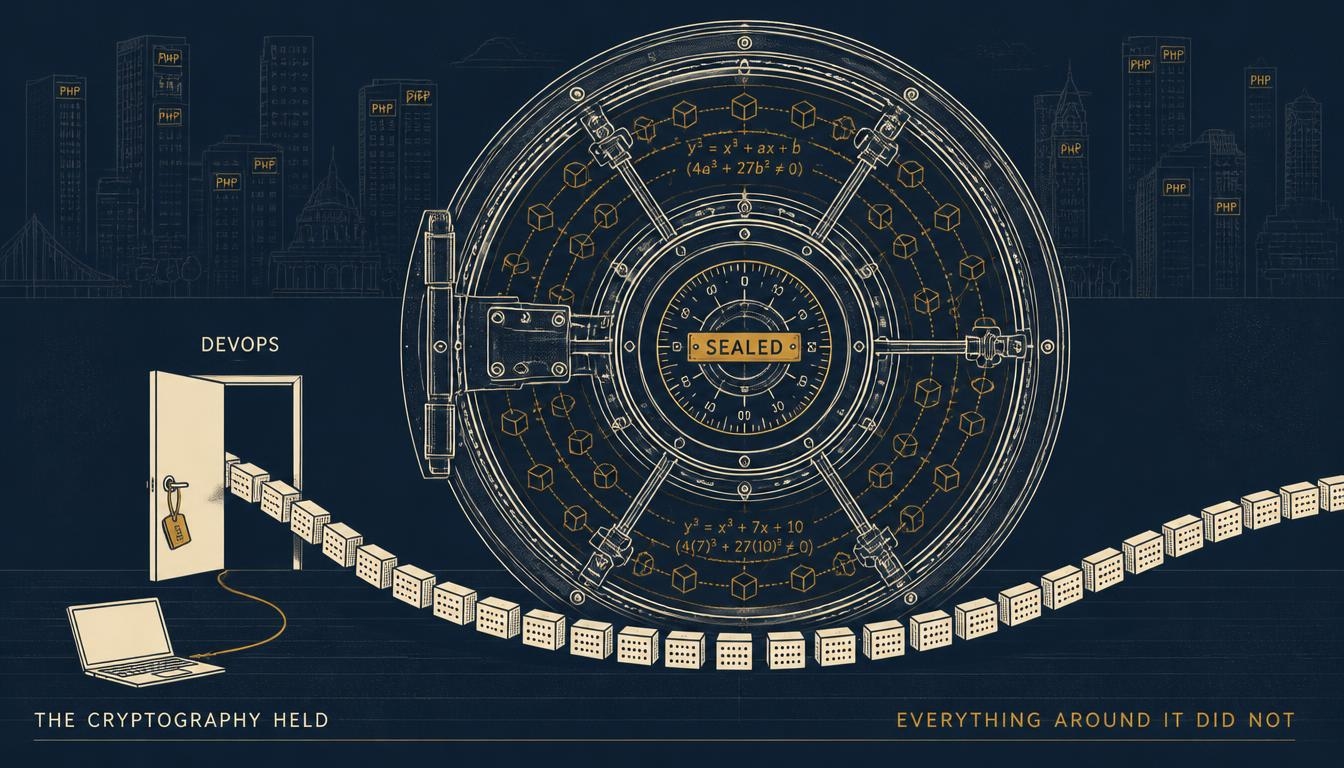
Between roughly 20:04 and 23:56 UTC on October 29, 2026, an attacker drained Binance hot wallets across as many as ten blockchains, taking approximately 6.3 billion dollars — the largest cryptocurrency theft on record by a wide margin. Binance located the entry point as a compromised DevOps engineer's laptop, which allowed access to a service container from which unauthorized withdrawal transactions were submitted, and twelve hours later disclosed additional points of breach. Buried in the company's own statements is the fact that has received the least attention: Binance found no evidence that the private keys controlling those wallets were leaked. If that holds, the cryptography was never attacked. No elliptic curve was broken, no signature scheme forged, no hash inverted. The mathematics performed exactly as specified throughout the four hours in which six billion dollars left the building. What failed was the authorization path. Article 64 argues the distinction is the whole subject — that it reframes the quantum threat the cryptocurrency community has organized around, and that the wave of AI-accelerated vulnerability discovery now called Black October has already delivered the capability Q-day is supposed to represent, without requiring any mathematical breakthrough at all.
Featured essay: read the full analysis →
Researched and drafted with AI assistance · reviewed and edited by Jason D. Keys
Welcome to Issue #022 of The Dispatch. Each Monday, this letter takes one situation from the week's news and reads it through the lens of Carl Menger and Antal Fekete — paired with a foundational concept, the dashboard, the framework's prediction record, and a piece from the archive. If someone forwarded this to you, subscribe here.
The Lens
Six billion dollars left Binance in four hours, and every cryptographic signature involved was valid.
Between approximately 20:04 and 23:56 UTC on October 29, an attacker drained hot wallets across as many as ten blockchains — Ethereum, Bitcoin, Tron, the XRP Ledger, Solana, Arbitrum, Avalanche, Optimism, Base and Polygon. Binance put the figure at approximately $6.3 billion; Elliptic's Tom Robinson put it at $6.43 billion. It is the largest cryptocurrency theft on record by a wide margin.
The company's initial account located the entry point precisely. Co-CEO Richard Teng said the incident "may have started with a compromised DevOps engineer's laptop," which "allowed an attacker to gain access to a service container and submit unauthorized withdrawal transactions." Roughly twelve hours later the account changed: Binance disclosed that its investigation had "uncovered additional points of breach."
Then the sentence that reframes the whole event, which is in Binance's own disclosures and has been read past almost universally:
The company says it has found no evidence that the private keys controlling those wallets were leaked.
Take it at face value and consider what it rules out. No private key was stolen. No seed phrase recovered. No signature scheme forged. No elliptic curve broken, no hash function inverted, no random number generator found predictable.
The cryptography was never attacked. It performed exactly as specified, continuously, throughout the four hours.
Article 64 argues that the distinction between a cryptographic failure and an authorization-path failure is not a technical footnote. It is the whole subject.
Lead Essay: The Math Was Never Attacked
Start with what a blockchain actually secures.
A blockchain secures one thing with cryptography: the correspondence between a private key and the authority to move a balance. Given the key, the transaction is valid. Absent the key, it is not. That guarantee is strong, well-tested, and was not challenged on October 29.
Everything else is ordinary computer security. The key has to be stored somewhere. Something has to decide which transactions get signed. Someone has to administer that system, on a machine, with credentials, inside an organization with employees and vendors and dependencies.
The security of a cryptocurrency balance is bounded not by the strength of its cryptography but by the weakest authorization path to its signing infrastructure — which on October 29 was a laptop.
An attacker who reaches the signing path does not need to defeat the mathematics, because the mathematics will sign whatever the authorized path submits. That is what it is for.
The second half of the story is the environment that laptop was compromised in, and it is documented.
Security researchers have given the month a name. Black October refers to a cluster of major incidents in late October attributed substantially to artificial intelligence accelerating both the discovery of vulnerabilities and the execution of attacks.
The centerpiece is a pair of critical remote-code-execution flaws in PHP — CVE-2026-109618 and CVE-2026-109619, together called php2shell. Wiz Research found them with AI assistance alongside Calif and OpenAI, reported them in August, and patches shipped October 21. Both carry a CVSS score of 9.2, and PHP underlies something on the order of 70 percent of all websites; Censys counted roughly 36.7 million internet-facing services running affected versions. Wiz's own assessment is that these "rank among the most severe vulnerabilities discovered in PHP, and arguably in software history."
Two details matter more than the severity score.
The flaws had been present for more than a decade. They went undetected because exploiting them required technical work complex enough that nobody had assembled it — work that AI helped researchers complete. OpenAI's statement was carefully phrased: "To our knowledge, frontier AI found these vulnerabilities before attackers did." The qualifier is doing real work, because Amazon Threat Intelligence identified exploitation attempts in its telemetry on October 17, four days before public disclosure.
And the exploitation curve was nearly vertical. Cloudflare recorded attempts scaling from thousands to millions within hours of announcement. Governments and companies took sites offline to patch. Former CISA director Chris Krebs, speaking on CNBC, said that three percent of all critical vulnerabilities ever discovered had been found in the preceding month. Monthly disclosures rose from 5,045 in January 2026 to 10,740 in August.
Which brings the essay to its sharpest claim: Q-day is a misdirection.
The cryptocurrency community has organized a substantial portion of its security thinking around the anticipated moment a quantum computer can derive private keys from public keys. The concern is technically legitimate and post-quantum migration is sensible engineering. As a risk-management priority, it is badly ranked.
Q-day is attractive as a threat because it is legible — a single mechanism, an estimable date, a specifiable defense, a clear before and after. It can be put on a roadmap. The operational threat has none of those properties, and it arrived this month. It required no mathematical breakthrough. It required a laptop.
Consider what an adversary gains from each. A quantum capability lets you derive a key from an exposed public key. Access to the signing path lets you move funds without any key at all — and leaves the cryptography intact and attesting that every transaction was valid.
The capability Q-day is supposed to represent — the ability to take cryptocurrency from people who hold it correctly — already exists, has already been exercised at six billion dollars, and did not touch the cryptography.
A community that migrates to post-quantum signatures while its exchanges run signing infrastructure reachable from an engineer's laptop has hardened the part that was not failing.
→ Read the full analysis: The Math Was Never Attacked: Binance, Black October, and the Misdirection of Q-Day — The Forum
Concept in Focus: Custody Depth
Article 47 of this catalog developed Custody Depth: a count of the institutional counterparties standing between a holder and unencumbered control of an asset. Physical possession scores zero. Each intermediary adds one, and each one is a party whose failure, insolvency, error or decision can sever the holder from the thing he believes he owns.
Apply it to the asset class whose entire value proposition is that the count should be zero.
A cryptocurrency balance held in self-custody, with the holder controlling the private key, is close to a bearer instrument. That is the design, and it is the property that distinguishes the asset class from everything it was built to replace.
A balance held at an exchange is not that. It is a claim on the exchange, recorded in the exchange's internal ledger, backed by assets the exchange controls and signs for. The depositor does not hold a key. He holds an entry in a database and a contractual expectation.
An exchange balance is the clearest available case of the distinction: an asset whose entire value proposition is bearer self-custody, held in a form that is neither bearer nor self-custodied.
On October 29 that became operative for several million people at once. Whether they were made whole turned entirely on Binance's solvency and willingness — both of which, to the company's credit, held. Binance said it would cover all losses and set aside more than $6.3 billion of its own funds to do so.
And there is a cushion question underneath it that nobody is measuring. Binance maintains an emergency fund called SAFU, created specifically to protect customers in a breach. Its size is approximately $1 billion. The loss was $6.3 billion — so the fund covered roughly sixteen percent of the exposure it exists to cover. The remainder came from company funds, which Binance had and committed.
Article 48 asked exactly this question of the United States life insurance industry — $11.0 trillion in assets against $10.6 trillion in liabilities, a four percent cushion — and argued that a cushion is only meaningful relative to the loss distribution it is sized against. For cryptocurrency exchanges there is no regulatory capital requirement, no published loss-given-default modeling, and no standard disclosure of the ratio between an emergency fund and hot wallet exposure. Whether one-to-six is typical, conservative or fortunate is not knowable from outside. That is the measurement gap most worth closing, and it has nothing to do with cryptography either.
The Atlas page on Money vs Currency covers the distinction underneath: a good held, against a claim on an institution that holds it.
The Dashboard
Readings from the live toolkit as of November 4, 2026.
- Gold Basis — +3.86% annualized at constant 90-day maturity, spot $3,921.32. Contango, and wider than a week ago as spot fell. → /toolkit/gold-basis
- Silver Basis — +5.02% annualized, spot $49.47. Contango, and sharply wider — see the reading below. → /toolkit/silver-basis
- Silver / Gold Ratio — 79.04, against 74.74 a week ago. Silver's decline continues; the ratio has now run 67.8 to 74.0 to 71.3 to 74.7 to 79.0 across five weeks. → /toolkit/silver-gold-ratio
- Cross-Currency Basis — 14.7 bps mean absolute across four pairs. EUR/USD +3.3, GBP/USD +20.5, USD/CHF −24.6, USD/JPY −10.2. → /toolkit/cross-currency-basis
- ETF NAV Deviation — 14.6 bps panel aggregate across six bond funds. Elevated against its own history but stable week over week. → /toolkit/etf-nav-deviation
- OTROFF (10Y On/Off-the-Run Treasury Spread) — +1.27 bps, maturity-adjusted. An unremarkable premium for the most-current issue. → /toolkit/otroff-spread
- COMEX Deliveries — 38 contracts stopped on November 3 across two contracts. → /toolkit/comex-paper-physical
The framework's reading: silver fell hard and its basis went deeper into contango, which is the textbook demonstration of what the instrument is for. Spot dropped from $54.47 to $49.47 in a week — a decline of roughly nine percent — while the annualized constant-maturity basis nearly doubled, from +2.57 to +5.02 percent.
Those two facts together say something precise. A scarcity event tightens the curve: holders of physical metal become unwilling to lend it against a future delivery, carry compresses, and the basis falls toward backwardation. What happened instead was the opposite. More carry was available at a lower price, which is what a market looks like when paper sellers are more numerous than physical buyers and the metal itself is not scarce at all.
This is the fourth consecutive week the dashboard has returned the same verdict on silver in different words. The price has moved a great deal. The curve has not once suggested the move was about availability.
The Scorecard
Article 64 puts four new dated tests on the ledger, and states its own falsifiers rather than only its confirmations.
- Whether Binance publishes a root cause. The "additional points of breach" disclosure is the live question. A full technical post-mortem would either confirm the authorization-path reading or replace it.
- Whether the no-key-leakage finding survives. The entire argument rests on it. If Binance revises that statement, the thesis weakens substantially and the framework will report it.
- The php2shell exploitation curve. CISA's remediation deadline and the Cloudflare telemetry give measurable follow-through on whether AI-accelerated discovery proves net defensive or net offensive.
- Exchange disclosure of reserve-to-exposure ratios. The SAFU gap is the clearest reform target this incident produces, and one the industry could address voluntarily.
The framework notes what would not falsify the argument: further exchange hacks. Additional incidents are consistent with it and do not distinguish it from alternatives.
Forum #55's nearest dated test is seven weeks out. December 24, 2026 is a hard obligation on all twenty-seven EU member states to provide at least one certified European Digital Identity Wallet, under Article 5a(1) of Regulation (EU) 2024/1183.
Forum #16 banking diagnostics — the count holds at 6. No new U.S. bank failure. Six for 2026 against two in each of 2024 and 2025.
Next major resolutions on the ledger: the EUDI Wallet deadline on December 24; the digital euro pilot development phase, running through 2027; and the Q3 FDIC Quarterly Banking Profile.
The Actionable
The framework's operational observations calibrated to Forum #64:
- Ask what the cryptography is actually covering. It covers the correspondence between a key and the authority to move a balance. It does not cover where the key is stored, what decides which transactions get signed, or who administers that system. Strength in the covered part implies nothing about the rest, and the rest is where the losses happen.
- A threat model organized around a legible future event will underweight the illegible present one. Q-day has a date, a mechanism and a defense, so it gets a roadmap. An engineer's laptop has none of those and gets whatever attention is left. The ranking is backwards, and it is backwards for reasons of cognitive convenience rather than analysis.
- Custody depth is the variable, and it is countable. Self-custody with a key under your control is close to bearer. A balance at an exchange is a claim on an institution. These are different instruments with different failure modes, and the second is not a convenient version of the first.
- A cushion is only meaningful against the loss distribution it is sized for. One billion against a six billion loss is not a scandal on its own — Binance covered the gap. But the ratio was not disclosed in advance, is not required to be, and nobody outside the company could have computed it. That is true of every major exchange.
Educational content only — not investment advice.
From the Archive
"He explicitly stated that a gold certificate, if its security cannot be doubted, is just as much a present good as the gold coin itself. Heck no, it isn’t, and the marginal bondholder knows it."
— Antal Fekete, A Tale of Two Schools (2012)
Fekete is arguing with Mises about gold certificates, nine years before the largest exchange in cryptocurrency existed. The structure of the disagreement is the structure of October 29.
Mises' position is the intuitive one, and it is the position almost every exchange customer holds without having examined it: if the claim is good, the claim is as good as the thing. A certificate backed by metal that is really there, at an institution that will really honor it, is simply a more convenient metal.
Fekete's objection is that this smuggles the institution into the asset and then forgets it is there. A certificate is only as good as the entity standing behind it, and that entity's condition is a variable the holder does not control and usually cannot observe. The convenience and the exposure are the same property.
Binance made its customers whole, which is the outcome Mises' argument predicts when security "cannot be doubted." The framework's point is narrower and survives the happy ending: for four hours on October 29, several million people held something whose value depended entirely on a corporate decision not yet announced. They did not know that was what they were holding, and nothing in the arrangement was built to tell them.
→ Read the full essay in the Fekete Archive
Also This Week
- Forum #63 — The Category That Was Removed, the lead of Issue #021, shares more with this week's argument than the subjects suggest. There, the carriers that failed were the ones holding the shortest contracts against the input that moved. Here, the exchange customers most exposed were the ones holding the longest chain of intermediaries between themselves and the asset. Both essays are counting the same thing — how much stands between a holder and the thing he thinks he has — and both find that the count is invisible until the moment it matters.
- Forum #14 — Code Was Never Law is the direct ancestor of this week's lead and worth rereading beside it. Its argument was that the governing constraints on a cryptographic system are institutional and operational rather than mathematical. Article 64 offers the stronger version available after October 29: code was never the attack surface.
- The Divide continues under Learn, with six contested questions traced through primary texts. What Is Money? is the natural companion — Menger's account of money emerging undesigned from differential saleability, against Knapp's claim that money is a creature of law.
- Atlas: Money vs Currency — a good held, against a claim on an institution that holds it, which is the distinction the Binance incident turns into an operational one.
The Dispatch — New Austrian Economics
Get this in your inbox every Monday
Free weekly analysis through the Menger–Fekete framework. No jargon without definition.
Educational content only. Nothing in The Dispatch constitutes investment advice, financial advice, or a recommendation to buy or sell any security or asset. All analysis is provided for educational and informational purposes within the New Austrian Economics framework. Consult a qualified financial adviser before making any investment decisions.