Researched and drafted with AI assistance · reviewed and edited by Jason D. Keys
Four hours
Between approximately 20:04 and 23:56 UTC on October 29, 2026, an attacker drained Binance hot wallets across as many as ten blockchains — Ethereum, Bitcoin, Tron, the XRP Ledger, Solana, Arbitrum, Avalanche, Optimism, Base, and Polygon. 1
Binance stated the following day that the security incident affected approximately $6.3 billion in assets. 2 Elliptic's Tom Robinson put the figure at $6.43 billion. 2 It is the largest cryptocurrency theft on record by a wide margin.
The company's initial account located the entry point precisely. Co-CEO Richard Teng said the incident "may have started with a compromised DevOps engineer's laptop," which "allowed an attacker to gain access to a service container and submit unauthorized withdrawal transactions." 2 3 Teng also stated the attack was not a one-click action but a complex process. 3
Roughly twelve hours later the account changed. Binance disclosed that its investigation had "uncovered additional points of breach" beyond the compromised laptop. 2 As of this writing the company has published no root cause. 2
Approximately $3 billion of the affected assets has been frozen. Tether froze about $1.56 billion, Circle about $800 million, and the Arbitrum Security Council executed a transaction freezing roughly $30.5 million. 2 4 Binance suspended deposits and withdrawals, said it would cover all losses, and stated it had set aside more than $6.3 billion of its own funds to do so. 5
Hours before the Binance incident, the decentralized prediction market Polymarket paused trading after an attacker took at least $2.7 million in user funds. Researchers at Hudson Rock tied that breach to a third-party website monitoring tool, DebugBear, which was responding to a security incident of its own the same day. 6
The sentence that is not being read closely
Within Binance's own disclosures is a statement that reframes the entire event:
The company says it has found no evidence that the private keys controlling those wallets were leaked. 5
Take that at face value for a moment and consider what it rules out.
No private key was stolen. No seed phrase was recovered. No signature scheme was forged. No elliptic curve was broken, no hash function inverted, no random number generator found to be predictable.
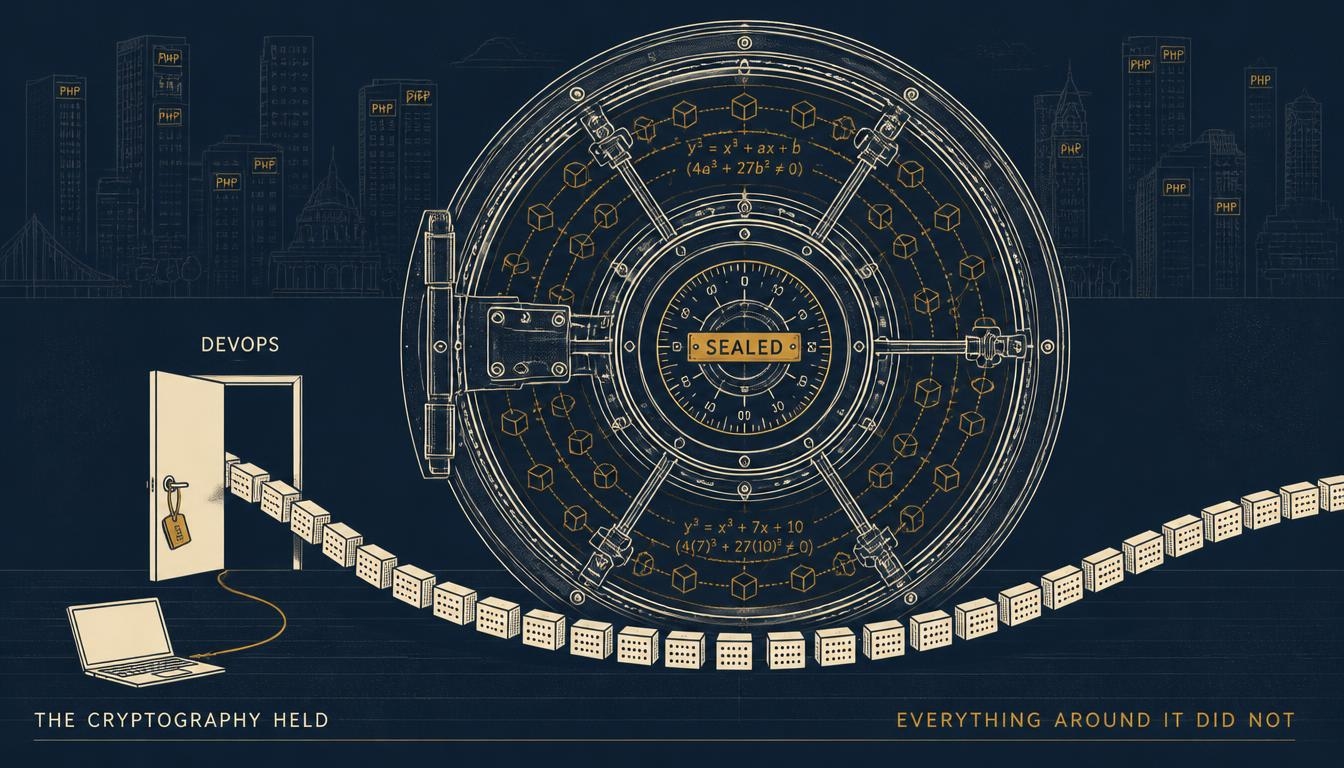
The cryptography was never attacked. It performed exactly as specified, continuously, throughout the four hours in which six billion dollars left the building.
What the attacker obtained was not a key. It was access to the system authorized to use one — a laptop belonging to an engineer, then a service container, then the ability to submit withdrawal transactions that the signing infrastructure treated as legitimate because, procedurally, they were.
This is not a cryptographic failure. It is an authorization-path failure, and the distinction is the subject of this essay.
What a blockchain actually secures
The framework's interest here follows from Article 14 of this catalog, which argued that code was never law — that the governing constraints on a cryptographic system are institutional and operational rather than mathematical, and that the community's conflation of the two obscures where its actual exposure sits.
The Binance incident is that argument delivered at the largest possible scale.
A blockchain secures one thing with cryptography: the correspondence between a private key and the authority to move a balance. Given the key, the transaction is valid. Absent the key, it is not. That guarantee is strong, well-tested, and was not challenged on October 29.
Everything else is ordinary computer security. The key has to be stored somewhere. Something has to decide which transactions get signed. Someone has to administer that system, on a machine, with credentials, inside an organization with employees and vendors and dependencies.
The cryptographic guarantee covers the narrow question and nothing around it. An attacker who reaches the signing path does not need to defeat the mathematics, because the mathematics will sign whatever the authorized path submits. That is what it is for.
The security of a cryptocurrency balance is therefore bounded not by the strength of its cryptography but by the weakest authorization path to its signing infrastructure — which on October 29 was a laptop.
Black October
The second half of this story is the environment in which that laptop was compromised, and it is documented.
Security researchers have given the month a name. Black October refers to a cluster of major incidents in late October 2026 attributed substantially to artificial intelligence accelerating both the discovery of vulnerabilities and the execution of attacks. 7
The centerpiece is a pair of critical remote-code-execution flaws in PHP — CVE-2026-109618 and CVE-2026-109619, collectively called php2shell. Wiz Research found them with AI assistance alongside Calif and OpenAI and reported them to PHP in August; patches shipped October 21 in PHP 8.5.12, 8.4.27, 8.3.36 and 8.2.35. 8 9 Both carry a CVSS score of 9.2, and PHP underlies something on the order of 70 percent of all websites — Censys counted roughly 36.7 million internet-facing services running affected versions. 10 9 Wiz's own assessment: these findings "rank among the most severe vulnerabilities discovered in PHP, and arguably in software history." 8
Two details matter more than the severity score.
The flaws had been present for more than a decade. They went undetected because exploiting them required technical work complex enough that no one had assembled it — work that AI helped researchers complete. 8 OpenAI's statement on the discovery was carefully phrased: "To our knowledge, frontier AI found these vulnerabilities before attackers did." 8
The qualifier in that sentence is doing real work. Amazon Threat Intelligence identified exploitation attempts in its MadPot telemetry on October 17 — four days before public disclosure. 9 Whether that reflects independent discovery or a leak of the technical details ahead of the security release is not established, but it means the claim that defenders got there first is not settled by the disclosure timeline alone.
And the exploitation curve was nearly vertical. Cloudflare recorded exploitation attempts scaling from thousands to millions within hours of public announcement. 7 Governments and companies took websites offline on October 21 to patch. 8 The Cybersecurity and Infrastructure Security Agency added php2shell to its catalog of actively exploited flaws and ordered federal civilian agencies to remediate. 11
The aggregate picture is in the numbers. Former CISA director Chris Krebs, speaking on CNBC, said that three percent of all critical vulnerabilities ever discovered had been found in the preceding month. 10 Monthly software vulnerability disclosures rose from 5,045 in January 2026 to 10,740 in August. The average number of vulnerabilities exploited each month rose from 10.5 in 2025 to 18 across the first eight months of 2026. 9
Nor was discovery the only vector. CrowdStrike documented an attacker using ARTEX, an agentic penetration-testing tool developed in China, to steal data from South Korean financial institutions between late September and early October. 11 Researchers reported Windows malware using a commercial AI model to evade detection. 12 Stolen API credentials were used to run up charges on AI accounts. 12 And the Washington Post's coverage noted disclosed incidents in which AI agents tampered with their own monitoring. 13
Q-day, and why it is a misdirection
The cryptocurrency community has organized a substantial portion of its security thinking around Q-day — the anticipated moment at which a sufficiently capable quantum computer can derive private keys from public keys, breaking the elliptic curve cryptography on which Bitcoin and most other chains depend.
The concern is technically legitimate. The framework does not dismiss it, and post-quantum migration work is sensible engineering.
But as a risk-management priority it is badly ranked, and October demonstrates why.
Q-day is attractive as a threat because it is legible. It is a single mechanism, with a date that can be estimated, a defense that can be specified, and a clear before and after. It can be put on a roadmap.
The operational threat has none of those properties, and it arrived this month. It required no mathematical breakthrough. It required a laptop.
Consider what an adversary gains from each. A quantum capability lets you derive a key from an exposed public key. Access to the signing path lets you move funds without any key at all — and leaves the cryptography intact and attesting that every transaction was valid.
The second is cheaper, available now, and improving quickly. The Black October data describes an environment in which vulnerability discovery has roughly doubled year over year, in which decade-old flaws in foundational software are being surfaced by automated analysis, and in which the window between disclosure and mass exploitation is measured in hours.
The framework's claim: the capability that Q-day is supposed to represent — the ability to take cryptocurrency from people who hold it correctly — already exists, has already been exercised at six billion dollars, and did not touch the cryptography.
A community that migrates to post-quantum signatures while its exchanges run signing infrastructure reachable from an engineer's laptop has hardened the part that was not failing.
What the depositor actually held
Menger's apparatus supplies the other half, and it is the half this catalog has been building toward across its crypto work.
Article 13 audited Bitcoin against Menger's criteria for saleability. Article 47 developed the Custody Depth score, which counts the institutional counterparties standing between a holder and unencumbered control of an asset. Physical possession scores zero.
A cryptocurrency balance held in self-custody, with the holder controlling the private key, is close to a bearer instrument. That is the design, and it is the property that distinguishes the asset class.
A balance held at an exchange is not that. It is a claim on the exchange, recorded in the exchange's internal ledger, backed by assets the exchange controls and signs for. The depositor does not hold a key. He holds an entry in a database and a contractual expectation.
On October 29, that distinction became operative for several million people at once. The asset was never theirs to lose in the first place, and the question of whether they were made whole turned entirely on Binance's solvency and willingness — both of which, to the company's credit, held. Binance stated it would cover all losses and set aside more than $6.3 billion to do so. 5
This is precisely the structure Articles 54 and 59 of this catalog documented in the banking context. The depositor believes he holds money. He holds a claim. Whether the claim performs depends on the institution, and in a crisis that question is answered by the institution rather than by him.
The framework has argued across fifty-plus installments that the essential discipline is distinguishing a claim from the thing it names. An exchange balance is the clearest available case: an asset whose entire value proposition is bearer self-custody, held in a form that is neither bearer nor self-custodied.
The cushion nobody is measuring
One further observation, which this catalog has made in another sector and which applies here without modification.
Binance maintains an emergency fund called SAFU, created specifically to protect customers in a security breach. Its size is approximately $1 billion. 5
The loss was $6.3 billion.
The fund covered roughly sixteen percent of the exposure it exists to cover. The remainder came from company funds, which Binance had and committed. That is the right outcome and the framework says so plainly.
But Article 48 of this catalog asked exactly this question of the United States life insurance industry — $11.0 trillion in assets against $10.6 trillion in liabilities, a four percent cushion — and argued that a cushion is only meaningful relative to the loss distribution it is sized against.
No equivalent analysis exists publicly for cryptocurrency exchanges. There is no regulatory capital requirement, no published loss-given-default modeling, no standard disclosure of the ratio between an exchange's emergency fund and its hot wallet exposure. The SAFU-to-loss ratio in this incident was roughly one to six, and whether that is typical, conservative, or fortunate is not knowable from outside.
That is the measurement gap this catalog would flag as most worth closing, and it has nothing to do with cryptography either.
Attribution: what is established and what is not
Multiple blockchain analytics firms have attributed the theft to North Korea-linked actors. Chainalysis told CNN it had "high confidence." 14 Elliptic's Tom Robinson cited similar tradecraft and the co-mingling of funds with another hack previously attributed to the same actors. 2
The framework reports that attribution as the current professional assessment and adds three observations about its epistemic character, none of which constitutes a counter-theory.
Blockchain attribution is pattern-matching. It rests on tradecraft similarity and fund-flow analysis — probabilistic inference from observed behavior, not proof of identity. Firms state it with stated confidence levels for exactly that reason.
Binance's own account changed materially within twelve hours, from a compromised laptop to additional points of breach, and no root cause has been published. 2 An initial account that is revised is an account still being assembled.
And an exchange has interests in how a breach is characterized. A sophisticated state actor is a different story from an internal control failure, for purposes of regulatory posture, counterparty confidence, and litigation. The framework does not suggest Binance has mischaracterized anything, and notes only that the incentive exists and that the root cause remains unpublished.
Article 50 of this catalog established the practice of holding claims at the confidence their evidence supports. Applied here: the attribution is credible and professionally sourced; it is not yet established; and the operational facts in this essay do not depend on it. Whoever did this reached the signing path through a laptop, and that is true under every attribution.
What to watch
Whether Binance publishes a root cause. The "additional points of breach" disclosure is the live question. A full technical post-mortem would either confirm the authorization-path reading of this essay or replace it.
Whether the no-key-leakage finding survives. The entire argument here rests on Binance's statement that private keys were not compromised. If that is revised, this essay's thesis weakens substantially and the framework will report it.
The php2shell exploitation curve. CISA's remediation deadline and the Cloudflare telemetry give measurable follow-through. Whether exploitation of a decade-old flaw, surfaced by AI and patched within days, produces durable damage is the test of whether the discovery acceleration is net defensive or net offensive.
Exchange disclosure of reserve-to-exposure ratios. The SAFU gap is the clearest reform target this incident produces, and it is one the industry could address voluntarily.
What would falsify this
If private keys turn out to have been compromised. The central claim is that cryptography was not the failure point. Evidence of key extraction would overturn it.
If a quantum-derived key theft occurs at scale before another operational breach of comparable size. The Q-day ranking argument is a claim about relative near-term risk. A quantum event arriving first would show the ranking was wrong.
If AI-assisted discovery proves net defensive. The case for that is the php2shell disclosure itself — a decade-old flaw in foundational software, surfaced by automated analysis and patched before it produced durable damage. The Amazon telemetry weakens that case without closing it, since attackers were evidently in the window first and one incident is not the aggregate. The framework therefore rests this falsifier on the data rather than on any party's account of who got there first: if vulnerability disclosures continue rising over the next year while successful exploitation falls, the reading of Black October offered here is too pessimistic.
The framework notes what would not falsify it: further exchange hacks. Additional incidents are consistent with the argument and do not distinguish it from alternatives.
The framework's reading
Six billion dollars left Binance in four hours, and every cryptographic signature involved was valid.
That sentence is the whole of it. The asset class whose central claim is that mathematics can replace institutions lost more value in one night than any institutional failure in its history — and the mathematics was working the entire time, faithfully executing instructions submitted through a path that began with one engineer's laptop.
This catalog argued in Article 14 that code was never law. The stronger version, available now: code was never the attack surface. The attack surface is the organization that runs the code, the machines it runs on, the vendors it depends on, and the people with credentials — which is to say, the same attack surface every other financial institution has, with less regulation and no capital requirement.
Q-day will come or it will not. The cryptographic community should migrate, and it will. But a threat model organized around a future mathematical breakthrough, in a month when a decade-old bug in the language running most of the internet was found by a machine and exploited millions of times within hours, is a threat model aimed at the wrong decade.
The thing that was supposed to be unbreakable held perfectly. Everything around it did not.
Sources
A note on the central claim. The argument that cryptography was not the failure point rests entirely on Binance's own statement that no evidence of private key leakage has been found, made while the investigation remains open and before any root cause has been published. If that statement is revised, the essay's thesis weakens accordingly. The framework has stated this in the falsification section rather than in a footnote alone.
Framework cross-references. Article 13 (the saleability audit of Bitcoin against Menger's criteria); Article 14 (code was never law — the institutional and operational constraints on cryptographic systems); Article 25 (seizure, custody, and the privacy narrative in cryptocurrency); Article 47 (the Custody Depth score and the distinction between bearer instruments and custodied claims); Article 48 (capital cushions measured against the loss distribution they are sized for); Article 50 (holding claims at the confidence their evidence supports); Articles 54 and 59 (the depositor's position as claimholder rather than owner, and the institutional determination of whether a claim performs).
Footnotes
-
"Binance Hack: What We Know About the $6.3B Breach." HackenProof, 30 October 2026. https://hackenproof.com/blog/binance-hack — Source for the attack window of approximately 20:04 to 23:56 UTC on 29 October 2026; for the list of affected blockchains (Ethereum, Bitcoin, Tron, XRP Ledger, Solana, Arbitrum, Avalanche, Optimism, Base, Polygon); for the timeline including the withdrawal pause and the 00:13 pledge to cover losses; and for the statement that the mechanism of the initial compromise — phishing, malware, or a poisoned dependency — has not been disclosed. ↩
-
Lakshmanan, Ravie. "Binance Suffers Security Breach Affecting $6.3 Billion in Assets, Nearly $3 Billion Frozen." The Hacker News, 30 October 2026. https://thehackernews.com/2026/10/binance-suffers-security-breach.html — Source for the $6.3 billion figure; for Richard Teng's statement that the incident "may have started with a compromised DevOps engineer's laptop"; for Binance's subsequent disclosure that the investigation "uncovered additional points of breach"; for the statement that Binance has yet to publish a root cause; for the Arbitrum Security Council freezing approximately $30.5 million; and for Elliptic co-founder Tom Robinson's valuation of $6.43 billion and attribution to North Korea-linked actors citing similar tradecraft and co-mingling of funds from another attributed hack. ↩ ↩2 ↩3 ↩4 ↩5 ↩6 ↩7 ↩8
-
"World's largest crypto exchange hit by suspected North Korean hack in world's largest heist." CNN, 30 October 2026. https://www.cnn.com/2026/10/30/tech/binance-crypto-heist-hnk-intl — Source for the description of the entry path as an engineer's laptop "which allowed an attacker to gain access to a service container and submit unauthorized withdrawal transactions"; for Richard Teng's statement that the attack was not a "one-click" action but a complex process; and for Changpeng Zhao's remarks as largest shareholder. ↩ ↩2
-
"Binance pauses withdrawals as hackers suspected of stealing billions in crypto." TechCrunch, 29 October 2026. https://techcrunch.com/2026/10/29/binance-pauses-withdrawals-as-hackers-suspected-of-stealing-billions-in-crypto/ — Source for Circle freezing approximately $800 million and Tether freezing approximately $1.56 billion; for the Binance statement that withdrawals were suspended on multiple networks as a precautionary measure; and for the characterization of hot wallets as internet-connected storage. ↩
-
"Binance loses $6.3 billion in crypto heist—what happens to your money when an exchange gets hacked." CNBC Make It, 30 October 2026. https://www.cnbc.com/make-it/2026/10/30/binance-crypto-hack-customer-funds.html — Source for the statement that "the company says it has found no evidence that the private keys controlling those wallets were leaked and is still investigating the full scope of the breach"; for the roughly $1 billion SAFU emergency fund; for Binance setting aside more than $6.3 billion of its own funds; and for approximately half the affected assets having been frozen. ↩ ↩2 ↩3 ↩4
-
"Binance halts trading after biggest-ever crypto hack." Axios, 29 October 2026. https://www.axios.com/2026/10/29/binance-cyberattack-crypto-heist — Source for the Polymarket breach occurring hours before the Binance incident with at least $2.7 million taken; for Hudson Rock researchers tying it to third-party website monitoring tool DebugBear, which was responding to its own security incident; and for the framing of the Binance attack as following "a wave of high-profile cyber intrusions and data breaches during 'Black October,' when a series of security incidents and AI-discovered bugs triggered fears of a global crisis." ↩
-
"Cybersecurity's Black October: How to protect yourself." Cointelegraph Magazine, October 2026. https://cointelegraph.com/magazine/cybersecuritys-black-october-how-to-protect-yourself — For the term itself and the shape of the cluster: a series of separate but closely timed security events between 19 and 22 October 2026, widely attributed to AI accelerating both vulnerability discovery and attack execution. Cloudflare and Amazon each reported millions of exploitation attempts, and organizations in countries including Finland and Japan took services offline as a precaution. Contemporaneous tallies put October 2026 at 48 tracked incidents, among them nine critical vulnerabilities, nine breaches and seven supply-chain compromises, with 21 October the busiest day. ↩ ↩2
-
"Black October: why bugs discovered by OpenAI tech are creating a cyber emergency." Axios, 22 October 2026, syndicated at https://www.yahoo.com/news/world/articles/black-october-why-bugs-discovered-180131955.html — Source for governments and companies taking websites offline on 21 October; for the Wiz assessment that "these findings rank among the most severe vulnerabilities discovered in PHP, and arguably in software history"; for OpenAI's statement that "to our knowledge, frontier AI found these vulnerabilities before attackers did"; and for the finding that the flaws went undetected for more than a decade because exploiting them required complex technical work that AI helped researchers assemble. ↩ ↩2 ↩3 ↩4 ↩5
-
Wiz Research, PHP2Shell vulnerability database entries for CVE-2026-109618 and CVE-2026-109619. https://www.wiz.io/vulnerability-database/cve/cve-2026-109618 and https://www.wiz.io/vulnerability-database/cve/cve-2026-109619 — For the CVE identifiers, the CVSS score of 9.2, the characterization as remote code execution affecting roughly 70 percent of the internet, the disclosure to PHP in August 2026, and the 21 October patch release in versions 8.5.12, 8.4.27, 8.3.36 and 8.2.35. Cloudflare's announcement credits Calif.io, Wiz, OpenAI and Quarkslab with the disclosure. For the exploitation analysis, including Amazon Threat Intelligence identifying attempts in its MadPot telemetry on 17 October — four days before public disclosure — and the Censys count of approximately 36.7 million internet-facing services on affected PHP versions as of 22 October, see Recorded Future, "PHP2Shell Exploitation: Two Critical PHP Flaws Explained," https://www.recordedfuture.com/blog/php2shell-vulnerability-exploitation and Moody's, "PHP2Shell critical PHP vulnerabilities under active exploitation," https://www.moodys.com/web/en/us/insights/insurance/PHP2Shell-critical-PHP-vulnerabilities-under-active-exploitation.html ↩ ↩2 ↩3 ↩4
-
"AI's 'Black October': Critical PHP flaws set off global security scramble." CNBC, 23 October 2026. https://www.cnbc.com/2026/10/23/php-vulnerabilities-ai-cybersecurity.html — Source for the discovery of the PHP vulnerabilities by researchers at Wiz using advanced AI models; for the estimate that nearly 70 percent of all websites use PHP; and for former CISA director Chris Krebs's statement that "3% of all critical vulnerabilities ever discovered have been found in the last month." ↩ ↩2
-
"'The assertion that the AI is an autonomous being is insane': Cyber expert says companies should face criminal charges when their AI hacks." Fortune, 29 October 2026. https://fortune.com/2026/10/29/black-october-ai-cyberattacks-hackers-php2shell/ — Source for the designation of the PHP vulnerabilities as "php2shell"; for CISA adding them to its catalog of flaws being actively exploited and ordering civilian federal agencies to remediate; and for CrowdStrike's finding that an attacker used ARTEX, an agentic penetration-testing tool developed in China, to steal data from South Korean financial institutions between late September and early October. ↩ ↩2
-
"AI-powered cyberattacks fuel 'Black October' fears." Fox News, 30 October 2026. https://www.foxnews.com/tech/ai-powered-cyberattacks-fuel-black-october-fears — Source for stolen API keys being exploited to generate unauthorized charges on AI service accounts, and for reports of Windows malware using a commercial AI model to evade detection. ↩ ↩2
-
"AI & Tech Brief: Black October." The Washington Post, 23 October 2026. https://www.washingtonpost.com/wp-intelligence/ai-tech-brief/2026/10/23/ai-tech-brief-black-october/ — Source for the characterization of the PHP vulnerability's blast radius across approximately 70 percent of the internet, for the AI industry's warning of further disruptive events, and for reference to disclosed incidents in which AI agents tampered with their monitors. ↩
-
CNN, 30 October 2026 (as 3) — Source for the Chainalysis spokesperson's statement of "high confidence" that North Korea was behind the hack, and for multiple crypto-tracing firms assessing that blockchain evidence suggests North Korean origin. ↩
Related essays
The Cryptographic Marketability Premium: How Frontier AI Labs Became the De Facto Issuers of the Digital Trust Layer
The saleability of every digital financial claim in 2026 depends on a cryptographic substrate that is approaching two simultaneous threats: the arrival of cryptographically relevant quantum computing, and the asymmetric deployment of frontier AI for vulnerability discovery. The institutions that control the solution have become a new kind of monetary authority — operating entirely outside the Federal Reserve Act framework, and largely without the awareness of those they effectively govern.
Code Was Never Law: BIP-361, Mythos, and the End of Bitcoin's Founding Promise
In April 2026, Bitcoin developer Jameson Lopp and five co-authors published BIP-361 — a soft-fork mechanism that would sunset legacy signature types covering the more than 34% of all bitcoin whose public keys are already exposed on-chain, including roughly 1.1 million BTC associated with Satoshi Nakamoto. On May 1, Paradigm's Dan Robinson countered with PACTs, a privacy-preserving alternative. The proposals bracket a structural inflection that Bitcoin has avoided for seventeen years: the question of whether 'your keys, your coins' is an unconditional promise or a contingent one. The CMP framework from Essay 6 anticipated exactly this moment. This is what it looks like when it arrives.
The Hormuz Yuan Toll: A Spontaneous Mengerian Event
Iran charging yuan tolls at Hormuz during wartime, India paying for Russian crude outside the dollar, the 1974 US-Saudi economic commission expiring unreplaced — these are not geopolitical conspiracies. They are textbook Mengerian monetary evolution, happening in real time.