Researched and drafted with AI assistance · reviewed and edited by Jason D. Keys
What Article 35 claimed
On July 5, 2026, two months after Spirit Airlines ceased operations and while the global failure cluster was still accumulating, this catalog published an analysis of the event. That essay made several claims. One was causal and testable.
It argued that the Hormuz lag documented in Article 26 — the delay between a shipping-lane disruption and its appearance in downstream costs — had arrived at the airline profit and loss statement, and that fuel was the operative mechanism converting a sector of chronically thin-margin operators into a sequence of insolvencies.
That was a specific reading offered while the cluster was still in progress and while most coverage was treating the failures as separate corporate events. This essay scores it, and then takes up the development that matters more.
The call, scored
The reading is now the consensus explanation, stated without hedging across the trade press.
One sector tracker introduces its bankruptcy list with the attribution built into the headline framing: a growing list of airlines has collapsed in 2026 as jet fuel prices surge. 1 The industry's own trade body states it directly. Willie Walsh, director general of the International Air Transport Association, told Reuters he expects some airlines to go out of business and others to be acquired by larger carriers, and said of Spirit's collapse that it would not be the last. 2
The magnitude is not in dispute either. Jet fuel prices have more than doubled since the beginning of the war with Iran, which choked supplies and disrupted key air corridors, forcing costly detours. The twenty-two scheduled United States passenger airlines lost a combined $966 million after taxes in the first quarter, and the global industry nearly halved its 2026 profit forecast. 2
Spirit's own post-mortem coverage now attributes the outcome directly: although the airline had filed for Chapter 11 protection twice before, "the skyrocketing price of jet fuel dealt the final blow to its operations." 3 A separate account notes that Spirit "had been unprofitable since the pandemic, declaring bankruptcy twice before the spike in jet fuel prices this year derailed its plan to emerge from its latest bankruptcy." 4
The attribution extends beyond Spirit. Flybondi's grounding is described as a situation in which "the spike in jet fuel prices caused a snowballing financial hole." 5 BeOnd's suspension of all Maldives-to-Europe service was reported under a headline naming the Middle East conflict as driving a jet fuel crisis. 1 Even Ryanair — Europe's largest carrier and among its best-capitalized — announced potential route reductions. 2
The framework scores this as correct, with one qualification it will not omit.
The claim was not difficult. Fuel is typically the largest or second-largest line item in an airline's cost structure, the oil move was public, and the lag between a crude price spike and its arrival in a carrier's financials is short and well understood. A reader should weigh this as a correct application of an established mechanism rather than as a non-obvious forecast. The catalog's practice, set out in Article 50, is to score calls on the terms they were made and to resist inflating the ones that land.
What Article 35 did add, and what the trade coverage still does not, was the connection to the broader substrate argument — that the airline cluster was a corporate-scale instance of a fragility this catalog had been tracking across other sectors. That connection is the subject of the rest of this essay.
What has failed since
Article 35 documented Spirit plus nine failures across eight further jurisdictions through late June. The list has grown.
Flybondi (Argentina) is the most significant addition, and its collapse is near-total. Founded in 2016 and grown into the second-largest airline in Argentina after the state-owned flag carrier Aerolíneas Argentinas, Flybondi suspended all flight operations on August 6, 2026 amid frozen bank accounts and grounded aircraft. On October 2 it filed for creditor protection to restructure liabilities of roughly $120 million. Approximately 2,400 flights were canceled during 2026, affecting more than 380,000 passengers still seeking refunds. 5
The scale of the contraction is visible in a single comparison. In August 2025 Flybondi carried 254,533 domestic passengers, a 17 percent market share. In August 2026 it carried 1,865 — a share of 0.1 percent. Ten aircraft were returned to lessors; the three remaining in the country were inoperative. 5
Jetflite (Finland) shut down all operations at the start of July 2026. 2
Zenith Airlines (United Kingdom) canceled flights from early June while administrators weighed restructuring or sale. All 41 flight crew and administrative staff were left unemployed and the Civil Aviation Authority suspended its operating certificate. 1
OMNI Aviação (Portugal) — a charter, aircraft management, maintenance and air ambulance operator — entered insolvency following suspension of its license. 6
Fischer Air (Germany) is now fully insolvent, and has become a criminal matter: the Hamburg public prosecutor's office has brought charges against the airline's chief over flights sold but repeatedly postponed through 2025 and 2026, alleging commercial fraud. The website advertising the airline and selling tickets has been removed. 3
BeOnd (Maldives), an all-business-class operator founded in 2022, canceled all service between the Maldives and Europe. 1 Jet It, a United States fractional private jet operator, ceased operations. 2 Air Antilles (France), grounded since December 2025, was ordered dissolved by a court in Guadeloupe in April 2026. 7
Running alongside the insolvencies is a parallel wave of operating certificate revocations: Pen-Avia (British charter), Total Linhas Aéreas (Brazil), Mali Air (Austria), Westair Aviation (Ireland), AirAiles (France), and Bestfly Aircraft Management Aruba. 6
The composition confirms Article 35's reading of the cluster's shape. The failures remain concentrated in charter, regional, low-cost, and private aviation — the segments operating with the least pricing power and the thinnest capital buffers — and they continue to span jurisdictions, currencies, and regulatory regimes simultaneously.
The development that matters more
The additive story is that more airlines failed. The structural story is different and has only become legible recently.
The cluster did not just remove firms. It removed a competitive category.
Five low-cost carriers now remain in the United States: Frontier, Allegiant Air, Breeze Airways, Sun Country Airlines, and Avelo Air. 8 Southwest and JetBlue — once the leading American low-cost carriers — have both migrated to hybrid models positioned between a low-cost carrier and a traditional airline, following an activist investor campaign at the former and a slow post-pandemic recovery at the latter. 8
And the competitive consequence is being stated openly. Shye Gilad, a former airline captain, notes in the same reporting that the legacy carriers learned a set of defensive strategies against the low-cost segment — price-matching, and the introduction of basic economy fares. 8
The precedent is in the same reporting and it is exact. Delta launched Song in 2003 and United created Ted in 2004, both as responses to low-cost competition. Both failed to gain traction and "were shut down within several years after fuel prices spiked." 8
So this has happened before, in the same sector, through the same mechanism, within living memory of the people running these companies. A fuel shock does not distribute its damage evenly across an industry. It eliminates the operators whose model depends on the cost line that moved.
The sorting mechanism: the hedge is the term
Here the framework applies an argument it developed last week in an entirely different market, because the structure is the same.
Article 62 of this catalog examined two housing markets under the same rising interest-rate structure and found the stress sorting by completely different variables. In Canada, where mortgage terms are commonly five years, the liability reprices at renewal and the stress follows balance size — which is why court-ordered listings moved up-market into West Vancouver and Vancouver's West Side, inverting the 2008 pattern that had concentrated in the affordable periphery. In the United States, where the thirty-year fixed insulates the borrower entirely, stress sorted by equity instead, producing an FHA delinquency rate of 11.79 percent against 2.72 percent for conventional loans within the Mortgage Bankers Association's survey.
The conclusion of that essay was that exposure to a cost shock is determined by the duration of the obligation that absorbs it.
Airlines face the identical structure, on the input side rather than the financing side.
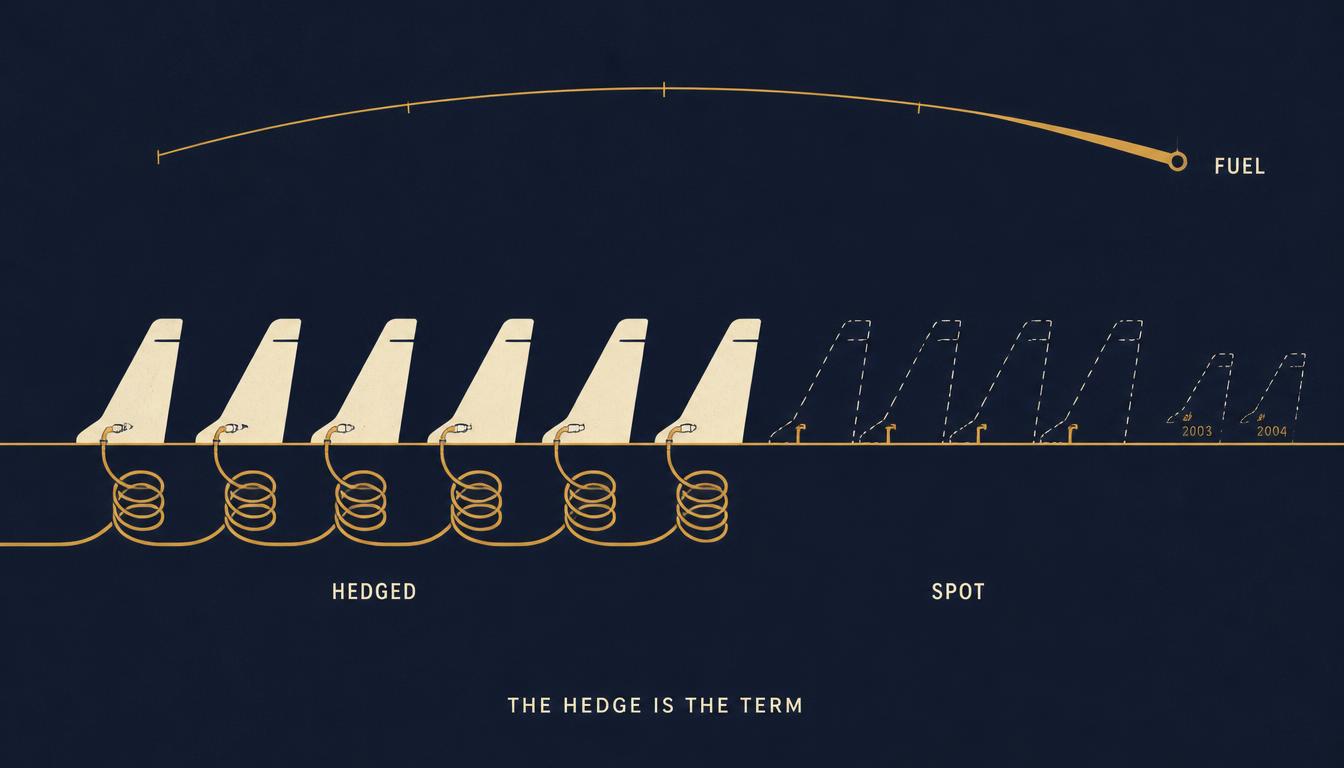
A carrier with substantial forward fuel hedging holds, in effect, a fixed-price obligation for a defined term. A crude spike does not reach it until the hedges roll. A carrier without hedging reprices continuously, at the spot market, on every tank of fuel.
The hedge is the term. And the ultra-low-cost model is structurally the least able to hold one.
The reasons are internal to the business model rather than incidental to it. Ultra-low-cost carriers compete on fare, which compresses margin and leaves little cash to post as collateral against hedging positions. They run thinner balance sheets, which raises the cost of the counterparty credit a hedge program requires. And they operate with less pricing power to pass costs through to passengers, because the passenger they attract is the one who chose them on price.
Every one of those properties is a feature of the model working as designed. Together they mean the model carries the shortest possible duration against its largest volatile input.
The industry reporting arrives at the same place from the revenue side. Budget carriers are absorbing the sharpest hit, Reuters notes, precisely because they lack the higher-margin streams larger airlines use to offset rising costs — premium cabins, high-yield business travelers, and credit card loyalty programs. 2 A legacy carrier facing a fuel spike has somewhere else to earn. An ultra-low-cost carrier has the fare, and the fare is what it competes on.
Spirit had been unprofitable since the pandemic and had filed twice before. 4 What the fuel spike did was remove the remaining interval in which a restructuring could be completed. The same mechanism operating at smaller scale, across charter and regional operators with even less hedging capacity, produced the rest of the cluster.
What the framework takes from this
Failure clusters produce concentration, and the concentration is the lasting effect.
The firms that failed were the ones whose cost structure repriced. The firms that survived were, disproportionately, the better-capitalized incumbents the low-cost segment existed to discipline. Six months after Spirit, American legacy carriers face a competitive landscape with one fewer ultra-low-cost operator, two former low-cost competitors repositioned upmarket, and an industry observer stating that the survivors have learned how to prevent the category from reconstituting.
This catalog has documented the same shape elsewhere. Article 46 established index concentration at levels exceeding 2000. Article 53 argued that the mandated bid sustaining that concentration requires no coordination. Article 48 traced the capital flows. The airline sector supplies something those essays could not: a completed cycle, in which a shock removed a category and the surviving structure is directly observable.
The framework's reading is that this is what fragility looks like when it resolves. Not a systemic collapse, and not a bailout — Article 35 documented that the attempted federal equity infusion at Spirit failed, and nothing in the subsequent six months reversed that. What occurred instead is a quieter outcome: a sector emerged from the shock more concentrated than it entered, with the eliminated competitors' customers distributed among the survivors, and with the mechanism of elimination widely understood and unlikely to be resisted next time.
And Menger's apparatus names the cost to the passenger. The ultra-low-cost carrier was, whatever its service reputation, the instrument through which air travel became accessible to people for whom the legacy fare was prohibitive. Its removal is not a price change. It is a reduction in the set of transactions available — which is a saleability question on the consumer side, and this catalog has argued across its housing and labor work that reductions of that kind rarely appear in a price index at all.
What to watch
Whether a new entrant attempts the ultra-low-cost model. The strongest test of the "category removed" claim is whether capital will fund a new United States ultra-low-cost carrier in the next two to three years. Breeze and Avelo were both founded in the last decade; the question is whether that remains possible after Spirit.
Fuel prices and the surviving five. Frontier, Allegiant, Breeze, Sun Country and Avelo face the same structural hedging constraint Spirit did. If crude stays elevated, the framework's mechanism predicts further failures in that group specifically, rather than distributed across the industry.
Whether the AOC revocation wave continues. The certificate revocations are a separate signal from the insolvencies, because a regulator withdrawing an operating certificate on financial grounds is making a forward solvency judgment rather than recording a completed failure. A continuing wave would indicate the cluster is not finished.
Legacy carrier fare behavior on former Spirit routes. If the concentration argument is correct, fares on routes where an ultra-low-cost carrier has exited should rise relative to routes where one remains. This is measurable and the framework has not measured it.
What would falsify this
If a well-capitalized ultra-low-cost entrant appears and gains traction. That would indicate the category was not removed but temporarily vacated, and the framework's structural reading would be wrong.
If the surviving low-cost carriers hedge their way through sustained high fuel. The duration argument predicts that carriers with the thinnest hedging capacity fail first under a sustained input shock. Survival of the remaining five through an extended period of elevated crude would indicate that hedging capacity is less binding than this essay claims.
If fares on former Spirit routes do not rise. The concentration claim has a price implication. If it does not appear, the competitive effect is smaller than argued.
The framework notes what would not falsify it: further airline failures. Additional insolvencies are consistent with the argument and do not distinguish it from alternatives.
The framework's reading
Article 35 read the Spirit shutdown as substrate fragility made visible at corporate scale, and identified fuel as the transmission mechanism. Six months later the mechanism is uncontested and the cluster has roughly doubled.
What has become visible since is the thing a failure cluster leaves behind. A sector that entered 2026 with a contested low-fare segment exits it with that segment substantially reduced, its two largest former members repositioned, and the incumbents reported to have learned how to prevent its reconstitution.
The sorting was not arbitrary and it was not about management quality. It followed duration — the same variable this catalog identified in two national mortgage markets operating under the same rate structure. The carriers that died were the ones whose largest volatile input repriced continuously, and that property is inseparable from the business model that made them cheap.
An economy can absorb a fuel shock. What it cannot do is absorb one without changing which firms exist afterward, and the firms that do not survive are not the marginal ones in any moral sense. They are the ones holding the shortest contracts against the thing that moved.
Sources
A note on scoring. The framework records Article 35's fuel attribution as correct while stating explicitly that the claim was not difficult: fuel is among the largest cost lines in an airline's structure, the crude move was public, and the transmission lag is short. Article 50 of this catalog established the practice of scoring calls on the terms they were made and declining to inflate the ones that land. This is an application of that rule.
A note on the duration argument. The claim that hedging capacity is the sorting variable in the airline cluster is the framework's own extension of the argument developed in Article 62 regarding mortgage term structure. It is offered as a structural reading consistent with the observed pattern rather than as a measured finding; the framework has not obtained carrier-level hedging data for the failed operators. The falsification section states what would count against it.
Framework cross-references. Article 16 (the failure-cluster diagnostic); Article 26 (the Hormuz lag and its transmission to downstream costs); Article 27 (the extend-and-pretend ceiling); Article 35 (the original analysis of the Spirit shutdown and the 2026 cluster); Article 44 (the forced-seller conditions); Article 46 (index concentration); Article 48 (capital flows sustaining concentration); Article 50 (the practice of scoring calls on their stated terms); Article 53 (the mandated bid and concentration without coordination); Article 62 (duration as the variable determining exposure to a cost shock).
Footnotes
-
"These airlines filed for bankruptcy or ceased operations in the first half of 2026." FTN News, 2026. https://ftnnews.com/travel-news/aviation/these-airlines-filed-for-bankruptcy-or-ceased-operations-in-the-first-half-of-2026/ — Source for the framing that "a growing list of airlines has collapsed in 2026 as jet fuel prices surge"; for Zenith Airlines canceling flights from early June with all 41 flight crew and administrative personnel left unemployed and the UK Civil Aviation Authority suspending its AOC; for BeOnd's cancellation of all Maldives-to-Europe service and the headline attributing it to Middle East conflict driving a jet fuel crisis; and for the Magnicharters and Joy Air filings. ↩ ↩2 ↩3 ↩4
-
Reuters, reporting remarks by Willie Walsh, director general of the International Air Transport Association, and the sector's 2026 financial position. Syndicated coverage at https://www.khaleejtimes.com/business/iran-war-leaves-crisis-weary-european-airlines-ready-for-a-shakeout and https://news.tuoitre.vn/high-fuel-costs-to-trigger-airline-failures-and-consolidation-industry-chief-says-103260607095354658.htm — Source for Walsh's expectation that some airlines will go out of business and others be acquired by larger carriers, and his statement that Spirit would not be the last; for jet fuel prices having more than doubled since the beginning of the war with Iran, choking supplies and disrupting air corridors; for the global industry nearly halving its 2026 profit forecast; and for the finding that budget carriers are absorbing the sharpest hit because they lack the higher-margin revenue streams — premium cabins, high-yield travelers, credit card loyalty programs — that larger airlines use to offset rising costs. On the twenty-two scheduled U.S. passenger airlines losing a combined $966 million after taxes in the first quarter, see Scripps News, https://www.abc15.com/life/travel/us-airlines-lost-close-to-1-billion-last-quarter-as-iran-war-sends-costs-higher — Also the source for easyJet nearing a U.S.-led takeover, airBaltic seeking short-term financing, and Norse Atlantic undertaking a strategic review. ↩ ↩2 ↩3 ↩4 ↩5 ↩6
-
TheStreet, "Airline grounded, cancels all flights after bankruptcy," 2026, syndicated at https://finance.yahoo.com/economy/articles/another-airline-ends-bankruptcy-hundreds-070200966.html — Source for the Spirit attribution that "although the airline had filed for Chapter 11 protection twice before, the skyrocketing price of jet fuel dealt the final blow to its operations"; and for Fischer Air's insolvency, the Hamburg public prosecutor's charges against its chief over flights sold but repeatedly postponed through 2025 and 2026, and the removal of its ticket-selling website. ↩ ↩2
-
Skores, Alexandra. "In Europe, budget airlines thrive. Why not the US?" CNN, 20 October 2026. Syndicated at https://www.ksl.com/article/51638547/in-europe-budget-airlines-thrive-why-not-the-us — Source for the statement that Spirit "had been unprofitable since the pandemic" before its 2026 collapse, and for the comparative scale of the European and American low-cost segments. ↩ ↩2
-
Argentine financial press on Flybondi's collapse: El Economista, https://eleconomista.com.ar/economia/flybondi-pidio-concurso-acreedores-n98643 ; Forbes Argentina, https://www.forbesargentina.com/negocios/flybondi-pidio-concurso-preventivo-acreedores-ahogada-sus-deudas-n99473 ; and ANBariloche, https://www.anbariloche.com.ar/noticias/2026/10/06/119181-el-colapso-de-flybondi-derivo-en-un-concurso-judicial-para-evitar-la-quiebra — Source for the suspension of all flight operations on 6 August 2026 amid frozen bank accounts and grounded aircraft; for the 2 October 2026 filing for creditor protection (concurso preventivo) covering liabilities of roughly $120 million, reported in pesos as debts of 609.589 billion against negative net equity of 433.485 billion; for approximately 2,400 flights canceled during 2026 affecting more than 380,000 passengers; for the fall in domestic traffic from 254,533 passengers and a 17 percent share in August 2025 to 1,865 passengers and 0.1 percent in August 2026; and for ten aircraft returned to lessors with three remaining inoperative in the country. The framework notes that the October filing is a reorganization proceeding rather than a liquidation. ↩ ↩2 ↩3
-
TheStreet, "Another airline files for bankruptcy, cancels all flights," 2026, syndicated at https://finance.yahoo.com/small-business/articles/another-airline-files-bankruptcy-cancels-155035110.html — Source for OMNI Aviação's insolvency following license suspension and the description of its charter, aircraft management, maintenance and air ambulance operations; for the observation that the most common reasons for AOC suspension or revocation are a failed safety audit or a financial situation calling into question the airline's ability to remain in business; and for the 2026 AOC revocation list including Pen-Avia (United Kingdom), Total Linhas Aéreas (Brazil), Mali Air (Austria), Westair Aviation (Ireland), AirAiles (France), and Bestfly Aircraft Management Aruba. ↩ ↩2
-
"Airlines that stopped flying in 2026." Allplane, updated 20 August 2026. https://allplane.tv/blog/2026/4/29/airlines-that-stopped-flying-in-2026-updated-as-of-29426 — Source for Air Antilles having been grounded in December 2025 after the regulator identified operational and security deficiencies, and for the April 2026 order of dissolution by a court in Guadeloupe; and for the observation that "the global geopolitical environment is straining the industry to levels that few could have anticipated just a few months prior." ↩
-
CNN, 20 October 2026 (as 4) — "Today, five low-cost carriers remain in the U.S. — Frontier, Allegiant Air, Breeze Airways, Sun Country Airlines and Avelo Air." Also the source for Southwest and JetBlue having been "once the leading low-cost carriers in the U.S." and now operating a more hybrid model; for Shye Gilad, a former airline captain, on the defensive strategies legacy carriers adopted against the segment, including price-matching and the introduction of basic economy fares; and for Delta launching a low-cost subsidiary in 2003 and United in 2004, both of which "were shut down within several years after fuel prices spiked." ↩ ↩2 ↩3 ↩4