Researched and drafted with AI assistance · reviewed and edited by Jason D. Keys
Monday to Tuesday
The timeline is the article, so it goes first, stated flat.
Monday, November 2. Regulators investigating ueno bank's loans to companies linked to its owners found poorly documented lending, and found expenses the bank had wrongly counted as assets. After the books were corrected, ueno's capital stood below half the legal minimum — a solvency ratio of 5.56 percent against a required 12, with accounting adjustments exceeding 1.6 trillion guaraníes and difficulty replenishing a legal reserve requirement of roughly $70 million. 1 2
Tuesday, November 3. The central bank seized the lender, announcing it would move customer accounts and any remaining valuable assets to other banks and liquidate the remainder. 3 ueno's app, cards, and transfers stopped working. Branches closed. 1
Wednesday, November 4. Depositors rushed to open accounts elsewhere and crashed other banks' applications in the attempt. Central bank president Carlos Carvallo resigned at the president's request. 1
Thursday, November 5. President Santiago Peña announced his resignation, having lost the support of his own party. The lower house voted unanimously to impeach him minutes afterward, while rejecting a separate impeachment motion against Vice President Pedro Alliana, who is next in line. 4 5
Four days end to end. The operative interval — between the determination that the bank was insolvent and the moment three million people could no longer spend their own money — was one.
What ueno was
ueno went from an obscure finance company to a household name in under five years. It won its banking license in 2023, merged with Visión Banco in 2024, and grew to more than seventy locations. 1 2
It reported 2,941,996 clients as of June 2026, in a country of roughly seven million people. 2 6 The Associated Press reports it claimed more than sixty percent of Paraguay's adults as customers. 1
By deposits it was the fifth-largest private bank in Paraguay, holding 8.9 percent of the system's deposits and 5.9 percent of its loans as of December 2025, and more than $2.8 billion in deposits by September 2026. 7
Two figures from that customer base matter for everything that follows.
Approximately 280,000 people banked only with ueno. 1 No second institution, no second card, no second rail.
Roughly $800 to $850 million of its deposits were public money — about a quarter of its total — including funds from the state pension and health institute and from the operators of Paraguay's large hydroelectric dams. 1 2
What failed, and why that is the less interesting question
The proximate story is documented, and it is a corruption story.
Inspectors found a pattern of risky lending to insiders as early as June, five months before the seizure. 1 ueno lent large sums to companies tied to its owners, beyond legal limits and without sufficient collateral; on a single day in September 2025, nearly $39 million went to three such companies. 1 Prosecutors have charged twenty-seven bank officials and business associates with offenses including breach of trust and attempted fraud, and eight senior executives were detained, among them founder Miguel Vázquez and president Juan Manuel Gustale. 1
The institutional picture around the lending is worse than the lending.
Carlos Carvallo, the central bank president who supervised ueno, had previously been president of Financiera Ueno — the bank's own predecessor entity — before Peña appointed him to the central bank. 1 Peña himself held a stake in ueno's holding company until last year, and government money flowed into the bank under his administration. 1 As recently as October, with solvency doubts already a matter of public pressure, Peña publicly defended both ueno and the central bank's oversight of it, dismissing the concerns as a smear campaign. 1 8
None of that is minimized here, and nothing below depends on contesting it.
But it explains why ueno failed. It does not explain why three million people lost access to everything they had in a single day. Those are different questions, and only the second one travels.
A bank can fail through fraud in any country under any regulatory regime, and many have. What is new in Paraguay is not the failure. It is the execution.
A correction to Article 54
In September this catalog examined European bail-in authority alongside the Bank for International Settlements proposal for a unified ledger — a single programmable platform combining central bank digital currency, tokenized deposits, and tokenized assets, justified on the stated ground that "by having 'everything in one place', a unified ledger provides a setting in which a broader array of contingent actions can be automatically executed."
That essay's argument was deliberately narrow. It did not claim such an architecture would create a power to adjust a depositor's claim, because that power already exists in directive law and has been exercised. What it argued was:
What a unified ledger would change is not the authority. It is the latency.
And it specified what the latency was protecting. Executing a resolution requires convening an authority, performing a valuation, applying the creditor hierarchy, and propagating instructions across separate institutional systems with their own reconciliation cycles and operating hours. That takes days, conventionally compressed into a weekend. The friction, Article 54 argued, was designed by no one and defends no one deliberately, yet functions as a constraint in three ways: it bounds scope, because work that does not parallelize is practicable for one bank and difficult for several; it creates an interval in which the decision is reviewable, by a court or a political process or the authority itself; and it makes the action visible before it completes, so depositors elsewhere can act on the information.
Paraguay is not a test of that argument, and this essay will not present it as one.
ueno was not bailed in. No deposit was statutorily converted into loss-absorbing capital. There was no tokenization, no central bank digital currency, no unified ledger, and no European framework. It was a seizure and liquidation under a national deposit guarantee regime — a different instrument, in a different legal system, through a different mechanism. Calling it a confirmation would mean widening the original claim until the evidence fits, which is the move Article 50 refused when it kept a failed inflation call scored as a loss rather than rescuing it with later data.
What Paraguay does is correct the essay's baseline assumption, and the correction matters more than a confirmation would have.
Article 54 treated operational friction as the status quo — the condition every bank operates under, which a new architecture would remove. That was wrong. The friction is not structural. It is a property of a particular kind of institution: one whose customer access runs through branches, cards issued by third parties, checks, correspondent relationships, and systems that were assembled separately and never fully integrated.
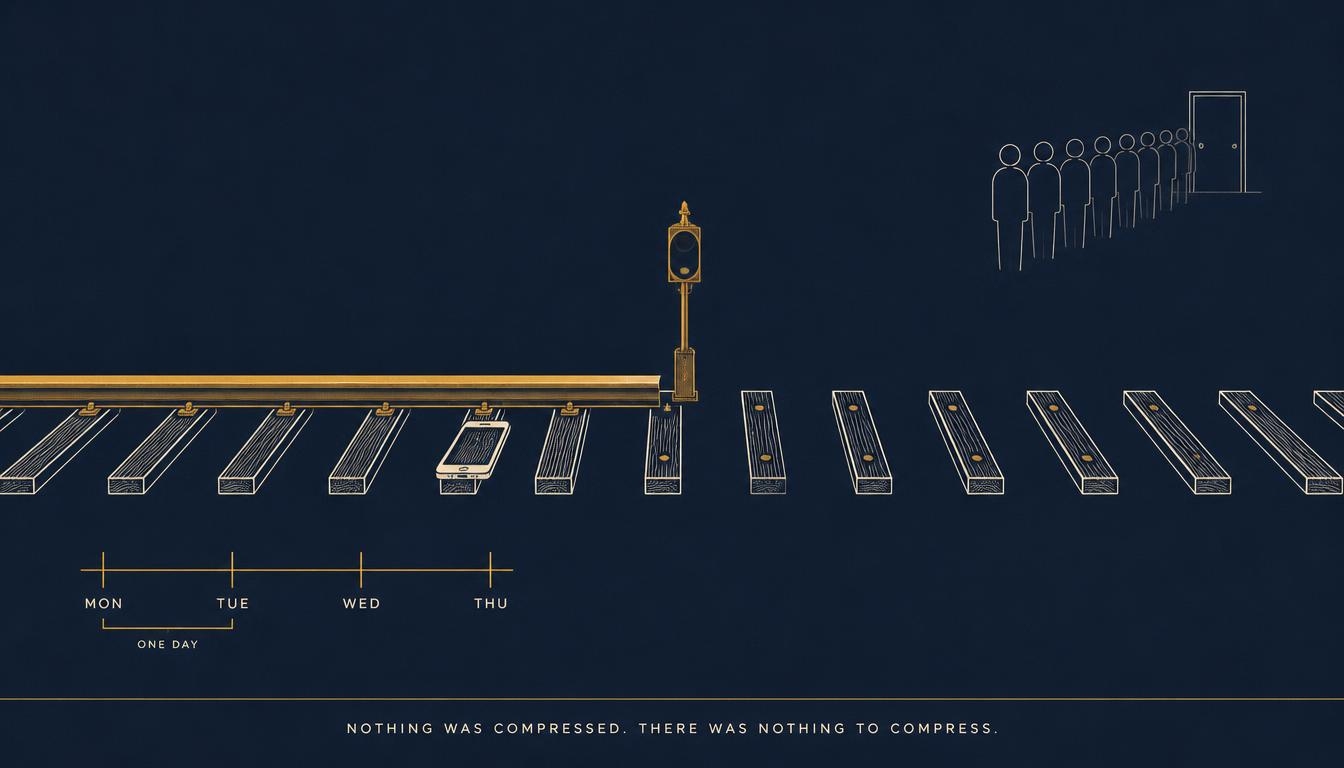
An institution built digital-only never has it. When the access layer and the claim ledger are the same object, maintained by the same operator, there is no distance between adjusting the claim and terminating the access. Nothing was compressed at ueno. There was nothing to compress.
This cuts in both directions and both are worth stating.
It strengthens the underlying claim. Article 54 argued the protection was accidental and undefended. Paraguay is a case where its absence had consequences and nobody noticed it was missing — because nobody had identified it as a protection to begin with. No Paraguayan disclosure, prospectus, or supervisory framework treated continuity of access as a thing a depositor was owed separately from the money itself.
It weakens the framing. Article 54 located the risk in a future architecture under construction in Europe, on a timeline running to 2029. The relevant variable turns out not to be tokenization at all. It is whether an institution has an access layer separable from its claim ledger — and ordinary commercial digital banks, available now, in dozens of countries, do not. The essay was looking at the right mechanism through too narrow a lens.
The three functions, in a case where they were absent
Article 54 named three things the friction does. Each can now be examined where it was not present.
Scope. The argument was that friction bounds how many institutions can be acted on at once, because the work does not parallelize. Paraguay does not address this directly — one bank was seized, not several. But it clarifies what the constraint was made of. It was never the regulator's willingness; it was the labor. Where the labor approaches zero for a given institution, the remaining limit on scope is how many such institutions exist. In a country where one digital bank held more than sixty percent of adults as customers, one was enough.
Reviewability. Here the record is unambiguous. The interval between the corrected books and the dead app was roughly twenty-four hours. No court was petitioned in that window. No legislative process intervened. The decision may well have been correct — a bank at 5.56 percent solvency against a required 12 is insolvent by any measure, and a regulator who delays is choosing a different harm. The point is not that the seizure was wrong. It is that the window in which it could have been reviewed did not meaningfully exist, and that nobody decided to eliminate it.
Visibility. Article 54 argued a weekend resolution is observable while it happens, letting depositors elsewhere act on the information. Paraguay inverts this instructively. The action was instantly visible — the app simply stopped — but visibility arrived after completion rather than during. What followed was the response the friction was supposed to enable: depositors moved, on Wednesday, crashing other banks' applications in the attempt. 1 They moved after their own money was already frozen. That is a queue forming at a door that has already closed.
The failure mode does not depend on what failed
Last week this catalog examined the Binance breach, in which roughly $6.3 billion left hot wallets across ten blockchains in under four hours while — by the exchange's own account — no private key was compromised and the cryptography performed exactly as designed throughout.
The argument there was that the security of a digital balance is bounded not by the strength of its cryptography but by the weakest authorization path to its signing infrastructure.
Paraguay supplies the mirror image.
At Binance, the technology worked perfectly and the money left anyway. At ueno, the technology worked perfectly until a regulator switched it off. One was theft; one was lawful resolution. One involved a criminal actor, the other a supervisory authority acting within its mandate.
The user experience was identical. The number on the phone stopped being spendable, with no warning, through no act of the holder, and with no recourse available at the moment it happened.
The generalization: the failure mode of a digital claim does not depend on what failed. Theft, insolvency, resolution, sanction, outage, error — the holder's position is the same in every case, because in every case what he controls is not the asset but a permission to transact, granted and revocable by someone else.
This catalog has argued across sixty-four prior installments that the essential discipline is distinguishing a claim from the thing it names. Two events three days apart in late October and early November 2026 are the clearest paired demonstration it has had.
What the guarantee actually covers
Paraguay's Fondo de Garantía de Depósitos, established by Ley 2334/03, covers deposits up to the equivalent of seventy-five minimum monthly salaries, per depositor, per institution. 9 As of the ueno resolution that limit stands at 228.3 million guaraníes. 10 2
Three features of it should be read together.
The first payment is not the limit. Depositors will initially receive up to 10 million guaraníes — roughly four percent of the guaranteed ceiling — with the central bank stating it will pay "a la brevedad, sin precisar una fecha": as soon as possible, without specifying a date. The remaining guaranteed balance follows on a schedule not published at the time of writing. 10
Debts are netted first. Amounts owed to ueno are subtracted before the guarantee is paid, so a customer who also borrowed may receive less than his deposit balance, in some cases materially less. 10
Above the limit, nothing is guaranteed. The central bank has said it will use available legal mechanisms to protect as much of the excess as possible, and has explicitly not guaranteed its return. 10
Now set the limit against the population it covers, because the two measures diverge sharply and the divergence is the point.
By depositor, the coverage is nearly total. The 228.3 million guaraní ceiling is enough to fully cover approximately 97 percent of ueno's depositors. 7 For the overwhelming majority of the three million, the statutory guarantee reaches their entire balance.
By value, it is not. As of December 2024, guaranteed deposits across the system — after netting depositors' debts — totaled roughly 25.97 trillion guaraníes against total private-system deposits of about 151.42 trillion. The guarantee covers approximately 17 percent of deposits by value. 9
Both figures are true simultaneously, and a deposit guarantee is routinely defended using the first while the second is what determines whether the fund survives contact with a large failure. Ninety-seven percent of depositors made whole is a sentence a regulator can say. It is compatible with the great majority of the money being unprotected, because deposits are not distributed evenly across depositors.
That figure belongs to a short series this catalog has been building without intending to. Article 48 examined a United States life insurance industry carrying $11.0 trillion in assets against $10.6 trillion in liabilities — a four percent equity cushion. Article 64 noted Binance's SAFU fund at roughly $1 billion against a $6.3 billion loss, about one to six. Paraguay's guarantee fund stands at roughly $1 billion against a $2.8 billion failure, covers 17 percent of system deposits by value, and caps individual recovery near thirty thousand dollars.
Three sectors, two months, one structural observation: a cushion is only meaningful relative to the loss distribution it is sized against, and in none of the three cases is that relationship published.
The numbers that are not available
One figure is now reported and one is not, and the pair is more informative than either alone.
ueno's deposit base is approximately $2.8 billion as of September 2026. 7 That figure is consistent with the public-funds component: $800–850 million against a $2.8 billion base is roughly thirty percent, close to the "about a quarter" the Associated Press describes. 1
The current resources of the Fondo de Garantía de Depósitos are not stated in the coverage of the resolution, though the central bank has separately published that the fund reached a historic high equivalent to approximately $1 billion. 11
Put the two together and the ratio is the single most informative figure about this episode: a guarantee fund of roughly one billion dollars standing behind a failed institution holding roughly 2.8 billion in deposits — about one to three, at a single bank, in a system where that bank was the fifth largest and held 8.9 percent of deposits. 7
The framework states the obvious caveat: the fund covers the guaranteed tranche rather than the full deposit base, so one-to-three is not the operative coverage ratio and is not presented as one. What it establishes is the order of magnitude, and the order of magnitude is that a single mid-sized failure is a material fraction of the entire national guarantee. Nobody is required to publish that comparison at the moment it matters, and this catalog had to assemble it from three separate sources none of which set out to make it legible.
A smaller discrepancy, for the reader's benefit. Published dollar equivalents of the 228.3 million guaraní limit vary meaningfully across sources — roughly $29,000 to $38,600 — depending on the exchange rate assumed. 2 6 9 The guaraní figure and the statutory definition of seventy-five minimum salaries are exact; the dollar conversions are not, and are treated here as approximations.
Menger, and a saleability that is binary
Menger's account of money rests on Absatzfähigkeit — saleability, the degree to which a good can be disposed of without loss. 12 This catalog has used it as a continuous measure applicable to any asset, and has argued that the decay of marketability is the signature of an instrument's degradation.
A deposit at a digital-only bank does not decay. It has a saleability of one until it has a saleability of zero, and the transition is instantaneous, discontinuous, and controlled entirely by a third party.
No commodity has that property and no bearer instrument has it. A banknote in a pocket does not become unspendable because an institution was seized. Gold in a safe does not stop being gold because a regulator corrected a balance sheet. Both can be lost, stolen, confiscated, or devalued — but none of those is a state change executed remotely, simultaneously, against every holder at once.
Article 47 developed the Custody Depth score, counting the institutional counterparties standing between a holder and unencumbered control of an asset. Physical possession scores zero.
Paraguay supplies the limiting case from the other end. For roughly 280,000 people the count was one, and one was sufficient. Not one institution among several — one institution, full stop, with no parallel arrangement of any kind.
Article 43 found that under conditions of sudden displacement, portability dominates every other consideration, and that bearer instruments proved close to uniquely protective in exactly that scenario. The threat model there was flight across a border. The threat model here is a supervisory determination on a Tuesday morning, and the defense that works against it is the same: an instrument that requires nobody's permission to function.
ueno reached sixty percent of Paraguay's adults in under five years, which is a real achievement in financial inclusion and is not what this essay disputes. What it disputes is that the arrangement was understood. The people holding those accounts believed they held money. They held a permission with a single point of failure, and no disclosure framework required telling them.
The supervisor and the supervised
The Charter series — Articles 57 through 59 — traced how institutional limits on corporations were dismantled across two centuries, and found in each case that the consequential outcome arrived without a decision producing it: charter limits competed away by states seeking revenue, corporate constitutional rights accumulated through narrow holdings, financial privacy rendered inapplicable rather than repealed.
Paraguay is different in a specific respect. The separation between supervisor and supervised did not erode here. It was never constructed. The central bank president had run the bank's predecessor entity. The head of state had held a stake in its holding company. Public pension money sat on its balance sheet. Each relationship was known, none was concealed, and the system operated with all three in place until the arithmetic stopped working.
Article 52 examined a case in which three institutions acted on the same variable with different mandates and no coordinating mechanism, and argued the resulting price was not a price in Menger's sense but the residue of three administrative programs. Paraguay presents the inverse pathology: not three institutions with no coordination, but one set of people occupying three roles with no separation — supervisor, depositor, and until recently owner.
What that arrangement guaranteed is that no party in the structure held both the information and an independent interest in acting on it. The June inspection findings sat for five months. 1
What to watch
Whether the 280,000 are made whole, and when. The central bank said accounts were being opened at other institutions for customers who banked nowhere else, and that repayments had begun. 1 The interval between the first 10 million guaraní payment and full guaranteed recovery is the measurable test of what a guarantee is worth in practice rather than in statute.
What happens above the limit. Deposits above 228.3 million guaraníes are explicitly not guaranteed. 10 The recovery rate on that tranche tells depositors elsewhere what an uninsured balance at a Paraguayan bank is actually worth.
Whether public funds receive different treatment. The state pension and health institute and the hydroelectric dam operators held $800–850 million at ueno. Whether public depositors are made whole on terms unavailable to private ones is both a political question and a direct test of where the creditor hierarchy sits when the sovereign is itself a creditor.
Whether any regulator draws the operational conclusion. The access-continuity question is not specific to Paraguay. Any jurisdiction with a digital-only bank of systemic customer reach has the same property, and no regulatory framework known to this catalog treats continuity of access as a requirement distinct from deposit protection.
What would falsify this
If the resolution timeline proves longer than reported. The argument rests on the one-day interval between corrected books and terminated access. If operational work extended materially before or after the public timeline, the compression is less dramatic than stated.
If a conventional branch-based bank is resolved at comparable speed. The claim is that digital-only structure is why the friction was absent. A traditional bank resolved in twenty-four hours with equivalent access termination would show the friction was never doing the work attributed to it.
If depositors are made whole quickly and substantially. The argument concerns the gap between holding an asset and holding a permission. A guarantee that performs rapidly and nearly in full narrows that gap considerably. The first payment of 10 million guaraníes against a 228.3 million ceiling is the current evidence, and it is early.
If Paraguay proves genuinely idiosyncratic. The strongest objection is that a small country with documented governance problems and a central banker who previously ran the failed institution is not a system under stress but a system that was never functioning. The answer offered here is that the fraud explains the failure and not the execution — but a reader who finds the governance story sufficient is entitled to that view, and this catalog has no comparable case in a well-governed jurisdiction to offer against it.
What would not falsify it: further revelations about the fraud. Additional detail on insider lending is consistent with everything here and bears on the wrong question.
The framework's reading
Three million people woke up on Tuesday with bank accounts and went to bed without them.
That sentence contains no cryptography, no tokenization, no central bank digital currency, and no unified ledger. It contains a corrected balance sheet, an administrative decision, and an application that stopped responding.
Article 54 asked what a programmable settlement layer would change about powers that already exist, and answered: the latency. The answer was right and the premise beneath it was not. That essay assumed every bank sits behind days of operational friction, and that the friction was the thing a new architecture would take away. Paraguay shows the friction was never universal — that institutions can be built without it, have been, and were welcomed when they were, because the same property that makes a bank resolvable in a day is what makes it convenient on every other day.
The 280,000 people who banked nowhere else did not choose a custody arrangement. They chose a bank with a good application, in a country where that was a genuine improvement over the alternative. The convenience and the vulnerability were the same property, and nothing in the arrangement was built to tell them so.
Sources
A note on what this essay does and does not claim about Article 54. Paraguay is not a test of that essay's argument and is not presented as one. ueno was not bailed in, no deposit was statutorily converted to loss-absorbing capital, and no unified ledger, tokenization, or central bank digital currency was involved. What Paraguay corrects is the baseline assumption beneath the argument — that operational friction is the universal condition a new architecture would remove — and the correction weakens that essay's framing while strengthening its underlying claim about the friction being accidental and undefended. This catalog scores its own calls on the terms they were made (Article 50) and declines to count a different mechanism producing a similar outcome as a confirmation.
A note on a moving story. This essay was written on 5 November 2026, three days after the seizure and hours after the resignation and impeachment. The political situation, the recovery timeline, and the full accounting of ueno's balance sheet were all unresolved at the time of writing. Article 49 established the rule that a single early report is an observation rather than a fact; this essay is written under that constraint and will be corrected if the record requires it.
Framework cross-references. Article 43 (threat models, and the protective property of bearer instruments under sudden loss of access); Article 47 (the Custody Depth score); Article 48 (the four percent insurance cushion and the question of what a cushion is sized against); Article 49 (a single early report as observation rather than fact); Article 50 (scoring calls on the terms they were made); Article 52 (multiple institutions acting on one variable with no coordinating mechanism); Article 54 (bail-in authority, the unified ledger, and the latency argument this essay corrects); Articles 57 through 59 (the Charter series on institutional limits dismantled without decision); Article 64 (the Binance breach, and the claim that the security of a digital balance is bounded by its weakest authorization path).
Footnotes
-
Associated Press, "How one bank's collapse is upending Paraguay, trapping savings and threatening its president," via ABC News, 5 November 2026. https://abcnews.go.com/Business/wireStory/banks-collapse-upending-paraguay-trapping-savings-threatening-president-137881113 — Source for the Monday–Wednesday timeline including the discovery of poorly documented insider lending and expenses wrongly counted as assets; for ueno winning its banking license in 2023 and growing to more than seventy locations; for the claim of more than sixty percent of Paraguay's adults as customers; for approximately 280,000 people banking only with ueno; for roughly $800 million in public deposits constituting about a quarter of the total, including the state pension and health fund and hydroelectric dam operators; for the June inspection findings reported by ABC Color; for the September 2025 single-day transfer of nearly $39 million to three insider-linked companies; for Carlos Carvallo's resignation at Peña's request and the naming of Pedro Acosta Bernal as interim central bank president; for Carvallo having previously served as president of Financiera Ueno; for Peña's stake in ueno's holding company until last year and his October defense of the bank as a smear campaign; for the detention of eight senior executives including founder Miguel Vázquez and president Juan Manuel Gustale and charges against twenty-seven officials and associates; for depositors crashing other banks' applications on Wednesday; and for accounts being opened at other institutions with repayments begun. ↩ ↩2 ↩3 ↩4 ↩5 ↩6 ↩7 ↩8 ↩9 ↩10 ↩11 ↩12 ↩13 ↩14 ↩15 ↩16 ↩17
-
"Qué pasó con Ueno Bank: las 10 claves del escándalo financiero que conmociona a Paraguay." La Gaceta, November 2026. https://www.lagaceta.com.ar/nota/amp/1161157/economia/que-paso-ueno-bank-10-claves-escandalo-financiero-conmociona-paraguay.html — Source for 2,941,996 clients as of June 2026 per the bank's own records; for the solvency ratio of 5.56 percent against a required 12 percent; for accounting adjustments exceeding 1.6 trillion guaraníes; for difficulties replenishing a legal reserve requirement of approximately $70 million; for the 2024 merger with Visión Banco; for US$800–850 million in public funds under administration; for investigations covering credits and overdrafts to Grupo Vázquez companies between 2025 and 2026; and for the coverage limit of 228.3 million guaraníes with a first payment of up to 10 million guaraníes per saver. ↩ ↩2 ↩3 ↩4 ↩5 ↩6
-
"Paraguay seizes major digital bank tied to president, leaving millions of customers in limbo." ABC News, 3 November 2026. https://abcnews.go.com/International/wireStory/paraguay-seizes-major-digital-bank-tied-president-leaving-137806474 — Source for the 3 November seizure and the announced plan to transfer customer accounts and remaining valuable assets to other banks before liquidating the remainder. See also Bloomberg, "Central Banker to Quit Over Solvency Crisis at a Paraguay Lender," 3 November 2026, https://www.bloomberg.com/news/articles/2026-11-03/paraguay-central-bank-intervenes-in-ueno-bank-on-solvency-fears ↩
-
"Paraguay's president is impeached minutes after resigning following a bank collapse." NPR, 5 November 2026. https://www.npr.org/2026/11/05/nx-s1-6030842/paraguay-president-impeached-bank-collapse ↩
-
"President of Paraguay resigns amid crisis over bank collapse that left millions unable to access their money." CNN, 5 November 2026. https://www.cnn.com/2026/11/05/americas/president-paraguay-resigns-latam-intl ↩
-
"Qué pasó con el Ueno Bank en Paraguay y qué sucederá con los ahorros de casi 3 millones de clientes." Perfil, November 2026. https://www.perfil.com/economia/que-paso-con-el-ueno-bank-en-paraguay-y-que-sucedera-con-los-ahorros-de-casi-3-millones-de-clientes-akRIu5P10Qk5 — Corroborates 2,941,996 clients as of June 2026 and the coverage limit of seventy-five minimum monthly salaries, approximately 228.3 million guaraníes, with a first payment of up to 10 million guaraníes. ↩ ↩2
-
Reuters and Bloomberg coverage of the resolution, 3–4 November 2026. Reuters via Internazionale, "Paraguay's central bank chief resigns at president's request as digital lender crisis deepens," https://www.internazionale.it/ultime-notizie-reuters/2026/11/03/paraguay-s-central-bank-chief-resigns-at-president-s-request-as-digital-lender-crisis-deepens and via The Star, https://www.thestar.com.my/news/world/2026/11/04/paraguay039s-central-bank-chief-resigns-at-president039s-request-as-digital-lender-crisis-deepens — Source for ueno standing as the fifth-largest private bank in Paraguay, holding 8.9 percent of the system's deposits and 5.9 percent of its loans as of December 2025 and more than US$2.8 billion in deposits by September 2026; and for the 228.3 million guaraní ceiling being sufficient to fully cover approximately 97 percent of ueno's depositors. See also Bloomberg (as 3). ↩ ↩2 ↩3 ↩4
-
"Pressure mounts on Paraguay's central bank over doubts about some lenders' solvency." MercoPress, 18 October 2026. https://en.mercopress.com/2026/10/18/pressure-mounts-on-paraguay-s-central-bank-over-doubts-about-some-lenders-solvency/comments — Cited at headline level to establish that solvency doubts regarding Paraguayan lenders were a matter of public pressure by 18 October 2026, two weeks before the seizure. The substance of Peña's response in that period is taken from 1. ↩
-
"Depósitos bancarios: ¿Hasta cuánto cubre el Fondo de Garantías del BCP?" ABC Color, 24 January 2025. https://www.abc.com.py/negocios/2025/01/24/depositos-hasta-cuanto-cubre-el-fondo-de-garantias-del-bcp/ — Source for the statutory coverage limit of "el equivalente de setenta y cinco (75) salarios mínimos mensuales" per depositor per institution; for Ley 2334/03 establishing the Fondo de Garantía de Depósitos on 12 December 2003; and for guaranteed deposits of approximately 25.97 trillion guaraníes after netting depositors' debts against total private-system deposits of approximately 151.42 trillion as of December 2024 — roughly 17 percent coverage by value. The article states the limit at that date as G. 209,873,175, approximately US$26,909. ↩ ↩2 ↩3
-
"Crisis financiera en Paraguay: qué pasará con los ahorros de Ueno Bank y cuánto podrán recuperar los clientes." Ámbito, November 2026. https://www.ambito.com/mundo/crisis-financiera-paraguay-que-pasara-los-ahorros-ueno-bank-y-cuanto-podran-recuperar-los-clientes-n6341154 — Source for the coverage limit of 228.3 million guaraníes per depositor per bank with multiple accounts counting toward a single combined limit; for the first payment of up to 10 million guaraníes with the central bank stating it will pay "a la brevedad, sin precisar una fecha"; for the remaining guaranteed balance following a schedule not yet published; for debts owed to ueno being subtracted before the guarantee is paid; and for the statement that deposits above the limit are not covered and that the central bank will use legal mechanisms to protect what it can without guaranteeing return of the excess. ↩ ↩2 ↩3 ↩4 ↩5
-
Banco Central del Paraguay, "Recursos del Fondo de Garantía de Depósitos alcanzan monto histórico equivalente a USD 1.000 millones." https://www.bcp.gov.py/web/institucional/w/recursos-del-fondo-de-garant%C3%ADa-de-dep%C3%B3sitos-alcanzan-monto-hist%C3%B3rico-equivalente-a-usd-1.000-millones — Cited for the central bank's own published figure of approximately US$1 billion in fund resources. This catalog was unable to confirm the publication date of the announcement or whether the figure remains current as of the ueno resolution, and treats it as indicative rather than established. ↩
-
Menger, Carl. "On the Origins of Money." Economic Journal, Vol. 2 (1892), pp. 239–255. Translated by Caroline A. Foley. https://mises.org/library/book/origins-money — The concept of Absatzfähigkeit, saleability, as the degree to which a good can be disposed of without loss. ↩
Related essays
The Hormuz Yuan Toll: A Spontaneous Mengerian Event
Iran charging yuan tolls at Hormuz during wartime, India paying for Russian crude outside the dollar, the 1974 US-Saudi economic commission expiring unreplaced — these are not geopolitical conspiracies. They are textbook Mengerian monetary evolution, happening in real time.
Monetary Power to the People
Money is a medium in McLuhan's sense — an extension of the human body that amplifies the capacity for exchange. Understanding this is the critical path to navigating the financial disruptions of the present age.
The Saleability Audit of Bitcoin: What Menger Would Say in 2026
Bitcoin maximalists insist Bitcoin is the most saleable monetary good ever created. Skeptics insist it doesn't work for the African villager or the rural Chinese citizen the maximalists invoke. Both positions miss what Menger's framework actually says when applied carefully. The audit produces uncomfortable results in both directions — Bitcoin scores remarkably well on some criteria and remarkably poorly on others — and the actual ground-truth of crypto adoption in emerging markets in 2026 is something neither camp accurately describes.