
Researched and drafted with AI assistance · reviewed and edited by Jason D. Keys
Listen
What Survives: The Diagnosis Doesn't Write the Prescription
Read in Jason D. Keys' synthesized voice
Narrated in the author’s synthesized voice, generated with AI from a recording of his own. The words are his; the delivery is machine-rendered.
Download (21.0 MB)The problem, restated
Article 42 of this catalog tested whether the framework's recommended hedge — physical gold, sized between 5 and 25 percent of savings — could be defended against the objection that a correct diagnosis of monetary unsoundness provides no information about when that diagnosis will pay off, and found that it could, provided the position is sized to a tolerable worst-case cost rather than asserted as a fixed percentage without evidentiary support. This installment examines a related but logically distinct claim, one that Article 37's July 2026 revision flagged but did not resolve: that the framework's Mengerian and Feketean theoretical apparatus — the analysis of what money is, developed across this catalog since Article 1 — has been treated as though it settles a separate and more practical question, namely what specifically preserves an individual's wealth when a monetary or institutional collapse actually occurs. 1
These are not the same claim, and conflating them is a specific error worth naming precisely. Carl Menger's 1892 theory of Absatzfähigkeit explains why certain commodities emerge, through the voluntary and repeated choices of market participants, as more saleable than others, and why precious metals in particular have historically won this competition across most trading environments recorded in economic history. This is a theory about spontaneous order under conditions of voluntary exchange. It is a claim about tendency — about what commodity a market will, left to its own operation, converge on as a medium of exchange. It is not, on its own terms, a claim about what happens to an individual's specific holdings when a state exercises coercive power to seize, freeze, or forcibly convert a specific asset class, because coercive seizure is definitionally not a market phenomenon; it is the suspension of the voluntary exchange process the theory describes. A reader who treats Menger's saleability theory as a complete guide to surviving every conceivable form of collapse is asking the theory a question it was not built to answer, and the framework's prior treatment of hard-asset diversification — while correct as monetary theory — has not always been careful about this distinction.
This essay tests the practical question directly, using four documented historical episodes chosen specifically because they are not the same kind of collapse: a gradual, then catastrophic, currency debasement in which the holder remained in place (Weimar Germany, 1921-1923); a targeted state confiscation of the specific asset class the framework recommends (the United States, 1933); a sudden freeze of the banking system that trapped assets regardless of their currency denomination (Argentina, December 2001); and a sudden, undocumented flight in which advance planning was impossible and only what could be physically carried survived (Vietnamese and Cambodian refugees, 1975). 2 Each case is developed with specific historical detail rather than summarized in the abstract, because the specific mechanics are what reveal which variable — saleability, jurisdiction, portability, or political targeting — actually determined the outcome. The essay then returns to Menger's own stated criteria for saleability and asks, directly, which of the four scenarios his theory actually predicts, and which fall outside its scope. The finding is more precise, and more useful, than either "gold always works" or "gold doesn't work, hold something else instead."
Case one: Weimar Germany, 1921-1923 — the case that fits the theory best
Germany's postwar currency collapse is the most extensively studied hyperinflation in modern economic history, and the specific facts are worth restating precisely because the popular shorthand version of the episode compresses several distinct phases into a single undifferentiated collapse. The currency of the inflation was the Papiermark — the Reichsmark did not exist until 1924, and the pre-war unit was the gold mark. Its exchange rate against the U.S. dollar moved from 4.2 marks before the war to roughly 48 by late 1919, past 300 by mid-1922, to 7,400 by December 1922, and then through a collapse of a wholly different order across 1923, ending at approximately 4.2 trillion marks per dollar in November 1923 — the rate at which the Rentenmark was fixed, restoring by arithmetic the same 4.2 to the dollar that had prevailed before the war. 3 Within roughly two years the currency had become, in the most literal sense, worthless: cheaper to burn as fuel than to spend on firewood.
The specific mechanism by which wealth was preserved or destroyed across this collapse is well documented and more differentiated than "hard assets won, paper lost." Gold specifically maintained what economic historians describe as near-perfect purchasing power parity throughout the crisis. The pre-war gold mark was defined at 2,790 marks per kilogram of fine gold, which puts an ounce at 86.8 marks; at the November 1923 conversion of one trillion paper marks to one gold mark, that same ounce stood at roughly 87 trillion paper marks — tracking the currency's collapse essentially exactly, meaning a German who held gold coin or jewelry could purchase food, property, and goods at fair, stable prices throughout the period when currency holders could not. Foreign currency behaved identically, for the identical reason: both gold and stable foreign currencies retained purchasing power because neither was subject to the domestic printing press destroying the mark. Real property — land and factories — also preserved wealth, though through a distinct mechanism worth separating from gold's mechanism: real estate's nominal price rose roughly in step with the general price level (an imperfect but broadly functional inflation hedge for an asset that cannot be printed), and critically, existing mortgage debt on that property was denominated in the same collapsing marks, meaning property owners who had borrowed to purchase real estate before the crisis found their debt effectively erased by the same inflation that was destroying savers. The pattern is well attested: borrowers who mortgaged property in the early stages of the inflation repaid in marks worth a small fraction of what they had borrowed, and corporate bankruptcies fell as the inflation ran — debts were evaporating — before surging once stabilization arrived and the debt relief stopped.
Equities are the most instructive complication in this case, because the popular narrative that "stocks are a good inflation hedge" does not survive contact with the German experience without qualification. German shares were initially treated by investors as a hedge — a claim on the real productive capacity of an operating company, which should in principle track the price level as the company's revenues and asset values are marked up in nominal terms. For a period, this worked. But real returns tell a different story from nominal ones: measured against the parallel exchange rate, German shares had lost the great majority of their real value by late 1922, and the recovery that followed was violent in both directions. The most quoted illustration is that the whole of Daimler — factories, land, reserves, dealer network — was valued on the Berlin bourse at the paper-mark equivalent of 327 of its own cars. The causes include the practical breakdown of ordinary commerce, the inability of companies to plan or price contracts meaningfully, and the general collapse of the institutional and legal infrastructure equity claims depend on to have meaning. The lesson is specific: a claim on productive capacity is a reasonably effective hedge against moderate and even severe inflation, but its protection degrades as the currency's collapse becomes total and the underlying economic and legal machinery breaks down — a distinction the framework's prior treatment of "productive assets" as a preservation category had not drawn.
What did not preserve wealth is equally instructive. Currency holdings of any kind were destroyed absolutely — there was no partial loss, no floor. Fixed-income claims (bonds, savings accounts, insurance policies, pensions denominated in marks) were destroyed with the currency, wiping out the accumulated savings of the German middle class specifically, a group whose prudence had been to hold exactly the instruments this catalog's Article 37 has, in its substitute-layer analysis, identified as claims on a depreciating unit of account. And ordinary daily survival, once the currency ceased to function as a medium of exchange at all, depended substantially on barter and on social capital in the most literal sense — farmers refusing paper money for produce, city dwellers traveling to the countryside to trade family heirlooms directly for potatoes, existing social and family networks determining who could access food and goods when money itself stopped mediating exchange.
The Weimar case, read carefully, is the strongest available historical validation of the framework's core hard-asset recommendation — gold specifically preserved wealth with near-perfect fidelity, for a documented, specific, mechanically clear reason (its supply could not be expanded by the same printing press destroying the currency). It is also a case in which the holder never had to leave the country, never had assets frozen by a foreign or domestic banking authority, and never faced a state specifically targeting gold for confiscation — conditions that, as the following cases show, do not hold universally, and whose absence in this specific case is precisely why gold performed as cleanly as the framework's theory predicts.
Case two: the United States, 1933 — when the state targets the asset itself
On April 5, 1933, President Franklin D. Roosevelt signed Executive Order 6102, requiring individuals, partnerships, associations, and corporations within the continental United States to deliver most gold coin, gold bullion, and gold certificates to the Federal Reserve by May 1, 1933, in exchange for $20.67 per troy ounce — the official government price at the time. 4 The order exempted gold coins with "recognized special value to collectors of rare and unusual coins" (the numismatic exemption), gold used in industry, dentistry, and jewelry manufacturing, and permitted each individual to retain gold coin and certificates up to an aggregate value of $100, approximately five troy ounces. 4 Violation carried a penalty of up to $10,000 (equivalent to roughly $240,000 in 2026 dollars) or up to ten years' imprisonment, or both, under the Trading with the Enemy Act of 1917 as amended. 4
The order's enforcement record is more limited than its statutory severity suggests, and the specific record matters for calibrating how seriously to weight this case. Only one individual is known to have been prosecuted specifically under Executive Order 6102: the New York attorney Frederick Barber Campbell, who held some 5,000 ounces on deposit at Chase National Bank and brought himself to the government's attention by suing the bank when it refused to release the metal. 5 He was acquitted — on the technical ground that the order had been signed by the President when the statute required the Secretary of the Treasury, a defect the administration cured by reissuing it over Morgenthau's signature. The prosecutions that followed under that corrected authority targeted dealers, traders, and corporations holding large commercial quantities, not individual holders of modest personal gold. Compliance appears to have been driven primarily by a combination of banking-crisis exhaustion, fear of the statutory penalty, and general patriotic sentiment during a genuine national emergency, rather than by systematic house-to-house enforcement. The line between an ordinary gold coin and a numismatically exempt "rare and unusual" coin was never precisely established by the courts, and many collectors retained their holdings throughout the period without prosecution — a fact directly relevant to the framework's own recommendation, in Article 37, that collectible and numismatic coins carry a distinct legal treatment from bullion-value gold, a distinction that, this case shows, has specific historical precedent as a surviving exemption category during the one occasion the United States actually confiscated monetary gold.
Just under ten months after the order, on January 30, 1934, the Gold Reserve Act revalued gold from $20.67 to $35.00 per troy ounce — a 69 percent increase. 4 Every individual who had surrendered gold at the mandated $20.67 price in 1933 missed this revaluation entirely; the government, not the surrendering citizen, captured the resulting gain. This is the specific mechanism by which the episode should properly be described — not as an outright, uncompensated seizure (compensation was in fact paid, at the prevailing official price), but as a forced conversion at a below-market rate immediately preceding a foreseeable-in-hindsight currency devaluation, a mechanism closer to the compulsory-exchange logic that would recur, in a different form, in the Argentine case examined next.
The specific lesson this case adds to the Weimar case is one the framework's prior treatment of hard assets had not confronted directly: the state can target the framework's own recommended hedge specifically, by law, with real criminal penalties attached, and did so within living memory of the pre-1971 monetary system this catalog treats as the model of soundness. Gold's saleability and stable marginal utility — the properties Menger's theory identifies — do not protect a holder against a sovereign that has decided, for its own fiscal reasons, to make holding that specific commodity illegal. A framework that recommends gold specifically because of its monetary properties, without separately addressing the risk that a future sovereign might repeat this specific targeting, has identified a correct hedge against currency depreciation while leaving a separate and real risk — confiscation risk targeting the hedge itself — unaddressed. The practical answer this case suggests is not "do not hold gold," but "do not hold only gold," since the 1933 episode specifically demonstrates that concentration in any single recommended asset class, however theoretically sound, creates exposure to the specific risk that a state chooses to target that exact class.
Case three: Argentina, December 2001 — when jurisdiction, not currency, determines the outcome
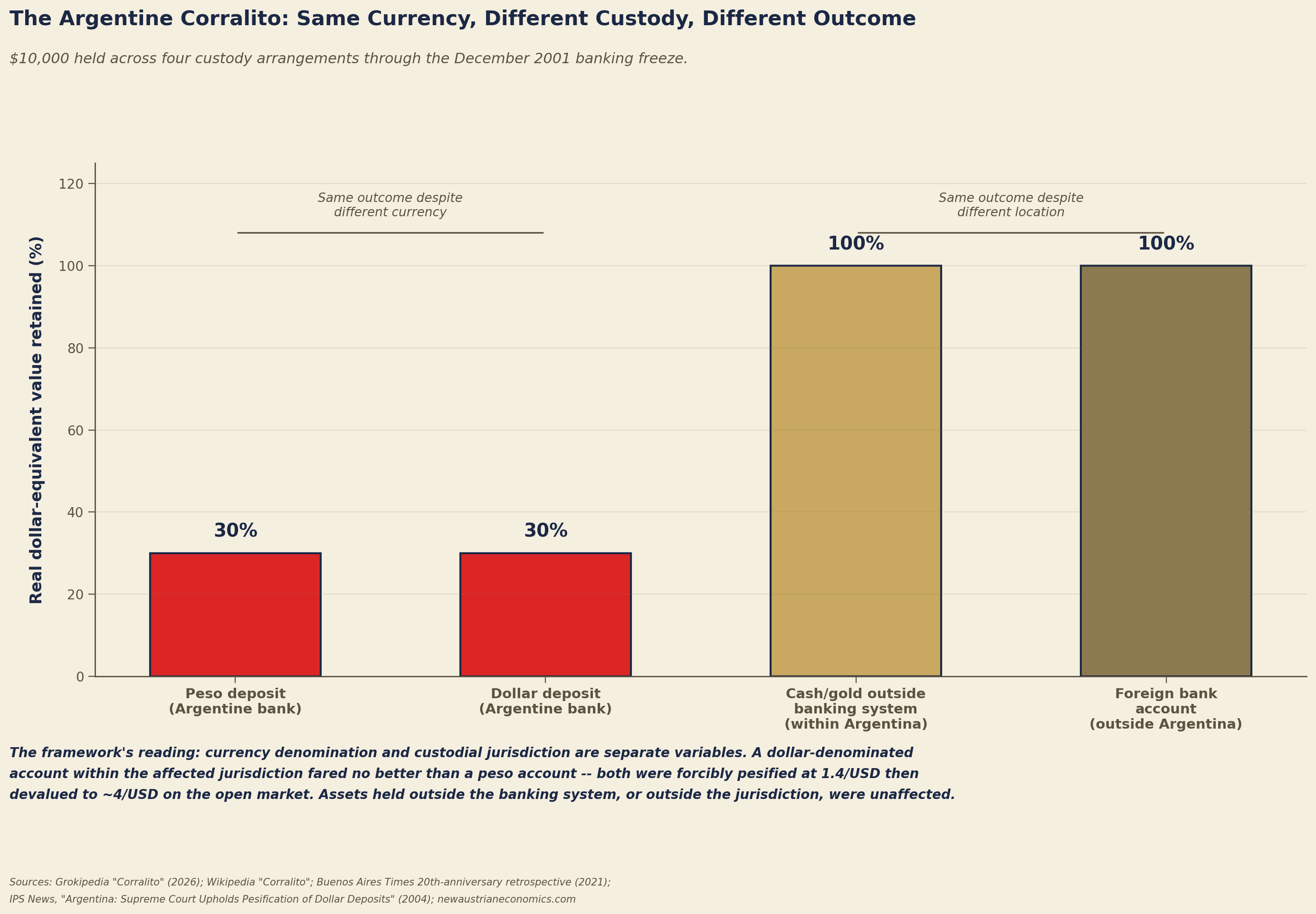
On December 1, 2001, Argentine Economy Minister Domingo Cavallo announced the corralito — an emergency freeze on bank accounts intended to halt a bank run that was destroying the country's financial system amid the collapse of the peso's decade-long one-to-one peg to the U.S. dollar. The freeze limited weekly cash withdrawals to 250 Argentine pesos (approximately $250 at the still-nominal 1:1 exchange rate) and, critically for this essay's purposes, prohibited withdrawals from U.S. dollar-denominated accounts entirely unless the account holder agreed to convert the funds into pesos. 6
This last provision is the specific detail that makes the Argentine case analytically distinct from both Weimar and 1933, and it deserves to be stated as precisely as the sources allow: Argentines who had done everything the framework's own logic would recommend — holding their savings in a hard, internationally traded currency rather than a soft local one — discovered that this precaution provided no protection whatsoever, because the dollars were held in an Argentine bank, subject to Argentine banking law, and Argentine banking law froze them exactly as it froze peso deposits. The freeze immobilized somewhere between $70 and $85 billion in deposits altogether, the majority of them dollar-denominated under the convertibility regime then still nominally in force. 6 When the interim government of Eduardo Duhalde subsequently abandoned the peso-dollar peg in early 2002, dollar-denominated deposits and debts were forcibly converted — "pesified" — at a rate of 1.4 pesos per dollar for deposits, while the market exchange rate for the now-floating peso spiked to approximately 4 pesos per dollar within months. A saver who had held $10,000 in an Argentine dollar-denominated account was forcibly converted to 14,000 pesos, which, at the prevailing 4:1 market rate, could then purchase only approximately $3,500 in actual dollar-equivalent purchasing power — a real loss of roughly two-thirds of the account's dollar value, despite the account having been denominated in dollars the entire time.
The specific analytical point this case establishes, more cleanly than any other episode in this essay, is that currency denomination and custodial jurisdiction are two entirely separate variables, and that a saver who diversifies the first while ignoring the second has not actually diversified against the risk this essay is examining. A dollar held in a Buenos Aires bank and a dollar held in a New York or Zurich bank are, in ordinary times, functionally identical claims on the same underlying currency; in December 2001, they were entirely different assets, because the Argentine dollar deposit was subject to Argentine sovereign authority over the Argentine banking system, while the foreign-held dollar deposit was not. This is the precise historical demonstration behind the jurisdictional axis this catalog's Article 37 revision introduced and the Custody Depth score it developed: the number of institutional counterparties, and specifically which sovereign jurisdiction those counterparties operate under, determined the entire outcome in this case, independent of what asset or currency was actually held.
It is worth noting, for completeness, that gold held physically in Argentina by an individual saver — outside the banking system entirely, at Custody Depth zero in the framework's terms — would not have been subject to the corralito at all, since the freeze applied specifically to bank-held deposits and did not extend to physical possession of currency or metal outside the banking system. This is the case's second lesson: it is not that hard assets failed in Argentina; physically-held hard assets outside the banking system would have worked exactly as the framework's theory predicts. It is that a specific substitute-layer instrument — a foreign-currency-denominated bank deposit — which savers often treat as equivalent to holding the foreign currency itself, is not equivalent once the custodial jurisdiction is compromised, and this distinction is precisely the one Article 37's Custody Depth score was built to make legible.
Case four: sudden flight, 1975 — the scenario Menger's theory predicts most directly
The final case is different in kind from the preceding three, because it removes the variable that Weimar, 1933, and Argentina all share: time to plan. In each of the first three cases, the saver had, at minimum, weeks or months of visible warning — the German inflation accelerated over roughly two years; the 1933 gold order gave holders nearly a month between announcement and the surrender deadline; the Argentine peso's convertibility regime had been visibly strained for years before the corralito, even if the specific freeze arrived without formal notice. The 1975 collapses of the U.S.-aligned governments in South Vietnam and Cambodia, by contrast, produced sudden, often single-day flight for millions of people, with no meaningful opportunity to relocate financial assets, liquidate real property, or arrange foreign custodial accounts in advance. 7
Academic research on this specific episode — notably Tulane University anthropologist Allison Truitt's field research and her book Dreaming of Money in Ho Chi Minh City — documents that Vietnamese refugees fleeing in 1975 carried gold specifically because, as Truitt's research describes it, gold had "external value without borders" at a moment when no one knew where they might ultimately end up, and because gold was additionally used as direct payment to state and border officials to secure permission and passage to leave the country at all — a specific dual function (store of value plus a universally negotiable bribe) that no other asset class in this essay's case studies provides. 8 The parallel Cambodian case is documented in specific and vivid form: as Khmer Rouge forces seized power in 1975, jewelry-store owner Jerry Young grabbed a fistful of jewels from his shop and fled, walking and hitching rides to the Thai border and waiting days before finding his family in a camp. Those stones — a few cut rubies and sapphires — became the seed capital for Tory Jewelry Company, opened in 1978 and later renamed Inta Gems & Diamonds, the first of what are now hundreds of Cambodian-owned jewelry stores in Southern California. Khatharya Um, professor of ethnic studies at the University of California, Berkeley, who fled Cambodia herself in 1975, has studied how those stores came to serve their communities as financial institutions — helping people hold wealth in what she calls its most "crisis-proof" form, gold, because it gives the holder "greater control" independent of any government's continued existence or goodwill, a description that applies to essentially no other asset class examined in this essay — not real estate (which was uniformly abandoned), not bank deposits (uniformly inaccessible or frozen by the collapsing or hostile successor regime), and not business ownership (uniformly seized or abandoned).
This is the case that validates the framework's hard-asset recommendation most directly and most narrowly, and the reason is specific rather than general: Menger's own account of saleability — engaged in this catalog since Article 1 — treats transportability as a named determinant, and specifically as the determinant of saleability across space. That placement is the point. A refugee is not merely liquidating; he is moving, and the whole of his wealth has to remain saleable at the far end of a journey whose destination he does not know. In ordinary circumstances the spatial limit on saleability is a background condition; in the specific circumstance of sudden, undocumented flight, it becomes the dominant and in practice the only relevant one, because every other form of wealth this essay has examined — land, business equity, bank deposits, even foreign-currency accounts arranged in advance — requires either time to liquidate, or continued access to institutions that may cease to recognize the holder's claim the moment the political order that enforced it collapses. Gold and gems, small enough to be sewn into clothing or carried in a pocket, are the one form of wealth in this essay's four cases that requires neither.
A necessary caveat, for intellectual honesty: even this case is not unconditional. Destination-country risk exists independently of origin-country collapse. In November 2025 the United Kingdom's Labor government announced proposals, modeled on Denmark's asylum system, under which valuables could be taken from asylum seekers to contribute to the cost of their accommodation and claims. 9 Ministers stated that the measure was aimed at those arriving with a large number of high-value items rather than at family heirlooms, and that valuables would not be seized at the border itself — qualifications that narrow the parallel considerably, though they do not eliminate the underlying point that portable wealth surviving the crossing of one border does not guarantee its survival at the next one. The finding this case supports is narrower than "gold is always safe for refugees"; it is that gold's specific advantage — portability without dependence on any institution's continued cooperation — is real, well-documented, and academically established, while remaining subject to its own distinct risks at the point of arrival.
Four threat models, not one verdict
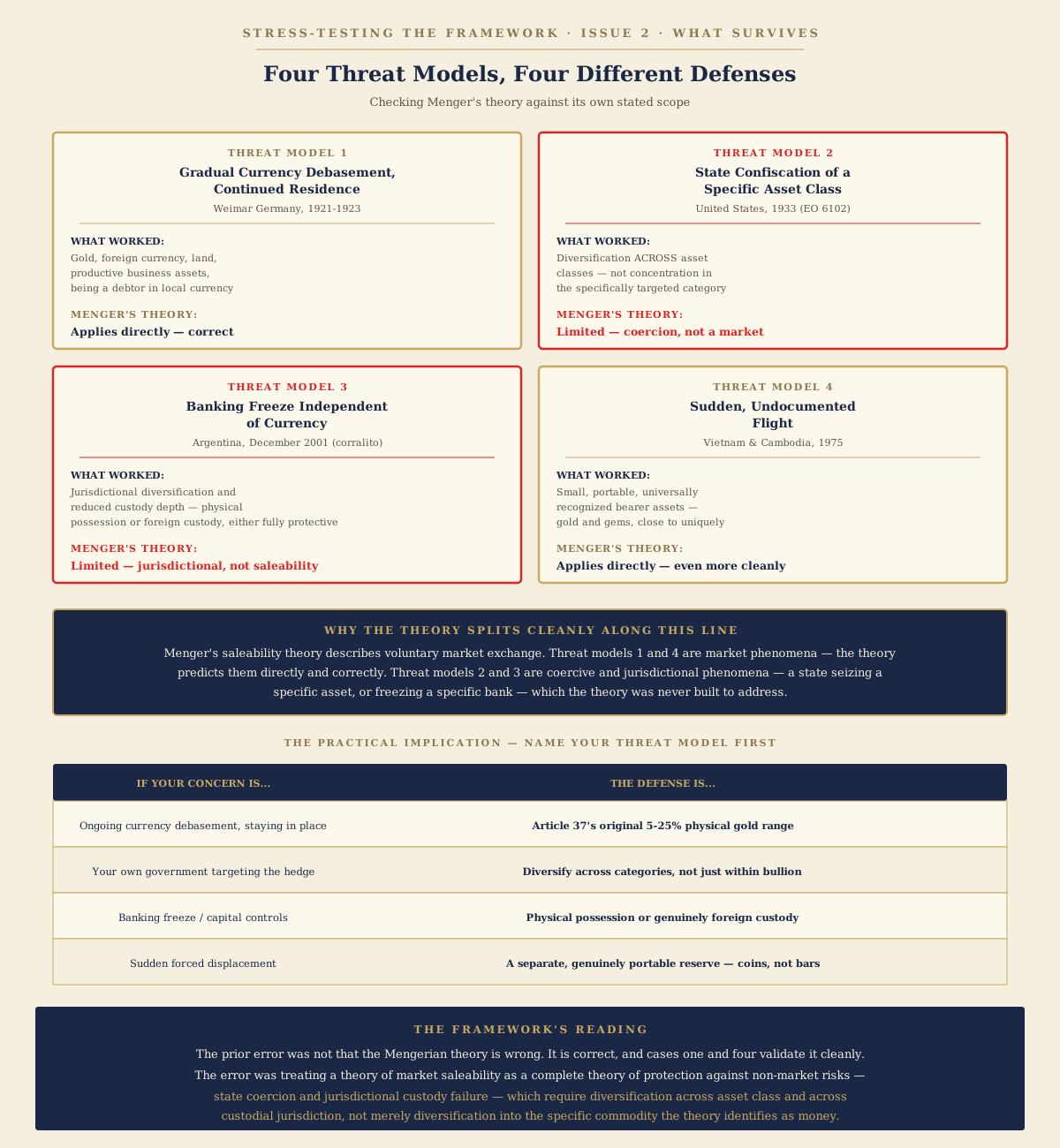
The four cases developed above do not converge on a single answer, and the framework's task is to name precisely why, rather than average them into a compromise recommendation that would misrepresent all four.
Threat model one: gradual-to-severe currency debasement with continued residence (Weimar). The saver remains in the affected jurisdiction, has weeks to years of visible warning, and needs an asset that preserves purchasing power against a domestic currency being actively destroyed by its own government. Gold, foreign currency, and real productive assets (land, operating businesses) all worked, for related but distinct reasons; being a debtor in the collapsing currency also worked, inverting the usual creditor-debtor risk relationship. The defense here is precisely what the framework's existing hard-asset recommendation already contemplates, and this case is the strongest available validation of that recommendation.
Threat model two: state confiscation targeting a specific asset class (1933). The saver's specific recommended hedge becomes the object of legal seizure, with real criminal penalties, by the saver's own government. Diversification within the hard-asset category — physical gold alone — provides no defense, because the state's targeting decision falls on the category itself. The defense is diversification across asset classes (gold, but also foreign real assets, foreign equity, numismatic exemption categories, and other stores of value the state has not targeted), on the theory that a state choosing to confiscate one specific asset class is unlikely to simultaneously confiscate every plausible alternative, though history offers no guarantee of this.
Threat model three: banking-system freeze independent of currency denomination (Argentina). The saver's assets are trapped not because the wrong currency was chosen but because the wrong custodian and the wrong jurisdiction were chosen. The defense is jurisdictional diversification and reduced custody depth specifically — assets held outside the banking system entirely, or inside a banking system in a different sovereign jurisdiction than the one at risk — precisely the axis Article 37's July 2026 revision introduced.
Threat model four: sudden, undocumented flight (Vietnam and Cambodia, 1975). The saver has no advance warning and no opportunity to execute any of the defenses above. The only assets that survive are those small enough to carry on one's person, universally recognized without institutional verification, and usable both as store of value and as immediate payment. This is the narrowest but also the most absolute case: portable gold and gems are close to uniquely suited to this specific threat model, and nothing else examined in this essay comes close to substituting for them.
Returning to Menger — what the theory actually predicts
Menger's 1892 essay does not offer a flat list of properties. It sorts the determinants of saleability into three kinds, and the sorting is what matters here. Saleability at a given market turns on how many people want the commodity and how badly, their purchasing power, the quantity available against the unmet want, the commodity's divisibility, the development of the market, and whatever political and social limitations are imposed on trading it. Saleability across space turns on how widely demand is distributed and — the determinant most directly relevant to this essay's findings — on "the degree to which the goods lend themselves to transport, and the cost of transport incurred in proportion to their value." Saleability across time turns on the permanence of demand, durability, storage cost, and the rest. Recognizability and stability of value enter later, in Menger's discussion of why the precious metals in particular won this competition, rather than as general criteria. The theory does not claim that any single commodity dominates on every one of these dimensions simultaneously in every conceivable circumstance; it claims that gold and silver have historically dominated in the aggregate, across the range of ordinary voluntary-exchange circumstances a functioning market economy presents.
Checked against this essay's four threat models, the theory's predictive power is uneven in a specific and informative way, rather than uniformly strong or uniformly weak. In threat model one (Weimar), Menger's theory predicts gold's advantage directly and correctly, because the scenario is precisely the kind of ordinary-if-severe market-exchange environment the theory was built to describe: prices are still being set, goods are still changing hands, and the question is which medium of exchange best preserves value across that ongoing exchange process. In threat model four (sudden flight), the theory again predicts the outcome directly and correctly, arguably even more cleanly, because the spatial limit on saleability — Menger's own category, and the one gold is least constrained by, since its value is high relative to the cost of moving it — becomes the single dominant variable, and gold's advantage on exactly that dimension is what the historical record shows.
In threat models two and three, however, the theory's applicability is genuinely limited, and the framework should say so plainly rather than stretch the theory to cover ground it was not built for. State confiscation of a specific asset class (1933) is not a market phenomenon Menger's saleability apparatus describes; it is the suspension of voluntary exchange by coercive state authority, a political and legal event that saleability theory has no specific mechanism to predict or defend against, because saleability describes what happens when trade is voluntary and confiscation is precisely the case where it is not. Banking-system freezes independent of currency denomination (Argentina) are similarly a question of custodial and jurisdictional law — which sovereign's courts and regulators have authority over a specific account — rather than a question of which commodity is most saleable in the abstract; a U.S. dollar remains, in the ordinary Mengerian sense, one of the most saleable currencies on earth, and this fact was simply irrelevant to Argentine depositors whose dollars were never at issue in a saleability sense but in a jurisdictional-custody sense entirely outside the theory's scope.
The finding this essay reaches, stated as precisely as the evidence supports: the framework's prior error was not that its Mengerian theory is incorrect. The theory is correct, and cases one and four validate it cleanly. The error was treating a theory of market saleability as though it were also a complete theory of protection against non-market risks — state coercion and jurisdictional custody failure — that the theory was never built to address, and that require entirely different tools: diversification across asset class for confiscation risk, and diversification across custodial jurisdiction for freeze risk, neither of which is a claim about which commodity has the highest Absatzfähigkeit.
What this means practically — naming the threat model first
The practical implication of this essay is not a revised percentage to replace Article 37's 5-to-25 percent range; it is a prior question the framework had not previously required savers to ask explicitly, because the original treatment implicitly assumed a single threat model (something close to threat model one, gradual currency debasement) without stating that assumption or acknowledging the other three.
A saver whose primary concern is currency debasement while continuing to live and work in their current jurisdiction — the threat model this catalog's broader diagnosis of substrate fragility most directly concerns — is well served by Article 37's original recommendation largely as stated: physical gold and silver, held domestically, sized per Article 42's calibration analysis. A saver additionally concerned about targeted confiscation risk — a concern that rises, though remains speculative, in proportion to how politically salient hard-asset holdings become in a specific jurisdiction's public discourse — should diversify the hard-asset allocation itself across categories (bullion, numismatic coins, foreign real assets, foreign equity) rather than concentrating entirely in bullion gold, on the theory that a state's confiscation decision, if it comes, will likely target a specific category rather than every category simultaneously. A saver concerned about banking-system freeze or capital-control risk specifically — a concern the Custody Depth score developed in Article 37's revision was built to make legible — should prioritize physical possession or custody in a genuinely separate jurisdiction over any domestic bank or brokerage account, regardless of what currency or asset that account holds. And a saver whose specific circumstances (geopolitical exposure, residence in a jurisdiction with a documented history of sudden political rupture) make sudden undocumented flight a live rather than remote concern should hold a specific, separate, genuinely portable reserve — small-denomination gold coins or jewelry, not bullion bars, not paper claims of any kind — sized and structured for that scenario specifically, independent of and in addition to whatever allocation serves the other three threat models.
This is a more demanding framework than a single percentage, and the framework states plainly that it is more demanding because the underlying reality — four distinct threat models with four distinct defenses — is itself more complicated than a single number can represent. What the framework can responsibly offer is not a simplification of that complexity but a clear enough map of it that a saver can identify which threat model actually concerns them and select the defense that history shows actually worked against that specific threat, rather than assuming the single defense the framework's theoretical apparatus most directly recommends will protect against every threat the apparatus was never built to address.
The framework's synthesis
This essay set out to test whether the Mengerian diagnosis of unsound money identifies gold as the correct empirical hedge against actual historical collapse, and the answer is conditional rather than universal: it identifies gold correctly and cleanly for two of the four threat models examined — gradual currency debasement with continued residence, and sudden undocumented flight — because both scenarios fall within the scope of what a theory of market saleability actually describes. It does not, by itself, address the other two threat models — targeted state confiscation and jurisdictional custody failure — because both are fundamentally questions of coercive state power and legal jurisdiction rather than questions of which commodity a voluntary market converges on as its medium of exchange. The framework's prior treatment conflated these, recommending a single hedge sized to a single percentage without distinguishing which threat that hedge actually defended against.
The four cases developed in this essay — Weimar Germany, the United States in 1933, Argentina in 2001, and the refugee flights from Vietnam and Cambodia in 1975 — are not offered as an exhaustive catalog of collapse mechanisms, and the framework does not claim that every future collapse will resemble one of these four templates precisely. They are offered as sufficiently varied, sufficiently well documented, and sufficiently rigorously sourced to establish that "what preserves wealth through collapse" is not a single empirical answer, and that the framework's own analytical apparatus — properly and narrowly applied — already contains the tools needed to see why, once the apparatus is checked against its own stated scope rather than extended past it.
This is the second installment of Stress-Testing the Framework, following Article 42's treatment of the calibration problem. The third and closing installment of this initial series arc will develop the "never be a forced seller" principle Article 37's July 2026 revision generalized into its own full treatment, including the proper case for human capital as the dominant asset for most of a working life, connecting to Article 31's analysis of the machinery question. Together, the three installments in this series subject the framework's personal-savings apparatus to the same standard of evidence — real numbers, real historical cases, and an honest accounting of what the framework's theory does and does not establish — that this catalog applies elsewhere.
Sources
Footnotes
-
Menger, Carl. "On the Origin of Money." Economic Journal 2, 1892. https://monadnock.net/menger/money.html — Section V sorts the determinants of saleableness into those operating at a given market (breadth and intensity of want, purchasing power, quantity against unmet want, divisibility, market development, political and social limitations), those bounding it across space (geographic distribution of demand, transportability and transport cost relative to value, infrastructure, organized markets, commercial restrictions), and those bounding it across time (permanence of demand, durability, storage cost, interest, market periodicity, speculation). Recognisability and stability of value appear in section VIII, not among the general criteria. ↩
-
The currency of the German inflation was the Papiermark. The Rentenmark was issued 15–16 November 1923 at one Rentenmark to one trillion paper marks and 4.2 to the dollar; the Reichsmark followed under the monetary law of 30 August 1924. Exchange-rate anchors: 4.2 marks to the dollar pre-war, roughly 48 in late 1919, past 300 by mid-1922, 7,400 in December 1922, and 4,210,500,000,000 in November 1923. ↩
-
German pre-war gold mark definition and Reichsbank conversion tables. https://www.bundesbank.de/en — The pre-war gold mark was defined at 2,790 marks per kilogram of fine gold, placing a troy ounce at 86.8 marks and, at the trillion-to-one conversion, at roughly 87 trillion paper marks by November 1923. On equities, real returns measured against the parallel exchange rate collapsed well before the terminal phase; the Daimler valuation of 327 cars is the standard illustration. ↩
-
Executive Order 6102, signed 5 April 1933 — delivery to the Federal Reserve required by 1 May 1933 at $20.67 per troy ounce, with exemptions for collectors' coins of recognized special value, industrial, dental and jewelry use, and holdings up to $100; penalties of up to $10,000 or ten years under the Trading with the Enemy Act of 1917 as amended. The Gold Reserve Act of 30 January 1934 revalued gold to $35.00. ↩ ↩2 ↩3 ↩4
-
Campbell v. Chase National Bank, 71 F.2d 669 (2d Cir. 1934). https://www.federalreservehistory.org/essays/roosevelts-gold-program — The single known prosecution under the order was of New York attorney Frederick Barber Campbell, who held about 5,000 ounces at Chase National Bank and sued when it would not release them. He was acquitted on the ground that the order had been signed by the President rather than the Secretary of the Treasury, after which the administration reissued it over Morgenthau's signature. ↩
-
Argentina's corralito was announced 1 December 2001 by Economy Minister Domingo Cavallo, limiting cash withdrawals to 250 pesos a week and barring withdrawals from dollar accounts unless the holder accepted conversion into pesos; between $70 and $85 billion in deposits were immobilised. Deposits were pesified at 1.4 pesos per dollar in early 2002 under Duhalde, against a floating rate that reached roughly 4 within months. ↩ ↩2
-
On Cambodia: the account of Jerry Young, who took a fistful of stones from his shop in 1975, reached the Thai border, and used a few cut rubies and sapphires as seed capital for Tory Jewelry Company in 1978, later Inta Gems & Diamonds; and the research of Khatharya Um, professor of ethnic studies at UC Berkeley, who fled Cambodia in 1975 and has studied Cambodian-American jewelry stores as community financial institutions holding wealth in its most "crisis-proof" form. ↩
-
Truitt, Allison J. Dreaming of Money in Ho Chi Minh City. University of Washington Press, 2013. https://news.tulane.edu/news/research-shows-gold-valuable-part-vietnamese-history — For gold's "external value without borders" and for refugees carrying it in the 1970s because they did not know where they might end up. ↩
-
UK Home Office asylum policy statement, 17 November 2025. https://www.gov.uk/government/organisations/home-office — The United Kingdom's asylum proposals of 17 November 2025, modeled on the Danish system, under which valuables could be taken from asylum seekers to contribute to accommodation costs. Ministers stated the measure targeted those arriving with a large number of high-value items rather than family heirlooms, and that valuables would not be seized at the border. ↩
Related essays
Monetary Power to the People
Money is a medium in McLuhan's sense — an extension of the human body that amplifies the capacity for exchange. Understanding this is the critical path to navigating the financial disruptions of the present age.
The Saleability Audit of Bitcoin: What Menger Would Say in 2026
Bitcoin maximalists insist Bitcoin is the most saleable monetary good ever created. Skeptics insist it doesn't work for the African villager or the rural Chinese citizen the maximalists invoke. Both positions miss what Menger's framework actually says when applied carefully. The audit produces uncomfortable results in both directions — Bitcoin scores remarkably well on some criteria and remarkably poorly on others — and the actual ground-truth of crypto adoption in emerging markets in 2026 is something neither camp accurately describes.
The Decay Function of Marketability: Toward a Computable Menger-Fekete Framework
Menger argued that saleability is a spectrum; Fekete developed the gold basis to measure it for one commodity. This essay proposes a generalizable decay function of marketability, measurable across every modern financial instrument, that renders Menger's core insight computable for the first time.